


 journal menu


issue contents
May 2026 issue
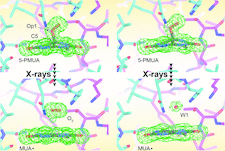
Cover illustration: Radiation damage to bound ligands in the active site of urate oxidase at 100 K and room temperature showing disintegration of the 5PMUA adduct: cleavage is incomplete at 100 K after a dose of 373 kGy (left), while after a dose of 72.5 kGy at room temperature (right) the trapped O2 has escaped and is replaced by a water molecule [Koulas et al. (2026), Acta Cryst. D82, 492–503].
letters to the editor


Free 

This letter describes the development of cryo-EM in Portugal, highlighting a strategy based on research training and the establishment of a national facility with regional support nodes. Our experience demonstrates how access to European research infrastructures can enable the creation of sustainable national platforms without investment in high-end microscopes.
scientific comment


Open access
access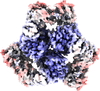
ArnA contamination was independently observed during the purification of a soluble, low-yield protein complex, leading to an unintended 3.23 Å resolution cryo-EM structure. This work broadens recent findings and highlights ArnA as a recurrent His-tag-associated contaminant in Escherichia coli purification workflows.
EMDB reference: E. coli ArnA hexamer, EMD-67448
PDB reference: E. coli ArnA hexamer, 21ak
image processing for cryoem
Open access
access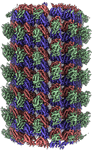
Cryo-EM reconstructions of microtubules are currently technically challenging and time-consuming for average users. A cryo-EM processing pipeline for microtubules using CryoSPARC has been developed that overcomes many of these current issues.
ISDSB2025
Open access
access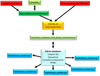
Alphafuser is a structure-prediction pipeline that integrates experimental interaction data with AlphaFold-based modeling to systematically assemble multiprotein complexes in a computationally efficient manner. By implementing an ipTM-based pruning algorithm and validating against known structures and experimental assays, Alphafuser enables the accurate identification of higher-order assemblies from large interactome datasets.
radiation damage
Open access
access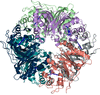
We characterize the formation of a ferryl state of a dye-decolourizing peroxidase by drop-on-chip serial femtosecond crystallography and also the modulation of the heme redox state using dose-resolved serial synchrotron crystallography.
Open access
access
The use of X-rays and electrons for diffraction and imaging of soft biological samples is compared.
Open access
access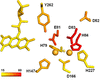
Flavodiiron proteins (FDPs) are di-iron enzymes that reduce NO and/or O2 with distinct substrate selectivity. We have produced E. coli FDP variants targeting second coordination-sphere residues and determined their structures. Although the kinetics remained unchanged, the E. coli FDP S262Y variant showed X-ray radiation-induced photoreduction, suggesting increased structural sensitivity without altered selectivity.
PDB references: Escherichia coli FDP, D52K mutant, oxidized state, 7r0f; D52K mutant, reduced state, 7r1h; S262Y mutant, oxidized state, 7r2o; S262Y mutant, reduced state, 7r1j; D52K/S262Y mutant, oxidized state, 7r2p; D52K/S262Y mutant, reduced state, 7r2r; D52K mutant, pressurized with krypton gas, 7r2s
Open access
access
Analytical expressions for the damage-limited resolution are developed and applied to X-ray and electron imaging of beam-sensitive specimens. The findings will guide future microscopy and instrument design.
Open access
access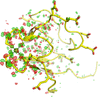
This first systematic radiation-damage study at 0.55 Å resolution reveals extensive small conformational changes in response to dose. The findings demonstrate the benefits of using large crystals fully bathed in a large `top-hat' beam with a uniform fluence profile, together with low-dose data-collection protocols, for sub-Ångström structure investigations on macromolecules.
Open access
access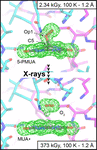
This manuscript investigates the X-ray-induced radiolysis of the catalytic C5-peroxide adduct in urate oxidase crystals, utilizing a top-hat X-ray beam to monitor peroxide occupancy across extensive dose series at both 100 K and room temperature. The study reveals a kinetic phase transition where the peroxide decays rapidly via zero-order kinetics at room temperature, whereas at 100 K the decay is retarded and follows first-order kinetics due to an efficient recombination mechanism involving trapped oxygen.
Open access
access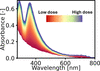
Radiation-induced changes during X-ray crystallographic data collection can compromise concurrent spectroscopic studies. Suitable protocols to detect and identify spectral artefacts from crystallization buffers and cryoprotectants are essential for the reliable analysis of chromophoric ligands in macromolecules.
research papers
Open access
access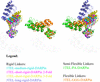
In this study, we examine the effect of short to medium-length flexible, semi-flexible and rigid linkers on the crystallization of a DARPin or the TNK1 UBA domain fused to the 1TEL protein crystallization chaperone, demonstrating that while rigid linkers can impair crystallization and reduce diffraction quality, the ideal linker character remains target protein-dependent.
PDB references: DARPin fused to 1TEL via a Pro-Ala linker, 9db5; DARPin fused to 1TEL via a helical Lys-Gln-Arg linker, 9dp8; DARPin fused to 1TEL via a direct helical fusion, 9dvg; DARPin fused to 3TEL via a Gly-Gly-Gly fusion, 9e4q; DARPin fused to 1TEL via a direct helical fusion in a `3-fold' crystal form, 9znb
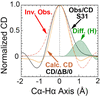
Model-dependent and model-independent visualization of hydrogen atoms in high-resolution cryoEM maps
A hidden hydrogen peak as a shoulder feature of a larger carbon peak can be computationally decomposed in a model-independent visualization method by calculating the one-dimensional profile difference between the right side of the profile that adjoins this H atom and the left side that does not.
Open access
access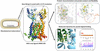
This study investigates the mycobacterial membrane protein MmpL3, a key target for new antituberculosis drugs, by combining high-resolution crystallography and computational simulations. It reveals how the inhibitor UPAR-1109 binds to MmpL3, providing detailed insights into the function and flexibility of the protein and supporting the rational design of next-generation antimycobacterial therapies.
PDB reference: M. smegmatis MmpL3 in complex with UPAR-1109, 9kbe
obituaries
Free