


 menu
menu


issue contents
October 2026 issue
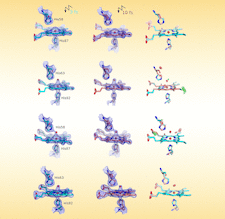
Cover illustration: Serial femtosecond crystallography data from hemoglobin crystals obtained using 3 and 10 fs pulses at comparable peak intensities and fixed photon energy were compared [Galchenkova et al. (2026), Acta Cryst. D82, 1169–1180]. Combined experimental and theoretical results indicated that 10 fs pulses were adequate to obtain damage-free protein structures using femtosecond crystallography under the intensity conditions explored.
topical reviews


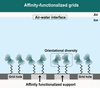
Affinity-functionalized and engineered cryo-EM supports are transforming specimen preparation by enabling on-grid enrichment and improved recovery of challenging biological assemblies. This review provides a critical assessment of current platforms, emerging technologies and the remaining challenges that must be addressed to establish affinity-based specimen preparation as a routine component of cryo-EM workflows.
a tribute to George Sheldrick
Open  access
access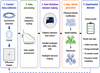
Auto-Rickshaw is an example of practical, decision-driven automated macromolecular structure determination from crystallographic diffraction data. This review traces its development at the EMBL Hamburg/DESY beamline environment, where rapid validation of diffraction experiments was essential, through its expansion into a general platform for automated structure solution and its continuing relevance to beamline automation.
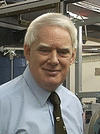
Eleanor Dodson examines George Sheldrick's contributions to macromolecular crystallography.
radiation damage


Open access
access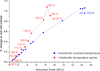
The nature of the expansion of the crystal unit-cell volume with absorbed dose and with temperature was examined for three different proteins.
Open access
access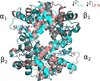
Protein structures determined by serial femtosecond crystallography are indistinguishable when measured with 3 and 10 fs X-ray pulses, indicating no structural benefit from further shortening the pulse duration under the studied conditions.
SSRL/LCLS users' meeting
Open access
access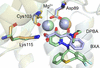
To facilitate structure-based drug development, XFEL sources are of paramount interest. Here, we analyse the feasibility and data quality of serial femtosecond X-ray crystallography compound screening at Linac Coherent Light Source and compare it with PETRA III synchrotron experiments. For one Lassa virus model protein, we determined new crystal structures with two inhibitors.

Download citation


Download citation
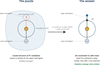
High-resolution crystallography combined with in crystallo Co K-edge XANES shows that cobalamin retains octahedral cobalt coordination in both oxidized and reduced states. These results rule out radiation-induced Co–CN cleavage as the cause of the missing axial ligand in intrinsic factor-bound cobalamin.
research papers
Open access
access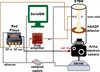
Software for a multipurpose hardware board enables flexible scanning with a ready acquisition and processing pipeline to implement 4D-STEM electron tomography.