issue contents

Journal logoCRYSTALLOGRAPHIC
COMMUNICATIONS
ISSN: 2056-9890

December 2025 issue

Highlighted illustration

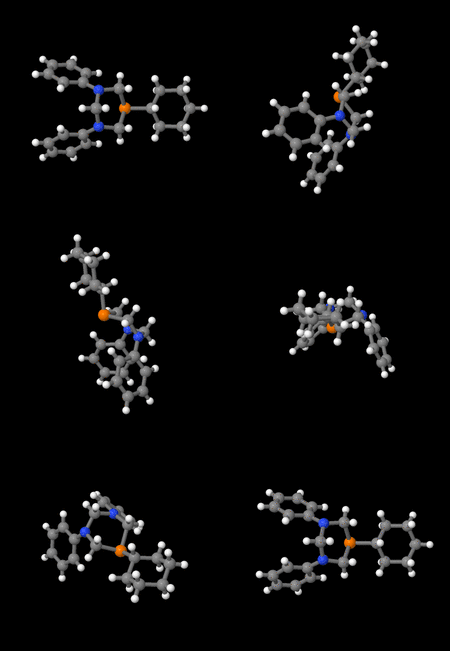
Cover illustration: Diazaphosphinanes are a class of six-membered NPN heterocycles that are typically stabilized by substituents on phosphorus. Seeking to expand this ligand family, a new NPN heterocycle (5-cyclohexyl-1,3-diphenyl-1,3,5-diazaphosphinane) was synthesized, along with its isostructural phosphine oxide derivative and a corresponding nickel(II) complex. The free ligand is a rare example of a diazaphosphinane bearing a bulky cyclohexyl substituent on phosphorus. When reacted with NiCl2, it produces a square-planar trans-dichlorobis(ligand)nickel(II) complex. In contrast to related diazaphosphinane ligands with phenyl groups, which often form cis square-planar or octahedral complexes, the steric bulk of the cyclohexyl group in this new ligand appears to favour trans coordination. This behaviour suggests potential usefulness of the ligand framework in the design of metal complexes where trans selectivity is desired. See: Esjornson, Anderson, Vo, Krause, Hubin & Oliver [Acta Cryst. (2025). E81, 1144–1148].

research communications


link to html
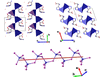
A one-dimensional lanthanum coordination polymer based on 3,6-di­chloro­phthalate has been prepared by microwaves-assisted synthesis and structurally described.

link to html
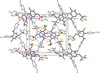
In the crystal, N—H⋯N hydrogen bonds of R22(8) motif dimers generate ribbons of mol­ecules in the crystal that are linked in the [101] direction.

link to html
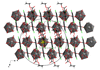
The hybrid organic–inorganic compound (4-amino-1,2,4-triazolium)PbBr3 crystallizes in a polar space group and features polymeric one-dimensional inorganic chains formed by face-sharing distorted octa­hedra, which alternate with organic cations.

link to html
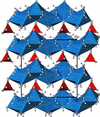
Depending on their water content, the two phosphates Na3(PO4)(H2O)n (n = 6, 7) exhibit different cross-linking of the polyhedra around the sodium cations, namely in the form of layers (n = 7) or a three-dimensional framework (n = 6).

link to html
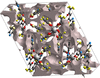
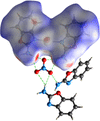
In the hydrated title compound, two substituted benzimidazole ring systems are bridged over a pyridine ring. O—H—N and C—H—O hydrogen bonds as well as π–π stacking inter­actions consolidate the crystal packing.

link to html
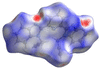
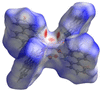
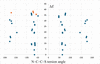
Crystal structures, Hirshfeld surfaces and energy lattices of (S)-1-(naphthalen-1-yl)ethanol (1) and (R)-1-(naphthalen-2-yl)ethanol (2), both C12H12O, were studied to understand much lower crystallization propensity of the latter. The study provides new insights into the supra­molecular inter­actions and crystal packing of regioisomeric naphthalenyl-ethanol compounds, which may have implications for the design of new materials with tailored properties.

link to html
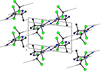
The crystal structure of (C2H8NO)2[PbI4] is layered and can be derived from the perovskite structure where the N,O-di­methyl­hydroxyl­ammonium cations are organized in layers and bound to the anionic layers through N—H⋯I inter­actions.

link to html
The asymmetric unit of the title compound, C56H44CuN6O10, contains one half of the complex mol­ecule. In the crystal, C—H⋯O hydrogen bonds link the mol­ecules, enclosing R44(18) ring motifs. In addition π–π inter­actions with centroid-to-centroid distances of 3.808 (2) Å and also a series of C—H⋯π(ring) inter­actions help to consolidate the packing in a three-dimensional architecture within the crystal.

link to html
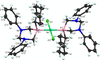
Crystal structures have been obtained for the heterocyclic NPN compound, 5-cyclo­hexyl-1,3-diphenyl-1,3,5-di­aza­phosphinane and its air oxidized phosphine oxide, 5-cyclo­hexyl-1,3-diphenyl-1,3,5-di­aza­phosphinan-5-one. The nickel(II) dichloride complex with bis di­aza­phosphinane ligands has also been obtained and structurally characterized.

link to html
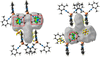
In the crystal of the anhydrous salt of levofloxacin with 4-methyl­benzoic acid, C18H21FN3O4+·C8H7O2, the levofloxacinium ions inter­act with the 4-methyl­benzoate anion via N—H+⋯O and C—H⋯O hydrogen bonds, forming a tape-like supra­molecular structure.

link to html
Treatment of a tetra­(aceto­nitrile)­copper(I) precursor with excess xylyl isocyanide forms the title tetra­(isocyanide)copper(I) complex, which was characterized structurally and spectroscopically.

link to html
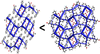
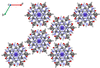
The newly synthesized compound (L-HisH2)CuI3·H2O (where L-HisH2 = L-histidinium) possesses a rare one-dimensional A2CuX3-type structure built from chiral left-handed helical chains of corner-sharing [CuI4] tetra­hedra. Crystal structure and Hirshfeld surface analyses reveal that hydrogen bonding and π⋯I inter­actions play a vital role in mediating the inter­actions between the organic and inorganic components of this compound. Distortion analysis using τ4, τ4', and Baur indices shows that this compound exhibits the lowest [CuI4] tetra­hedral distortion among reported analogues.

link to html
In the complex anion in the title compound, the cerium cation adopts a near regular square-anti­prismatic coordination geometry arising from four O,O-bidentate ligands.

link to html
Single-crystal X-ray diffraction studies were performed on two new forms of tinidazole: triclinic and hemihydrate, and their structures were compared to that of the known monoclinic form.

link to html
The (modified) triazine ring in the title compound is planar. The packing involves classical and ‘weak' hydrogen bonds, together with π contacts to the triazine ring.

link to html
In the complex [Ag(2AB)2]NO3·(2AB)2 (2AB: 2-amino­benzoxazole), the central silver atom is coordinated monodentately by two 2AB ligands forming a linear geometry. The extended structure features N—H⋯N, N—H⋯π and π–π inter­actions.

link to html
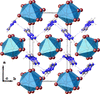
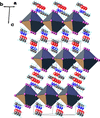
The structure of a tris­[hexa­kis­(imidazole)­cobalt(II)] bis­(benzene-1,3,5-tri­carboxyl­ate) compound was determined by single-crystal X-ray diffraction.

link to html
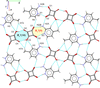
The extended structure of the title salt features a network of N—H⋯O, O—H⋯O, and C—H⋯O hydrogen bonds, which generate infinite layers.

education and outreach


link to html
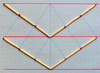
A paper-based virtual X-ray diffraction experiment, which is based on the right-angle condition for constructive inter­ference, allows the implications of Bragg's law to be studies in a simple way.

Research communications

Research communications are designed to help authors bring out the science behind their structure determinations. Authors are encouraged to report more than one structure in the same communication and also to include the results of investigations with other techniques. The Research communications format makes Acta E the natural home for structure determinations with interesting science to report.

Emerging Sources Citation Index

Acta E is included in the Emerging Sources Citation Index.

ESCI

Follow Acta Cryst. E
Sign up for e-alerts
Follow Acta Cryst. on Twitter
Follow us on facebook
Sign up for RSS feeds