journal menu


issue contents
November 2025 issue
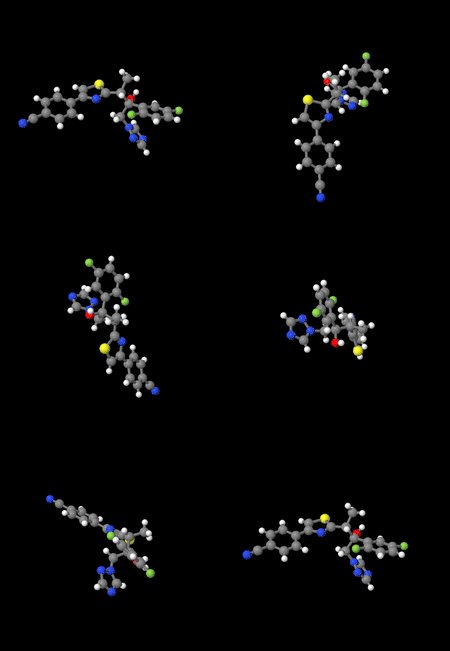
Cover illustration: Crystallography is uniquely powerful in characterizing drug polymorphs, which can differ widely in their stability, solubility and pharmacological effectiveness. Ben & Chęcińska [Acta Cryst. (2025). E81, 1018–1022] report the crystal structure of a new orthorhombic polymorph of the promising new antifungal drug isavuconazole, C22H17F2N5, and compare its structure to the known monoclinic form.
research communications


Download citation


Download citation
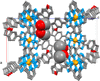
The title compound, [Fe(C18H11N6O)2]·2CH3OH, crystallizes in the orthorhombic space group, with a distorted pseudooctahedral FeII coordination sphere formed by two deprotonated tridentate 3-(benzofuran-6-yl)-5-[6-(1H-pyrazol-1-yl)pyridin-2-yl]-4H-1,2,4-triazol ligands. In the crystal, molecules stack in chains along the b-axis direction connected by weak C—H(pz)⋯π(ph) interactions and linked into layers by C—H⋯N/C/O interactions, which were quantified by Hirshfeld surface and energy framework analysis.
CCDC reference: 2492851
Download citation
Download citation
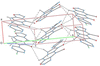
The molecule of the title compound, C16H9BrClNO2, contains furan and phenyl rings and an almost planar isoindole ring system, which is coplanar with the furan ring. In the crystal, C—H⋯O hydrogen bonds link the molecules into a two-dimensional network. π–π stacking helps to consolidate the packing.
CCDC reference: 2492471
Download citation
Download citation
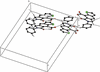
The molecule of the title compound contains a planar thieno[2,3-f]isoindole ring system and a phenyl ring. In crystal, the molecules are linked through C—H⋯O hydrogen bonds, enclosing R22(14) ring motifs, into a three-dimensional architecture. π–π interactions further consolidate the crystal structure.
CCDC reference: 2492514
Download citation
Download citation
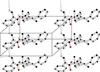
The title compound is a multi-substituted piperidine derivative in which the piperidine ring adopts a chair conformation.
CCDC reference: 2493059
Download citation
Download citation
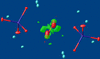
The crystal structures of the two title hydrated phases of K3(VO4) consist of isolated vanadate tetrahedra linked via K+ cations. The difference in water content is noticeable in the hydrogen-bonding interactions, which define a finite network for the 0.56-hydrate phase and an infinite network for the 4-hydrate phase.
Download citation
Download citation
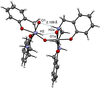
A μ-oxo vanadium(V) dimeric complex, μ-oxido-bis[(2,2′-{[ethane-1,2-diylbis(azanediyl)]bis(methylene)}diphenolato)oxidovanadium(V)], was synthesized and structurally characterized.
CCDC reference: 2492548
Download citation
Download citation
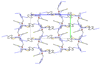
The crystal structure of a new orthorhombic polymorph of pure isavuconazole has been determined and and is compared with the known monoclinic form.
CCDC reference: 2495049
Download citation
Download citation
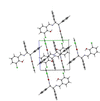
The polymorphism of the title salen-type compound synthesized from racemic-(+/-)-1,2-diphenylethylenediamine and 3-chlorosalicylaldehyde is reported
CCDC reference: 2494676
Download citation
Download citation
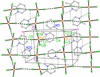
Packing patterns of the title compounds are analysed in terms of hydrogen bonds, halogen bonds, coinage bonds and halogen⋯π contacts.
Download citation
Download citation
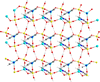
The title compound displays an infinite ladder structure built of alternately arranged ZnO3N and PO3(OH) tetrahedra, linked O—H⋯O hydrogen bonds into supramolecular sheets. C—H⋯O interactions between CH groups of the pyridine rings and phosphate groups connect the sheets into a three-dimensional framework structure.
CCDC reference: 2472401
Download citation
Download citation
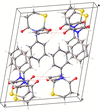
One of the title compounds shows spontaneous resolution during crystallization.
Download citation
Download citation
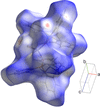
Monodentate zwitterionic silanolate (sil) ligands in [ZnBr2(sil)2] coordinate to zinc(II) centres, yielding complexes with intramolecular N—H⋯O hydrogen bonds and distorted ZnBr2O2 tetrahedral environments that assemble into loosely packed two-dimensional layers stabilized by weak intermolecular C—H⋯Br interactions.
CCDC reference: 2495680
Download citation
Download citation
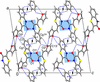
The crystal structures of two new (Z)-2-arylmethylidene-2H-benzo[b][1,4]thiazin-3(4H)-ones are dominated by mutual hydrogen bonding with the assembly of dimers, which may provide a prototype for reliable supramolecular synthons with the appropriately functionalized substrates for biomedical systems.
Download citation
Download citation
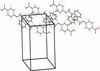
In the title compounds, 2,2′-{[anthracene-9,10-diylbis(methylene)]bis(sulfanediyl)}dibenzoic acid dimethylacetamide tetrasolvate, C30H22O4S2·4C4H9NO 1 and 4,4′-{[anthracene-9,10-diylbis(methylene)]bis(oxy)}dibenzoic acid dimethylformamide disolvate, C30H22O6·2C3H7NO 2, the complete anthracene–benzoic acid molecule is generated by a crystallographic centre of symmetry. The dihedral angle between the anthracene ring system and the pendant ring is 71.43 (7) in 1 and 75.27 (12)° in 2. In the extended structures of both compounds, O—H⋯O hydrogen bonds link the main molecules into pairs of solvent molecules to generate trimers.
Download citation
Download citation
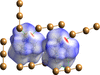
The crystal structure of (C6H14N2)[Br3]2 contains diprotonated triethylenediaminium cations, the charge of which is compensated by [Br3]− anions. The crystal packing is stabilized by Br⋯Br contacts, forming two-dimensional layers, and by N—H⋯Br/C—H⋯Br interactions between cations and tribromide anions.
CCDC reference: 2495993
Download citation
Download citation
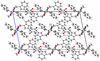
In the title solvates, the indole ring rotations (58–72°) relative to the plane of the central ring govern non-planarity. In the extended structures, N—H⋯O links form chains or sheets and disordered solvents were masked.
Download citation
Download citation
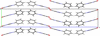
The phenyl ring forms a dihedral angle of 34.72 (6)° with the mean plane of the pyrazolo[3,4-d]pyrimidine ring system.
CCDC reference: 2497282
Download citation
Download citation
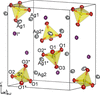
The two compounds Ag3ISO4 and Ag4I2SO4, comprising Ag and I atoms and SO4 tetrahedra, exhibit characteristic silver arrangements, with Ag3ISO4 containing triangularly arranged Ag atoms in zigzag ladder chains along the a-axis direction and Ag4I2SO4 featuring discrete Ag4 clusters.
Download citation
Download citation
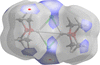
The lithium halide dimethyl ether (DME) adducts [Li2Cl2(DME)4] and [Li2Br2(DME)4] form dimeric units linked into layers by CH3⋯Cl tetrel bonds or CH3⋯CH3, CH3⋯O and CH3⋯Br contacts, illustrating the coordination ability of dimethyl ether and its role in directing supramolecular assembly.
Download citation
Download citation
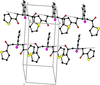
In the crystal, the molecules are linked into [010] chains by C—H⋯O hydrogen bonds, creating a C(6) motif. Weak C—H⋯Cl and C—H⋯F interactions link these chains, forming sheets parallel to the (100) plane.
CCDC reference: 2496991
Download citation
Download citation
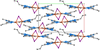
The product of an azide–alkyne Huisgen cycloaddition between a pyridine azide and a simple alkyne was crystallized alongside the products of the corresponding complexation reactions with copper(I) iodide and silver(I) nitrate.