journal menu


issue contents
January 2026 issue
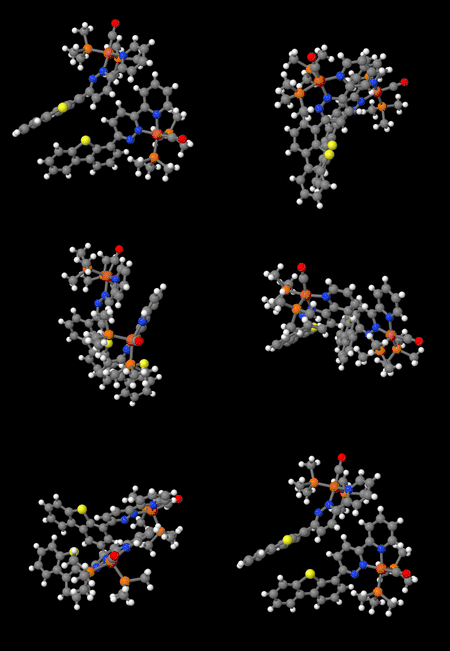
Cover illustration: Carbonyl[3-(dibenzo[b,d]thiophen-4-yl)-6-(pyridin-2-yl-κN)pyridazine-κN1]bis(trimethylphosphane)iron(0), [Fe(C21H13N3S)(CO)(PMe3)2], exhibits a square-pyramidal geometry, distinct from the trigonal–bipyramidal geometry in [Fe(C21H13N3S)(CO)3], due to the σ-donating properties of the two trimethylphosphane ligands. An increase in π-back-donation from the electron-rich iron centre to the pyridazine moiety was also confirmed. The steric and electronic factors were investigated by combining crystal structure and density functional theory (DFT) calculations. See: Futaki, Chikaraishi Kasuga & Hirotsu [Acta Cryst. (2026). E82, 61–66].
research communications


Download citation


Download citation
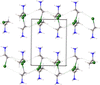
Bis(2-bromoethanamminium) hexabromidostannate(IV) is a hybrid tin perovskite with 0D topology due to the presence of isolated octahedral [SnBr6]2– anions.
CCDC reference: 2505907
Download citation
Download citation
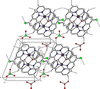
The title compound is a centrosymmetric cationic dinuclear zinc(II) complex with two pentadentate ligand containing quinolin-8-olato and bis(pyridin-2-ylmethyl)amine groups, two perchlorate counter-ions and one acetonitrile solvate molecule. The ZnII atom adopts a distorted octahedral geometry and coordinates the O atom and the N atom of the quinolin-8-olato group and three N atom of the bis(pyridin-2-ylmethyl)amine group in a ligand, and the O atom in an adjacent ligand generated by an inversion operation. In the crystal, the cationic dinuclear complex molecules and perchlorates are linked by C—H⋯Cl and C—H⋯O hydrogen bonds to form a three-dimensional network.
CCDC reference: 2512101
Download citation
Download citation
The crystal structure of the complex tetrachloridobis(1H-imidazo[4,5-b]pyridin-4-ium-κN3)iron(II) has been determined. The compound crystallizes in the monoclinic system and shows an octahedral coordination environment around the Fe centre.
CCDC reference: 2505852
Download citation
Download citation
The title compounds have different local symmetries but a consistent supramolecular motif of zigzag supramolecular ribbons propagating along the [100] direction linked by N—H⋯N and N—H⋯O hydrogen bonds. Various weak interactions consolidate both structures.
Download citation
Download citation
The title compound crystallizes with two independent molecules in the asymmetric unit, which are connected into chains by N—H⋯O hydrogen bonds.
CCDC reference: 2512078
Download citation
Download citation
5,17-Diamino-11-tert-butyl-25,26,27,28-tetrapropoxy-23-[(triphenylmethyl)amino]calix[4]arene crystallizes as a dichloromethane monosolvate and represents a calixarene with a pinched cone shape.
CCDC reference: 2502810
Download citation
Download citation
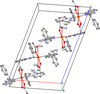
The copper(II) complex bis(acetato-κ2O,O′)(2-(phenylmethyl)-1H-benzimidazolyl)copper(II) crystallizes in the monoclinic space group P21/n with the Cu2+ ion exhibiting a distorted octahedral geometry. The crystal packing features N—H⋯O and C—H⋯π interactions.
CCDC reference: 2512906
Download citation
Download citation
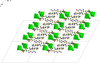
The crystal structure of racemic calcium 5-methyltetrahydrofolate trihydrate has been solved and refined using synchrotron X-ray powder diffraction data, and optimized using density functional theory techniques.
Download citation
Download citation
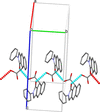
The title compounds exhibit a consistent pattern of intermolecular O—H⋯O hydrogen bonds, forming a C(7) zigzag chain propagating in the [010] direction in each case.
Download citation
Download citation
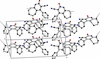
The two molecules in the asymmetric unit of the title compound, C17H16N2O, have a structural overlap with a root-mean-square deviation of 1.11 Å.
CCDC reference: 2512805
Download citation
Download citation
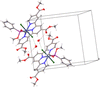
In the title RuII complex, a meridionally bound 4,4′,4′′-tris(methoxycarbonyl)terpyridine and a dimethoxyphenylphosphine ligand define a distorted trans-RuN3PCl2 octahedral coordination environment, and water molecules of crystallization bridge pairs of complex molecules into discrete hydrogen-bonded dimers.
CCDC reference: 2512964
Download citation
Download citation
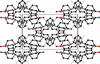
In the crystal, C—H⋯O hydrogen bonds link the molecular pairs to form dimers with an R22(16) ring motif. Additionally, ribbons are formed along the [101] direction by C—H⋯π interactions. van der Waals interactions between the ribbons contribute to the cohesion of the molecular packing.
CCDC reference: 2486561
Download citation
Download citation
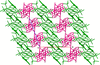
The title compound [Fe(C21H13N3S)(CO)(PMe3)2] exhibits a square-pyramidal geometry, distinct from the trigonal–bipyramidal geometry in [Fe(C21H13N3S)(CO)3], due to the σ-donating properties of the two trimethylphosphane ligands. An increase in π-back-donation from the electron-rich iron center to the pyridazine moiety was also confirmed.
CCDC reference: 2513314
Download citation
Download citation
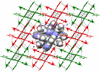
The title asymmetric biazolpyridine crystallizes in the triclinic space group P1 with two independent molecules in the asymmetric unit. Structural and Hirshfeld surface analysis revealed key non-covalent interactions such as C—H⋯N/C/O and π–π stacking, which consolidate the crystal structure.
CCDC reference: 2513428
Download citation
Download citation
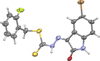
The crystal structures of a solvated and an unsolvated dithiocarbazate imine derivatives are compared and contrasted.
Download citation
Download citation
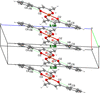
Bis(4-phenylbutan-2-one-κ2O,O′)copper(II) (P21/n) features an almost ideal square-planar CuO4 core and forms offset chains along [011] consolidated by π–π, weak π–metal and C—H⋯O contacts. Hirshfeld analysis shows dominant H⋯H contacts (54.8%); DFT (UB3LYP, ECP on Cu) gives HOMO/LUMO = −6.19/−1.83 eV (ΔE = 4.36 eV), consistent with mixed MLCT/ligand-centered transitions and high electronic stability.
CCDC reference: 2514420
Download citation
Download citation
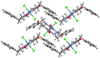
The crystal structure of a new complex between the theophylline ligand and palladium has been elucidated.
CCDC reference: 2515121
Download citation
Download citation
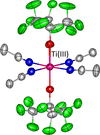
The crystal structure of the first complex of titanium(III) with acetonitrile and perfluorinated tert-butoxide ligands crystallizes in space group P1 with the titanium(III) atoms coordinated octahedrally by four acetonitrile molecules and two perfluorinated tert-butoxide anions.
CCDC reference: 2515927
Download citation
Download citation
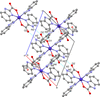
The cobalt(II) complex, [C30H22CoN8O4], crystallizes in the monoclinic space group P21/c, with the Co+2 ion adopting an octahedral coordination environment. The crystal structure features N—H⋯O hydrogen bonds and C—H⋯π contacts forming a chain along [011]. Hirshfeld surface analysis indicates that H⋯C/C⋯H and H⋯H contacts dominate the intermolecular interactions.
CCDC reference: 2515503
Download citation
Download citation
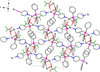
In the title coordination polymer, μ2-N,P-bridging diphenyl(4-pyridyl)phosphane and O-bonded trifluoroacetate ligands generate centrosymmetric dinuclear AgI units that extend into a two-dimensional hcb coordination network.
CCDC reference: 2515821
Download citation
Download citation
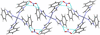
In the title compound, the central zinc(II) ion coordinated by four 5-phenylimidazole ligands, with two nitrate anions providing charge balance·In the crystal, the nitrate ions occupy the voids formed by the [Zn(C9H8N2)4]2+ cations and function as counter-ions. The nitrate oxygen atoms participate in weak N—H⋯O hydrogen-bonding interactions.
CCDC reference: 2433548
Download citation
Download citation
The isotypic strontium analogue of the mineral henmilite, Sr2Cu(OH)4[B(OH)4]2, displays a quasi two-dimensional spin system with CuII ions.
CCDC reference: 2517776
education and outreach
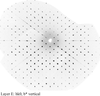
We share our pedagogical vision for a graduate-level small-molecule chemical crystallography in-class exercises and list our preferred textbooks, computer programs, and websites.