journal menu


issue contents
May 2026 issue
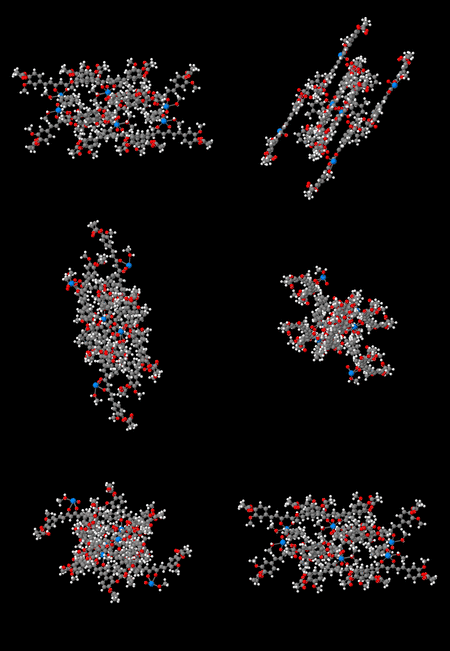
Cover illustration: Curcuminoids are biologically relevant β-diketone ligands, but structurally characterized actinide complexes of this family have remained unknown. To address this gap, a uranyl(VI) complex of 4,4′-diacetylcurcumin was synthesized and its crystal structure determined. Beyond establishing the first structurally characterized uranium–curcuminoid complex, this study shows that acetylated curcumin can support well-defined uranyl coordination, which may be useful in expanding the chemistry of bioinspired actinide ligands. See: Van Ha Nguyen, Thi Nguyet Trieu and Chien Thang Pha [Acta Cryst. (2026). E82, 422–425].
research communications


Download citation


Download citation
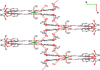
The first uranium–curcuminoid complex, [U(C25H23O8)2O2(CH3OH)]·C6H5CH3, features a uranyl(VI) center coordinated by two monoanionic bidentate 4,4′-diacetylcurcuminato ligands and one methanol molecule. The uranium atom adopts a distorted pentagonal–bipyramidal coordination geometry, with four O atoms from the β-diketonate moieties and one O atom from the methanol ligand defining the equatorial plane, while the two uranyl O atoms occupy the axial positions.
CCDC reference: 2536300
Download citation
Download citation
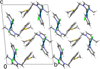
The two palladium–N-heterocyclic carbene (Pd–NHC) title complexes have the same formula type but crystallize in different space-group types, viz. the PdCl2 complex in P1 with Z = 4 and two molecules in the asymmetric unit, and the PdBr2 complex in C2/c with Z = 8 and one molecule in the asymmetric unit.
Download citation
Download citation
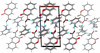
The title salt, C7H10N+·C10H4O−, crystallizes in the triclinic space group P1 with Z = 2. The structure of the 1:1 co-crystal formed between 2-oxo-2H-chromene-3-carboxylic acid and benzylamine features an N—H⋯O hydrogen bond. A Hirshfeld surface analysis, antibacterial studies and intermolecular interaction energies within the crystal structure are reported.
CCDC reference: 2542776
Download citation
Download citation
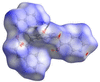
In the title compound, the dihedral angle between the naphthalene units is 10.85 (4)° and the pyran ring adopts a shallow boat conformation. In the crystal, C—H⋯N and C—H⋯O hydrogen bonds link the molecules, enclosing R22(16) ring motifs.
CCDC reference: 2543051
Download citation
Download citation
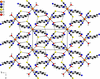
In the crystal structure of the title compound, the nickel cations are octahedrally coordinated by two terminal N-bonding thiocyanate anions, two 4-cyanopyridine ligands and two water molecules into discrete complexes that are linked by O—H⋯S hydrogen bonds into layers. These layers are further connected into a three-dimensional network by weak C—H⋯N interactions.
CCDC reference: 2542643
Download citation
Download citation
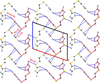
The molecular and crystal structure of the 3,3′-[ethane-1,2-diylbis(sulfanediyl)]bis(1H-1,2,4-triazol-5-amine) were studied and Hirshfeld surfaces and fingerprint plots were generated to investigate the various intermolecular interactions.
CCDC reference: 2543358
Download citation
Download citation
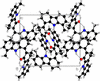
In the title compound, the dihedral angle between the indole fused ring units is 36.37 (5)° and an intramolecular N—H⋯O hydrogen bond closes an S(7) ring. In the extended structure, inversion dimers linked by pairwise N—H⋯O hydrogen bonds generate an R22(10) loop. Secondary C—H⋯π contacts consolidate the packing and a π–π stacking interaction is also observed.
CCDC reference: 1540676
Download citation
Download citation
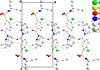
The title molecule adopts a shallow cup-shaped conformation with the chlorobenzamide portion as the bottom. In the crystal, helical chains along the a-axis direction are formed by N—H⋯O hydrogen bonds reinforced by C—H⋯π(ring) and weak π-stacking interactions. A Hirshfeld surface analysis was performed.
CCDC reference: 2544250
Download citation
Download citation
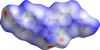
The asymmetric unit of the title compound contains one crystallographically independent molecule featuring a chromenone fragment with hydroxy and methoxy substituents and a benzaldehyde group. Intramolecular O—H⋯O, C—H⋯O hydrogen bonds are observed. In the crystal, molecules are linked by O—H⋯O intermolecular bonds, forming chains along [201].
CCDC reference: 2543411
Download citation
Download citation
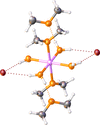
Unlike typical hexahydrates, the title compound, [Mg(C2H6O)2(H2O)4]Br2·2C2H6O or [Mg(H2O)4(DME)2]Br2·DME2 (DME = dimethyl ether, C2H6O), is a water-poor magnesium(II) complex. The central magnesium cation (site symmetry 1) is coordinated by four water molecules and two molecules of dimethyl ether and adopts a slightly elongated trans-octahedral coordination geometry. The water molecules are linked to outer-sphere bromide anions and additional dimethyl ether molecules via O—H⋯Br and O—H⋯O hydrogen bonds. Due to the volatility of dimethyl ether, the presence of coordinating and non-coordinating molecules of this ether makes this solid state structure presented here particularly interesting.
CCDC reference: 2544504
Download citation
Download citation
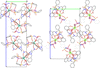
A strategy of combining a Cu2+–Schiff base unit with a sulfonylamidophosphate co-ligand and lanthanide(III) nitrate enabled the formation of two new heterobimetallic 3d–4f complexes. Structural analysis of the Cu2+–Ce3+ and Cu2+–Gd3+ compounds reveals distinct coordination modes of the sulfonylamidophosphate and NO3− ligands and a geometry-dependent rearrangement of the bridging fragments. These findings suggest that steric effects, together with subtle differences in metal–ligand interactions, govern the assembly of Cu2+–Ln3+ units and influence structural parameters relevant to 3d–4f exchange pathways.
Download citation
Download citation
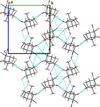
The absolute configurations of the four chiral centres of the title compound, a new camphor derivative, have been determined. Weak intermolecular interactions consolidate the crystal packing.
CCDC reference: 2544283
Download citation
Download citation

The structure of nirmatrelvir MTBE solvate has monoclinic (P21) symmetry. The asymmetric unit contains one nirmatrelvir molecule and one methyl tert-butyl ether molecule. The extended structure consists of N—H⋯O hydrogen bonds that create [010] chains.
CCDC reference: 2545296
Download citation
Download citation
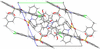
The title compound crystallizes with two independent molecules in the asymmetric unit. In the extended structure, O—H⋯O hydrogen bonds and C—H⋯O and C—H⋯Cl interactions link the molecules to form a three-dimensional network. Furthermore, C—H⋯π interactions are also observed.
CCDC reference: 2545066
Download citation
Download citation
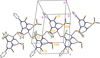
There are two formula units of the title compound, C14H13ClN4O2S2·C2H6OS, in the asymmetric unit. Both main molecules are closely similar except for minor differences in the orientations of the aromatic rings. The bond angles at the nitrogen atoms of the SC—NH—Cguanidine moiety are ca 130°. There are several intra- and intermolecular hydrogen bonds; the latter link the residues to form a ribbon parallel to the b axis.
CCDC reference: 2541315
Download citation
Download citation
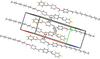
The title molecule was synthesized by an acid–phenol coupling reaction. A Hirshfeld surface analysis was performed to quantify the intermolecular interactions in the crystal.
CCDC reference: 2546170
Download citation
Download citation
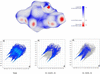
The reaction of copper(II) chloride with famotidine in aqueous solution at 333 K gave the title compound, which features coordination of the thiopropanoic acid derivative obtained in the acid-catalyzed in situ hydrolysis of famotidine.
CCDC reference: 2545262
Download citation
Download citation
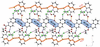
The asymmetric unit of the title hydrated complex salt, (C12H12NO2)[Sn(C10H6NO2)Cl4]·H2O, consists of one 2-(ethoxycarbonyl)quinolinium cation, one tetrachlorido(quinolinium-2-carboxylato)stannate(IV) anion and one water molecule. The compound was obtained by reaction of quinaldic acid with tin(II) chloride dihydrate in ethanol.
CCDC reference: 2269813
Download citation
Download citation
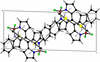
In the crystal, the C—H⋯F interactions between molecules form layers parallel to the (101) plane. Additionally, the molecules also form layers parallel to the (101) plane through C—H⋯π interactions.
CCDC reference: 2545790
Download citation
Download citation
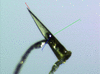
The crystal structure of datiscetin, isolated from the ethyl acetate fraction of Datisca cannabina L., and its monohydrate were determined by single-crystal X-ray diffraction analysis.
Download citation
Download citation
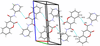
In the crystal of the title compound, the molecules are linked via C—H⋯O hydrogen bonds, giving rise to centrosymmetric inversion dimers. On one side of the molecule, C—H⋯O interactions generate R22(16)ring motifs, while on the opposite side, C—H⋯O hydrogen bonds form R22(14) ring motifs.
CCDC reference: 2545176
Download citation
Download citation
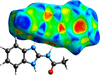
The crystal structure of N-(1H-benzo[d]imidazol-2-yl)acetamide, refined using non-spherical atomic scattering factors, features a pseudocentrosymmetric dimeric assembly governed by N—H⋯O and N—H⋯N hydrogen bonds, with its supramolecular assembly further consolidated by C—H⋯π interactions, as quantified by Hirshfeld surface analysis.
CCDC reference: 2394740
Download citation
Download citation
In the title salt, the cation (C2H3BrN3S)+, the anion Cl- and the water molecule are bonded by N—H⋯Cl, N—H⋯O and O—H⋯Cl hydrogen bonds, forming molecular layers parallel to the (002) plane.
CCDC reference: 2549381
Download citation
Download citation
Crystal structures and Hirshfeld surface analyses of two precursors of the etoxazole metabolite ‘R8’
The crystal structures and Hirshfeld surface analyses of two precursors obtained in the synthesis of metabolite ‘R8’ of the insecticide/acaricide etoxazole are presented.
education and outreach
Download citation
Download citation
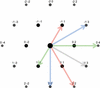
The conceptual basis of modern direct methods software, used in crystal structure determination, is demonstrated using the manual symbolic addition method with three fully worked two-dimensional examples.