issue contents

Journal logoCRYSTALLOGRAPHIC
COMMUNICATIONS
ISSN: 2056-9890

July 2026 issue

Highlighted illustration

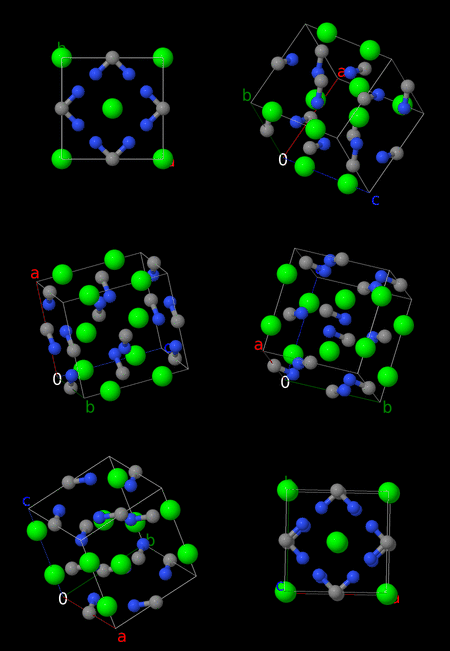
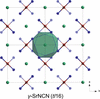
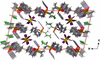
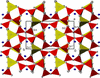
Cover illustration: In this issue, Brüning, Krach, Jurzick, Schnick & Bykov [Acta Cryst. (2026). E82, 764–767] report the structure from synchrotron single-crystal data of a new polymorph of strontium carbodiimide, γ-SrNCN. The material was synthesized at 38 (3) GPa in a laser-heated diamond anvil cell and displays a packing arrangement related to the CsCl structure type. The previously reported polymorphs, α-SrNCN (NaSCN structure type) and β-SrNCN (β-NaN3 structure type) were obtained at high temperatures under very different synthesis conditions. Exploring different synthetic routes is of the utmost importance to obtain different polymorphs of these materials, which are known to exhibit interesting optical, magnetic and catalytic activities.

early career research


link to html
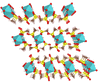
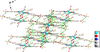
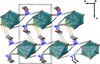
An aluminium hydroxide methane­sulfonate salt, Al(OH)(CH3SO3)2, crystallizes with one-dimensional chains of AlO6 connected via hydrogen bonding.

link to html
γ-SrNCN was synthesized from a mixture of strontium subnitride (Sr2N) and tetra­cyano­ethyl­ene (C6N4) at 38 (3) GPa in a laser-heated diamond anvil cell. The new polymorph crystallizes in the space group I4/mcm (No. 140), where the Sr2+ and NCN2− packing can be derived from the CsCl (B2) structure type.

link to html
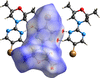
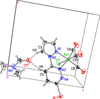
The title compound, C10H14N3OBr, crystallizes in the monoclinic system (space group P21/c, Z = 4) with the mol­ecule exhibiting approximate CS point-group symmetry.

research communications

link to html
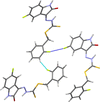
The crystal structure of the title solvate features homohalogen (F⋯F) Type I inter­molecular inter­actions, non classical Car—H⋯F and Car—H⋯S hydrogen bonds, as well as S⋯O chalcogen bonds.

link to html
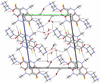
The components of the title mol­ecular salt are linked by numerous N—H⋯O and O—H⋯O hydrogen bonds and aromatic π–π stacking inter­actions.

link to html
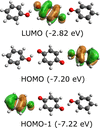
The solvent-free synthesis of X-ray quality crystals of pheno­quinone (1:2 p-benzo­phenone:phenol cocrystal) is reported, along with its crystal structure re-determined at low temperature. A detailed time-dependent density functional examination of the charge-transfer excitation of pheno­quinone accounting for its color is also provided.

link to html
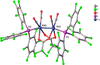
The title heterometallic single cubane cluster [(Tp*)MoFe3S33-Cl)(PMe3)3](BPh4) [Tp* = tris­(3,5-di­methyl­pyrazol-1-yl)hydro­borate(1–)] features distinct coordination geometries for the Mo and Fe sites and serves as a typical example in the Mo–Fe–S cluster family with potential applications for the construction of high-nuclearity clusters and synthesis of FeMo-co mimics.

link to html
Synthetic SrZnSi3O8 belongs to the feldspar group with 1/4 of the cationic sites of the tetra­hedral framework fully occupied by Zn2+ and 3/4 fully occupied by Si4+.

link to html
A novel tetra­nuclear Cu2+ complex was solvothermally constructed from a salicyl­aldehyde-based Schiff base ligand, which possesses a centrosymmetric framework with two dinuclear Cu2+ units; all Cu2+ centers adopt a distorted trigonal–bipyramidal coordination geometry. C—H⋯O hydrogen bonds and C—H⋯π inter­actions further consolidate the packing.

link to html
The title compound contains two 1,3,4-thia­diazol-2-amine moieties bridged by a tris­ulfanediyl group. In the crystal, N—H⋯N hydrogen bonds generate infinite [010] chains.

link to html
In the title compound, the Zn2+ ions are coordinated by one water mol­ecule and four oxygen atoms from four different pba ligands to form a [ZnO5] trigonal bipyramid. The trigonal bipyramids are bridged by the pba ligands, extending the structure into chains. The chains are connected through hydrogen-bonding inter­actions.

link to html
In the crystal structure of the sparfloxacinium 4-amino­salicylate salt, two sparfloxacin and two 4-amino­salicylic acid mol­ecules inter­act with each other through N—H⋯O hydrogen bonds, forming an R44(12) ring motif.

link to html
In the title salt, the components are linked by N—H⋯N, C—H⋯S, C—H⋯π and C—S⋯π inter­actions.

link to html
The title compound, C10H11ClN2S, consists of a chloro­phenyl ring and a propanoyl moiety bridged over a thio­urea functional group. In the crystal, N—H⋯S hydrogen bonds link the mol­ecules into centrosymmetric dimers. π–π stacking inter­actions may help to consolidate the packing.

link to html
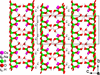
In the title compound, penta­borate [B5O10(OH)]6– building units are inter­connected to form (001) layers containing nine-membered rings. Na+ and Cs+ cations as well as water mol­ecules occupy the inter­layer space.

link to html
In the crystal structure of {(C2H7BrN)[SnBr3]}n, inorganic polymeric chains created by face-sharing SnBr6 octa­hedra are inter­leaved by organic cations of 2-bromo­ethyl­ammonium.

link to html
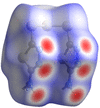
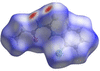
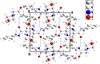
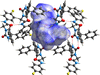
In the title mol­ecule, the dihedral angle between the mean plane of the phenyl ring and that defined by the ipso-C—NH—(C=O)—CH2— unit is 66.59 (11)°. In the crystal, N—H⋯O hydrogen bonds and C—H⋯π(ring) inter­actions form chains extending along the b-axis direction. A Hirshfeld surface analysis showed H⋯H contacts to constitute nearly 70% of the inter­molecular contacts in the crystal.

link to html
The efficacy of 4-pyrrolidino­pyridine as a strong halogen-bond acceptor is demonstrated and compared to 4-(N,N-di­methyl­amino)­pyridine.

link to html
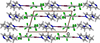
In the title mol­ecule, the imidazolidine ring is slightly non-planar and the 4-fluoro­phenyl­acetamide substituent extends up and out from the mean plane of this ring. In the crystal, inversion-related N—H⋯O hydrogen bonds form dimers, which are connected into layers parallel to the bc plane by additional N—H⋯O hydrogen bonds. The layers pack along the a-axis direction with normal van der Waals contacts. A Hirshfeld surface analysis was performed.

link to html
The reaction of pypyrBr [3-bromo-6-(1H-pyrazol-1-yl)pyridazine] with Re(CO)5Cl in refluxing toluene leads to fac-[(κ2-N,N-pypyrBr)Re(CO)3Cl] in a 48% yield. Crystallization leads to a 1:1 di­methyl­formamide solvate, with hydrogen bonding between the dDMFmol­ecule and the pyrazolyl-pyridazine fragment on the octa­hedral [(pypyrBr)Re(CO)3Cl] mol­ecule.

link to html
The compound [Ru2(O2CCF3)2{P(C6F5)3}2(CO)4] (1), has been synthesized by two protocols and its structure has been determined. Various structural, spectroscopic, and DFT calculated parameters of (1), and a group of related compounds 24: [Ru2(O2CCH3)2(CO)4{P(C6F5)3}2] (2), [Ru2(O2CCF3)2(CO)4(PPh3)2] (3), and [Ru2(O2CCH3)2(CO)4(PPh3)2] (4), are presented.

link to html
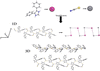
The title cocrystal features infinite chains of alternating components linked by O—H⋯N hydrogen bonds.

link to html
In the title mol­ecule, the dihedral angles between the central carbonyl­phenyl and adjacent perfluoro­phen­oxy and (tetra­dec­yloxy)benzoate rings are 74.19 (2) and 67.86 (2)°, respectively and the tetra­decyl chain adopts an extended conformation. In the crystal, the mol­ecules are linked by C—H⋯O and C—H⋯F hydrogen bonds, forming C(7) and C(10) chains, respectively, both running infinitely along [010].

link to html
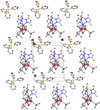
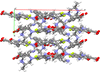
A binuclear cobalt(II) complex assembled from 1,10-phenanthroline and 4-nitro­phthalate ligands features carboxyl­ate-bridged metal centres in distorted octa­hedral coordination environments. The crystal packing is further consolidated by O—H⋯O hydrogen bonds and aromatic π–π stacking inter­actions, resulting in a three-dimensional supra­molecular network.

link to html
The crystal structures of fisetin dihydrate and luteolin monohydrate, obtained from ethanol-water mixtures, were determined by single-crystal X-ray diffraction.

link to html
The mol­ecular conformation of the title compound is consolidated by intra­molecular C—H⋯S inter­actions, which form an S(6) ring. The mol­ecules are linked in the crystal by C—H⋯F inter­actions into a three-dimensional network.

link to html
The crystal structure of the (1R,2S,5R) diastereomer of acoltremon has been solved and refined using synchrotron X-ray powder diffraction data, and optimized using density functional theory techniques.

link to html
The crystal structure of clofarabine (form I) has been solved and refined using synchrotron X-ray powder diffraction data, and optimized using density functional theory techniques.

link to html
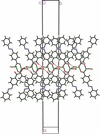
The previously unknown 1:3 complex of iso­propyl­stannate(IV) iodide, iPrSnI3, and pyridine N-oxide, PyNO, partially decomposes upon prolonged storage in deutero­chloro­form, forming a novel mixed-valent organic–inorganic tin(IV) and tin(II) compound. Both compounds exhibit an ionic structure and contain an octa­hedral [iPrSnI2(pyNO)3] + ion, in which the three Lewis base mol­ecules are arranged in a facial configuration and the two iodine atoms are in a cis position, whilst charge balancing is ensured in the first compound by an isolated iodide ion and in the second by a tri­iodido­stannate(II) ion, [SnI3], which is linked via tetrel bonds to one-dimensional chains.

education and outreach


link to html
The description and commentary for a set of simple exercises intended for undergraduate learners. These exercises introduce some basic practices for handling and reporting crystallographic data of small mol­ecules.

Research communications
Research communications are designed to help authors bring out the science behind their structure determinations. Authors are encouraged to report more than one structure in the same communication and also to include the results of investigations with other techniques. The Research communications format makes Acta E the natural home for structure determinations with interesting science to report.
Emerging Sources Citation Index

Acta E is included in the Emerging Sources Citation Index.

ESCI

Follow Acta Cryst. E
Sign up for e-alerts
Follow Acta Cryst. on Twitter
Follow us on facebook
Sign up for RSS feeds