
Acta Crystallographica
Section E CRYSTALLOGRAPHIC COMMUNICATIONS


 menu


research communications
| CRYSTALLOGRAPHIC COMMUNICATIONS |
 access
Occupational disorder of cobalt and indium in the crystal structure of Co5In3SbSi2O16

aInstitute for Chemical Technologies and Analytics, Division of Applied Solid State Chemistry, Getreidemarkt 9/E164-05-1, 1060 Vienna, Austria
*Correspondence e-mail: [email protected]
Pentacobalt(II) triindium(III) antimony(V) disilicon(VI) hexadecaoxide, Co5In3SbSi2O16, was obtained as a single-crystalline by-product through a reaction with the silica glass ampoule during a chemical vapor transport reaction. It crystallizes isotypically with Co8TeAs2O16 in space group Cmce, with two (out of four) Co sites co-occupied by In, the Te site replaced by Sb, and the As site replaced by Si. The crystal structure of Co5In3SbSi2O16 consists of [CoO6], [(In,Co)O6], and [SbO6] octahedra, and [CoO4] and [SiO4] tetrahedra, fused by vertex- and edge-sharing into a complex three-dimensional framework.
CCDC reference: 2597010
1. Chemical context
First-row divalent transition-metal (MII) antimonates with composition M2InSbO6 have a corundum-related crystal structure and exhibit interesting magnetic properties, including frustrated magnetism for Mn2InSbO6 (Ivanov et al., 2011 ), long-range incommensurate antiferromagnetic order at low temperatures for Ni2InSbO6 (Ivanov et al., 2013), or, depending on the modification of Co2InSbO6, a sharp ferrimagnetic transition at 65 K (Ji et al., 2022). The relevant materials were produced as powder samples via solid-state reactions, either at normal pressure (M = Ni, Mn) or under high-pressure conditions (M = Co). Since chemical vapour transport reactions (Binnewies et al., 2012) had been successfully applied for single crystal growth of Ni2InSbO6 in the millimetre size range (Weil et al., 2014), an attempt was made to apply this method to crystal growth of Co2InSbO6. The crystals obtained during one of these experiments did not have the desired composition, but also contained silicon as an additional element, which resulted from a reaction with the silica glass ampoule. This article reports on the corresponding crystal structure of Co5In3SbSi2O16, (I).
2. Structural commentary
Compound (I) is isotypic with Co8TeAs2O16 (Staack & Müller-Buschbaum, 1997). It comprises two Co sites (Co1: multiplicity 8, Wyckoff letter f, site symmetry m..; Co2: 8 e, .2.), two mixed-occupied (In/Co) sites (In1/Co3: 8 f; In2/Co4: 8 e), one Si (Si1: 8 f), one Sb (Sb1: 4 a, 2/m..) and six O sites (O2–O5: 8 f; O1, O6: 16 g, 1) in the asymmetric unit. Compared with Co8TeAs2O16, sites Co3 and Co4 of Co5In3SbSi2O16 are co-occupied by In, the Te site is replaced by Sb, and the As site by Si. Co-occupation of sites by Co and In was also observed for different modifications of Co2InSbO6 (Ji et al., 2022) or Co2InBO5 and Co3–xInxBO5 solid solutions (Cai et al., 2014).
The principal building units in the crystal structure of (I) are [Co1O4] and [Si1O4] tetrahedra and [Co2O6], [(In1,Co3)O6], [(In2,Co4)O6] and [Sb1O6] octahedra. Ranges and averages of bond lengths in these polyhedra comply with literature values and are summarized in Table 1.
|
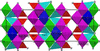
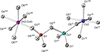
The rather complex crystal structure of (I) is made up from vertex- and edge-sharing of the building units and is displayed in Fig. 1. As the structural details have already been discussed at length in connection with isotypic Co8TeAs2O16 (Staack & Müller-Buschbaum, 1997), we will limit ourselves to the most notable features: The [Sb1O6] octahedra are isolated from others, and a {Co1Si1O7} double tetrahedron is formed via a bridging O atom (O2) and is also isolated from other double tetrahedra. These entities are linked by [100] chains of edge-sharing [CoO6] and [(In,Co)O6] octahedra into a framework structure; a fragment of this is shown in Fig. 2.
|
Figure 1
Polyhedral representation of the crystal structure of (I) in a view along [  00]. Displacement ellipsoids are represented at the 90% probability level. Colour codes for polyhedra: Co in tetrahedral coordination is turquoise, Co2 in octahedral coordination is blue, mixed (In,Co) sites in octahedral coordination are pink, antimonate octahedra are green and silicate tetrahedra are red. |
|
Figure 2
Fragment of the crystal structure showing the {Co1Si1O7} double tetrahedron linked to [(In2,Co4)O6] and [Co2O6] octahedra. Displacement ellipsoids are as in Fig. 1 . [Symmetry codes: (i) x −  , y + , z; (ii) −x + , y + , z; (iii) x, y + , −z + ; (iv) x, y − , −z + ; (v) x + , y − , z; (vi) −x, −y + , z − ; (vii) −x + , −y + , −z + 1; (viii) x, −y + , z + ; (ix) −x + , −y + , −z; (xiii) x + , y + , z; (xiv) −x + , −y + 1, z − ; (xv) x, −y + 1, −z + 1; (xvi) −x, −y + 1, −z + 1; (xxi) x − , y + , z − 1; (xxii) −x + , y + , z − 1.] |
Bond-valence-sum (BVS) calculations (Brown, 2002) were carried out with the ECoN21 program (Ilinca, 2022) to validate the structure model. The calculated bond-valence sums (Table 2) of Co1, Co2, Sb1, Si1 and the six O atoms are close to the expected values (in parentheses) for Co (2), Sb (5), Si (4) and O (2) atoms. The mixed-occupied (In1,Co3) and (In2,Co4) sites exhibit BVS values between 2 and 3, which is consistent with the formal charges of +2 for Co and +3 for In, as well as the different In:Co ratio. The strongest deviation from expectation pertains to O4, which is bonded to five metal cations [2Co, 3(In,Co)] and not to the higher-charged Si or Sb atoms. The global instability index (GII) of 0.11 valence units indicates a stable and not particularly strained crystal structure (Salinas-Sanchez et al., 1992; Brown, 2009).
|
Numerical data from a quantitative comparison of the isotypic structures of (I) and Co8TeAs2O16, carried out using the compstru program (de la Flor et al., 2016), which is available on the Bilbao Crystallographic Server (Aroyo et al., 2006), are summarized in Table 2. The low values for the degree of lattice distortion (0.0050) and the measure of similarity (0.027) indicate a high degree of similarity between the two crystal structures. The highest differences in atomic positions pertain to atoms O2 and O3, both of which are part of the silicate tetrahedron and two [CoO6] (for the arsenate) or one [CoO6] and one [(In,Co)O6] octahedron (for the silicate). Interestingly, the differences for O4, which is bound to five octahedrally coordinated metal atoms [Co or (In,Co)] but not to the double tetrahedron or the Sb (Te) atom (Table 2), are small.
3. Synthesis and crystallization
Co5In3SbSi2O16 formed serendipitously during phase-formation studies in the system Co/In/Sb/O aimed at a phase with composition Co2InSbO6 (Ji et al., 2022) by using chemical vapour transport reactions (CVTR; Binnewies et al., 2012). Stoichiometric amounts of Co3O4 (Alfa-Aesar, >99%), In2O3 (Merck KGaA, >99.5%) and Sb2O5 [Thermo Fisher Scientific, 99.998% (metals basis)] were weighted in an 1.333:1:1 ratio (altogether ca. 300 mg), intimidately ground in an agate mortar and combined with HgCl2 (60 mg) as the transport agent. The mixture was loaded in a silica ampoule (volume ca. 20 cm3) that was evacuated, sealed and placed in a two-zone furnace using a gradient 1223 → 1123 K for 4 days. Co5In3SbSi2O16 crystallized in the cooler sink side by reacting with the glass ampoule in form of sub-mm blue plates; brown crystals of preliminary composition Co8In11Sb7O42 were also present at the sink side. Powder X-ray diffraction of the bulk revealed an approximate phase ratio Co5In3SbSi2O16:Co8In11Sb7O42 of 1:9. At the source side, CoSb2O6 (Reimers et al., 1989) and monoclinic InSbO4 (Wolflehner, 2026) were identified.
An attempt to synthesize Co5In3SbSi2O16 specifically under the same conditions as described above, using Co3O4, Sb2O5, In2O3 and SiO2 (Merck, purum) in the stoichiometric ratio 1.67:0.5:1.5:2, resulted in the formation of Co5In3SbSi2O16 crystals as the only product present in the sink region. In the source region, Co5In3SbSi2O16, CoSb2O6 and spinel-type Co2.33Sb0.67O4 (Dulac & Durif, 1960) were identified in an approximate ratio of 5:1:1 according to powder X-ray diffraction of the bulk.
4. Refinement
Crystal data, data collection and structure refinement details are summarized in Table 3. Starting atomic coordinates and the labelling scheme were taken from isotypic Co8As2TeO16 (Staack & Müller-Buschbaum, 1997). Initial refinement considering two Co, two In, one Sb, one Si and six O sites resulted in the composition Co4In4SbSi2O16, i.e. a charged compound under consideration of oxidation states of +II for Co, +III for In, +V for Sb and +IV for Si. Successive free refinement of the site occupation factors of the metal sites revealed full occupation for Co1, Co2, Sb1, Si1, but a minor under-occupation for In1 and a pronounced under-occupation for In2. To achieve charge neutrality, both sites were co-occupied with Co atoms in a fixed In1:Co3 ratio of 0.9:0.1 and In2:Co4 ratio of 0.6:0.4. The remaining maximum and minimum electron densities in the final model are located 0.96 and 0.76 Å, respectively, from Sb1.
|
Supporting information
CCDC reference: 2597010
Crystal structure: contains datablock I. DOI: https://doi.org/10.1107/S2056989026010960/hb8265sup1.cif
Structure factors: contains datablock I. DOI: https://doi.org/10.1107/S2056989026010960/hb8265Isup2.hkl
| Co5In3SbSi2O16 | Dx = 5.741 Mg m−3 |
| Mr = 1073.04 | Mo Kα radiation, λ = 0.71073 Å |
| Orthorhombic, Cmce | Cell parameters from 14765 reflections |
| a = 6.1012 (4) Å | θ = 3.4–36.5° |
| b = 23.8586 (6) Å | µ = 14.40 mm−1 |
| c = 8.5282 (18) Å | T = 293 K |
| V = 1241.4 (3) Å3 | Plate, red |
| Z = 4 | 0.10 × 0.08 × 0.05 mm |
| F(000) = 1956 |
| Stoe STADIVARI diffractometer | 1320 reflections with I > 2σ(I) |
| Detector resolution: 13.33 pixels mm-1 | Rint = 0.032 |
| rotation method, ω scans | θmax = 36.4°, θmin = 3.4° |
| Absorption correction: multi-scan (LANA; Koziskova et al., 2016) | h = −3→10 |
| Tmin = 0.474, Tmax = 0.874 | k = −39→35 |
| 6885 measured reflections | l = −6→14 |
| 1580 independent reflections |
| Refinement on F2 | 75 parameters |
| Least-squares matrix: full | 0 restraints |
| R[F2 > 2σ(F2)] = 0.024 | w = 1/[σ2(Fo2) + (0.033P)2] where P = (Fo2 + 2Fc2)/3 |
| wR(F2) = 0.056 | (Δ/σ)max = 0.001 |
| S = 1.01 | Δρmax = 1.54 e Å−3 |
| 1580 reflections | Δρmin = −2.23 e Å−3 |
Geometry. All esds (except the esd in the dihedral angle between two l.s. planes) are estimated using the full covariance matrix. The cell esds are taken into account individually in the estimation of esds in distances, angles and torsion angles; correlations between esds in cell parameters are only used when they are defined by crystal symmetry. An approximate (isotropic) treatment of cell esds is used for estimating esds involving l.s. planes. |
| x | y | z | Uiso*/Ueq | Occ. (<1) | |
| Co1 | 0.000000 | 0.55684 (2) | 0.12353 (6) | 0.00899 (10) | |
| Co2 | 0.250000 | 0.42916 (2) | 0.250000 | 0.00861 (10) | |
| Co3 | 0.000000 | 0.13625 (2) | 0.03647 (3) | 0.00856 (6) | 0.1 |
| In1 | 0.000000 | 0.13625 (2) | 0.03647 (3) | 0.00856 (6) | 0.9 |
| Co4 | 0.250000 | 0.80155 (2) | 0.250000 | 0.00934 (7) | 0.4 |
| In2 | 0.250000 | 0.80155 (2) | 0.250000 | 0.00934 (7) | 0.6 |
| Si1 | 0.000000 | 0.68839 (4) | 0.10629 (12) | 0.00706 (17) | |
| Sb1 | 0.000000 | 0.000000 | 0.000000 | 0.00677 (7) | |
| O1 | 0.2222 (3) | 0.06057 (8) | 0.0046 (2) | 0.0096 (3) | |
| O2 | 0.000000 | 0.13256 (11) | 0.2799 (3) | 0.0108 (5) | |
| O3 | 0.000000 | 0.24301 (12) | 0.2804 (3) | 0.0106 (5) | |
| O4 | 0.000000 | 0.13194 (11) | 0.7828 (3) | 0.0089 (5) | |
| O5 | 0.000000 | 0.99103 (12) | 0.2319 (3) | 0.0098 (5) | |
| O6 | 0.2821 (3) | 0.18631 (8) | 0.9968 (2) | 0.0107 (4) |
| U11 | U22 | U33 | U12 | U13 | U23 | |
| Co1 | 0.00738 (19) | 0.0093 (2) | 0.0103 (2) | 0.000 | 0.000 | 0.00064 (18) |
| Co2 | 0.00728 (19) | 0.0091 (2) | 0.0095 (2) | 0.000 | 0.00118 (16) | 0.000 |
| Co3 | 0.00825 (10) | 0.00913 (12) | 0.00829 (12) | 0.000 | 0.000 | −0.00009 (9) |
| In1 | 0.00825 (10) | 0.00913 (12) | 0.00829 (12) | 0.000 | 0.000 | −0.00009 (9) |
| Co4 | 0.00864 (13) | 0.00895 (15) | 0.01044 (15) | 0.000 | −0.00114 (10) | 0.000 |
| In2 | 0.00864 (13) | 0.00895 (15) | 0.01044 (15) | 0.000 | −0.00114 (10) | 0.000 |
| Si1 | 0.0067 (4) | 0.0072 (4) | 0.0073 (4) | 0.000 | 0.000 | −0.0004 (4) |
| Sb1 | 0.00580 (12) | 0.00698 (14) | 0.00754 (15) | 0.000 | 0.000 | 0.00012 (11) |
| O1 | 0.0072 (7) | 0.0092 (9) | 0.0123 (9) | −0.0016 (6) | −0.0006 (6) | 0.0005 (8) |
| O2 | 0.0142 (12) | 0.0076 (12) | 0.0106 (13) | 0.000 | 0.000 | −0.0005 (10) |
| O3 | 0.0086 (10) | 0.0106 (12) | 0.0124 (13) | 0.000 | 0.000 | 0.0023 (10) |
| O4 | 0.0085 (10) | 0.0094 (12) | 0.0089 (12) | 0.000 | 0.000 | 0.0004 (10) |
| O5 | 0.0113 (11) | 0.0083 (12) | 0.0098 (12) | 0.000 | 0.000 | −0.0007 (10) |
| O6 | 0.0064 (7) | 0.0130 (10) | 0.0128 (9) | −0.0016 (6) | −0.0016 (6) | 0.0010 (8) |
| Co1—O1i | 1.977 (2) | In2—O3iii | 2.084 (2) |
| Co1—O1ii | 1.977 (2) | In2—O3xiii | 2.084 (2) |
| Co1—O2iii | 1.986 (3) | In2—O6xiv | 2.1340 (19) |
| Co1—O5iv | 1.997 (3) | In2—O6xv | 2.1340 (19) |
| Co2—O5v | 2.128 (2) | In2—O4xiv | 2.219 (2) |
| Co2—O5iv | 2.128 (2) | In2—O4xvi | 2.219 (2) |
| Co2—O4vi | 2.128 (2) | Sb1—O1xvii | 1.9818 (19) |
| Co2—O4vii | 2.128 (2) | Sb1—O1xii | 1.9818 (19) |
| Co2—O1viii | 2.1913 (19) | Sb1—O1xviii | 1.9818 (19) |
| Co2—O1ix | 2.1913 (19) | Sb1—O1 | 1.9818 (19) |
| In1—O2 | 2.078 (3) | Sb1—O5xix | 1.989 (3) |
| In1—O6x | 2.1220 (18) | Sb1—O5xx | 1.989 (3) |
| In1—O6xi | 2.1220 (18) | Si1—O3iii | 1.622 (3) |
| In1—O4x | 2.165 (3) | Si1—O6xxi | 1.6252 (19) |
| In1—O1 | 2.2744 (19) | Si1—O6xxii | 1.6252 (19) |
| In1—O1xii | 2.2745 (19) | Si1—O2iii | 1.648 (3) |
| O1i—Co1—O1ii | 118.00 (11) | O3iii—Si1—O6xxii | 111.51 (10) |
| O1i—Co1—O2iii | 99.91 (8) | O6xxi—Si1—O6xxii | 109.78 (14) |
| O1ii—Co1—O2iii | 99.91 (8) | O3iii—Si1—O2iii | 107.36 (15) |
| O1i—Co1—O5iv | 110.62 (7) | O6xxi—Si1—O2iii | 108.28 (10) |
| O1ii—Co1—O5iv | 110.62 (7) | O6xxii—Si1—O2iii | 108.28 (10) |
| O2iii—Co1—O5iv | 117.34 (12) | O1xvii—Sb1—O1xii | 93.67 (11) |
| O5v—Co2—O5iv | 92.17 (11) | O1xvii—Sb1—O1xviii | 86.33 (11) |
| O5v—Co2—O4vi | 176.59 (10) | O1xii—Sb1—O1xviii | 180.00 (11) |
| O5iv—Co2—O4vi | 87.25 (7) | O1xvii—Sb1—O1 | 180.0 |
| O5v—Co2—O4vii | 87.25 (7) | O1xii—Sb1—O1 | 86.33 (11) |
| O5iv—Co2—O4vii | 176.59 (10) | O1xviii—Sb1—O1 | 93.67 (11) |
| O4vi—Co2—O4vii | 93.54 (11) | O1xvii—Sb1—O5xix | 93.38 (8) |
| O5v—Co2—O1viii | 92.86 (9) | O1xii—Sb1—O5xix | 86.62 (8) |
| O5iv—Co2—O1viii | 78.17 (9) | O1xviii—Sb1—O5xix | 93.38 (8) |
| O4vi—Co2—O1viii | 83.73 (9) | O1—Sb1—O5xix | 86.62 (8) |
| O4vii—Co2—O1viii | 105.22 (10) | O1xvii—Sb1—O5xx | 86.62 (8) |
| O5v—Co2—O1ix | 78.17 (9) | O1xii—Sb1—O5xx | 93.38 (8) |
| O5iv—Co2—O1ix | 92.86 (9) | O1xviii—Sb1—O5xx | 86.62 (8) |
| O4vi—Co2—O1ix | 105.22 (10) | O1—Sb1—O5xx | 93.38 (8) |
| O4vii—Co2—O1ix | 83.73 (9) | O5xix—Sb1—O5xx | 180.00 (17) |
| O1viii—Co2—O1ix | 167.15 (10) | Co1v—O1—Sb1 | 124.31 (10) |
| O2—In1—O6x | 100.54 (7) | Co1v—O1—Co2ix | 116.55 (9) |
| O2—In1—O6xi | 100.54 (7) | Sb1—O1—Co2ix | 96.61 (8) |
| O6x—In1—O6xi | 108.41 (10) | Co1v—O1—In1 | 119.02 (9) |
| O2—In1—O4x | 174.85 (10) | Sb1—O1—In1 | 99.99 (8) |
| O6x—In1—O4x | 82.40 (7) | Co2ix—O1—In1 | 94.35 (7) |
| O6xi—In1—O4x | 82.40 (7) | Si1iv—O2—Co1iv | 119.41 (17) |
| O2—In1—O1 | 94.93 (8) | Si1iv—O2—In1 | 123.65 (16) |
| O6x—In1—O1 | 86.81 (7) | Co1iv—O2—In1 | 116.94 (14) |
| O6xi—In1—O1 | 155.68 (8) | Si1iv—O3—Co4iv | 127.76 (8) |
| O4x—In1—O1 | 80.96 (7) | Si1iv—O3—Co4xxiii | 127.76 (8) |
| O2—In1—O1xii | 94.93 (8) | Co4iv—O3—Co4xxiii | 94.07 (12) |
| O6x—In1—O1xii | 155.68 (8) | Co2xxiv—O4—Co2vii | 91.56 (11) |
| O6xi—In1—O1xii | 86.81 (7) | Co2xxiv—O4—Co3xxv | 99.44 (9) |
| O4x—In1—O1xii | 80.96 (7) | Co2vii—O4—Co3xxv | 99.44 (9) |
| O1—In1—O1xii | 73.18 (10) | Co2xxiv—O4—Co4xxvi | 164.99 (15) |
| O3iii—In2—O3xiii | 95.85 (12) | Co2vii—O4—Co4xxvi | 88.89 (2) |
| O3iii—In2—O6xiv | 98.43 (9) | Co3xxv—O4—Co4xxvi | 95.28 (10) |
| O3xiii—In2—O6xiv | 92.02 (9) | Co2xxiv—O4—Co4xvi | 88.89 (2) |
| O3iii—In2—O6xv | 92.02 (9) | Co2vii—O4—Co4xvi | 164.99 (15) |
| O3xiii—In2—O6xv | 98.43 (9) | Co3xxv—O4—Co4xvi | 95.28 (10) |
| O6xiv—In2—O6xv | 164.39 (11) | Co4xxvi—O4—Co4xvi | 86.85 (10) |
| O3iii—In2—O4xiv | 176.38 (8) | Sb1xxvii—O5—Co1iii | 121.97 (15) |
| O3xiii—In2—O4xiv | 87.73 (7) | Sb1xxvii—O5—Co2i | 98.44 (10) |
| O6xiv—In2—O4xiv | 80.88 (9) | Co1iii—O5—Co2i | 120.04 (9) |
| O6xv—In2—O4xiv | 87.96 (9) | Sb1xxvii—O5—Co2iii | 98.44 (10) |
| O3iii—In2—O4xvi | 87.73 (7) | Co1iii—O5—Co2iii | 120.04 (9) |
| O3xiii—In2—O4xvi | 176.38 (8) | Co2i—O5—Co2iii | 91.56 (11) |
| O6xiv—In2—O4xvi | 87.96 (9) | Si1xxviii—O6—Co3xxv | 126.11 (11) |
| O6xv—In2—O4xvi | 80.88 (9) | Si1xxviii—O6—Co4xxvi | 129.60 (11) |
| O4xiv—In2—O4xvi | 88.68 (10) | Co3xxv—O6—Co4xxvi | 99.15 (7) |
| O3iii—Si1—O6xxi | 111.51 (10) |
| Symmetry codes: (i) x−1/2, y+1/2, z; (ii) −x+1/2, y+1/2, z; (iii) x, y+1/2, −z+1/2; (iv) x, y−1/2, −z+1/2; (v) x+1/2, y−1/2, z; (vi) −x, −y+1/2, z−1/2; (vii) −x+1/2, −y+1/2, −z+1; (viii) x, −y+1/2, z+1/2; (ix) −x+1/2, −y+1/2, −z; (x) x, y, z−1; (xi) −x, y, z−1; (xii) −x, y, z; (xiii) x+1/2, y+1/2, z; (xiv) −x+1/2, −y+1, z−1/2; (xv) x, −y+1, −z+1; (xvi) −x, −y+1, −z+1; (xvii) −x, −y, −z; (xviii) x, −y, −z; (xix) −x, −y+1, −z; (xx) x, y−1, z; (xxi) x−1/2, y+1/2, z−1; (xxii) −x+1/2, y+1/2, z−1; (xxiii) x−1/2, y−1/2, z; (xxiv) −x, −y+1/2, z+1/2; (xxv) x, y, z+1; (xxvi) −x+1/2, −y+1, z+1/2; (xxvii) x, y+1, z; (xxviii) x+1/2, y−1/2, z+1. |
| Site | Coordination number | Range of bond lengths (Å) | Mean bond length (Å) | Mean bond length (literature value) (Å) | BVS (valence units) |
| Co1 | 4 | 1.977 (2)–1.997 (3) | 1.984 | 1.967 (22)c | 1.86 |
| Co2 | 6 | 2.128 (2)–2.1913 (19) | 2.147 | 2.108 (62)c | 1.82 |
| (In1,Co3)a | 6 | 2.078 (3)–2.2745 (19) | 2.156 | Co 2.108 (62)c, In 2.142 (42)d | 2.73 |
| (In2,Co4)b | 6 | 2.084 (2)–2.219 (2) | 2.137 | Co 2.108 (62)c, In 2.142 (42)d | 2.53 |
| Sb1 | 6 | 1.9818 (19)–1.989 (3) | 1.984 | 1.977 (34)d | 4.94 |
| Si1 | 4 | 1.622 (3)–1.648 (3) | 1.630 | 1.625 (24)d | 3.94 |
| O1 | 4 [2Co+Sb+(In,Co)] | 1.93 | |||
| O2 | 3 [Si+Co+(In,Co)] | 1.96 | |||
| O3 | 3 [Si+2(In,Co)] | 1.97 | |||
| O4 | 5 [2Co+3(In,Co)] | 1.80 | |||
| O5 | 4 (Sb+3Co) | 1.90 | |||
| O6 | 3 [Si+2(In,Co)] | 1.93 |
| Notes: (a) In:Co ratio 0.9:0.1; (b) In:Co ratio 0.6:0.4; (c) Gagné & Hawthorne (2020); (d) Gagné & Hawthorne (2018). |
| Co1 | 0.0523 | O1 | 0.0526 | |
| Co2 | 0.0817 | O2 | 0.1220 | |
| (In1,Co3)a/Co3 | 0.0943 | O3 | 0.1195 | |
| (In2,Co4)b/Co4 | 0.1057 | O4 | 0.0413 | |
| Sb1/Te1 | 0 | O5 | 0.0243 | |
| Si1/As1 | 0.0489 | O6 | 0.0709 | |
| S | 0.0050 | |||
| dav | 0.0694 | |||
| δ | 0.027 |
| Notes: (a) In:Co ratio 0.9:0.1; (b) In:Co ratio 0.6:0.4. |
Acknowledgements
The authors acknowledge the X-ray Centre of TU Wien for providing access to instrumentation and analysis software and TU Wien Bibliothek for financial support through its Open Access Funding Program.
References
 Aroyo, M. I., Perez-Mato, J. M., Capillas, C., Kroumova, E., Ivantchev, S., Madariaga, G., Kirov, A. & Wondratschek, H. (2006). Z. Kristallogr. 221, 15–27.
Web of Science
CrossRef
CAS
Google Scholar
Binnewies, M., Glaum, R., Schmidt, M. & Schmidt, P. (2012). Chemical Vapor Transport Reactions Berlin, Boston: De Gruyter.
Google Scholar
Brown, I. D. (2002). The Chemical Bond in Inorganic Chemistry: The Bond Valence Model. Oxford University Press.
Google Scholar
Brown, I. D. (2009). Chem. Rev. 109, 6858–6919.
Web of Science
CrossRef
PubMed
CAS
Google Scholar
Cai, G. M., Wang, L., Su, L. M., Liu, H. S. & Jin, Z. P. (2014). J. Alloys Compd. 615, 809–816.
CrossRef
CAS
Google Scholar
Dowty, E. (2006). ATOMS. Shape Software, Kingsport, Tennessee, USA.
Google Scholar
Dulac, J. F. & Durif, A. (1960). C. R. Hebd. Seances Acad. Sci. 251, 747–749.
CAS
Google Scholar
Flor, G. de la, Orobengoa, D., Tasci, E., Perez-Mato, J. M. & Aroyo, M. I. (2016). J. Appl. Cryst. 49, 653–664.
Web of Science
CrossRef
IUCr Journals
Google Scholar
Folkers-Karlsson, L. C., Celani, P., Hahn, F. & Richter, J. (2026). Z. Kristallogr. 241, 41–51.
CAS
Google Scholar
Gagné, O. C. & Hawthorne, F. C. (2018). Acta Cryst. B74, 79–96.
Web of Science
CrossRef
IUCr Journals
Google Scholar
Gagné, O. C. & Hawthorne, F. C. (2020). IUCrJ 7, 581–629.
Web of Science
CrossRef
PubMed
IUCr Journals
Google Scholar
Ilinca, G. (2022). Minerals 12, 924.
Web of Science
CrossRef
Google Scholar
Ivanov, S. A., Mathieu, R., Nordblad, P., Tellgren, R., Ritter, C., Politova, E., Kaleva, G., Mosunov, A., Stefanovich, S. & Weil, M. (2013). Chem. Mater. 25, 935–945.
CrossRef
CAS
Google Scholar
Ivanov, S., Nordblad, P., Mathieu, R., Tellgren, R., Politova, E. & André, G. (2011). Eur. J. Inorg. Chem. pp. 4691–4699.
Web of Science
CrossRef
Google Scholar
Ji, K., Solana–Madruga, E., Patino, M. A., Shimakawa, Y. & Attfield, J. P. (2022). Angew. Chem. Int. Ed. 61, e202203062.
CrossRef
Google Scholar
Koziskova, J., Hahn, F., Richter, J. & Kožíšek, J. (2016). Acta Chim. Slovaca 9, 136–140.
CrossRef
CAS
Google Scholar
Reimers, J. N., Greedan, J. E., Stager, C. V. & Kremer, R. (1989). J. Solid State Chem. 83, 20–30.
CrossRef
CAS
Web of Science
Google Scholar
Salinas-Sanchez, A., Garcia-Muñoz, J. L., Rodriguez-Carvajal, J., Saez-Puche, R. & Martinez, J. L. (1992). J. Solid State Chem. 100, 201–211.
CAS
Google Scholar
Sheldrick, G. M. (2015a). Acta Cryst. A71, 3–8.
Web of Science
CrossRef
IUCr Journals
Google Scholar
Sheldrick, G. M. (2015b). Acta Cryst. C71, 3–8.
Web of Science
CrossRef
IUCr Journals
Google Scholar
Staack, M. & Müller-Buschbaum, Hk. (1997). Z. Naturforsch. Teil B 52, 643–646.
CrossRef
CAS
Google Scholar
Weil, M., Mathieu, R., Nordblad, P. & Ivanov, S. A. (2014). Cryst. Res. Technol. 49, 142–151.
CrossRef
CAS
Google Scholar
Westrip, S. P. (2010). J. Appl. Cryst. 43, 920–925.
Web of Science
CrossRef
CAS
IUCr Journals
Google Scholar
Wolflehner, T. (2026). Part of PhD Thesis (unpublished). TU Wien, Austria.
Google Scholar
This is an open-access article distributed under the terms of the Creative Commons Attribution (CC-BY) Licence, which permits unrestricted use, distribution, and reproduction in any medium, provided the original authors and source are cited.
| CRYSTALLOGRAPHIC COMMUNICATIONS |
access