
Acta Crystallographica
Section E CRYSTALLOGRAPHIC COMMUNICATIONS


 menu


research communications
| CRYSTALLOGRAPHIC COMMUNICATIONS |
 access
Synthesis, crystal structure and Hirshfeld surface analysis of di-μ2-chlorido-bis[(nitrato-κO)bis(pyridine-κN)copper(II)]

aTermez State University, Barkamol avlod str. 43, Termez, 190100, Uzbekistan, and bUniversity of Business and Science, Dostlik str. 14, Namangan, 160108, Uzbekistan
*Correspondence e-mail: [email protected]
The title compound, [Cu2Cl2(NO3)2(C5H5N)4], crystallizes as a centrosymmetric binuclear CuII complex in which the two central CuII atoms are interconnected by a pair of μ2-chlorido bridges. The CuII atom is additionally coordinated by two pyridine N atoms and one O atom from a monodentate nitrato ligand, resulting in a distorted square-pyramidal coordination environment. In the crystal, the binuclear complexes are linked by C—H⋯Cl and C—H⋯O hydrogen bonds, generating a supramolecular framework structure. Hirshfeld surface analysis was performed to quantify and further elucidate the intermolecular interactions.
Keywords: crystal; copper; pyridine; synthesis; Hirshfeld surface analysis; hydrogen bonding.
CCDC reference: 2494595
1. Chemical context
Copper(II) complexes continue to attract considerable interest in coordination chemistry owing to the structural diversity of the CuII coordination environments and the ability of ancillary ligands to generate mono- and multinuclear structures. Pyridine is a simple neutral N-donor ligand that readily coordinates to CuII and has been widely employed in the preparation of many different copper(II) complexes (Pandey, 2018 ; Bowmaker et al., 2011). In copper(II) halide–pyridine systems, the nature of the halido ligand(s) and the coordination environment can lead to distinct molecular and extended structural motifs, in particular the ability of chlorido ligands to link symmetry-related copper(II) atoms through μ2-binding modes into binuclear units (Bowmaker et al., 2011; Herringer et al., 2011).
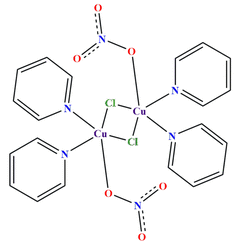
In this context, the present work describes the synthesis and single-crystal X-ray characterization of a centrosymmetric binuclear CuII complex, [Cu2(μ2-Cl)2(κO-NO2)2(C5H5N)4], (1), together with an analysis of its intermolecular interactions.
2. Structural commentary
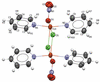
Compound (1) represents a centrosymmetric binuclear CuII molecular complex in which two copper(II) ions are connected by two μ2-chlorido bridges, forming a {Cu2Cl2} core. The CuII atom is five-coordinate, with two ligating pyridine nitrogen atoms (N1 and N2), one oxygen atom (O1) from a monodentate nitrate ligand, and the two bridging chloride ions (Fig. 1). The coordination environment of the CuII atom is distorted square-pyramidal, with the symmetry-related chlorido ligand Cl1(−x + 1, −y + 1, −z + 1) occupying the apical position. The five-coordinate geometry was assessed using the τ5 parameter (Addison et al., 1984). The calculated value of τ5 = 0.18 indicates a shape closer to square-pyramidal than trigonal-bipyramidal, consistent with the observed structural parameters.
|
Figure 1
View of the title complex with the atom-numbering scheme of the asymmetric unit. Displacement ellipsoids are drawn at the 50% probability level; unlabelled atoms are related to the labelled atoms by symmetry operation −x + 1, −y + 1, −z + 1. |
The observed distortion around CuII in compound (1) may be discussed in the context of the Jahn–Teller effect characteristic of many CuII complexes (Hakimov et al., 2025). The Cu—N bond lengths are 1.998 (3) and 2.000 (3) Å, while the Cu—O1 and basal Cu—Cl1 distances are 2.021 (2) and 2.3009 (10) Å, respectively. The apical Cu1—Cl1(−x + 1, −y + 1, −z + 1) bond is significantly longer at 2.7025 (10) Å, and the intradimer Cu⋯Cu separation is 3.4958 (7) Å. The angles in the basal plane, N—Cu—N = 167.24 (13)° and O—Cu—Cl = 177.77 (8)°, deviate from ideal values.
3. Supramolecular features
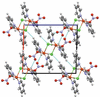
The crystal packing is consolidated by weak intermolecular C—H⋯O and C—H⋯Cl contacts, the numerical parameters of which are summarized in Table 1. The C—H⋯O interactions connect neighbouring molecules into layers parallel to (101). These layers are further linked by C—H⋯Cl contacts, resulting in a supramolecular framework structure (Fig. 2). In addition, π–π contacts between pyridine rings within the centrosymmetric dimer are present, with centroid-to-centroid distances of 4.201 (2) Å between Cg3 (ring N1/C1–C5) and Cg4(–x + 1, –y + 1, –z + 1) (ring N2/C6–C10), and a slippage of 1.457 Å.
|
|||||||||||||||||||||||||||
 ; (ii)
 ; (iii)
 .
|
Figure 2
Packing plot of (1) in a view along [010]. C—H⋯O and C—H⋯Cl interactions are shown as turquoise dotted lines. |
4. Hirshfeld surface analysis
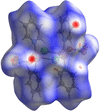
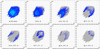
A Hirshfeld surface analysis was performed using CrystalExplorer (Spackman et al., 2021) to quantify the intermolecular contacts in the crystal structure. The Hirshfeld surface mapped over dnorm is shown in Fig. 3. The red regions on the surface indicate close intermolecular contacts, particularly C—H⋯O and C—H⋯Cl interactions, which contribute to the cohesion of the crystal packing. The two-dimensional fingerprint plots provide further insight into the relative contributions of the intermolecular contacts (Fig. 4). H⋯H contacts show the largest contribution to the Hirshfeld surface. The prominent H⋯O/O⋯H contacts are associated with C—H⋯O interactions and are characterized by sharp features in the corresponding fingerprint plot (McKinnon et al., 2007), consistent with directional close contacts. Similarly, the characteristic features in the H⋯Cl/Cl⋯H plot reflect intermolecular C—H⋯Cl contacts. The H⋯C/C⋯H and O⋯C/C⋯O contributions arise from additional close contacts involving the aromatic rings and oxygen atoms. Although these contacts are less prominent in the fingerprint analysis, they provide further insight into the intermolecular environment and the packing arrangement.
|
Figure 3
View of the three-dimensional Hirshfeld surface of the title compound plotted over dnorm. |
|
Figure 4
Two-dimensional fingerprint plots of (1) showing (a) all interactions, and delineated into (b) H⋯H (42.3%), (c) H⋯O/O⋯H (29.9%), (d) H⋯C/C⋯H (10.4%), (e) H⋯Cl/Cl⋯H (6.3%), (f) O⋯C/C⋯O (5.2%), (g) H⋯N/N⋯H (1.4%)and (h) O⋯N/N⋯O (1.4%) interactions. |
5. Database survey
A search of the Cambridge Structural Database (CSD, Version 2025.3.1; Groom et al., 2016) for the di-μ2-chlorido-bis[bis(pyridine-κN)(nitrato-κO)copper(II)] complex unit resulted in three hits, CSD refcodes COLZOT (Han et al., 2008), VAVXUM (Atria et al., 2004) and ZATQOA (Alvarez-Larena et al., 1995). These structures and that of compound (1) comprise two central CuII atoms linked through two μ2-chlorido ligands, forming a characteristic {Cu2Cl2} core, while each copper(II) atom is in a five-coordinate environment involving oxygen and nitrogen donor atoms from the nitrate unit and different pyridine derivatives, respectively. Although COLZOT shares the Cu2Cl2 core with the title compound, its coordination environment differs significantly. In COLZOT, each CuII center is six-coordinate, with two pyridine nitrogen donors, two bridging chloride ions, one oxygen donor from a coordinated water molecule, and one oxygen donor from a nitrate ligand. This results in a distorted octahedral geometry, whereas the title compound contains five-coordinate CuII centers with a distorted square-pyramidal geometry. The key difference is the additional coordinated water molecule in COLZOT.
6. Synthesis and crystallization
Pyridine (2 mmol, 158 mg) and CuCl2·2H2O (1 mmol, 170 mg) were placed in a glass vial, followed by the addition of distilled water (4 ml) and concentrated HNO3 (1 ml). The mixture was stirred at room temperature for several minutes until a clear dark-blue solution was obtained. The solution was transferred to a 25 ml Teflon-lined stainless-steel autoclave, heated at 398 K for 48 h, and then cooled to 298 K at a rate of 10 K h−1 (Liu et al., 2018). The resulting solution was transferred into a glass vial and kept in the dark at room temperature for four weeks, during which dark-blue prism-shaped crystals of [Cu2Cl2(C5H5N)4(NO3)2] formed. The crystals were isolated by filtration and dried at room temperature; yield 204 mg (64%, based on Cu), melting point 491–499 K.
7. Refinement
Crystal data, data collection and structure refinement details are summarized in Table 2. H atoms attached to C were positioned geometrically and refined using a riding model with distance constraints of C—H = 0.93 Å and with Uiso(H) = 1.2Ueq(C).
|
Supporting information
CCDC reference: 2494595
Crystal structure: contains datablock I. DOI: https://doi.org/10.1107/S2056989026010728/wm5808sup1.cif
Structure factors: contains datablock I. DOI: https://doi.org/10.1107/S2056989026010728/wm5808Isup3.hkl
| [Cu2Cl2(NO3)2(C5H5N)4] | F(000) = 644 |
| Mr = 638.40 | Dx = 1.696 Mg m−3 |
| Monoclinic, P21/n | Cu Kα radiation, λ = 1.54184 Å |
| a = 11.7560 (5) Å | Cell parameters from 1423 reflections |
| b = 8.1793 (3) Å | θ = 6.6–62.2° |
| c = 13.0074 (6) Å | µ = 4.49 mm−1 |
| β = 91.698 (4)° | T = 295 K |
| V = 1250.19 (9) Å3 | Block, clear blue |
| Z = 2 | 0.21 × 0.20 × 0.18 mm |
| Xcalibur, Ruby diffractometer | 1578 reflections with I > 2σ(I) |
| Detector resolution: 10.2576 pixels mm-1 | Rint = 0.026 |
| ω scans | θmax = 62.0°, θmin = 5.0° |
| Absorption correction: multi-scan (CrysAlisPro; Rigaku OD, 2020) | h = −10→13 |
| Tmin = 0.619, Tmax = 1.000 | k = −8→9 |
| 3303 measured reflections | l = −14→12 |
| 1928 independent reflections |
| Refinement on F2 | Hydrogen site location: inferred from neighbouring sites |
| Least-squares matrix: full | H-atom parameters constrained |
| R[F2 > 2σ(F2)] = 0.039 | w = 1/[σ2(Fo2) + (0.0515P)2] where P = (Fo2 + 2Fc2)/3 |
| wR(F2) = 0.103 | (Δ/σ)max = 0.001 |
| S = 1.04 | Δρmax = 0.50 e Å−3 |
| 1928 reflections | Δρmin = −0.34 e Å−3 |
| 164 parameters | Extinction correction: SHELXL2019/2 (Sheldrick, 2015b), Fc*=kFc[1+0.001xFc2λ3/sin(2θ)]-1/4 |
| 0 restraints | Extinction coefficient: 0.0040 (3) |
| Primary atom site location: iterative |
Geometry. All esds (except the esd in the dihedral angle between two l.s. planes) are estimated using the full covariance matrix. The cell esds are taken into account individually in the estimation of esds in distances, angles and torsion angles; correlations between esds in cell parameters are only used when they are defined by crystal symmetry. An approximate (isotropic) treatment of cell esds is used for estimating esds involving l.s. planes. |
| x | y | z | Uiso*/Ueq | ||
| Cu1 | 0.41702 (4) | 0.50764 (6) | 0.60920 (4) | 0.0344 (2) | |
| Cl1 | 0.39492 (7) | 0.34861 (10) | 0.46408 (6) | 0.0378 (3) | |
| O1 | 0.4407 (2) | 0.6529 (3) | 0.73372 (19) | 0.0417 (6) | |
| O2 | 0.2887 (2) | 0.5160 (3) | 0.7709 (2) | 0.0531 (8) | |
| N1 | 0.5022 (2) | 0.3299 (3) | 0.6834 (2) | 0.0362 (7) | |
| N2 | 0.3024 (3) | 0.6668 (3) | 0.5523 (2) | 0.0373 (7) | |
| O3 | 0.3510 (3) | 0.7100 (4) | 0.8724 (2) | 0.0644 (9) | |
| N3 | 0.3575 (3) | 0.6260 (4) | 0.7945 (2) | 0.0426 (8) | |
| C1 | 0.6025 (3) | 0.3566 (5) | 0.7304 (3) | 0.0441 (10) | |
| H1 | 0.633957 | 0.460729 | 0.727360 | 0.053* | |
| C10 | 0.3302 (4) | 0.8169 (5) | 0.5222 (3) | 0.0445 (10) | |
| H10 | 0.405587 | 0.850344 | 0.529814 | 0.053* | |
| C5 | 0.4567 (3) | 0.1802 (5) | 0.6898 (3) | 0.0450 (10) | |
| H5 | 0.386417 | 0.160124 | 0.657634 | 0.054* | |
| C6 | 0.1935 (4) | 0.6214 (5) | 0.5431 (3) | 0.0519 (11) | |
| H6 | 0.172908 | 0.517588 | 0.564971 | 0.062* | |
| C9 | 0.2519 (4) | 0.9237 (5) | 0.4803 (3) | 0.0559 (12) | |
| H9 | 0.274166 | 1.027395 | 0.459501 | 0.067* | |
| C4 | 0.5108 (4) | 0.0548 (5) | 0.7428 (4) | 0.0591 (12) | |
| H4 | 0.477106 | −0.047810 | 0.746832 | 0.071* | |
| C3 | 0.6148 (4) | 0.0839 (5) | 0.7891 (3) | 0.0599 (13) | |
| H3 | 0.653637 | 0.000928 | 0.824276 | 0.072* | |
| C8 | 0.1408 (4) | 0.8762 (6) | 0.4695 (3) | 0.0581 (12) | |
| H8 | 0.086473 | 0.946167 | 0.440424 | 0.070* | |
| C2 | 0.6609 (4) | 0.2379 (6) | 0.7828 (3) | 0.0571 (12) | |
| H2 | 0.731328 | 0.260742 | 0.814085 | 0.069* | |
| C7 | 0.1111 (4) | 0.7233 (6) | 0.5025 (3) | 0.0591 (12) | |
| H7 | 0.035716 | 0.688927 | 0.497299 | 0.071* |
| U11 | U22 | U33 | U12 | U13 | U23 | |
| Cu1 | 0.0372 (4) | 0.0333 (3) | 0.0324 (4) | 0.0025 (2) | −0.0061 (2) | 0.0012 (2) |
| Cl1 | 0.0398 (5) | 0.0382 (5) | 0.0350 (5) | −0.0069 (4) | −0.0046 (4) | −0.0019 (4) |
| O1 | 0.0409 (15) | 0.0408 (14) | 0.0435 (15) | −0.0016 (12) | 0.0011 (12) | −0.0033 (12) |
| O2 | 0.0487 (18) | 0.0548 (17) | 0.0559 (19) | −0.0097 (15) | 0.0026 (14) | −0.0025 (14) |
| N1 | 0.0401 (18) | 0.0338 (17) | 0.0344 (17) | 0.0018 (14) | −0.0053 (13) | 0.0036 (13) |
| N2 | 0.0387 (18) | 0.0362 (17) | 0.0365 (17) | 0.0071 (14) | −0.0064 (13) | 0.0002 (14) |
| O3 | 0.085 (2) | 0.0627 (19) | 0.0459 (18) | 0.0058 (17) | 0.0107 (16) | −0.0184 (16) |
| N3 | 0.047 (2) | 0.0409 (18) | 0.0398 (19) | 0.0111 (17) | −0.0020 (16) | 0.0024 (16) |
| C1 | 0.049 (2) | 0.038 (2) | 0.045 (2) | −0.0009 (19) | −0.0158 (19) | 0.0025 (18) |
| C10 | 0.051 (2) | 0.038 (2) | 0.045 (2) | 0.0025 (19) | 0.0019 (19) | 0.0039 (19) |
| C5 | 0.043 (2) | 0.042 (2) | 0.051 (2) | −0.0078 (19) | −0.0021 (18) | 0.0065 (19) |
| C6 | 0.051 (3) | 0.044 (2) | 0.061 (3) | 0.002 (2) | −0.008 (2) | 0.006 (2) |
| C9 | 0.068 (3) | 0.042 (2) | 0.058 (3) | 0.014 (2) | 0.006 (2) | 0.010 (2) |
| C4 | 0.077 (3) | 0.041 (2) | 0.060 (3) | −0.004 (2) | 0.004 (2) | 0.013 (2) |
| C3 | 0.076 (3) | 0.048 (3) | 0.055 (3) | 0.025 (2) | −0.003 (2) | 0.017 (2) |
| C8 | 0.064 (3) | 0.061 (3) | 0.049 (3) | 0.027 (3) | −0.006 (2) | 0.005 (2) |
| C2 | 0.051 (3) | 0.063 (3) | 0.056 (3) | 0.010 (2) | −0.016 (2) | 0.006 (2) |
| C7 | 0.045 (3) | 0.066 (3) | 0.066 (3) | 0.006 (2) | −0.012 (2) | 0.000 (2) |
| Cu1—Cl1i | 2.7025 (10) | C10—C9 | 1.370 (5) |
| Cu1—Cl1 | 2.3009 (10) | C5—H5 | 0.9300 |
| Cu1—O1 | 2.021 (2) | C5—C4 | 1.380 (6) |
| Cu1—N1 | 1.998 (3) | C6—H6 | 0.9300 |
| Cu1—N2 | 2.000 (3) | C6—C7 | 1.372 (5) |
| O1—N3 | 1.295 (4) | C9—H9 | 0.9300 |
| O2—N3 | 1.242 (4) | C9—C8 | 1.366 (6) |
| N1—C1 | 1.329 (4) | C4—H4 | 0.9300 |
| N1—C5 | 1.341 (4) | C4—C3 | 1.368 (6) |
| N2—C10 | 1.332 (5) | C3—H3 | 0.9300 |
| N2—C6 | 1.335 (5) | C3—C2 | 1.375 (6) |
| O3—N3 | 1.228 (4) | C8—H8 | 0.9300 |
| C1—H1 | 0.9300 | C8—C7 | 1.371 (6) |
| C1—C2 | 1.361 (5) | C2—H2 | 0.9300 |
| C10—H10 | 0.9300 | C7—H7 | 0.9300 |
| Cl1—Cu1—Cl1i | 91.74 (3) | C9—C10—H10 | 118.8 |
| O1—Cu1—Cl1i | 86.11 (8) | N1—C5—H5 | 118.9 |
| O1—Cu1—Cl1 | 177.77 (8) | N1—C5—C4 | 122.1 (4) |
| N1—Cu1—Cl1 | 91.59 (9) | C4—C5—H5 | 118.9 |
| N1—Cu1—Cl1i | 94.77 (9) | N2—C6—H6 | 119.0 |
| N1—Cu1—O1 | 89.17 (11) | N2—C6—C7 | 122.0 (4) |
| N1—Cu1—N2 | 167.24 (13) | C7—C6—H6 | 119.0 |
| N2—Cu1—Cl1 | 90.34 (9) | C10—C9—H9 | 120.4 |
| N2—Cu1—Cl1i | 97.79 (10) | C8—C9—C10 | 119.2 (4) |
| N2—Cu1—O1 | 89.38 (11) | C8—C9—H9 | 120.4 |
| Cu1—Cl1—Cu1i | 88.26 (3) | C5—C4—H4 | 120.6 |
| N3—O1—Cu1 | 107.5 (2) | C3—C4—C5 | 118.9 (4) |
| C1—N1—Cu1 | 121.9 (2) | C3—C4—H4 | 120.6 |
| C1—N1—C5 | 118.1 (3) | C4—C3—H3 | 120.6 |
| C5—N1—Cu1 | 120.0 (2) | C4—C3—C2 | 118.8 (4) |
| C10—N2—Cu1 | 122.7 (3) | C2—C3—H3 | 120.6 |
| C10—N2—C6 | 118.2 (3) | C9—C8—H8 | 120.7 |
| C6—N2—Cu1 | 119.1 (3) | C9—C8—C7 | 118.7 (4) |
| O2—N3—O1 | 118.0 (3) | C7—C8—H8 | 120.7 |
| O3—N3—O1 | 118.4 (3) | C1—C2—C3 | 119.3 (4) |
| O3—N3—O2 | 123.6 (4) | C1—C2—H2 | 120.4 |
| N1—C1—H1 | 118.6 | C3—C2—H2 | 120.4 |
| N1—C1—C2 | 122.8 (4) | C6—C7—H7 | 120.3 |
| C2—C1—H1 | 118.6 | C8—C7—C6 | 119.4 (4) |
| N2—C10—H10 | 118.8 | C8—C7—H7 | 120.3 |
| N2—C10—C9 | 122.5 (4) | ||
| Cu1—O1—N3—O2 | 5.0 (4) | N2—C6—C7—C8 | 0.4 (7) |
| Cu1—O1—N3—O3 | −175.2 (2) | C1—N1—C5—C4 | −0.4 (6) |
| Cu1—N1—C1—C2 | 178.8 (3) | C10—N2—C6—C7 | 1.1 (6) |
| Cu1—N1—C5—C4 | −178.1 (3) | C10—C9—C8—C7 | 0.9 (7) |
| Cu1—N2—C10—C9 | 178.0 (3) | C5—N1—C1—C2 | 1.2 (6) |
| Cu1—N2—C6—C7 | −178.5 (3) | C5—C4—C3—C2 | 1.1 (7) |
| N1—C1—C2—C3 | −0.8 (7) | C6—N2—C10—C9 | −1.5 (6) |
| N1—C5—C4—C3 | −0.7 (7) | C9—C8—C7—C6 | −1.4 (7) |
| N2—C10—C9—C8 | 0.5 (6) | C4—C3—C2—C1 | −0.4 (7) |
| Symmetry code: (i) −x+1, −y+1, −z+1. |
| D—H···A | D—H | H···A | D···A | D—H···A |
| C4—H4···O1ii | 0.93 | 2.49 | 3.390 (5) | 163 |
| C5—H5···O2iii | 0.93 | 2.57 | 3.237 (4) | 129 |
| C2—H2···Cl1iv | 0.93 | 2.84 | 3.639 (4) | 135 |
| Symmetry codes: (ii) x, y−1, z; (iii) −x+1/2, y−1/2, −z+3/2; (iv) x, y+1, z. |
Acknowledgements
The authors thank the Institute of Bioorganic Chemistry of the Academy of Sciences of Uzbekistan, Tashkent, Uzbekistan for providing the single-crystal XRD facility.
References
 Addison, A. W., Rao, T. N., Reedijk, J., van Rijn, J. & Verschoor, G. C. (1984). J. Chem. Soc. Dalton Trans. pp. 1349–1356.
CSD
CrossRef
Web of Science
Google Scholar
Alvarez-Larena, A., Briansó-Penalva, J. L., Piniella, J. F., Moreno-Esparza, R., Ruiz-Ramírez, L. & Tovar, A. (1995). Z. Kristallogr. 210, 543–544.
CAS
Google Scholar
Atria, A. M., Cortés, P., Acevedo, L., Trujillo, R., Manzur, J., Peña, O. & Baggio, R. (2004). J. Chil. Chem. Soc. 49, 341–344.
CrossRef
CAS
Google Scholar
Bowmaker, G. A., Di Nicola, C., Pettinari, C., Skelton, B. W., Somers, N. & White, A. H. (2011). Dalton Trans. 40, 5102–5115.
Web of Science
CSD
CrossRef
CAS
PubMed
Google Scholar
Dolomanov, O. V., Bourhis, L. J., Gildea, R. J., Howard, J. A. K. & Puschmann, H. (2009). J. Appl. Cryst. 42, 339–341.
Web of Science
CrossRef
CAS
IUCr Journals
Google Scholar
Groom, C. R., Bruno, I. J., Lightfoot, M. P. & Ward, S. C. (2016). Acta Cryst. B72, 171–179.
Web of Science
CrossRef
IUCr Journals
Google Scholar
Hakimov, M., Ortikov, I., Sattarov, T., Tashkhodjaev, B. & Tojiboev, A. (2025). Acta Cryst. E81, 271–274.
CrossRef
IUCr Journals
Google Scholar
Han, K.-F., Wu, H.-Y., Wang, Z.-M. & Guo, H.-Y. (2008). Acta Cryst. E64, m1607–m1608.
Web of Science
CrossRef
IUCr Journals
Google Scholar
Herringer, S. N., Turnbull, M. M., Landee, C. P. & Wikaira, J. L. (2011). Dalton Trans. 40, 4242–4252.
Web of Science
CSD
CrossRef
CAS
PubMed
Google Scholar
Liu, T., Wang, Y.-A., Zang, Q. & Zhong, G.-Q. (2018). Bioinorg. Chem. Appl. 8459638.
Google Scholar
McKinnon, J. J., Jayatilaka, D. & Spackman, M. A. (2007). Chem. Commun. pp. 3814–3816.
Web of Science
CrossRef
Google Scholar
Pandey, P. P. (2018). Pyridine. London: IntechOpen.
Google Scholar
Rigaku OD (2020). CrysAlis PRO. Rigaku Oxford Diffraction, Yarnton, England.
Google Scholar
Sheldrick, G. M. (2015a). Acta Cryst. A71, 3–8.
Web of Science
CrossRef
IUCr Journals
Google Scholar
Sheldrick, G. M. (2015b). Acta Cryst. C71, 3–8.
Web of Science
CrossRef
IUCr Journals
Google Scholar
Spackman, P. R., Turner, M. J., McKinnon, J. J., Wolff, S. K., Grimwood, D. J., Jayatilaka, D. & Spackman, M. A. (2021). J. Appl. Cryst. 54, 1006–1011.
Web of Science
CrossRef
CAS
IUCr Journals
Google Scholar
Westrip, S. P. (2010). J. Appl. Cryst. 43, 920–925.
Web of Science
CrossRef
CAS
IUCr Journals
Google Scholar
This is an open-access article distributed under the terms of the Creative Commons Attribution (CC-BY) Licence, which permits unrestricted use, distribution, and reproduction in any medium, provided the original authors and source are cited.
| CRYSTALLOGRAPHIC COMMUNICATIONS |
access