
Acta Crystallographica
Section E CRYSTALLOGRAPHIC COMMUNICATIONS


 menu


research communications
| CRYSTALLOGRAPHIC COMMUNICATIONS |
 access
Synthesis and crystal structure of ethyl 2-{[4-amino-5-cyano-6-(3,4-dimethoxyphenyl)pyrimidin-2-yl]sulfanyl}acetate

aPharmaceutical Chemistry Deapartment, Faculty of Pharmacy, Capital University, Helwan, Egypt, bTherapeutic Chemistry Department, National Research Centre, Dokki, Cairo, Egypt, cBiochemistry and Molecular Biology, Faculty of Pharmacy, Capital University, Helwan, Egypt, dChemistry Department, Faculty of Science, Capital University, Helwan, Egypt, and eInstitut für Anorganische und Analytische Chemie, Technische Universität Braunschweig, Hagenring 30, D-38106 Braunschweig, Germany
*Correspondence e-mail: [email protected]
In the title compound, C17H18N4O4S, the pyrimidine and phenyl rings subtend an interplanar angle of 30.05 (5)°. The ring angle at the C atom between the N atoms is very wide at 129.32 (11)° and the angles at the ring N atoms are narrow [115.58 (10) and 115.98 (10)°]. The molecules are linked by two classical hydrogen bonds with the amine group as donor, namely N—H⋯N≡C and N—H⋯O=C, via an inversion centre and a 21 screw axis, respectively. There are also short contacts of 3.6006 (7) Å between the centroids of pairs of pyrimidine rings across inversion centres.
Keywords: crystal structure; pyrimidine; hydrogen bond; ester; acetate.
CCDC reference: 2593312
1. Chemical context
In medicinal chemistry, pyrimidines are an important class of nitrogen-containing heterocycles. As components of nucleic acids, they are necessarily constituents of every cell, and thus of all biological living matter. They are also present in many other naturally occurring molecules, such as vitamins, coenzymes and uric acids. Various pyrimidine scaffolds have been designed and used by chemists to produce innovative medicaments with a range of pharmacological activities (Luo et al., 2026 ). There are many clinically approved drugs containing pyrimidine in their structures; some examples are 5-fluorouracil and Gemcitabine as anticancer, Zidovudine and Stavudine as anti-HIV, Buspirone as anti-anxiety, and Trimethoprim, Sulfadiazine and Sulfadoxine as antimicrobial agents (Sahu et al., 2016; Stolarczyk et al., 2018). One significant family of pyrimidines consists of 2-thiopyrimidine (2-TP) and its derivatives, also well known as 2-mercaptopyrimidine compounds, in which the S atom replaces the O atom of uridine-based systems. 2-TP derivatives have found a wide range of applications in the preparation of cardiotonic drugs and anticancer, antitubercular, anti-inflammatory and antibacterial agents (Lamie et al., 2020; El-serwy et al., 2019). They have attracted the attention of chemists and biochemists who wish to develop the range of potentially therapeutic compounds bearing thiopyrimidine scaffolds (Sondhi et al., 2005; Rabeh et al., 2026).
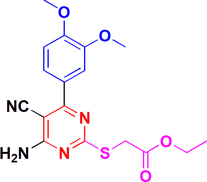
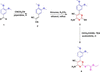
We have recently described various synthetic approaches to the synthesis of purine and pyrimidine analogs (Abu-Zaied et al., 2020; Abu-Zaied et al., 2021). In the majority of biochemical reactions, several derivatives of these ring structures are regarded as crucial antimetabolites (Khedr et al., 2022; Khedr et al., 2023). As a continuation of these studies of the synthesis of biologically active antimetabolic agents (Elgemeie et al., 2019; Elgemeie et al., 2022), the current study reports the synthesis of ethyl 2-{[4-amino-5-cyano-6-(3,4-dimethoxyphenyl)pyrimidin-2-yl]sulfanyl}acetate, 4, by reacting the pyrimidine-2-thiol derivative 3 with ethyl chloroacetate (Fig. 1). The crystal structure was determined to confirm the nature of 4, and is reported here.
|
Figure 1
The synthesis of compound 4. |
2. Structural commentary
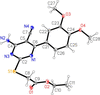
The molecule of compound 4 in the crystal is shown in Fig. 2, with selected molecular dimensions in Table 1. Both rings are essentially planar, with r.m.s. deviations of 0.010 and 0.013 Å for the pyrimidine and phenyl ring, respectively. The only substituent lying significantly out-of-plane is C7 [by 0.221 (2) Å]. The interplanar angle is 30.05 (5)°. The ring angle at C2 is the widest at 129.32 (11)°, associated with a narrow angle N3—C2—S1 of 112.01 (8)° at the planar centre C2. The narrowest ring angles are those at the N atoms [115.58 (10) and 115.98 (10)°]. The bond length S1—C2 is significantly shorter than S1—C8, consistent with the different hybridizations of the C atoms; similar considerations apply to C5—C7 being shorter than C6—C21. The NH2 group is planar, with the N atom lying an insignificant 0.003 (9) Å out of the plane of its substituents. The atom sequence C8—C9—O2—C10—C11 of the side chain displays an extended conformation.
|
||||||||||||||||||||||||||||||||||||||||||||||||||||||||||||||
|
Figure 2
The molecule of compound 4 in the crystal. Displacement ellipsoids represent 50% probability levels. |
3. Supramolecular features
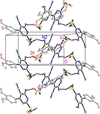
The main intermolecular contacts are the classical hydrogen bonds from the H atoms of the amino group, H021 and H022, to the acceptors N4 and O1 of adjacent molecules, via an inversion centre and the 21 screw axis, respectively (Table 2, which also includes some borderline weak hydrogen bonds). Fig. 3 shows the infinite chains of molecules parallel to the b axis formed by the contact H022⋯O1. It also shows (implicitly) the short contacts between pairs of pyrimidine rings connected by inversion, with a centroid-to-centroid distance of 3.6006 (7) Å and an offset of 1.2 Å (symmetry operator: −x + 2, −y + 1, −z + 1) for the pair involving the reference molecule.
|
 ; (ii)
 ; (iii)
 ; (iv)
 ; (v)
 .
|
Figure 3
Two chains of molecules of compound 4, running vertically, linked by the hydrogen bonds N2⋯H022—O1 (thick dashed lines). The view direction is perpendicular to the bc plane, in the region a ≃ 0.75. Atom names indicate the asymmetric unit. H atoms not involved in these interactions are omitted for clarity. |
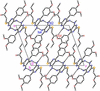
The combination of inversion and 21 symmetry for the two hydrogen bonds means that the overall packing is three-dimensional rather than a ribbon or layer structure. The second packing diagram (Fig. 4) is therefore a projection showing the combination of both hydrogen bonds.
|
Figure 4
A projection of the three-dimensional packing of compound 4 parallel to the b axis, showing linkages via both classical hydrogen bonds (thick dashed lines). Atom names indicate the asymmetric unit. H atoms not involved in these interactions are omitted for clarity. |
4. Database survey
Searches were conducted using the Cambridge Structural Database (CSD, Version 6.01, update November 2025; Groom et al., 2016) and the ConQuest routine (Version 2025.3.1; Bruno et al., 2002), and were restricted to non-disordered `organic' structures.
A general search for pyrimidine systems with no further annelation gave 2950 hits. The angle at C2 was consistently and significantly larger than 120°, with a mean angle of 126.9 (17)° for 3782 values. A search restricted to the substitution pattern of compound 4 (S at C2, N at C4, CN at C5 and C at C6) gave just two hits: 4-[4-(7-chloroquinolin-4-yl)piperazin-1-yl]-2-(methylsulfanyl)-6-phenylpyrimidine-5-carbonitrile (refcode HUKRUC; Kaur et al., 2015) and 2-[(4-chlorobenzyl)sulfanyl]-4-(2-methylpropyl)-6-[3-(trifluoromethyl)anilino]pyrimidine-5-carbonitrile (XAZLUH; El-Emam et al., 2012). However, neither of these can be regarded as closely similar to 4, thus underlining its novel nature.
5. Synthesis and crystallization
A mixture of compound 3 (1 mmol) and ethyl chloroacetate (1.2 mmol) in acetonitrile containing a few drops of triethylamine was stirred at room temperature for 48 h. The precipitate thus formed was filtered off and washed with ethanol to give the desired compound 4, as a buff powder, which was recrystallized from acetonitrile to give pale-yellow crystals (isolated single crystals are effectively colourless) in 65% yield.
M.p. 453–455 K; IR (KBr, ν cm−1): 3470, 3347 (NH2) 2206 (CN), 1736, (C=O); 1H NMR (DMSO-d6, 500 MHz): δ (ppm) 1.11 (t, J = 7.0 Hz, 3H, CH2CH3), 3.84 (s, 3H, OCH3), 3.85 (s, 3H, OCH3), 4.03 (s, 2H, S-CH2), 4.07 (q, J = 7.0 Hz, 2H, CH2CH3), 7.12 (d, J = 8.5 Hz, 1H, Ar-H), 7.54 (d, J = 2.0 Hz, 1H, Ar-H), 7.57 (d, J = 8.5 Hz, 1H, Ar-H), 8.03 (br s, 2H, NH2, D2O-exchangeable); 13C NMR (DMSO-d6, 150 MHz): δ (ppm) 14.4 (CH2CH3), 33.5 (S—CH2), 56.2 (2OCH3), 61.6 (CH2CH3), 82.3, 111.6, 112.4, 117.1, 122.6, 128.2, 148.8, 152.0, 164.1, 166.7, 169.4 (C=O ester), 172.4. Analysis calculated (%) for C17H18N4O4S: C 54.53, H 4.85, N 14.96, S 8.56; found: C 54.54, H 5.13, N 14.85, S 8.74.
6. Refinement
Details of data collection and structure refinement are summarized in Table 3. H atoms of the NH2 group were refined freely. Methyl groups were refined as idealized rigid groups allowed to rotate but not tip, with C—H = 0.98 Å and H—C—H = 109.5°. Other H atoms were refined using a riding model, with aromatic C—H = 0.95 Å and methylene C—H = 0.99 Å. The Uiso(H) values were fixed at 1.5Ueq of the parent C atoms for the methyl groups and 1.2Ueq for the other H atoms. Two badly fitting reflections (Δ/σ > 8) were omitted from the refinement.
|
Supporting information
CCDC reference: 2593312
Crystal structure: contains datablocks I, global. DOI: https://doi.org/10.1107/S2056989026010352/yz2085sup1.cif
Structure factors: contains datablock I. DOI: https://doi.org/10.1107/S2056989026010352/yz2085Isup2.hkl
Supporting information file. DOI: https://doi.org/10.1107/S2056989026010352/yz2085Isup3.cml
| C17H18N4O4S | F(000) = 784 |
| Mr = 374.41 | Dx = 1.451 Mg m−3 |
| Monoclinic, P21/c | Cu Kα radiation, λ = 1.54184 Å |
| a = 13.4276 (5) Å | Cell parameters from 44633 reflections |
| b = 8.2128 (3) Å | θ = 3.5–80.1° |
| c = 16.6201 (7) Å | µ = 1.97 mm−1 |
| β = 110.762 (5)° | T = 100 K |
| V = 1713.80 (13) Å3 | Prism, colourless |
| Z = 4 | 0.14 × 0.05 × 0.03 mm |
| Rigaku XtaLAB Synergy diffractometer | 3747 independent reflections |
| Radiation source: micro-focus sealed X-ray tube, PhotonJet (Cu) X-ray Source | 3512 reflections with I > 2σ(I) |
| Mirror monochromator | Rint = 0.044 |
| Detector resolution: 10.0000 pixels mm-1 | θmax = 81.6°, θmin = 3.5° |
| ω scans | h = −16→17 |
| Absorption correction: multi-scan (CrysAlis PRO; Rigaku OD, 2026) | k = −10→10 |
| Tmin = 0.763, Tmax = 1.000 | l = −21→21 |
| 78100 measured reflections |
| Refinement on F2 | Primary atom site location: dual |
| Least-squares matrix: full | Hydrogen site location: mixed |
| R[F2 > 2σ(F2)] = 0.030 | H atoms treated by a mixture of independent and constrained refinement |
| wR(F2) = 0.079 | w = 1/[σ2(Fo2) + (0.038P)2 + 0.7704P] where P = (Fo2 + 2Fc2)/3 |
| S = 1.09 | (Δ/σ)max = 0.001 |
| 3747 reflections | Δρmax = 0.33 e Å−3 |
| 246 parameters | Δρmin = −0.27 e Å−3 |
| 0 restraints |
| x | y | z | Uiso*/Ueq | ||
| S1 | 0.94829 (2) | 0.20843 (4) | 0.67241 (2) | 0.01892 (9) | |
| N1 | 0.84359 (8) | 0.39055 (12) | 0.53524 (6) | 0.0170 (2) | |
| C2 | 0.92716 (9) | 0.38561 (14) | 0.60876 (7) | 0.0165 (2) | |
| N3 | 1.00361 (7) | 0.49571 (12) | 0.64206 (6) | 0.0171 (2) | |
| C4 | 0.99444 (9) | 0.63454 (14) | 0.59681 (7) | 0.0167 (2) | |
| C5 | 0.90500 (9) | 0.65719 (14) | 0.51876 (7) | 0.0162 (2) | |
| C6 | 0.83380 (9) | 0.52791 (14) | 0.48834 (7) | 0.0160 (2) | |
| C7 | 0.88980 (9) | 0.81410 (14) | 0.47967 (7) | 0.0172 (2) | |
| C8 | 0.82267 (9) | 0.10613 (14) | 0.62413 (8) | 0.0194 (2) | |
| H8A | 0.805412 | 0.098954 | 0.561170 | 0.023* | |
| H8B | 0.828418 | −0.006128 | 0.647040 | 0.023* | |
| C9 | 0.73379 (9) | 0.19453 (14) | 0.64200 (7) | 0.0167 (2) | |
| C10 | 0.55229 (9) | 0.26761 (15) | 0.58683 (8) | 0.0209 (2) | |
| H10A | 0.564619 | 0.386653 | 0.591305 | 0.025* | |
| H10B | 0.542433 | 0.229385 | 0.640011 | 0.025* | |
| C11 | 0.45556 (10) | 0.22845 (19) | 0.50957 (8) | 0.0292 (3) | |
| H11A | 0.467709 | 0.261922 | 0.457205 | 0.044* | |
| H11B | 0.393828 | 0.286890 | 0.513533 | 0.044* | |
| H11C | 0.442029 | 0.110989 | 0.507580 | 0.044* | |
| C21 | 0.74471 (9) | 0.53373 (14) | 0.40457 (7) | 0.0161 (2) | |
| C22 | 0.75448 (9) | 0.62478 (14) | 0.33607 (7) | 0.0159 (2) | |
| H22 | 0.819795 | 0.677987 | 0.342878 | 0.019* | |
| C23 | 0.67021 (9) | 0.63755 (14) | 0.25914 (7) | 0.0160 (2) | |
| C24 | 0.57304 (9) | 0.55837 (13) | 0.24843 (7) | 0.0156 (2) | |
| C25 | 0.56457 (9) | 0.46370 (14) | 0.31507 (7) | 0.0177 (2) | |
| H25 | 0.500013 | 0.407833 | 0.307827 | 0.021* | |
| C26 | 0.65032 (9) | 0.45039 (14) | 0.39242 (7) | 0.0179 (2) | |
| H26 | 0.644264 | 0.383860 | 0.437216 | 0.021* | |
| C27 | 0.76480 (10) | 0.82281 (16) | 0.20173 (8) | 0.0217 (2) | |
| H27A | 0.755218 | 0.884562 | 0.149059 | 0.033* | |
| H27B | 0.827392 | 0.752223 | 0.214699 | 0.033* | |
| H27C | 0.775101 | 0.898458 | 0.249615 | 0.033* | |
| C28 | 0.38928 (9) | 0.52854 (16) | 0.16163 (8) | 0.0225 (2) | |
| H28A | 0.338779 | 0.564480 | 0.105858 | 0.034* | |
| H28B | 0.368932 | 0.574936 | 0.207907 | 0.034* | |
| H28C | 0.388298 | 0.409430 | 0.164783 | 0.034* | |
| O1 | 0.74353 (7) | 0.26372 (12) | 0.70858 (5) | 0.02394 (19) | |
| O2 | 0.64265 (6) | 0.18454 (11) | 0.57556 (5) | 0.02001 (18) | |
| O3 | 0.67237 (6) | 0.72523 (11) | 0.18981 (5) | 0.02081 (19) | |
| O4 | 0.49428 (6) | 0.58233 (10) | 0.17089 (5) | 0.01874 (18) | |
| N2 | 1.06917 (8) | 0.74770 (14) | 0.62655 (7) | 0.0207 (2) | |
| H021 | 1.0695 (14) | 0.837 (2) | 0.5990 (11) | 0.033 (4)* | |
| H022 | 1.1204 (14) | 0.733 (2) | 0.6765 (12) | 0.030 (4)* | |
| N4 | 0.87969 (8) | 0.94458 (13) | 0.45245 (6) | 0.0220 (2) |
| U11 | U22 | U33 | U12 | U13 | U23 | |
| S1 | 0.01518 (14) | 0.02360 (15) | 0.01707 (14) | 0.00250 (10) | 0.00460 (11) | 0.00545 (10) |
| N1 | 0.0160 (4) | 0.0198 (5) | 0.0144 (4) | 0.0012 (4) | 0.0043 (4) | 0.0008 (4) |
| C2 | 0.0156 (5) | 0.0214 (6) | 0.0139 (5) | 0.0034 (4) | 0.0068 (4) | 0.0004 (4) |
| N3 | 0.0150 (4) | 0.0231 (5) | 0.0133 (4) | 0.0014 (4) | 0.0052 (3) | 0.0012 (4) |
| C4 | 0.0159 (5) | 0.0226 (6) | 0.0124 (5) | 0.0005 (4) | 0.0062 (4) | −0.0016 (4) |
| C5 | 0.0152 (5) | 0.0202 (5) | 0.0130 (5) | 0.0020 (4) | 0.0049 (4) | 0.0000 (4) |
| C6 | 0.0150 (5) | 0.0191 (5) | 0.0139 (5) | 0.0030 (4) | 0.0052 (4) | −0.0009 (4) |
| C7 | 0.0138 (5) | 0.0232 (6) | 0.0133 (5) | −0.0011 (4) | 0.0032 (4) | −0.0037 (4) |
| C8 | 0.0190 (5) | 0.0182 (5) | 0.0208 (5) | 0.0002 (4) | 0.0069 (4) | 0.0003 (4) |
| C9 | 0.0165 (5) | 0.0165 (5) | 0.0162 (5) | −0.0019 (4) | 0.0046 (4) | 0.0021 (4) |
| C10 | 0.0173 (6) | 0.0254 (6) | 0.0194 (5) | 0.0023 (5) | 0.0058 (5) | −0.0026 (5) |
| C11 | 0.0200 (6) | 0.0403 (8) | 0.0224 (6) | 0.0054 (5) | 0.0014 (5) | −0.0069 (5) |
| C21 | 0.0159 (5) | 0.0162 (5) | 0.0147 (5) | 0.0024 (4) | 0.0036 (4) | −0.0011 (4) |
| C22 | 0.0137 (5) | 0.0175 (5) | 0.0156 (5) | 0.0004 (4) | 0.0040 (4) | −0.0017 (4) |
| C23 | 0.0164 (5) | 0.0172 (5) | 0.0141 (5) | 0.0010 (4) | 0.0049 (4) | −0.0007 (4) |
| C24 | 0.0142 (5) | 0.0157 (5) | 0.0145 (5) | 0.0012 (4) | 0.0020 (4) | −0.0020 (4) |
| C25 | 0.0165 (5) | 0.0165 (5) | 0.0193 (5) | −0.0018 (4) | 0.0052 (4) | −0.0013 (4) |
| C26 | 0.0199 (5) | 0.0173 (5) | 0.0157 (5) | 0.0000 (4) | 0.0052 (4) | 0.0005 (4) |
| C27 | 0.0175 (5) | 0.0256 (6) | 0.0211 (6) | −0.0054 (5) | 0.0056 (4) | 0.0014 (5) |
| C28 | 0.0131 (5) | 0.0272 (6) | 0.0232 (6) | −0.0034 (5) | 0.0015 (4) | 0.0016 (5) |
| O1 | 0.0190 (4) | 0.0330 (5) | 0.0179 (4) | 0.0016 (4) | 0.0042 (3) | −0.0049 (4) |
| O2 | 0.0161 (4) | 0.0250 (4) | 0.0172 (4) | 0.0013 (3) | 0.0038 (3) | −0.0031 (3) |
| O3 | 0.0166 (4) | 0.0282 (5) | 0.0146 (4) | −0.0054 (3) | 0.0019 (3) | 0.0041 (3) |
| O4 | 0.0131 (4) | 0.0228 (4) | 0.0162 (4) | −0.0025 (3) | 0.0002 (3) | 0.0016 (3) |
| N2 | 0.0183 (5) | 0.0260 (5) | 0.0139 (5) | −0.0042 (4) | 0.0011 (4) | 0.0019 (4) |
| N4 | 0.0216 (5) | 0.0219 (5) | 0.0198 (5) | −0.0010 (4) | 0.0040 (4) | 0.0001 (4) |
| S1—C2 | 1.7619 (12) | C11—H11C | 0.9800 |
| S1—C8 | 1.7987 (12) | C21—C26 | 1.3908 (16) |
| N1—C2 | 1.3348 (14) | C21—C22 | 1.4066 (16) |
| N1—C6 | 1.3508 (15) | C22—C23 | 1.3786 (15) |
| C2—N3 | 1.3323 (15) | C22—H22 | 0.9500 |
| N3—C4 | 1.3473 (15) | C23—O3 | 1.3677 (13) |
| C4—N2 | 1.3279 (16) | C23—C24 | 1.4115 (16) |
| C4—C5 | 1.4335 (15) | C24—O4 | 1.3609 (13) |
| C5—C6 | 1.3980 (16) | C24—C25 | 1.3905 (16) |
| C5—C7 | 1.4250 (16) | C25—C26 | 1.3930 (16) |
| C6—C21 | 1.4801 (15) | C25—H25 | 0.9500 |
| C7—N4 | 1.1522 (16) | C26—H26 | 0.9500 |
| C8—C9 | 1.5136 (16) | C27—O3 | 1.4309 (14) |
| C8—H8A | 0.9900 | C27—H27A | 0.9800 |
| C8—H8B | 0.9900 | C27—H27B | 0.9800 |
| C9—O1 | 1.2091 (15) | C27—H27C | 0.9800 |
| C9—O2 | 1.3288 (14) | C28—O4 | 1.4328 (14) |
| C10—O2 | 1.4608 (14) | C28—H28A | 0.9800 |
| C10—C11 | 1.5023 (17) | C28—H28B | 0.9800 |
| C10—H10A | 0.9900 | C28—H28C | 0.9800 |
| C10—H10B | 0.9900 | N2—H021 | 0.862 (19) |
| C11—H11A | 0.9800 | N2—H022 | 0.879 (19) |
| C11—H11B | 0.9800 | ||
| C2—S1—C8 | 101.07 (6) | C26—C21—C22 | 119.06 (10) |
| C2—N1—C6 | 115.58 (10) | C26—C21—C6 | 120.78 (10) |
| N3—C2—N1 | 129.32 (11) | C22—C21—C6 | 120.16 (10) |
| N3—C2—S1 | 112.01 (8) | C23—C22—C21 | 120.65 (10) |
| N1—C2—S1 | 118.62 (9) | C23—C22—H22 | 119.7 |
| C2—N3—C4 | 115.98 (10) | C21—C22—H22 | 119.7 |
| N2—C4—N3 | 118.49 (10) | O3—C23—C22 | 124.46 (10) |
| N2—C4—C5 | 121.75 (11) | O3—C23—C24 | 115.54 (10) |
| N3—C4—C5 | 119.76 (10) | C22—C23—C24 | 120.00 (10) |
| C6—C5—C7 | 123.56 (10) | O4—C24—C25 | 125.43 (10) |
| C6—C5—C4 | 118.35 (10) | O4—C24—C23 | 115.22 (10) |
| C7—C5—C4 | 117.94 (10) | C25—C24—C23 | 119.35 (10) |
| N1—C6—C5 | 120.76 (10) | C24—C25—C26 | 120.31 (10) |
| N1—C6—C21 | 116.78 (10) | C24—C25—H25 | 119.8 |
| C5—C6—C21 | 122.46 (10) | C26—C25—H25 | 119.8 |
| N4—C7—C5 | 176.29 (12) | C21—C26—C25 | 120.53 (10) |
| C9—C8—S1 | 111.62 (8) | C21—C26—H26 | 119.7 |
| C9—C8—H8A | 109.3 | C25—C26—H26 | 119.7 |
| S1—C8—H8A | 109.3 | O3—C27—H27A | 109.5 |
| C9—C8—H8B | 109.3 | O3—C27—H27B | 109.5 |
| S1—C8—H8B | 109.3 | H27A—C27—H27B | 109.5 |
| H8A—C8—H8B | 108.0 | O3—C27—H27C | 109.5 |
| O1—C9—O2 | 123.95 (11) | H27A—C27—H27C | 109.5 |
| O1—C9—C8 | 124.61 (10) | H27B—C27—H27C | 109.5 |
| O2—C9—C8 | 111.43 (10) | O4—C28—H28A | 109.5 |
| O2—C10—C11 | 107.23 (10) | O4—C28—H28B | 109.5 |
| O2—C10—H10A | 110.3 | H28A—C28—H28B | 109.5 |
| C11—C10—H10A | 110.3 | O4—C28—H28C | 109.5 |
| O2—C10—H10B | 110.3 | H28A—C28—H28C | 109.5 |
| C11—C10—H10B | 110.3 | H28B—C28—H28C | 109.5 |
| H10A—C10—H10B | 108.5 | C9—O2—C10 | 115.26 (9) |
| C10—C11—H11A | 109.5 | C23—O3—C27 | 117.04 (9) |
| C10—C11—H11B | 109.5 | C24—O4—C28 | 117.51 (9) |
| H11A—C11—H11B | 109.5 | C4—N2—H021 | 122.7 (12) |
| C10—C11—H11C | 109.5 | C4—N2—H022 | 119.3 (11) |
| H11A—C11—H11C | 109.5 | H021—N2—H022 | 118.1 (16) |
| H11B—C11—H11C | 109.5 | ||
| C6—N1—C2—N3 | −1.24 (17) | N1—C6—C21—C22 | −149.74 (10) |
| C6—N1—C2—S1 | −178.13 (8) | C5—C6—C21—C22 | 30.48 (16) |
| C8—S1—C2—N3 | 168.96 (8) | C26—C21—C22—C23 | 2.90 (17) |
| C8—S1—C2—N1 | −13.64 (10) | C6—C21—C22—C23 | −176.82 (10) |
| N1—C2—N3—C4 | 2.13 (17) | C21—C22—C23—O3 | 179.04 (10) |
| S1—C2—N3—C4 | 179.18 (8) | C21—C22—C23—C24 | −0.22 (16) |
| C2—N3—C4—N2 | −179.21 (10) | O3—C23—C24—O4 | −0.95 (14) |
| C2—N3—C4—C5 | 1.14 (15) | C22—C23—C24—O4 | 178.37 (10) |
| N2—C4—C5—C6 | 175.43 (11) | O3—C23—C24—C25 | 178.65 (10) |
| N3—C4—C5—C6 | −4.93 (15) | C22—C23—C24—C25 | −2.03 (16) |
| N2—C4—C5—C7 | −8.73 (16) | O4—C24—C25—C26 | −178.87 (10) |
| N3—C4—C5—C7 | 170.91 (10) | C23—C24—C25—C26 | 1.57 (17) |
| C2—N1—C6—C5 | −2.96 (15) | C22—C21—C26—C25 | −3.37 (17) |
| C2—N1—C6—C21 | 177.25 (9) | C6—C21—C26—C25 | 176.35 (10) |
| C7—C5—C6—N1 | −169.69 (10) | C24—C25—C26—C21 | 1.15 (17) |
| C4—C5—C6—N1 | 5.90 (16) | O1—C9—O2—C10 | 1.39 (16) |
| C7—C5—C6—C21 | 10.08 (17) | C8—C9—O2—C10 | −179.59 (9) |
| C4—C5—C6—C21 | −174.33 (10) | C11—C10—O2—C9 | −174.39 (10) |
| C2—S1—C8—C9 | −69.51 (9) | C22—C23—O3—C27 | −6.61 (16) |
| S1—C8—C9—O1 | −36.23 (15) | C24—C23—O3—C27 | 172.68 (10) |
| S1—C8—C9—O2 | 144.75 (8) | C25—C24—O4—C28 | 10.82 (16) |
| N1—C6—C21—C26 | 30.55 (15) | C23—C24—O4—C28 | −169.61 (10) |
| C5—C6—C21—C26 | −149.23 (11) |
| D—H···A | D—H | H···A | D···A | D—H···A |
| N2—H021···N4i | 0.862 (19) | 2.201 (19) | 3.0368 (15) | 163.4 (16) |
| N2—H022···O1ii | 0.879 (19) | 2.139 (19) | 2.9942 (13) | 164.0 (16) |
| N2—H022···S1ii | 0.879 (19) | 2.973 (17) | 3.4465 (11) | 115.7 (13) |
| C8—H8A···N4iii | 0.99 | 2.67 | 3.4693 (16) | 138 |
| C11—H11A···O3iv | 0.98 | 2.52 | 3.1459 (15) | 122 |
| C27—H27B···S1v | 0.98 | 2.95 | 3.6836 (12) | 133 |
| Symmetry codes: (i) −x+2, −y+2, −z+1; (ii) −x+2, y+1/2, −z+3/2; (iii) x, y−1, z; (iv) −x+1, y−1/2, −z+1/2; (v) −x+2, −y+1, −z+1. |
Acknowledgements
The authors acknowledge support by the Open Access Publication Funds of the Technical University of Braunschweig.
References
 Abu-Zaied, M. A., Elgemeie, G. H. & Mahmoud, N. M. (2021). ACS Omega 6, 16890–16904.
CAS
Google Scholar
Abu-Zaied, M. A., Mahmoud, N. M. & Elgemeie, G. H. (2020). ACS Omega 5, 20042–20050.
CAS
Google Scholar
Bruker (1998). XP. Bruker AXS Inc., Madison, Wisconsin, USA.
Google Scholar
Bruno, I. J., Cole, J. C., Edgington, P. R., Kessler, M., Macrae, C. F., McCabe, P., Pearson, J. & Taylor, R. (2002). Acta Cryst. B58, 389–397.
Web of Science
CrossRef
CAS
IUCr Journals
Google Scholar
El-Emam, A. A., Al-Deeb, O. A., El-Brollosy, N. R., Ng, S. W. & Tiekink, E. R. T. (2012). Acta Cryst. E68, o2059–o2060.
CrossRef
IUCr Journals
Google Scholar
Elgemeie, G. H., Azzam, R. A. & Elsayed, R. E. (2019). Med. Chem. Res. 28, 1099–1131.
Web of Science
CrossRef
CAS
Google Scholar
Elgemeie, G. H., Azzam, R. A., Zaghary, W. A., Khedr, M. A. & Elsherif, G. E. (2022). Curr. Pharm. Des. 28, 3374–3403.
Web of Science
CrossRef
CAS
PubMed
Google Scholar
El–serwy, W. S., Mohamed, H. S., El–serwy, W. S., Mohamed, N. A., Kassem, E. M. M., Nossier, E. S. & Shalaby, A. S. G. (2019). J. Heterocycl. Chem. 56, 2027–2035.
CAS
Google Scholar
Groom, C. R., Bruno, I. J., Lightfoot, M. P. & Ward, S. C. (2016). Acta Cryst. B72, 171–179.
Web of Science
CrossRef
IUCr Journals
Google Scholar
Kaur, H., Balzarini, J., de Kock, C., Smith, P. J., Chibale, K. & Singh, K. (2015). Eur. J. Med. Chem. 101, 52–62.
CrossRef
CAS
Google Scholar
Khedr, M. A., Zaghary, W. A., Elsherif, G. E., Azzam, R. A. & Elgemeie, G. H. (2022). Nucleosides Nucleotides Nucleic Acids 41, 643–670.
CrossRef
CAS
Google Scholar
Khedr, M. A., Zaghary, W. A., Elsherif, G. E., Azzam, R. A. & Elgemeie, G. H. (2023). Nucleosides Nucleotides Nucleic Acids 42, 77–104.
CrossRef
CAS
Google Scholar
Lamie, P. F. & Philoppes, J. N. (2020). J. Enzyme Inhib. Med. Chem. 35, 864–879.
CrossRef
CAS
Google Scholar
Luo, M., Jiang, S., Ma, Y. & Zhao, P. (2026). Future Med. Chem. 18, 1783–1796.
CrossRef
CAS
Google Scholar
Rabeh, R. M., Kassab, A. E., Hassan, R. A. & Shahin, I. G. (2026). RSC Adv. 16, 16976–16992.
CrossRef
CAS
Google Scholar
Rigaku OD (2026). CrysAlis PRO. Rigaku Oxford Diffraction Ltd, Yarnton, Oxfordshire, England.
Google Scholar
Sahu, M., Kumar, S., Aharwal, R. P. & Sandhu, S. S. (2016). Int. J. Pharm. Pharm. Sci. 8, 38.
CrossRef
Google Scholar
Sheldrick, G. M. (2015a). Acta Cryst. A71, 3–8.
Web of Science
CrossRef
IUCr Journals
Google Scholar
Sheldrick, G. M. (2015b). Acta Cryst. C71, 3–8.
Web of Science
CrossRef
IUCr Journals
Google Scholar
Sondhi, S. M., Goyal, R. N., Lahoti, A. M., Singh, N., Shukla, R. & Raghubir, R. (2005). Bioorg. Med. Chem. 13, 3185–3195.
CrossRef
CAS
Google Scholar
Stolarczyk, M., Bryndal, I., Matera-Witkiewicz, A., Lis, T., Królewska-Golińska, K., Cieślak, M., Kaźmierczak-Barańska, J. & Cieplik, J. (2018). Acta Cryst. C74, 1138–1145.
Web of Science
CSD
CrossRef
IUCr Journals
Google Scholar
Westrip, S. P. (2010). J. Appl. Cryst. 43, 920–925.
Web of Science
CrossRef
CAS
IUCr Journals
Google Scholar
This is an open-access article distributed under the terms of the Creative Commons Attribution (CC-BY) Licence, which permits unrestricted use, distribution, and reproduction in any medium, provided the original authors and source are cited.
| CRYSTALLOGRAPHIC COMMUNICATIONS |
access