
Acta Crystallographica
Section E CRYSTALLOGRAPHIC COMMUNICATIONS


 menu


research communications
| CRYSTALLOGRAPHIC COMMUNICATIONS |
 access
Nitrate salt of a hydrocarbazole oxime cation and a hydrated co-crystal of its chloride salt with cyclohexane-1,2,3-trione 1,3-dioxime

aCollege of Science and Technology, Nihon University, 1-8-14, Kanda Surugadai, Chiyoda, Tokyo 101-8308, Japan
*Correspondence e-mail: [email protected]
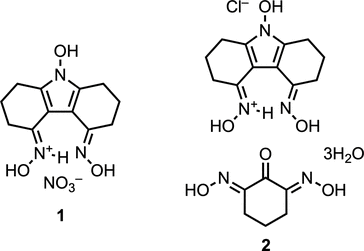
In the presence of nickel(II) salts, cyclohexane-1,3-dione dioxime is transformed into a hydrocarbazole oxime cation, isolated as a nitrate salt, N,9-dihydroxy-5-(hydroxyimino)-2,3,4,5,6,7,8,9-octahydro-1H-carbazol-4-iminium nitrate (1, C12H16N3O3+·NO3−), and as a hydrated chloride co-crystal with cyclohexane-1,2,3-trione 1,3-dioxime, N,9-dihydroxy-5-(hydroxyimino)-2,3,4,5,6,7,8,9-octahydro-1H-carbazol-4-iminium chloride–cyclohexane-1,2,3-trione 1,3-dioxime–water (1/1/3) (2, C12H16N3O3+·Cl−·C6H8N2O3·3H2O). In 1, the cation and nitrate anion occupy mirror sites. The symmetry-related ring methylene C atoms in the cation are disordered over two positions [occupancies 0.896 (12) and 0.104 (12)]. The asymmetric unit of 2 contains one cation, one trionedioxime molecule, one chloride anion and three water molecules; one water oxygen is disordered over two sites [occupancies 0.935 (7) and 0.065 (7)]. Both cations have an intramolecular N—H⋯N contact, with the proton distributed over mirror-related sites in 1 but assigned to a single nitrogen site in 2. The hydroxy group attached to the nitrogen at the 9-position of the hydrocarbazole moiety in 1 forms a hydrogen bond to the nitrate anion, whereas chloride, trionedioxime and water molecules participate in the hydrogen-bonding network of 2.
Keywords: crystal structure; dione dioxime; hydrocarbazole; trione dioxime; hydrogen bonding.
1. Chemical context
The central carbon of 1,3-dione dioximes is reactive toward chemical transformation. Previously, we have found that, in the presence of Cu(NO3)2, acetylacetone dioxime is transformed into trioxime that coordinates to copper to form a pentanuclear complex under ambient conditions in water (Otsuki et al., 2017 ). More recently, in the presence of Cu(NO3)2 in methanol, we found that cyclohexane-1,3-dione dioxime transformed into cyclohexane-1,2,3-trione 1,3-dioxime and its acetal or hemiacetal derivative with methanol, whereas cyclopentane-1,3-dione dioxime transformed into [1,1′-bicyclopentylidene]-2,2′,5,5′-tetrone tetraoxime (Hosoya et al., 2021, 2024). These transformed compounds served as ligands to form multinuclear copper complexes. Against this background, we herein investigated the crystal structures of products from cyclohexane-1,3-dione dioxime in the presence of Ni(NO3)2 and NiCl2 in methanol at room temperature.
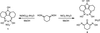
Reactions of cyclohexane-1,3-dione dioxime in methanol in the presence of these nickel(II) salts afforded crystals containing the metal-free salts of the same unexpected hydrocarbazole-derived cation. Compound 1 is the nitrate salt, whereas compound 2 is a hydrated co-crystal of the chloride salt with neutral cyclohexane-1,2,3-trione 1,3-dioxime. This outcome prompted an examination of their hydrogen-bonding arrangements in relation to those reported for oximes, oxime salts and multicomponent crystals (Bruton et al., 2003; Aakeröy et al., 2013; Tarai & Baruah, 2016a,b). We compare the crystallographic symmetry and proton arrangement of the cation, and its association with the different counter-ions and hydrogen-bonding partners. The crystal structures establish the compositions of the isolated solids but do not establish the reaction mechanism or the composition of the complete reaction mixtures. The reactions leading to compounds 1 and 2 are shown in Fig. 1.
|
Figure 1
Formation of compounds 1 and 2 from cyclohexane-1,3-dione dioxime under the conditions shown. |
2. Structural commentary
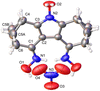
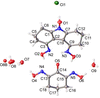
Both compounds contain an N-hydroxy hydrocarbazole framework bearing two oxime groups. Compound 1 crystallizes in the orthorhombic space group Cmce, with half of the cation and half of the nitrate anion in the asymmetric unit. The complete ions are generated by mirror symmetry. A methylene carbon C5 in the saturated ring is split between two sites with occupancies 0.896 (12) and 0.104 (12). The molecular structure of 1 is shown in Fig. 2. Compound 2 crystallizes in the monoclinic space group P21/n. Its asymmetric unit comprises one hydrocarbazole cation, one neutral trionedioxime molecule, one chloride anion and three water molecules, all on general positions. One water oxygen O8 occupies alternative sites with occupancies 0.935 (7) and 0.065 (7). The molecular structure of 2 is shown in Fig. 3.
|
Figure 2
View of compound 1, drawn with 50% probability displacement ellipsoids. All independent non-hydrogen atoms are labelled. Both components of the disordered C5 site are shown. The two mirror-related N-bound H-atom positions represent alternative half-occupied proton sites. The H atom attached to O2 likewise occupies two alternative half-occupied sites. |
|
Figure 3
View of compound 2, drawn with 50% probability displacement ellipsoids. Both alternative O8 and O8B water sites are displayed. |
An intramolecular contact in 1 is N1—H1⋯N1i (Table 1), with N1⋯N1i = 2.635 (5) Å [symmetry code (i): 1 − x, y, z]. The N-bound proton is modelled at two half-occupied mirror-related sites. In 2, the contact is N3—-H3A⋯N2, with N3⋯N2 = 2.706 (3) Å (Table 2). The model describes a symmetry-related proton distribution in 1 and inequivalent oxime nitrogen sites in 2. The oxime C=N bond length in 1 is 1.283 (4) Å, comparable to the two corresponding distances of 1.284 (4) and 1.291 (3) Å in 2. In contrast, the symmetry-equivalent oxime N—O bonds in 1 [1.388 (3) Å] become inequivalent in 2, with N2—O2 and N3—O3 distances of 1.398 (3) and 1.370 (3) Å, respectively. This asymmetry accompanies the assignment of the proton to N3 in 2.
|
 ; (ii)
 ; (iii)
 ; (iv)
 ; (v)
 .
|
 ; (ii)
 ; (iii)
 ; (iv)
 ; (v)
 ; (vi)
 ; (vii)
 ; (viii)
 .
The partially saturated six-membered rings of the hydrocarbazole cations adopt slightly distorted envelope conformations. For the major disorder component in 1, C5A and its mirror-related counterpart are the flap atoms, with a C3—C4—C5A—C6 torsion angle of −45.2 (6)°. In 2, the flap atoms are C5 and C11, with C3—C4—C5—C6 and C9—C10—C11—C12 torsion angles of 54.5 (3) and 52.4 (3)°, respectively. The six-membered ring of the neutral trionedioxime molecule in 2 also adopts a distorted envelope conformation, with C17 as the flap atom and a C1—C16—C17—C18 torsion angle of −52.6 (3)°.
3. Supramolecular features
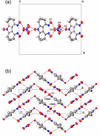
In 1, O1—H1A⋯O3(x, −y, 1 − z) and O2—H2⋯O4(1 − x, y +  ,
 − z) hydrogen bonds link the cations and nitrate anions into zigzag chains parallel to [001], as illustrated in Fig. 4. The O⋯O distances are 2.763 (4) and 2.910 (5) Å, with angles of 139 and 168°, respectively. H2 occupies two alternative mirror-related orientations. The minor disorder component forms a weak C5B—H5BB⋯O1(x, 1 − y, 1 − z) contact [C⋯O = 3.38 (5) Å, angle 140°] with its symmetry-related counterpart forming a dimer motif. These contacts link the [001] chains into a two-dimensional network parallel to the (100) plane. Because C5B and H5BB have an occupancy of only 0.104 (12), this is a disorder-dependent extension of the chain motif.
|
Figure 4
Crystal packing of compound 1. Dotted lines indicate hydrogen-bond contacts. Intramolecular N—H⋯N hydrogen bonds across the mirror plane involving disordered H atoms are omitted. (a) View from the b axis. (b) View from the a axis. The C5B—H5BB⋯O1 contacts depict minor-disorder component contacts. |
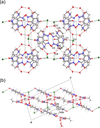
The hydrogen-bonds in 2 are shown in Fig. 5. The cation and neutral trionedioxime molecule form hydrogen-bonded pairs through an O3—H3⋯N5 contact [O⋯N = 2.763 (3) Å, 146°]. The neutral molecule and water molecules are linked by O4—H4⋯O7 and O6—H6⋯O9 contacts [O⋯O = 2.646 (3) and 2.614 (3) Å], respectively. A water molecule is disordered over two alternative sites, O8 and O8B. O7—H7B forms an O–H⋯O contact to either site.
|
Figure 5
Crystal packing of compound 2. Dotted lines indicate hydrogen-bond contacts. (a) A hydrogen-bonded sheet parallel to (  01), viewed perpendicular to this plane. O8/O8B and their attached H atoms are omitted. (b) View along the b axis showing O7—H7B⋯O8 and O8—H8A⋯Cl1 and O8—H8B⋯Cl1 hydrogen bonds and the intersheet C5—H5A⋯O3 contact (black dotted line; acceptor symmetry code: 2 − x, 1 − y, 1 − z). Only part of the neighbouring sheet is shown to illustrate the latter contact. |
The cations, neutral trionedioxime molecules, chloride ions and water molecules O7 and O9 form hydrogen-bonded sheets parallel to (01), as shown in Fig. 5(a). These hydrogen-bonded sheets are distinct from the apparent molecular packing layers parallel to (02); the (01) assignment reflects the connectivity of the hydrogen-bond network. The chloride ion accepts an O1—H1⋯Cl1 hydrogen bond [O⋯Cl = 2.983 (2) Å, 168°]. Water molecules O7, O8 and O9 also donate O—H⋯Cl contacts: O7—H7A⋯Cl1 [O⋯Cl = 3.208 (3) Å, 168 (4)°], O8—H8A⋯Cl1 [3.271 (3) Å, 160 (5)°], O8—H8B⋯Cl1 [3.320 (3) Å, 135 (5)°], and O9—H9B⋯Cl1 [3.205 (3) Å, 166 (4)°]. The weak C4—H4B⋯O6(1 − x, 1 − y, 1 − z) contact [C⋯O = 3.466 (3) Å, angle 152°] lies within these sheets. Water molecules at the major O8 site connect neighbouring sheets through O7—H7B⋯O8, O8—H8A⋯Cl1 and O8—H8B⋯Cl1 hydrogen bonds, producing a three-dimensional network. The C5—H5A⋯O3(2 − x, 1 − y, 1 − z) contact [C⋯O = 3.407 (3) Å, angle 152°] provides an additional intersheet link, illustrated in Fig. 5(b).
The present structures illustrate how additional hydrogen-bonding partners modify the assembly of oxime-containing molecules. Whereas intermolecular oxime–oxime O—H⋯N dimers are common in neutral dioximes (Bruton et al., 2003), the hydrocarbazole cations in 1 and 2 contain an intramolecular N—H⋯N contact and participate in extended networks involving counter-ions and, in 2, neutral trionedioxime and water. Tarai & Baruah (2016a) reported the nitrate and hydrated chloride salts of quinoline-4-carbaldoxime. Their nitrate structure contains anion-bridged cyclic motifs, whereas the chloride structure contains hydrogen-bonded chloride–water chains. Similarly, nitrate links the cations in 1, while chloride and water participate in the assembly of 2. Tarai & Baruah (2016b) reported anion-assisted assemblies of 1,3-benzenedialdoxime with tetrabutylammonium fluoride and chloride, with water participating in the chloride-containing structure. Compound 2 likewise incorporates chloride, water and a neutral dioxime into its hydrogen-bonding network, but additionally contains a hydrocarbazole oxime cation.
4. Synthesis and crystallization
Compound 1. A solution of cyclohexane-1,3-dione dioxime (285 mg, 2.00 mmol) in methanol (11.5 mL) was added to a solution of Ni(NO3)2·6H2O (394 mg, 1.35 mmol) in methanol (1 mL). Slow solvent evaporation at room temperature afforded precipitates after 31 days. After the precipitates were removed by filtration, methanol (approximately 10 mL) was added to the concentrated filtrate and diethyl ether vapour was allowed to diffuse into the solution. After 3 days, black precipitate formed, which was again removed and methanol (approximately 3 mL) was added to concentrated filtrate and the solvent was allowed to evaporate slowly at room temperature. After another 16 days, brown crystals were obtained.
Compound 2. A solution of cyclohexane-1,3-dione dioxime (285 mg, 2.00 mmol) in methanol (11.5 mL) was added to a solution of NiCl2·6H2O (239 mg, 1.00 mmol) in methanol (1.0 mL). Slow solvent evaporation at room temperature afforded yellow column-shaped crystals together with a black powder after 23 days. Selected crystals were used for single-crystal X-ray diffraction.
5. Refinement
Crystal data, data collection and structure refinement details are summarized in Table 3.
|
Refinement of compound 1. The structure was refined by full-matrix least squares on F2 using SHELXL2018/3. Non-H atoms were refined anisotropically, except for the minor disorder component C5B, which was refined isotropically. Atom C5 was modelled over two sites with occupancies of 0.896 (12) and 0.104 (12), constrained to sum to unity. Corresponding C4—C5A/C4—C5B and C6—C5A/C6—C5B distances were restrained to be similar using two SADI restraints with standard uncertainties of 0.02 Å. Hydrogen atoms on C4, C5 and C6 were assigned to the corresponding disorder components.
All H atoms were treated using constrained models. Methylene C—H distances were set to 0.97 Å, N—H to 0.86 Å and O—H to 0.82 Å. Hydrogen displacement parameters were tied to those of the parent atoms, with Uiso(H) = 1.2Ueq(C,N) or 1.5Ueq(O). The N-bound H1 was modelled with occupancy 0.5 at each of two mirror-related sites, giving one proton per cation. The hydroxy H atom H2 was modelled over two mirror-related orientations with equal occupancies.
Reflection 002 was omitted from the refinement. Inspection of its predicted positions showed proximity to the beam-stop support shadow, and no clear peak was observed on the inspected frames.
Refinement of compound 2. The structure was refined by full-matrix least squares on F2 using SHELXL2018/3. Non-H atoms were refined anisotropically, except for the minor water site O8B, which was refined isotropically. O8 and O8B were assigned complementary occupancies, which refined to 0.935 (7) and 0.065 (7). The H atoms attached to O8 shared its occupancy. The minor water site O8B has occupancy 0.065 (7); its hydrogen atoms were not included because their positions could not be established reliably. The reported formula, formula mass and F(000) assume two hydrogens for this minor water component, so the atom-site sum is lower by 0.13 H.
Methylene H atoms were treated using riding models, and H atoms on O1, O2, O3 and O6 were treated as rotating hydroxyl groups. The O4–H4 distance was restrained to 0.84 (2) Å. Water O—H distances were restrained to 0.85 (2) Å, and intramolecular H⋯H distances to 1.35 (4) Å for O7 and O8 and 1.35 (2) Å for O9. Water-H atom displacement parameters were fixed at 1.5Ueq(O). The N-bound H3A atom was refined with independent coordinates and an isotropic displacement parameter.
The measurements were made at room temperature for 1 and 100.15 K for 2, due to instrumental availability. Consequently, differences in displacement parameters or disorder should not be attributed solely to the counter-ion or co-crystal composition.
Supporting information
Crystal structure: contains datablocks 1, 2, publication. DOI: https://doi.org/10.1107/S2056989026011345/jp2038sup1.cif
Structure factors: contains datablock 1. DOI: https://doi.org/10.1107/S2056989026011345/jp20381sup4.hkl
Supporting information file. DOI: https://doi.org/10.1107/S2056989026011345/jp20381sup4.cml
Structure factors: contains datablock 2. DOI: https://doi.org/10.1107/S2056989026011345/jp20382sup5.hkl
Supporting information file. DOI: https://doi.org/10.1107/S2056989026011345/jp20382sup5.cml
| C12H16N3O3+·NO3− | Dx = 1.503 Mg m−3 |
| Mr = 312.29 | Mo Kα radiation, λ = 0.71073 Å |
| Orthorhombic, Cmce | Cell parameters from 3029 reflections |
| a = 16.7097 (10) Å | θ = 2.4–23.3° |
| b = 8.0402 (6) Å | µ = 0.12 mm−1 |
| c = 20.5509 (11) Å | T = 298 K |
| V = 2761.0 (3) Å3 | Block, clear dark brown |
| Z = 8 | 0.25 × 0.2 × 0.1 mm |
| F(000) = 1312 |
| XtaLAB Mini II diffractometer | 2153 independent reflections |
| Radiation source: fine-focus sealed X-ray tube, Rigaku (Mo) X-ray Source | 1253 reflections with I > 2σ(I) |
| Graphite monochromator | Rint = 0.089 |
| Detector resolution: 10.0000 pixels mm-1 | θmax = 30.7°, θmin = 2.4° |
| ω scans | h = −23→23 |
| Absorption correction: multi-scan (CrysAlisPro; Rigaku OD) | k = −11→11 |
| Tmin = 0.658, Tmax = 1.000 | l = −29→29 |
| 13480 measured reflections |
| Refinement on F2 | Primary atom site location: dual |
| Least-squares matrix: full | Hydrogen site location: inferred from neighbouring sites |
| R[F2 > 2σ(F2)] = 0.097 | H-atom parameters constrained |
| wR(F2) = 0.238 | w = 1/[σ2(Fo2) + (0.079P)2 + 3.6082P] where P = (Fo2 + 2Fc2)/3 |
| S = 1.11 | (Δ/σ)max = 0.009 |
| 2153 reflections | Δρmax = 0.26 e Å−3 |
| 113 parameters | Δρmin = −0.24 e Å−3 |
| 2 restraints |
Geometry. All esds (except the esd in the dihedral angle between two l.s. planes) are estimated using the full covariance matrix. The cell esds are taken into account individually in the estimation of esds in distances, angles and torsion angles; correlations between esds in cell parameters are only used when they are defined by crystal symmetry. An approximate (isotropic) treatment of cell esds is used for estimating esds involving l.s. planes. |
Refinement. The structure was refined by full-matrix least squares on F2 using SHELXL-2018/3. Non-H atoms were refined anisotropically, except for the minor disorder component C5B, which was refined isotropically. Atom C5 was modelled over two sites with occupancies of 0.896 (12) and 0.104 (12), constrained to sum to unity. Corresponding C4-C5A/C4-C5B and C6-C5A/C6-C5B distances were restrained to be similar using two SADI restraints with standard uncertainties of 0.02 Å. Hydrogen atoms on C4, C5 and C6 were assigned to the corresponding disorder components. All H atoms were treated using constrained models. Methylene C-H distances were set to 0.97 Å, N-H to 0.86 Å and O-H to 0.82 Å. Hydrogen displacement parameters were tied to those of the parent atoms, with Uiso(H) = 1.2Ueq(C,N) or 1.5Ueq(O). The N-bound proton H1 was modelled with occupancy 0.5 at each of two mirror-related sites, giving one proton per cation. The hydroxyl H atom H2 was modelled over two mirror-related orientations with equal occupancies. Its orientation should be regarded as less certain than the non-H-atom framework. Reflection 002 was omitted from the refinement. Inspection of its predicted positions showed proximity to the beam-stop support shadow, and no clear peak was observed on the inspected frames. Shadowing is a suspected, rather than demonstrated, explanation for its anomalously low intensity. Including this reflection in a comparison refinement gave R1 = 0.0995 and wR2 = 0.2503, compared with 0.0965 and 0.2382 when it was omitted. The lower residuals alone do not establish a reason for omission. |
| x | y | z | Uiso*/Ueq | Occ. (<1) | |
| O2 | 0.500000 | 0.7287 (4) | 0.74574 (14) | 0.0719 (10) | |
| H2 | 0.516070 | 0.683086 | 0.778953 | 0.108* | 0.5 |
| N2 | 0.500000 | 0.6157 (4) | 0.69510 (14) | 0.0469 (8) | |
| N1 | 0.42116 (15) | 0.2871 (3) | 0.52719 (11) | 0.0535 (7) | |
| H1 | 0.471258 | 0.275552 | 0.518747 | 0.064* | 0.5 |
| O1 | 0.36352 (16) | 0.2091 (4) | 0.48930 (14) | 0.0892 (9) | |
| H1A | 0.385338 | 0.144662 | 0.463961 | 0.134* | |
| C2 | 0.45684 (16) | 0.4571 (3) | 0.61516 (12) | 0.0406 (6) | |
| C3 | 0.43279 (17) | 0.5574 (3) | 0.66599 (13) | 0.0446 (7) | |
| N3 | 0.500000 | −0.0186 (5) | 0.6233 (2) | 0.0924 (18) | |
| C1 | 0.39770 (18) | 0.3770 (4) | 0.57514 (13) | 0.0474 (7) | |
| O3 | 0.500000 | −0.0990 (6) | 0.5732 (2) | 0.1174 (18) | |
| C4 | 0.3495 (2) | 0.5922 (5) | 0.68612 (18) | 0.0687 (10) | |
| H4BC | 0.344125 | 0.708897 | 0.697235 | 0.082* | 0.104 (12) |
| H4BD | 0.336471 | 0.526991 | 0.724412 | 0.082* | 0.104 (12) |
| H4AA | 0.332367 | 0.698619 | 0.668801 | 0.082* | 0.896 (12) |
| H4AB | 0.346067 | 0.596830 | 0.733208 | 0.082* | 0.896 (12) |
| C6 | 0.3113 (2) | 0.4084 (6) | 0.59144 (19) | 0.0805 (12) | |
| H6AA | 0.291290 | 0.496006 | 0.563365 | 0.097* | 0.896 (12) |
| H6AB | 0.280859 | 0.308522 | 0.582143 | 0.097* | 0.896 (12) |
| H6BC | 0.282310 | 0.421757 | 0.550897 | 0.097* | 0.104 (12) |
| H6BD | 0.290476 | 0.309620 | 0.612566 | 0.097* | 0.104 (12) |
| C5B | 0.2929 (18) | 0.550 (4) | 0.6325 (16) | 0.066 (12)* | 0.104 (12) |
| H5BA | 0.240707 | 0.531228 | 0.651695 | 0.079* | 0.104 (12) |
| H5BB | 0.288326 | 0.646999 | 0.604623 | 0.079* | 0.104 (12) |
| O4 | 0.4376 (3) | 0.0245 (4) | 0.64895 (16) | 0.1381 (16) | |
| C5A | 0.2970 (3) | 0.4573 (7) | 0.6609 (3) | 0.0811 (18) | 0.896 (12) |
| H5AA | 0.241732 | 0.492533 | 0.665221 | 0.097* | 0.896 (12) |
| H5AB | 0.304134 | 0.359761 | 0.688041 | 0.097* | 0.896 (12) |
| U11 | U22 | U33 | U12 | U13 | U23 | |
| O2 | 0.133 (3) | 0.0431 (17) | 0.0393 (14) | 0.000 | 0.000 | −0.0088 (13) |
| N2 | 0.073 (2) | 0.0356 (17) | 0.0322 (14) | 0.000 | 0.000 | −0.0033 (13) |
| N1 | 0.0613 (15) | 0.0497 (15) | 0.0496 (13) | −0.0099 (12) | −0.0146 (12) | −0.0025 (11) |
| O1 | 0.099 (2) | 0.085 (2) | 0.0837 (19) | −0.0169 (16) | −0.0330 (16) | −0.0227 (14) |
| C2 | 0.0508 (14) | 0.0357 (13) | 0.0352 (12) | −0.0004 (12) | 0.0017 (11) | 0.0037 (10) |
| C3 | 0.0564 (17) | 0.0389 (14) | 0.0385 (13) | 0.0015 (13) | 0.0059 (12) | 0.0046 (11) |
| N3 | 0.196 (6) | 0.037 (2) | 0.044 (2) | 0.000 | 0.000 | 0.0046 (19) |
| C1 | 0.0527 (17) | 0.0447 (15) | 0.0449 (14) | −0.0051 (13) | −0.0038 (13) | 0.0056 (12) |
| O3 | 0.200 (5) | 0.083 (3) | 0.069 (2) | 0.000 | 0.000 | −0.035 (2) |
| C4 | 0.071 (2) | 0.069 (2) | 0.066 (2) | 0.0113 (18) | 0.0181 (17) | −0.0035 (17) |
| C6 | 0.055 (2) | 0.103 (3) | 0.083 (2) | −0.014 (2) | −0.0051 (18) | −0.007 (2) |
| O4 | 0.224 (4) | 0.104 (3) | 0.086 (2) | 0.062 (3) | 0.030 (2) | 0.020 (2) |
| C5A | 0.061 (3) | 0.087 (4) | 0.095 (3) | −0.006 (2) | 0.022 (2) | −0.002 (3) |
| O2—H2 | 0.8200 | C4—H4BC | 0.9700 |
| O2—H2i | 0.82 (5) | C4—H4BD | 0.9700 |
| O2—N2 | 1.381 (4) | C4—H4AA | 0.9700 |
| N2—C3 | 1.356 (3) | C4—H4AB | 0.9700 |
| N2—C3i | 1.356 (3) | C4—C5B | 1.491 (18) |
| N1—H1 | 0.8600 | C4—C5A | 1.488 (5) |
| N1—O1 | 1.388 (3) | C6—H6AA | 0.9700 |
| N1—C1 | 1.283 (4) | C6—H6AB | 0.9700 |
| O1—H1A | 0.8200 | C6—H6BC | 0.9700 |
| C2—C2i | 1.442 (5) | C6—H6BD | 0.9700 |
| C2—C3 | 1.379 (4) | C6—C5B | 1.450 (18) |
| C2—C1 | 1.438 (4) | C6—C5A | 1.499 (6) |
| C3—C4 | 1.479 (4) | C5B—H5BA | 0.9700 |
| N3—O3 | 1.214 (6) | C5B—H5BB | 0.9700 |
| N3—O4 | 1.219 (4) | C5A—H5AA | 0.9700 |
| N3—O4i | 1.220 (4) | C5A—H5AB | 0.9700 |
| C1—C6 | 1.503 (5) | ||
| H2—O2—H2i | 38.2 | H4AA—C4—H4AB | 108.3 |
| N2—O2—H2i | 109.5 (14) | C5B—C4—H4BC | 109.6 |
| N2—O2—H2 | 109.5 | C5B—C4—H4BD | 109.6 |
| C3i—N2—O2 | 124.05 (15) | C5A—C4—H4AA | 110.0 |
| C3—N2—O2 | 124.04 (15) | C5A—C4—H4AB | 110.0 |
| C3i—N2—C3 | 111.8 (3) | C1—C6—H6AA | 108.7 |
| O1—N1—H1 | 120.9 | C1—C6—H6AB | 108.7 |
| C1—N1—H1 | 120.9 | C1—C6—H6BC | 107.9 |
| C1—N1—O1 | 118.2 (3) | C1—C6—H6BD | 107.9 |
| N1—O1—H1A | 109.5 | H6AA—C6—H6AB | 107.6 |
| C3—C2—C2i | 106.94 (17) | H6BC—C6—H6BD | 107.2 |
| C3—C2—C1 | 119.7 (3) | C5B—C6—C1 | 117.7 (13) |
| C1—C2—C2i | 133.41 (16) | C5B—C6—H6BC | 107.9 |
| N2—C3—C2 | 107.2 (2) | C5B—C6—H6BD | 107.9 |
| N2—C3—C4 | 126.2 (3) | C5A—C6—C1 | 114.2 (3) |
| C2—C3—C4 | 126.6 (3) | C5A—C6—H6AA | 108.7 |
| O3—N3—O4i | 121.2 (3) | C5A—C6—H6AB | 108.7 |
| O3—N3—O4 | 121.2 (3) | C4—C5B—H5BA | 107.7 |
| O4—N3—O4i | 117.6 (6) | C4—C5B—H5BB | 107.7 |
| N1—C1—C2 | 118.8 (3) | C6—C5B—C4 | 118.3 (15) |
| N1—C1—C6 | 124.0 (3) | C6—C5B—H5BA | 107.7 |
| C2—C1—C6 | 117.2 (3) | C6—C5B—H5BB | 107.7 |
| C3—C4—H4BC | 109.6 | H5BA—C5B—H5BB | 107.1 |
| C3—C4—H4BD | 109.6 | C4—C5A—C6 | 115.4 (4) |
| C3—C4—H4AA | 110.0 | C4—C5A—H5AA | 108.4 |
| C3—C4—H4AB | 110.0 | C4—C5A—H5AB | 108.4 |
| C3—C4—C5B | 110.3 (12) | C6—C5A—H5AA | 108.4 |
| C3—C4—C5A | 108.6 (3) | C6—C5A—H5AB | 108.4 |
| H4BC—C4—H4BD | 108.1 | H5AA—C5A—H5AB | 107.5 |
| O2—N2—C3—C2 | 175.9 (3) | C2—C3—C4—C5A | 21.2 (5) |
| O2—N2—C3—C4 | −5.3 (5) | C2—C1—C6—C5B | 17 (2) |
| N2—C3—C4—C5B | 163.2 (18) | C2—C1—C6—C5A | −24.4 (5) |
| N2—C3—C4—C5A | −157.3 (4) | C3i—N2—C3—C2 | −0.4 (4) |
| N1—C1—C6—C5B | −161 (2) | C3i—N2—C3—C4 | 178.3 (2) |
| N1—C1—C6—C5A | 157.4 (4) | C3—C2—C1—N1 | 178.5 (2) |
| O1—N1—C1—C2 | 179.4 (2) | C3—C2—C1—C6 | 0.1 (4) |
| O1—N1—C1—C6 | −2.4 (4) | C3—C4—C5B—C6 | 35 (4) |
| C2i—C2—C3—N2 | 0.3 (2) | C3—C4—C5A—C6 | −45.2 (6) |
| C2i—C2—C3—C4 | −178.5 (3) | C1—C2—C3—N2 | 179.9 (2) |
| C2i—C2—C1—N1 | −2.0 (3) | C1—C2—C3—C4 | 1.2 (4) |
| C2i—C2—C1—C6 | 179.7 (2) | C1—C6—C5B—C4 | −37 (4) |
| C2—C3—C4—C5B | −18.2 (19) | C1—C6—C5A—C4 | 49.0 (6) |
| Symmetry code: (i) −x+1, y, z. |
| D—H···A | D—H | H···A | D···A | D—H···A |
| N1—H1···O3ii | 0.86 | 2.41 | 2.878 (4) | 115 |
| N1—H1···N1i | 0.86 | 1.81 | 2.635 (5) | 161 |
| O1—H1A···O3ii | 0.82 | 2.10 | 2.763 (4) | 139 |
| O2—H2···O4iii | 0.82 | 2.10 | 2.910 (5) | 168 |
| O2—H2···O4iv | 0.82 | 2.35 | 2.910 (5) | 126 |
| C5B—H5BB···O1v | 0.97 | 2.58 | 3.38 (5) | 140 |
| Symmetry codes: (i) −x+1, y, z; (ii) x, −y, −z+1; (iii) −x+1, y+1/2, −z+3/2; (iv) x, y+1/2, −z+3/2; (v) x, −y+1, −z+1. |
| C12H16N3O3+·Cl−·C6H8N2O3·3H2O | F(000) = 1048 |
| Mr = 495.92 | Dx = 1.431 Mg m−3 |
| Monoclinic, P21/n | Cu Kα radiation, λ = 1.54184 Å |
| a = 8.3193 (1) Å | Cell parameters from 8445 reflections |
| b = 14.4635 (2) Å | θ = 4.6–72.4° |
| c = 19.3327 (2) Å | µ = 2.00 mm−1 |
| β = 98.301 (1)° | T = 100 K |
| V = 2301.86 (5) Å3 | Block, light yellow |
| Z = 4 | 0.25 × 0.05 × 0.03 mm |
| XtaLAB AFC10 (RCD3): quarter-chi single diffractometer | 4106 reflections with I > 2σ(I) |
| Detector resolution: 5.8140 pixels mm-1 | Rint = 0.022 |
| ω scans | θmax = 72.7°, θmin = 3.8° |
| Absorption correction: multi-scan (CrysAlisPro; Rigaku OD) | h = −10→8 |
| Tmin = 0.737, Tmax = 1.000 | k = −17→17 |
| 14657 measured reflections | l = −23→23 |
| 4420 independent reflections |
| Refinement on F2 | Primary atom site location: dual |
| Least-squares matrix: full | Hydrogen site location: mixed |
| R[F2 > 2σ(F2)] = 0.060 | H atoms treated by a mixture of independent and constrained refinement |
| wR(F2) = 0.177 | w = 1/[σ2(Fo2) + (0.0869P)2 + 3.991P] where P = (Fo2 + 2Fc2)/3 |
| S = 1.08 | (Δ/σ)max = 0.001 |
| 4420 reflections | Δρmax = 0.51 e Å−3 |
| 333 parameters | Δρmin = −0.76 e Å−3 |
| 10 restraints |
Geometry. All esds (except the esd in the dihedral angle between two l.s. planes) are estimated using the full covariance matrix. The cell esds are taken into account individually in the estimation of esds in distances, angles and torsion angles; correlations between esds in cell parameters are only used when they are defined by crystal symmetry. An approximate (isotropic) treatment of cell esds is used for estimating esds involving l.s. planes. |
| x | y | z | Uiso*/Ueq | Occ. (<1) | |
| O6 | 0.4445 (2) | 0.72565 (13) | 0.31859 (10) | 0.0266 (4) | |
| H6 | 0.474250 | 0.770057 | 0.345412 | 0.040* | |
| O4 | 0.3968 (2) | 0.24394 (14) | 0.33120 (11) | 0.0278 (4) | |
| O5 | 0.5412 (3) | 0.48624 (13) | 0.41726 (10) | 0.0290 (5) | |
| O3 | 0.6888 (2) | 0.65128 (13) | 0.47759 (10) | 0.0269 (4) | |
| H3 | 0.623674 | 0.626219 | 0.445849 | 0.040* | |
| O2 | 0.6814 (2) | 0.32387 (13) | 0.49552 (11) | 0.0270 (4) | |
| H2 | 0.607123 | 0.344148 | 0.465256 | 0.041* | |
| O1 | 1.3080 (2) | 0.50619 (16) | 0.74488 (11) | 0.0315 (5) | |
| H1 | 1.281009 | 0.500305 | 0.784865 | 0.047* | |
| N2 | 0.7728 (3) | 0.39780 (15) | 0.52672 (12) | 0.0221 (5) | |
| N3 | 0.7759 (3) | 0.58442 (16) | 0.51679 (12) | 0.0212 (5) | |
| N1 | 1.1711 (3) | 0.50173 (17) | 0.69507 (13) | 0.0253 (5) | |
| N4 | 0.4410 (3) | 0.32626 (16) | 0.36361 (12) | 0.0234 (5) | |
| N5 | 0.4762 (3) | 0.64389 (16) | 0.35393 (12) | 0.0228 (5) | |
| O9 | 0.5338 (3) | 0.85258 (17) | 0.41255 (13) | 0.0449 (6) | |
| H9A | 0.521 (5) | 0.854 (3) | 0.4547 (12) | 0.067* | |
| H9B | 0.601 (5) | 0.890 (3) | 0.403 (2) | 0.067* | |
| C14 | 0.4623 (3) | 0.48511 (18) | 0.35847 (14) | 0.0220 (5) | |
| C15 | 0.4189 (3) | 0.57234 (18) | 0.31953 (14) | 0.0214 (5) | |
| C9 | 0.8920 (3) | 0.61089 (18) | 0.56425 (13) | 0.0206 (5) | |
| C3 | 0.8802 (3) | 0.37307 (18) | 0.57786 (14) | 0.0222 (5) | |
| C13 | 0.4076 (3) | 0.39697 (18) | 0.32365 (14) | 0.0212 (5) | |
| C1 | 1.0999 (3) | 0.42056 (19) | 0.66911 (14) | 0.0237 (6) | |
| C18 | 0.3244 (3) | 0.39694 (19) | 0.24921 (14) | 0.0241 (6) | |
| H18A | 0.254301 | 0.341567 | 0.240942 | 0.029* | |
| H18B | 0.406960 | 0.394019 | 0.217178 | 0.029* | |
| C2 | 0.9813 (3) | 0.44475 (19) | 0.61475 (14) | 0.0218 (5) | |
| C7 | 1.1064 (3) | 0.5767 (2) | 0.65991 (14) | 0.0240 (6) | |
| C19 | 0.9847 (3) | 0.54413 (19) | 0.60853 (14) | 0.0218 (5) | |
| C16 | 0.3223 (3) | 0.5715 (2) | 0.24732 (14) | 0.0257 (6) | |
| H16A | 0.397447 | 0.576421 | 0.212195 | 0.031* | |
| H16B | 0.249328 | 0.625905 | 0.241843 | 0.031* | |
| C10 | 0.9346 (3) | 0.71158 (19) | 0.57331 (15) | 0.0247 (6) | |
| H10A | 0.835044 | 0.748919 | 0.560559 | 0.030* | |
| H10B | 1.011699 | 0.728179 | 0.540800 | 0.030* | |
| C6 | 1.1407 (3) | 0.3264 (2) | 0.69631 (15) | 0.0285 (6) | |
| H6A | 1.086419 | 0.314146 | 0.737696 | 0.034* | |
| H6B | 1.259510 | 0.320673 | 0.710427 | 0.034* | |
| C11 | 1.0106 (3) | 0.7362 (2) | 0.64784 (15) | 0.0276 (6) | |
| H11A | 0.927180 | 0.730391 | 0.679312 | 0.033* | |
| H11B | 1.047295 | 0.801360 | 0.649084 | 0.033* | |
| C17 | 0.2214 (3) | 0.48385 (19) | 0.23378 (15) | 0.0255 (6) | |
| H17A | 0.169779 | 0.482856 | 0.184318 | 0.031* | |
| H17B | 0.133865 | 0.484182 | 0.263475 | 0.031* | |
| C4 | 0.9069 (3) | 0.27526 (19) | 0.60450 (16) | 0.0265 (6) | |
| H4A | 0.878096 | 0.231766 | 0.565122 | 0.032* | |
| H4B | 0.833389 | 0.262983 | 0.639404 | 0.032* | |
| C12 | 1.1548 (3) | 0.6739 (2) | 0.67445 (16) | 0.0281 (6) | |
| H12A | 1.248776 | 0.689608 | 0.650597 | 0.034* | |
| H12B | 1.186826 | 0.682925 | 0.725334 | 0.034* | |
| C5 | 1.0826 (3) | 0.2569 (2) | 0.63807 (16) | 0.0287 (6) | |
| H5A | 1.154768 | 0.260424 | 0.601667 | 0.034* | |
| H5B | 1.090498 | 0.193550 | 0.657704 | 0.034* | |
| Cl1 | 1.26422 (10) | 0.47444 (6) | 0.89347 (4) | 0.0409 (2) | |
| O7 | 0.4417 (3) | 0.12075 (16) | 0.43339 (13) | 0.0396 (5) | |
| H7A | 0.518 (4) | 0.091 (3) | 0.418 (2) | 0.059* | |
| H7B | 0.365 (4) | 0.081 (2) | 0.426 (2) | 0.059* | |
| H4 | 0.416 (4) | 0.208 (2) | 0.3641 (15) | 0.038 (10)* | |
| H3A | 0.762 (5) | 0.527 (3) | 0.511 (2) | 0.046 (11)* | |
| O8 | 0.1642 (4) | 0.0144 (3) | 0.43836 (16) | 0.0584 (11) | 0.935 (7) |
| H8A | 0.159 (7) | −0.003 (4) | 0.4789 (13) | 0.088* | 0.935 (7) |
| H8B | 0.084 (5) | −0.008 (4) | 0.412 (2) | 0.088* | 0.935 (7) |
| O8B | 0.266 (4) | −0.052 (2) | 0.4463 (15) | 0.027 (9)* | 0.065 (7) |
| U11 | U22 | U33 | U12 | U13 | U23 | |
| O6 | 0.0263 (10) | 0.0183 (9) | 0.0340 (10) | 0.0006 (7) | 0.0001 (8) | 0.0033 (8) |
| O4 | 0.0274 (10) | 0.0197 (10) | 0.0353 (11) | −0.0030 (8) | 0.0016 (8) | −0.0013 (8) |
| O5 | 0.0316 (11) | 0.0238 (10) | 0.0284 (10) | −0.0028 (8) | −0.0064 (8) | 0.0011 (8) |
| O3 | 0.0257 (10) | 0.0195 (9) | 0.0326 (10) | 0.0004 (8) | −0.0058 (8) | 0.0029 (8) |
| O2 | 0.0242 (10) | 0.0198 (9) | 0.0353 (11) | −0.0040 (7) | −0.0018 (8) | −0.0011 (8) |
| O1 | 0.0161 (10) | 0.0503 (13) | 0.0263 (10) | −0.0007 (8) | −0.0029 (8) | 0.0012 (9) |
| N2 | 0.0201 (11) | 0.0184 (11) | 0.0276 (11) | −0.0028 (8) | 0.0032 (9) | −0.0024 (9) |
| N3 | 0.0192 (11) | 0.0174 (11) | 0.0267 (11) | 0.0011 (8) | 0.0023 (9) | 0.0008 (9) |
| N1 | 0.0146 (11) | 0.0328 (13) | 0.0272 (12) | 0.0011 (9) | −0.0008 (9) | −0.0003 (9) |
| N4 | 0.0172 (11) | 0.0208 (11) | 0.0320 (12) | −0.0026 (8) | 0.0033 (9) | −0.0042 (9) |
| N5 | 0.0187 (11) | 0.0204 (11) | 0.0293 (12) | 0.0010 (8) | 0.0035 (9) | 0.0026 (9) |
| O9 | 0.0602 (16) | 0.0344 (13) | 0.0390 (13) | −0.0091 (11) | 0.0040 (11) | −0.0026 (10) |
| C14 | 0.0167 (12) | 0.0214 (13) | 0.0277 (14) | 0.0009 (10) | 0.0028 (10) | −0.0010 (10) |
| C15 | 0.0157 (12) | 0.0221 (13) | 0.0262 (13) | 0.0007 (10) | 0.0022 (10) | 0.0005 (10) |
| C9 | 0.0171 (12) | 0.0201 (13) | 0.0254 (13) | −0.0011 (10) | 0.0057 (10) | −0.0028 (10) |
| C3 | 0.0189 (12) | 0.0198 (13) | 0.0288 (13) | 0.0025 (10) | 0.0071 (10) | 0.0026 (10) |
| C13 | 0.0143 (12) | 0.0220 (13) | 0.0270 (13) | −0.0012 (9) | 0.0023 (10) | 0.0003 (10) |
| C1 | 0.0166 (13) | 0.0271 (14) | 0.0281 (13) | 0.0025 (10) | 0.0054 (10) | 0.0016 (11) |
| C18 | 0.0227 (13) | 0.0233 (13) | 0.0259 (13) | −0.0022 (10) | 0.0025 (10) | −0.0029 (10) |
| C2 | 0.0164 (12) | 0.0246 (13) | 0.0248 (13) | 0.0015 (10) | 0.0041 (10) | 0.0011 (10) |
| C7 | 0.0162 (12) | 0.0298 (15) | 0.0261 (13) | −0.0001 (10) | 0.0035 (10) | −0.0027 (11) |
| C19 | 0.0163 (12) | 0.0236 (13) | 0.0259 (13) | −0.0007 (10) | 0.0046 (10) | −0.0019 (10) |
| C16 | 0.0228 (13) | 0.0259 (14) | 0.0269 (14) | 0.0011 (11) | −0.0009 (10) | 0.0016 (11) |
| C10 | 0.0226 (13) | 0.0194 (13) | 0.0322 (14) | −0.0017 (10) | 0.0037 (11) | −0.0022 (11) |
| C6 | 0.0184 (13) | 0.0327 (15) | 0.0341 (15) | 0.0035 (11) | 0.0034 (11) | 0.0101 (12) |
| C11 | 0.0234 (14) | 0.0248 (14) | 0.0347 (15) | −0.0040 (11) | 0.0051 (11) | −0.0065 (11) |
| C17 | 0.0176 (13) | 0.0306 (15) | 0.0271 (14) | −0.0003 (11) | −0.0007 (10) | −0.0001 (11) |
| C4 | 0.0218 (14) | 0.0210 (14) | 0.0369 (15) | 0.0018 (10) | 0.0048 (11) | 0.0066 (11) |
| C12 | 0.0207 (13) | 0.0297 (15) | 0.0331 (15) | −0.0046 (11) | 0.0013 (11) | −0.0054 (12) |
| C5 | 0.0229 (14) | 0.0234 (14) | 0.0408 (16) | 0.0052 (11) | 0.0083 (12) | 0.0105 (12) |
| Cl1 | 0.0413 (5) | 0.0462 (5) | 0.0350 (4) | 0.0041 (3) | 0.0050 (3) | −0.0013 (3) |
| O7 | 0.0437 (14) | 0.0330 (12) | 0.0421 (13) | −0.0013 (10) | 0.0061 (10) | 0.0020 (10) |
| O8 | 0.0414 (17) | 0.095 (3) | 0.0398 (16) | −0.0085 (16) | 0.0071 (12) | 0.0218 (16) |
| O6—H6 | 0.8400 | C18—H18B | 0.9900 |
| O6—N5 | 1.372 (3) | C18—C17 | 1.526 (4) |
| O4—N4 | 1.371 (3) | C2—C19 | 1.443 (4) |
| O4—H4 | 0.821 (18) | C7—C19 | 1.394 (4) |
| O5—C14 | 1.228 (3) | C7—C12 | 1.478 (4) |
| O3—H3 | 0.8400 | C16—H16A | 0.9900 |
| O3—N3 | 1.370 (3) | C16—H16B | 0.9900 |
| O2—H2 | 0.8400 | C16—C17 | 1.522 (4) |
| O2—N2 | 1.398 (3) | C10—H10A | 0.9900 |
| O1—H1 | 0.8400 | C10—H10B | 0.9900 |
| O1—N1 | 1.383 (3) | C10—C11 | 1.529 (4) |
| N2—C3 | 1.284 (4) | C6—H6A | 0.9900 |
| N3—C9 | 1.291 (3) | C6—H6B | 0.9900 |
| N3—H3A | 0.85 (4) | C6—C5 | 1.535 (4) |
| N1—C1 | 1.377 (4) | C11—H11A | 0.9900 |
| N1—C7 | 1.349 (4) | C11—H11B | 0.9900 |
| N4—C13 | 1.288 (4) | C11—C12 | 1.529 (4) |
| N5—C15 | 1.284 (4) | C17—H17A | 0.9900 |
| O9—H9A | 0.837 (18) | C17—H17B | 0.9900 |
| O9—H9B | 0.822 (19) | C4—H4A | 0.9900 |
| C14—C15 | 1.487 (4) | C4—H4B | 0.9900 |
| C14—C13 | 1.482 (4) | C4—C5 | 1.535 (4) |
| C15—C16 | 1.507 (4) | C12—H12A | 0.9900 |
| C9—C19 | 1.439 (4) | C12—H12B | 0.9900 |
| C9—C10 | 1.503 (4) | C5—H5A | 0.9900 |
| C3—C2 | 1.455 (4) | C5—H5B | 0.9900 |
| C3—C4 | 1.511 (4) | O7—H7A | 0.855 (19) |
| C13—C18 | 1.504 (4) | O7—H7B | 0.851 (19) |
| C1—C2 | 1.378 (4) | O8—H8A | 0.831 (19) |
| C1—C6 | 1.482 (4) | O8—H8B | 0.839 (19) |
| C18—H18A | 0.9900 | ||
| N5—O6—H6 | 109.5 | C15—C16—H16B | 109.2 |
| N4—O4—H4 | 101 (3) | C15—C16—C17 | 111.9 (2) |
| N3—O3—H3 | 109.5 | H16A—C16—H16B | 107.9 |
| N2—O2—H2 | 109.5 | C17—C16—H16A | 109.2 |
| N1—O1—H1 | 109.5 | C17—C16—H16B | 109.2 |
| C3—N2—O2 | 113.2 (2) | C9—C10—H10A | 108.9 |
| O3—N3—H3A | 125 (3) | C9—C10—H10B | 108.9 |
| C9—N3—O3 | 117.8 (2) | C9—C10—C11 | 113.2 (2) |
| C9—N3—H3A | 117 (3) | H10A—C10—H10B | 107.8 |
| C1—N1—O1 | 124.2 (2) | C11—C10—H10A | 108.9 |
| C7—N1—O1 | 122.8 (2) | C11—C10—H10B | 108.9 |
| C7—N1—C1 | 112.4 (2) | C1—C6—H6A | 110.1 |
| C13—N4—O4 | 113.3 (2) | C1—C6—H6B | 110.1 |
| C15—N5—O6 | 114.0 (2) | C1—C6—C5 | 108.1 (2) |
| H9A—O9—H9B | 113 (3) | H6A—C6—H6B | 108.4 |
| O5—C14—C15 | 121.0 (2) | C5—C6—H6A | 110.1 |
| O5—C14—C13 | 121.3 (2) | C5—C6—H6B | 110.1 |
| C13—C14—C15 | 117.6 (2) | C10—C11—H11A | 109.2 |
| N5—C15—C14 | 112.1 (2) | C10—C11—H11B | 109.2 |
| N5—C15—C16 | 126.5 (2) | C10—C11—C12 | 112.1 (2) |
| C14—C15—C16 | 121.3 (2) | H11A—C11—H11B | 107.9 |
| N3—C9—C19 | 120.4 (2) | C12—C11—H11A | 109.2 |
| N3—C9—C10 | 120.7 (2) | C12—C11—H11B | 109.2 |
| C19—C9—C10 | 118.9 (2) | C18—C17—H17A | 109.2 |
| N2—C3—C2 | 117.9 (2) | C18—C17—H17B | 109.2 |
| N2—C3—C4 | 125.1 (2) | C16—C17—C18 | 111.8 (2) |
| C2—C3—C4 | 117.0 (2) | C16—C17—H17A | 109.2 |
| N4—C13—C14 | 112.6 (2) | C16—C17—H17B | 109.2 |
| N4—C13—C18 | 127.1 (2) | H17A—C17—H17B | 107.9 |
| C14—C13—C18 | 120.2 (2) | C3—C4—H4A | 109.0 |
| N1—C1—C2 | 106.5 (2) | C3—C4—H4B | 109.0 |
| N1—C1—C6 | 126.1 (2) | C3—C4—C5 | 113.0 (2) |
| C2—C1—C6 | 127.3 (3) | H4A—C4—H4B | 107.8 |
| C13—C18—H18A | 109.5 | C5—C4—H4A | 109.0 |
| C13—C18—H18B | 109.5 | C5—C4—H4B | 109.0 |
| C13—C18—C17 | 110.8 (2) | C7—C12—C11 | 108.5 (2) |
| H18A—C18—H18B | 108.1 | C7—C12—H12A | 110.0 |
| C17—C18—H18A | 109.5 | C7—C12—H12B | 110.0 |
| C17—C18—H18B | 109.5 | C11—C12—H12A | 110.0 |
| C1—C2—C3 | 119.5 (2) | C11—C12—H12B | 110.0 |
| C1—C2—C19 | 107.2 (2) | H12A—C12—H12B | 108.4 |
| C19—C2—C3 | 133.3 (2) | C6—C5—H5A | 109.2 |
| N1—C7—C19 | 106.5 (2) | C6—C5—H5B | 109.2 |
| N1—C7—C12 | 126.2 (2) | C4—C5—C6 | 112.1 (2) |
| C19—C7—C12 | 127.3 (3) | C4—C5—H5A | 109.2 |
| C9—C19—C2 | 134.7 (2) | C4—C5—H5B | 109.2 |
| C7—C19—C9 | 118.0 (2) | H5A—C5—H5B | 107.9 |
| C7—C19—C2 | 107.3 (2) | H7A—O7—H7B | 101 (3) |
| C15—C16—H16A | 109.2 | H8A—O8—H8B | 108 (4) |
| O6—N5—C15—C14 | 177.5 (2) | C14—C13—C18—C17 | −33.8 (3) |
| O6—N5—C15—C16 | −0.9 (4) | C15—C14—C13—N4 | −175.3 (2) |
| O4—N4—C13—C14 | −177.6 (2) | C15—C14—C13—C18 | 5.3 (4) |
| O4—N4—C13—C18 | 1.8 (4) | C15—C16—C17—C18 | −52.6 (3) |
| O5—C14—C15—N5 | 1.4 (4) | C9—C10—C11—C12 | 52.4 (3) |
| O5—C14—C15—C16 | 179.9 (3) | C3—C2—C19—C9 | −0.2 (5) |
| O5—C14—C13—N4 | 5.1 (4) | C3—C2—C19—C7 | 178.2 (3) |
| O5—C14—C13—C18 | −174.4 (3) | C3—C4—C5—C6 | 54.5 (3) |
| O3—N3—C9—C19 | 178.1 (2) | C13—C14—C15—N5 | −178.3 (2) |
| O3—N3—C9—C10 | −3.0 (4) | C13—C14—C15—C16 | 0.2 (4) |
| O2—N2—C3—C2 | −179.3 (2) | C13—C18—C17—C16 | 57.8 (3) |
| O2—N2—C3—C4 | −1.3 (4) | C1—N1—C7—C19 | 0.7 (3) |
| O1—N1—C1—C2 | −172.3 (2) | C1—N1—C7—C12 | 179.9 (3) |
| O1—N1—C1—C6 | 9.4 (4) | C1—C2—C19—C9 | −178.4 (3) |
| O1—N1—C7—C19 | 172.4 (2) | C1—C2—C19—C7 | 0.0 (3) |
| O1—N1—C7—C12 | −8.5 (4) | C1—C6—C5—C4 | −48.7 (3) |
| N2—C3—C2—C1 | −178.8 (2) | C2—C3—C4—C5 | −30.2 (3) |
| N2—C3—C2—C19 | 3.1 (4) | C2—C1—C6—C5 | 23.1 (4) |
| N2—C3—C4—C5 | 151.8 (3) | C7—N1—C1—C2 | −0.8 (3) |
| N3—C9—C19—C2 | −0.4 (4) | C7—N1—C1—C6 | −179.1 (3) |
| N3—C9—C19—C7 | −178.6 (2) | C19—C9—C10—C11 | −28.4 (3) |
| N3—C9—C10—C11 | 152.8 (2) | C19—C7—C12—C11 | 24.3 (4) |
| N1—C1—C2—C3 | −178.1 (2) | C10—C9—C19—C2 | −179.2 (3) |
| N1—C1—C2—C19 | 0.5 (3) | C10—C9—C19—C7 | 2.5 (4) |
| N1—C1—C6—C5 | −159.0 (3) | C10—C11—C12—C7 | −48.3 (3) |
| N1—C7—C19—C9 | 178.3 (2) | C6—C1—C2—C3 | 0.2 (4) |
| N1—C7—C19—C2 | −0.4 (3) | C6—C1—C2—C19 | 178.7 (3) |
| N1—C7—C12—C11 | −154.7 (3) | C4—C3—C2—C1 | 3.0 (4) |
| N4—C13—C18—C17 | 146.8 (3) | C4—C3—C2—C19 | −175.0 (3) |
| N5—C15—C16—C17 | −158.2 (3) | C12—C7—C19—C9 | −0.8 (4) |
| C14—C15—C16—C17 | 23.5 (4) | C12—C7—C19—C2 | −179.5 (3) |
| D—H···A | D—H | H···A | D···A | D—H···A |
| O6—H6···O9 | 0.84 | 1.78 | 2.614 (3) | 172 |
| O3—H3···O5 | 0.84 | 2.18 | 2.855 (3) | 137 |
| O3—H3···N5 | 0.84 | 2.02 | 2.763 (3) | 146 |
| O2—H2···O5 | 0.84 | 2.29 | 2.942 (3) | 135 |
| O2—H2···N4 | 0.84 | 2.25 | 3.005 (3) | 150 |
| O1—H1···Cl1 | 0.84 | 2.16 | 2.983 (2) | 168 |
| O9—H9A···O7i | 0.84 (2) | 2.17 (2) | 2.981 (3) | 162 (4) |
| O9—H9B···Cl1ii | 0.82 (2) | 2.40 (2) | 3.205 (3) | 166 (4) |
| C18—H18A···O6iii | 0.99 | 2.51 | 3.466 (3) | 161 |
| C16—H16B···O4iv | 0.99 | 2.43 | 3.324 (3) | 150 |
| C6—H6B···N5v | 0.99 | 2.73 | 3.490 (4) | 134 |
| C11—H11A···O6vi | 0.99 | 2.75 | 3.468 (3) | 130 |
| C11—H11A···O4i | 0.99 | 2.70 | 3.483 (3) | 136 |
| C4—H4B···O6i | 0.99 | 2.56 | 3.466 (3) | 152 |
| C5—H5A···O3v | 0.99 | 2.50 | 3.407 (3) | 152 |
| O7—H7A···Cl1vii | 0.86 (2) | 2.37 (2) | 3.208 (3) | 168 (4) |
| O7—H7B···O8 | 0.85 (2) | 1.97 (2) | 2.787 (4) | 159 (4) |
| O7—H7B···O8B | 0.85 (2) | 2.16 (4) | 2.92 (3) | 150 (4) |
| O4—H4···O7 | 0.82 (2) | 1.83 (2) | 2.646 (3) | 174 (4) |
| N3—H3A···N2 | 0.85 (4) | 1.89 (4) | 2.706 (3) | 162 (4) |
| O8—H8A···Cl1viii | 0.83 (2) | 2.48 (2) | 3.271 (3) | 160 (5) |
| O8—H8B···Cl1ix | 0.84 (2) | 2.68 (5) | 3.320 (3) | 135 (5) |
| Symmetry codes: (i) −x+1, −y+1, −z+1; (ii) x−1/2, −y+3/2, z−1/2; (iii) −x+1/2, y−1/2, −z+1/2; (iv) −x+1/2, y+1/2, −z+1/2; (v) −x+2, −y+1, −z+1; (vi) x+1/2, −y+3/2, z+1/2; (vii) x−1/2, −y+1/2, z−1/2; (viii) −x+3/2, y−1/2, −z+3/2; (ix) x−3/2, −y+1/2, z−1/2. |
Acknowledgements
Single-crystal X-ray diffraction data for compound 2 were collected using the X-ray facilities of the Microstructural Characterization Division, Advanced Research Infrastructure for Materials and Nanotechnology in Japan (ARIM), The University of Tokyo (26UT0286).
Funding information
Funding for this research was provided by: Japan Society for the Promotion of Science (grant No. 24K08386).
References
 Aakeröy, C. B., Sinha, A. S., Epa, K. N., Chopade, P. D., Smith, M. M. & Desper, J. (2013). Cryst. Growth Des. 13, 2687–2695.
Google Scholar
Bruton, E. A., Brammer, L., Pigge, F. C., Aakeröy, C. B. & Leinen, D. S. (2003). New J. Chem. 27, 1084–1094.
Web of Science
CSD
CrossRef
CAS
Google Scholar
Dolomanov, O. V., Bourhis, L. J., Gildea, R. J., Howard, J. A. K. & Puschmann, H. (2009). J. Appl. Cryst. 42, 339–341.
Web of Science
CrossRef
CAS
IUCr Journals
Google Scholar
Hosoya, Y., Kobori, S., Kojima, Y., Sugawa, K. & Otsuki, J. (2021). J. Indian Chem. Soc. 98, 100110.
CSD
CrossRef
Google Scholar
Hosoya, Y., Yoshikawa, H., Tsukamoto, A., Sugawa, K. & Otsuki, J. (2024). Chem. Lett. 53, upad033.
CSD
CrossRef
Google Scholar
Otsuki, J., Sekine, T., Kida, Y., Shinozaki, Y., Kobayashi, S., Tamura, T., Sugawa, K., Yoshikawa, I., Houjou, H., Yoshikawa, H. & Tsukamoto, A. (2017). Dalton Trans. 46, 2760–2764.
CSD
CrossRef
CAS
PubMed
Google Scholar
Rigaku OD (2022). CrysAlis PRO. Version 1.171.42.72a. Rigaku Oxford Diffraction.
Google Scholar
Rigaku OD (2024). CrysAlis PRO. Version 1.171.43.121a. Rigaku Oxford Diffraction.
Google Scholar
Sheldrick, G. M. (2015a). Acta Cryst. A71, 3–8.
Web of Science
CrossRef
IUCr Journals
Google Scholar
Sheldrick, G. M. (2015b). Acta Cryst. C71, 3–8.
Web of Science
CrossRef
IUCr Journals
Google Scholar
Tarai, A. & Baruah, J. B. (2016a). CrystEngComm 18, 298–308.
CSD
CrossRef
CAS
Google Scholar
Tarai, A. & Baruah, J. B. (2016b). CrystEngComm 18, 5482–5491.
CSD
CrossRef
CAS
Google Scholar
This is an open-access article distributed under the terms of the Creative Commons Attribution (CC-BY) Licence, which permits unrestricted use, distribution, and reproduction in any medium, provided the original authors and source are cited.
| CRYSTALLOGRAPHIC COMMUNICATIONS |