
Acta Crystallographica
Section E CRYSTALLOGRAPHIC COMMUNICATIONS


 menu


research communications
| CRYSTALLOGRAPHIC COMMUNICATIONS |
 access
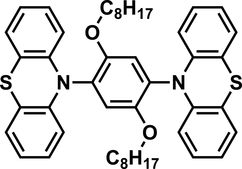
Synthesis and structure of 10,10′-[2,5-bis(octyloxy)-1,4-phenylene]bis(10H-phenothiazine)

aDepartment of Chemistry, Kindai University, Osaka, Japan, and bDepartment of Energy and Materials, Kindai University, Osaka, Japan
*Correspondence e-mail: [email protected]
The asymmetric unit of the title compound, C46H52N2O2S2, contains one half of the molecule, with the complete molecule generated by crystallographic inversion symmetry. The molecule comprises two phenothiazine units attached to a central benzene ring bearing two octyloxy substituents. The phenothiazine moieties exhibit nearly planar conformations, with a butterfly angle of 2.31 (7)°, which is considerably smaller than those reported for related compounds. The dihedral angle between each phenothiazine unit and the central benzene ring is 87.23 (5)°. In the crystal, adjacent phenothiazine units form slipped π–π stacking interactions, accompanied by weak C—H⋯π contacts and van der Waals interactions between the alkyl chains. In CHCl3 solution, the compound exhibits a strong absorption band at around 250 nm and a weak broad absorption band at 300–350 nm, together with photoluminescence centered at 450 nm. Cyclic voltammetry revealed an estimated HOMO energy level of −5.13 eV, while the LUMO energy level was estimated to be −1.72 eV from the optical absorption onset. These results provide insights into the molecular structure, crystal packing, and optoelectronic properties of this phenothiazine derivative.
Keywords: phenothiazine derivatives; crystal structure; π–π stacking; photoluminescence; cyclic voltammetry.
CCDC reference: 2600538
1. Chemical context
Phenothiazine is an electron-rich heterocyclic compound containing nitrogen and sulfur atoms. Owing to its characteristic non-planar structure and favorable electronic properties, it has been widely incorporated into functional organic molecules. In addition to its electron-donating ability arising from the nitrogen and sulfur atoms, the phenothiazine framework generally adopts a folded, butterfly-like conformation (Elliott et al., 2021 ). This molecular geometry is characterized by the dihedral angle between the two outer benzene rings, known as the butterfly angle. Furthermore, the non-planar structure contributes to the formation of twisted molecular architectures and can influence the luminescence properties in the solid state (Huang et al., 2021, Ekbote et al., 2020). In addition, phenothiazine has attracted considerable attention as a donor building block for optoelectronic materials owing to its electron-donating ability, with potential applications in light-emitting organic materials and charge-transport materials used in organic light-emitting diodes (OLEDs), perovskite solar cells (PSCs), and organic solar cells (OSCs) (Castriotta et al., 2023, Revoju et al., 2018, Wang et al., 2021).
This study reports the crystal structure of the title compound, C46H52N2O2S2, (1), a phenothiazine derivative bearing flexible octyloxy chains, determined by single-crystal X-ray diffraction analysis. Particular attention was paid to the molecular conformation, including the butterfly angles of the phenothiazine units, and the molecular arrangement in the crystal. Furthermore, the effects of the octyloxy chains on the molecular structure and crystal packing were investigated to provide structural insights into phenothiazine-based functional organic materials.
2. Structural commentary
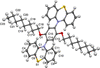
The molecular structure of compound 1 is shown in Fig. 1. The asymmetric unit contains one half of the molecule, with the complete molecule generated by an inversion operation centred at [−x +  , −y + , −z +
 ]. The molecule consists of a central benzene ring bearing two octyloxy substituents and two phenothiazine units. Both phenothiazine moieties adopt nearly planar conformations, with a butterfly angle of 2.31 (7)°. The C12—N1 and C1—N1 bond lengths are 1.4046 (16) and 1.4062 (18) Å, respectively, while the C6—S1 and C7—S1 bond lengths are 1.7599 (16) and 1.7607 (15) Å, respectively. These values are comparable to those reported for the corresponding C—N (1.409–1.426 Å) and C—S (1.754–1.759 Å) bond lengths in the phenothiazine framework of a related compound (Sun et al., 2004, Skhirtladze et al., 2022). In contrast, the butterfly angle of 2.31 (5)° is considerably smaller than the reported values of 25.6 and 30.1°, indicating that the phenothiazine moieties in the title compound adopt substantially more planar conformations than those in the related compounds (Skhirtladze et al., 2022, Wang et al., 2021). The C14—N1 bond connecting the central benzene ring to the phenothiazine unit measures 1.4396 (17) Å, which is close to the corresponding bond lengths reported for related phenothiazine derivatives (Sun et al., 2004; Song et al., 2024).
|
Figure 1
The molecular structure of compound 1 with displacement ellipsoids drawn at the 50% probability level. Unlabelled atoms are generated by the symmetry operation −x + , −y + , −z + . |
The dihedral angle between each phenothiazine unit and the central benzene ring is 87.23 (5)°, close to the reported value of approximately 90° for a related compound (Deng et al., 2022; Sugamata et al., 2025). These results indicate that the relative orientation of the phenothiazine units with respect to the central benzene ring is essentially unchanged, whereas their internal conformations differ considerably. The octyloxy substituents adopt extended conformations, with their alkyl chains extending approximately parallel to the plane of the central benzene ring and perpendicular to the phenothiazine units.
3. Supramolecular features
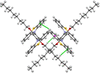
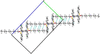
The crystal packing is characterized by slipped π–π stacking interactions between adjacent phenothiazine units (Fig. 2). The plane-to-centroid separation and centroid–centroid distance are 3.6026 (4) and 4.3892 (6) Å, respectively, corresponding to a lateral slippage of 2.507 Å. These values indicate a significantly offset, non-cofacial stacking arrangement. In addition, weak C—H⋯π interactions between neighboring molecules provide further intermolecular contacts (Table 1 and Fig. 3). Weak van der Waals interactions between the alkyl chains also contribute to the crystal packing (Fig. 4).
|

|
Figure 2
A view of the face-to-face π-stacking geometrical arrangement in compound 1. |
|
Figure 3
A view of the weak C—H⋯π interactions in compound 1. Details are given in Table 1 . |
|
Figure 4
A view of the weak van der Waals interactions of the alkyl chains in compound 1. |
4. Optical properties
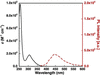
The UV-vis absorption and photoluminescence spectra of the title compound 1 in CHCl3 solution are shown in Fig. 5. The absorption spectrum exhibits a sharp absorption band at around 250nm and a weak broad absorption band in the range of 300–350nm. Based on studies of related compounds, the higher-energy absorption band is assigned to the n–π* and π–π* transitions of the phenothiazine unit, whereas the lower-energy band is attributed to charge-transfer (1CT) transitions from the phenothiazine to the benzene units (Skhirtladze et al., 2022). The photoluminescence spectrum exhibits a maximum at 450 nm, which is assigned to emission from the 1CT state.
|
Figure 5
UV–vis absorption and photoluminescence spectra of the title compound 1 in CHCl3 solution. The photoluminescence spectrum was measured at an excitation wavelength of 350 nm. |
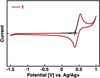
The HOMO level of the title compound 1 was determined from its oxidation potential obtained by cyclic voltammetry (CV) in CHCl3, using the vacuum energy level of ferrocene/ferrocenium+ (−4.8 eV) as a reference (Fig. 6). The LUMO level was estimated from the absorption onset wavelength (λedge). Accordingly, the HOMO and LUMO energy levels of the title compound 1 were estimated to be −5.13 and −1.72 eV, respectively. These results indicate that the title compound 1 exhibits donor character. The reported HOMO level of unsubstituted phenothiazine is −5.04 eV, suggesting that the HOMO of the title compound is primarily derived from the phenothiazine units (Zhou et al., 2022). In comparison, the HOMO level of 2,6-di(phenothiazinyl)naphthalene (DPTZN), a naphthalene derivative bearing two phenothiazine units, has been reported to be −5.35 eV (Wang et al., 2019). The relatively higher HOMO level of the title compound may be attributed to the electron-donating effect of the introduced alkoxy groups.
|
Figure 6
Cyclic voltammogram of the title compound 1 in CHCl3 solution. |
5. Database survey
A search of the Cambridge Structural Database (CSD, accessed via the CCDC Access Structures web interface on 25 October 2026; Groom et al., 2016) was performed to identify structurally related compounds. Three structurally related phenothiazine derivatives were identified (Skhirtladze et al., 2022, refcode RECBAG; Sun et al., 2004, refcode AVISED; Wang et al., 2021, refcode AVISED01). These compounds feature either an unsubstituted central benzene ring or one substituted with trifluoromethyl groups. Comparison with these compounds revealed that the corresponding bond lengths are similar to those of the title compound. However, the title compound exhibits a markedly reduced butterfly angle, indicating that the characteristic butterfly conformation of the phenothiazine moieties is suppressed, resulting in a more planar structure.
6. Synthesis and crystallization
1,4-Dibromo-2,5-bis(octyloxy)benzene
2,5-Dibromo-1,4-hydroquinone (500 mg, 1.87 mmol) and K2CO3 (516 mg, 2 eq) were added to a round-bottom flask and was purged with N2 for 15min. DMF (10 mL) was added and stirred at room temperature for 1 h. After then, 1-iodooctane (2.5 eq) was added to the reaction mixture and stirred at 353 K for 24 h. The reaction mixture was added to H2O (30mL), extracted with hexane, dehydrated with MgSO4 and concentrated using an evaporator. The crude product was purified by silica gel column eluted with hexane to give clear oil. Yield: 76%
10,10′-[2,5-Bis(octyloxy)-1,4-phenylene]bis(10H-phenothiazine) (1)
1,4-Dibromo-2,5-bis(octyloxy)benzene (800 mg, 1.62 mmol), phenothiazine (712 mg, 2.5 eq) and t-BuONa (936.9 mg, 6 eq) were added to round-bottom flask and flowed N2 for 15min. Toluene (60 mL), Pd2(dba)3 (74.4 mg, 5 mol%; dba = dibenzylideneacetone) and t-Bu3P (40 µL, 20mol%) were added to the reaction mixture and stirred at 383 K for 3 h. To the solution, 1M HCl aq (10mL) was added to quench the reaction, extracted with CHCl3, dehydrated with MgSO4 and concentrated using an evaporator. The crude product was purified by silica gel column eluted CHCl3:hexane to give white solid. Yield: 55%
Single crystals suitable for single-crystal X-ray diffraction analysis were obtained by slow evaporation of a hexane solution of the sample. 1H NMR (CDCl3, 400MHz); 7.166 (2H, s), 7.040 (4H, dd, J = 7.6, 1.6Hz), 6.990–6.800 (8H, m), 6.250 (4H, d, J = 6.8Hz), 3.896 (4H, t, J = 6.0Hz), 1.519 (4H, m), 1.300–1.050 (20H, m), 0.866 (6H, t, J = 7.2Hz).
HR-MS(ESI); m/z calculated for C46H53N2O2S2 ([M + H]+) 729.3543, found: 729.3543.
7. Refinement
Crystal data, data collection and structure refinement details are summarized in Table 2. All hydrogen atoms were placed in geometrically calculated positions and refined using a riding model, with their isotropic displacement parameters set to 1.2Ueq(C) for aromatic and methylene hydrogen atoms and 1.5Ueq(C) for methyl hydrogen atoms.
|
Supporting information
CCDC reference: 2600538
Crystal structure: contains datablock I. DOI: https://doi.org/10.1107/S2056989026011473/vm2338sup1.cif
Structure factors: contains datablock I. DOI: https://doi.org/10.1107/S2056989026011473/vm2338Isup2.hkl
Supporting information file. DOI: https://doi.org/10.1107/S2056989026011473/vm2338Isup3.cdx
Supporting information file. DOI: https://doi.org/10.1107/S2056989026011473/vm2338Isup4.cml
| C46H52N2O2S2 | F(000) = 1566.969 |
| Mr = 729.07 | Dx = 1.268 Mg m−3 |
| Monoclinic, I2/a | Cu Kα radiation, λ = 1.54184 Å |
| a = 10.1447 (2) Å | Cell parameters from 6309 reflections |
| b = 14.8550 (2) Å | θ = 3.4–72.9° |
| c = 25.4074 (3) Å | µ = 1.58 mm−1 |
| β = 94.298 (1)° | T = 100 K |
| V = 3818.12 (10) Å3 | Needle, clear whiteish white |
| Z = 4 | 0.1 × 0.05 × 0.05 mm |
| Rigaku Saturn724+ (2x2 bin mode) diffractometer | 3258 reflections with I ≥ 2u(I) |
| Detector resolution: 28.5714 pixels mm-1 | Rint = 0.032 |
| profile data from ω–scans | θmax = 73.2°, θmin = 3.5° |
| Absorption correction: multi-scan (CrysAlisPro; Rigaku OD, 2018) | h = −12→7 |
| Tmin = 0.696, Tmax = 1.000 | k = −17→18 |
| 10698 measured reflections | l = −31→31 |
| 3748 independent reflections |
| Refinement on F2 | 0 restraints |
| Least-squares matrix: full | 43 constraints |
| R[F2 > 2σ(F2)] = 0.038 | H-atom parameters constrained |
| wR(F2) = 0.106 | w = 1/[σ2(Fo2) + (0.058P)2 + 3.1081P] where P = (Fo2 + 2Fc2)/3 |
| S = 1.02 | (Δ/σ)max = 0.0002 |
| 3748 reflections | Δρmax = 0.26 e Å−3 |
| 236 parameters | Δρmin = −0.44 e Å−3 |
| x | y | z | Uiso*/Ueq | ||
| S1 | 0.22306 (4) | 0.70950 (3) | 0.335034 (14) | 0.02457 (13) | |
| O1 | 0.73399 (10) | 0.62994 (7) | 0.33279 (4) | 0.0216 (2) | |
| N1 | 0.50981 (12) | 0.72322 (8) | 0.29710 (5) | 0.0188 (3) | |
| C1 | 0.48179 (15) | 0.77538 (9) | 0.34108 (5) | 0.0195 (3) | |
| C6 | 0.35691 (15) | 0.77482 (9) | 0.36139 (6) | 0.0208 (3) | |
| C15 | 0.74617 (14) | 0.68848 (9) | 0.29216 (5) | 0.0180 (3) | |
| C14 | 0.63410 (14) | 0.73722 (9) | 0.27446 (5) | 0.0180 (3) | |
| C13 | 0.63781 (14) | 0.79774 (9) | 0.23294 (5) | 0.0190 (3) | |
| H13 | 0.56024 (14) | 0.83021 (9) | 0.22147 (5) | 0.0227 (4)* | |
| C12 | 0.42534 (14) | 0.65813 (9) | 0.27274 (5) | 0.0182 (3) | |
| C7 | 0.29476 (14) | 0.64581 (9) | 0.28619 (6) | 0.0198 (3) | |
| C17 | 0.81546 (14) | 0.51917 (10) | 0.39509 (5) | 0.0207 (3) | |
| H17a | 0.78550 (14) | 0.55643 (10) | 0.42421 (5) | 0.0248 (4)* | |
| H17b | 0.74175 (14) | 0.47899 (10) | 0.38264 (5) | 0.0248 (4)* | |
| C2 | 0.57891 (15) | 0.83075 (10) | 0.36541 (6) | 0.0233 (3) | |
| H2 | 0.66474 (15) | 0.83086 (10) | 0.35280 (6) | 0.0279 (4)* | |
| C11 | 0.46961 (15) | 0.60476 (10) | 0.23256 (6) | 0.0227 (3) | |
| H11 | 0.55848 (15) | 0.61074 (10) | 0.22366 (6) | 0.0273 (4)* | |
| C16 | 0.85028 (14) | 0.57965 (9) | 0.35037 (5) | 0.0199 (3) | |
| H16a | 0.88047 (14) | 0.54309 (9) | 0.32100 (5) | 0.0239 (4)* | |
| H16b | 0.92244 (14) | 0.62123 (9) | 0.36263 (5) | 0.0239 (4)* | |
| C18 | 0.93389 (14) | 0.46237 (9) | 0.41557 (5) | 0.0206 (3) | |
| H18a | 0.96209 (14) | 0.42418 (9) | 0.38652 (5) | 0.0247 (4)* | |
| H18b | 1.00831 (14) | 0.50281 (9) | 0.42680 (5) | 0.0247 (4)* | |
| C19 | 0.90346 (14) | 0.40244 (10) | 0.46181 (5) | 0.0210 (3) | |
| H19a | 0.87639 (14) | 0.44094 (10) | 0.49092 (5) | 0.0252 (4)* | |
| H19b | 0.82778 (14) | 0.36303 (10) | 0.45063 (5) | 0.0252 (4)* | |
| C20 | 1.01912 (15) | 0.34381 (10) | 0.48253 (6) | 0.0215 (3) | |
| H20a | 1.04808 (15) | 0.30643 (10) | 0.45327 (6) | 0.0258 (4)* | |
| H20b | 1.09397 (15) | 0.38310 (10) | 0.49490 (6) | 0.0258 (4)* | |
| C21 | 0.98508 (15) | 0.28233 (10) | 0.52768 (6) | 0.0222 (3) | |
| H21a | 0.95696 (15) | 0.31998 (10) | 0.55698 (6) | 0.0266 (4)* | |
| H21b | 0.90925 (15) | 0.24389 (10) | 0.51534 (6) | 0.0266 (4)* | |
| C5 | 0.33249 (16) | 0.82978 (11) | 0.40398 (6) | 0.0268 (3) | |
| H5 | 0.24772 (16) | 0.82876 (11) | 0.41752 (6) | 0.0321 (4)* | |
| C10 | 0.38817 (16) | 0.54342 (10) | 0.20527 (6) | 0.0258 (3) | |
| H10 | 0.42088 (16) | 0.50862 (10) | 0.17771 (6) | 0.0310 (4)* | |
| C9 | 0.25898 (16) | 0.53266 (10) | 0.21808 (6) | 0.0271 (3) | |
| H9 | 0.20193 (16) | 0.49135 (10) | 0.19909 (6) | 0.0326 (4)* | |
| C3 | 0.55349 (17) | 0.88582 (10) | 0.40764 (6) | 0.0274 (3) | |
| H3 | 0.62129 (17) | 0.92347 (10) | 0.42326 (6) | 0.0329 (4)* | |
| C22 | 1.09900 (15) | 0.22191 (10) | 0.54874 (6) | 0.0246 (3) | |
| H22a | 1.13305 (15) | 0.18837 (10) | 0.51894 (6) | 0.0295 (4)* | |
| H22b | 1.17163 (15) | 0.26005 (10) | 0.56451 (6) | 0.0295 (4)* | |
| C8 | 0.21405 (15) | 0.58291 (10) | 0.25894 (6) | 0.0249 (3) | |
| H8 | 0.12627 (15) | 0.57431 (10) | 0.26861 (6) | 0.0299 (4)* | |
| C4 | 0.42958 (17) | 0.88595 (11) | 0.42701 (6) | 0.0299 (4) | |
| H4 | 0.41131 (17) | 0.92395 (11) | 0.45564 (6) | 0.0359 (4)* | |
| C23 | 1.05843 (17) | 0.15506 (11) | 0.59000 (6) | 0.0296 (4) | |
| H23a | 0.9863 (8) | 0.1172 (5) | 0.57469 (16) | 0.0444 (5)* | |
| H23b | 1.1342 (4) | 0.1171 (6) | 0.6015 (4) | 0.0444 (5)* | |
| H23c | 1.0286 (11) | 0.18787 (11) | 0.6204 (2) | 0.0444 (5)* |
| U11 | U22 | U33 | U12 | U13 | U23 | |
| S1 | 0.0170 (2) | 0.0318 (2) | 0.0255 (2) | 0.00172 (14) | 0.00607 (14) | −0.00095 (14) |
| O1 | 0.0188 (5) | 0.0242 (5) | 0.0220 (5) | 0.0029 (4) | 0.0039 (4) | 0.0070 (4) |
| N1 | 0.0136 (6) | 0.0226 (6) | 0.0208 (6) | −0.0007 (5) | 0.0059 (5) | −0.0011 (5) |
| C1 | 0.0236 (8) | 0.0178 (7) | 0.0176 (7) | 0.0030 (5) | 0.0036 (6) | 0.0037 (5) |
| C6 | 0.0208 (7) | 0.0205 (7) | 0.0214 (7) | 0.0044 (6) | 0.0044 (6) | 0.0044 (5) |
| C15 | 0.0175 (7) | 0.0195 (7) | 0.0171 (6) | −0.0004 (5) | 0.0020 (5) | 0.0005 (5) |
| C14 | 0.0152 (7) | 0.0201 (7) | 0.0190 (7) | −0.0015 (5) | 0.0044 (5) | −0.0014 (5) |
| C13 | 0.0171 (7) | 0.0192 (7) | 0.0205 (7) | 0.0015 (5) | 0.0012 (5) | −0.0000 (5) |
| C12 | 0.0169 (7) | 0.0180 (6) | 0.0196 (7) | 0.0009 (5) | 0.0017 (5) | 0.0047 (5) |
| C7 | 0.0178 (7) | 0.0207 (7) | 0.0213 (7) | 0.0021 (5) | 0.0031 (5) | 0.0056 (5) |
| C17 | 0.0209 (7) | 0.0223 (7) | 0.0191 (7) | −0.0003 (6) | 0.0034 (6) | 0.0010 (5) |
| C2 | 0.0247 (8) | 0.0229 (7) | 0.0227 (7) | −0.0012 (6) | 0.0050 (6) | 0.0021 (6) |
| C11 | 0.0208 (7) | 0.0219 (7) | 0.0262 (7) | 0.0006 (6) | 0.0069 (6) | 0.0010 (6) |
| C16 | 0.0179 (7) | 0.0214 (7) | 0.0204 (7) | 0.0015 (5) | 0.0015 (5) | 0.0018 (5) |
| C18 | 0.0212 (7) | 0.0215 (7) | 0.0192 (7) | 0.0003 (6) | 0.0018 (5) | 0.0007 (5) |
| C19 | 0.0217 (7) | 0.0225 (7) | 0.0189 (7) | 0.0001 (6) | 0.0022 (5) | 0.0008 (5) |
| C20 | 0.0225 (8) | 0.0225 (7) | 0.0195 (7) | 0.0003 (6) | 0.0021 (6) | 0.0014 (5) |
| C21 | 0.0232 (8) | 0.0239 (7) | 0.0196 (7) | 0.0011 (6) | 0.0030 (6) | 0.0010 (6) |
| C5 | 0.0288 (8) | 0.0281 (8) | 0.0247 (7) | 0.0049 (6) | 0.0107 (6) | 0.0020 (6) |
| C10 | 0.0281 (8) | 0.0226 (7) | 0.0274 (8) | −0.0017 (6) | 0.0065 (6) | −0.0026 (6) |
| C9 | 0.0264 (8) | 0.0248 (7) | 0.0300 (8) | −0.0066 (6) | 0.0010 (6) | −0.0008 (6) |
| C3 | 0.0337 (9) | 0.0237 (8) | 0.0252 (7) | −0.0033 (6) | 0.0049 (6) | −0.0017 (6) |
| C22 | 0.0230 (8) | 0.0256 (7) | 0.0251 (7) | 0.0019 (6) | 0.0020 (6) | 0.0041 (6) |
| C8 | 0.0184 (7) | 0.0268 (8) | 0.0297 (8) | −0.0017 (6) | 0.0036 (6) | 0.0046 (6) |
| C4 | 0.0394 (10) | 0.0256 (8) | 0.0258 (8) | 0.0024 (7) | 0.0102 (7) | −0.0029 (6) |
| C23 | 0.0289 (9) | 0.0285 (8) | 0.0315 (8) | 0.0035 (7) | 0.0031 (7) | 0.0096 (6) |
| S1—C6 | 1.7599 (16) | C18—H18b | 0.9900 |
| S1—C7 | 1.7607 (15) | C18—C19 | 1.5240 (19) |
| O1—C15 | 1.3624 (16) | C19—H19a | 0.9900 |
| O1—C16 | 1.4389 (17) | C19—H19b | 0.9900 |
| N1—C1 | 1.4062 (18) | C19—C20 | 1.523 (2) |
| N1—C14 | 1.4396 (17) | C20—H20a | 0.9900 |
| N1—C12 | 1.4046 (18) | C20—H20b | 0.9900 |
| C1—C6 | 1.403 (2) | C20—C21 | 1.5260 (19) |
| C1—C2 | 1.392 (2) | C21—H21a | 0.9900 |
| C6—C5 | 1.393 (2) | C21—H21b | 0.9900 |
| C15—C14 | 1.394 (2) | C21—C22 | 1.528 (2) |
| C15—C13i | 1.395 (2) | C5—H5 | 0.9500 |
| C14—C13 | 1.3886 (19) | C5—C4 | 1.386 (2) |
| C13—H13 | 0.9500 | C10—H10 | 0.9500 |
| C12—C7 | 1.4046 (19) | C10—C9 | 1.383 (2) |
| C12—C11 | 1.3932 (19) | C9—H9 | 0.9500 |
| C7—C8 | 1.392 (2) | C9—C8 | 1.383 (2) |
| C17—H17a | 0.9900 | C3—H3 | 0.9500 |
| C17—H17b | 0.9900 | C3—C4 | 1.384 (2) |
| C17—C16 | 1.5108 (19) | C22—H22a | 0.9900 |
| C17—C18 | 1.527 (2) | C22—H22b | 0.9900 |
| C2—H2 | 0.9500 | C22—C23 | 1.523 (2) |
| C2—C3 | 1.389 (2) | C8—H8 | 0.9500 |
| C11—H11 | 0.9500 | C4—H4 | 0.9500 |
| C11—C10 | 1.381 (2) | C23—H23a | 0.9800 |
| C16—H16a | 0.9900 | C23—H23b | 0.9800 |
| C16—H16b | 0.9900 | C23—H23c | 0.9800 |
| C18—H18a | 0.9900 | ||
| C7—S1—C6 | 102.52 (7) | C19—C18—H18b | 109.05 (8) |
| C16—O1—C15 | 116.61 (10) | H19a—C19—C18 | 108.77 (8) |
| C14—N1—C1 | 118.23 (12) | H19b—C19—C18 | 108.77 (8) |
| C12—N1—C1 | 125.20 (12) | H19b—C19—H19a | 107.7 |
| C12—N1—C14 | 116.56 (11) | C20—C19—C18 | 113.90 (12) |
| C6—C1—N1 | 122.05 (13) | C20—C19—H19a | 108.77 (7) |
| C2—C1—N1 | 119.99 (13) | C20—C19—H19b | 108.77 (8) |
| C2—C1—C6 | 117.95 (13) | H20a—C20—C19 | 108.99 (7) |
| C1—C6—S1 | 123.74 (11) | H20b—C20—C19 | 108.99 (8) |
| C5—C6—S1 | 116.22 (11) | H20b—C20—H20a | 107.8 |
| C5—C6—C1 | 120.02 (14) | C21—C20—C19 | 112.96 (12) |
| C14—C15—O1 | 117.26 (12) | C21—C20—H20a | 108.99 (8) |
| C13i—C15—O1 | 124.58 (13) | C21—C20—H20b | 108.99 (8) |
| C13i—C15—C14 | 118.16 (13) | H21a—C21—C20 | 108.75 (8) |
| C15—C14—N1 | 120.91 (12) | H21b—C21—C20 | 108.75 (8) |
| C13—C14—N1 | 118.13 (13) | H21b—C21—H21a | 107.6 |
| C13—C14—C15 | 120.90 (13) | C22—C21—C20 | 114.02 (12) |
| C14—C13—C15i | 120.93 (13) | C22—C21—H21a | 108.75 (8) |
| H13—C13—C15i | 119.53 (8) | C22—C21—H21b | 108.75 (8) |
| H13—C13—C14 | 119.53 (8) | H5—C5—C6 | 119.38 (9) |
| C7—C12—N1 | 122.54 (12) | C4—C5—C6 | 121.24 (14) |
| C11—C12—N1 | 119.67 (12) | C4—C5—H5 | 119.38 (9) |
| C11—C12—C7 | 117.76 (13) | H10—C10—C11 | 120.00 (9) |
| C12—C7—S1 | 123.26 (11) | C9—C10—C11 | 119.99 (14) |
| C8—C7—S1 | 116.91 (11) | C9—C10—H10 | 120.00 (9) |
| C8—C7—C12 | 119.79 (13) | H9—C9—C10 | 120.48 (9) |
| H17b—C17—H17a | 108.0 | C8—C9—C10 | 119.04 (14) |
| C16—C17—H17a | 109.38 (8) | C8—C9—H9 | 120.48 (9) |
| C16—C17—H17b | 109.38 (8) | H3—C3—C2 | 119.94 (9) |
| C18—C17—H17a | 109.38 (7) | C4—C3—C2 | 120.12 (15) |
| C18—C17—H17b | 109.38 (8) | C4—C3—H3 | 119.94 (9) |
| C18—C17—C16 | 111.26 (12) | H22a—C22—C21 | 109.02 (8) |
| H2—C2—C1 | 119.17 (8) | H22b—C22—C21 | 109.02 (8) |
| C3—C2—C1 | 121.66 (14) | H22b—C22—H22a | 107.8 |
| C3—C2—H2 | 119.17 (9) | C23—C22—C21 | 112.82 (13) |
| H11—C11—C12 | 119.01 (8) | C23—C22—H22a | 109.02 (9) |
| C10—C11—C12 | 121.98 (14) | C23—C22—H22b | 109.02 (9) |
| C10—C11—H11 | 119.01 (9) | C9—C8—C7 | 121.39 (14) |
| C17—C16—O1 | 108.05 (11) | H8—C8—C7 | 119.31 (8) |
| H16a—C16—O1 | 110.09 (7) | H8—C8—C9 | 119.31 (9) |
| H16a—C16—C17 | 110.09 (8) | C3—C4—C5 | 118.99 (14) |
| H16b—C16—O1 | 110.09 (7) | H4—C4—C5 | 120.50 (9) |
| H16b—C16—C17 | 110.09 (8) | H4—C4—C3 | 120.50 (9) |
| H16b—C16—H16a | 108.4 | H23a—C23—C22 | 109.5 |
| H18a—C18—C17 | 109.05 (8) | H23b—C23—C22 | 109.5 |
| H18b—C18—C17 | 109.05 (8) | H23b—C23—H23a | 109.5 |
| H18b—C18—H18a | 107.8 | H23c—C23—C22 | 109.5 |
| C19—C18—C17 | 112.70 (12) | H23c—C23—H23a | 109.5 |
| C19—C18—H18a | 109.05 (8) | H23c—C23—H23b | 109.5 |
| S1—C6—C1—N1 | 0.39 (14) | C15—O1—C16—C17 | −179.81 (12) |
| S1—C6—C1—C2 | 179.50 (12) | C15—C14—N1—C12 | −90.81 (14) |
| S1—C6—C5—C4 | −178.25 (11) | C15—C14—C13—C15i | −0.09 (13) |
| S1—C7—C12—N1 | −0.46 (14) | C14—N1—C1—C2 | −7.58 (14) |
| S1—C7—C12—C11 | −178.62 (11) | C14—N1—C12—C7 | −171.47 (12) |
| S1—C7—C8—C9 | 176.78 (11) | C14—N1—C12—C11 | 6.65 (14) |
| O1—C15—C14—N1 | −2.33 (14) | C14—C15—O1—C16 | 179.58 (12) |
| O1—C15—C14—C13 | −179.46 (12) | C14—C15—C13i—C14i | −0.09 (13) |
| O1—C15—C13i—C14i | 179.43 (14) | C14—C13—C15i—O1i | −179.43 (13) |
| O1—C16—C17—C18 | 179.27 (11) | C14—C13—C15i—C14i | 0.09 (13) |
| N1—C1—C6—C5 | −177.95 (13) | C13i—C15—O1—C16 | 0.06 (17) |
| N1—C1—C2—C3 | 177.50 (13) | C13i—C15—C14—C13 | 0.09 (13) |
| N1—C14—C15—C13i | 177.22 (13) | C13—C14—N1—C12 | 86.40 (14) |
| N1—C14—C13—C15i | −177.30 (12) | C12—N1—C1—C2 | 172.93 (14) |
| N1—C12—C7—C8 | 177.10 (13) | C12—C7—C8—C9 | −0.94 (16) |
| N1—C12—C11—C10 | −176.21 (13) | C12—C11—C10—C9 | −0.94 (17) |
| C1—N1—C14—C15 | 89.66 (13) | C7—S1—C6—C5 | −176.38 (10) |
| C1—N1—C14—C13 | −93.13 (13) | C7—C12—C11—C10 | 2.00 (16) |
| C1—N1—C12—C7 | 8.03 (16) | C7—C8—C9—C10 | 2.02 (17) |
| C1—N1—C12—C11 | −173.85 (14) | C17—C18—C19—C20 | 179.06 (12) |
| C1—C6—S1—C7 | 5.22 (13) | C2—C1—C6—C5 | 1.16 (16) |
| C1—C6—C5—C4 | 0.21 (16) | C2—C3—C4—C5 | 0.68 (18) |
| C1—C2—C3—C4 | 0.73 (17) | C11—C12—C7—C8 | −1.05 (15) |
| C6—S1—C7—C12 | −5.18 (9) | C11—C10—C9—C8 | −1.09 (18) |
| C6—S1—C7—C8 | 177.19 (10) | C16—C17—C18—C19 | 178.34 (12) |
| C6—C1—N1—C14 | 171.51 (13) | C18—C19—C20—C21 | −178.24 (12) |
| C6—C1—N1—C12 | −7.98 (16) | C19—C20—C21—C22 | 179.27 (12) |
| C6—C1—C2—C3 | −1.63 (16) | C20—C21—C22—C23 | −174.43 (13) |
| C6—C5—C4—C3 | −1.14 (18) |
| Symmetry code: (i) −x+3/2, −y+3/2, −z+1/2. |
| Cg1, Cg2 and Cg3 are the centroids of rings C1–C6, C1–C6 and C7–C12, respectively. |
| C—H···Cg | C—H | H···Cg | C···Cg | C—H···Cg |
| C10—H10···Cg1i | 0.95 | 3.372 | 4.2732 (17) | 159 |
| C20—H20A···Cg2ii | 0.99 | 2.798 | 3.6177 (16) | 141 |
| C16—H16A···Cg3ii | 0.99 | 2.809 | 3.7090 (14) | 151 |
| Symmetry codes: (i) 1 - x, -1/2 + y, 1/2 - z; (ii) 1/2 + x, 1 - y, z. |
Funding information
Funding for this research was provided by: This work was supported by the Japan Science and Technology Agency (JST) SPRING Program (Support for Pioneering Research Initiated by the Next Generation), and the Asian Office of Aerospace Research and Development (AOARD) (FA2386-25-1-4007).
References
 Bourhis, L. J., Dolomanov, O. V., Gildea, R. J., Howard, J. A. K. & Puschmann, H. (2015). Acta Cryst. A71, 59–75.
Web of Science
CrossRef
IUCr Journals
Google Scholar
Castriotta, L. A., Infantino, R., Vesce, L., Stefanelli, M., Dessì, A., Coppola, C., Calamante, M., Reginato, G., Mordini, A., Sinicropi, A., Di Carlo, A. & Zani, L. (2023). Energy Environ. Mater. 6, e12455.
CrossRef
Google Scholar
Deng, H., Yang, Z., Li, G., Ma, D., Xie, Z., Li, W., Mao, Z., Zhao, J., Yang, Z., Zhang, Y. & Chi, Z. (2022). Chem. Eng. J. 438, 135519.
CrossRef
Google Scholar
Dolomanov, O. V., Bourhis, L. J., Gildea, R. J., Howard, J. A. K. & Puschmann, H. (2009). J. Appl. Cryst. 42, 339–341.
Web of Science
CrossRef
CAS
IUCr Journals
Google Scholar
Ekbote, A., Mobin, S. M. & Misra, R. (2020). J. Mater. Chem. C. 8, 3589–3602.
CrossRef
CAS
Google Scholar
Elliott, C. F., Fraser, K. E., Odom, S. A. & Risko, C. (2021). J. Phys. Chem. A 125, 272–278.
CrossRef
CAS
PubMed
Google Scholar
Groom, C. R., Bruno, I. J., Lightfoot, M. P. & Ward, S. C. (2016). Acta Cryst. B72, 171–179.
Web of Science
CrossRef
IUCr Journals
Google Scholar
Huang, M., Lu, H., Wang, M., Liu, B., Ma, Z., Wang, Z. & Yang, J. (2021). J. Phys. Chem. B 125, 11548–11556.
CrossRef
CAS
PubMed
Google Scholar
Revoju, S., Biswas, S., Eliasson, B. & Sharma, G. D. (2018). Dyes Pigments 149, 830–842.
CrossRef
CAS
Google Scholar
Rigaku (2011). CrystalClear-SM Expert. Rigaku Corporation, Tokyo, Japan.
Google Scholar
Rigaku OD (2018). CrysAlis PRO. Rigaku Oxford Diffraction, Yarnton, England.
Google Scholar
Sheldrick, G. M. (2015). Acta Cryst. A71, 3–8.
Web of Science
CrossRef
IUCr Journals
Google Scholar
Skhirtladze, L., Lietonas, K., Bucinskas, A., Volyniuk, D., Mahmoudi, M., Mukbaniani, O., Woon, K. L., Ariffin, A. & Grazulevicius, J. V. (2022). J. Mater. Chem. C. 10, 4929–4940.
CrossRef
CAS
Google Scholar
Song, T., Liu, H., Ren, J. & Wang, Z. (2024). Adv. Opt. Mater. 12, 2301215.
CrossRef
Google Scholar
Sugamata, K., Furukawa, R., Amanokura, N. & Minoura, M. (2025). Dalton Trans. 54, 8813–8818.
CrossRef
CAS
PubMed
Google Scholar
Sun, D., Rosokha, S. V. & Kochi, J. K. (2004). J. Am. Chem. Soc. 126, 1388–1401.
Web of Science
CSD
CrossRef
PubMed
CAS
Google Scholar
Wang, J., Liang, J., Xu, Y., Liang, B., Wei, J., Li, C., Mu, X., Ye, K. & Wang, Y. (2019). J. Phys. Chem. Lett. 10, 5983–5988.
CrossRef
CAS
PubMed
Google Scholar
Wang, Y., Yang, J., Fang, M., Gong, Y., Ren, J., Tu, L., Tang, B. Z. & Li, Z. (2021). Adv. Funct. Mater. 31, 2101719.
CrossRef
Google Scholar
Zhou, J., Mao, L., Wu, M. X., Peng, Z., Yang, Y., Zhou, M., Zhao, X. L., Shi, X. & Yang, H. B. (2022). Chem. Sci. 13, 5252–5260.
CrossRef
CAS
PubMed
Google Scholar
This is an open-access article distributed under the terms of the Creative Commons Attribution (CC-BY) Licence, which permits unrestricted use, distribution, and reproduction in any medium, provided the original authors and source are cited.
| CRYSTALLOGRAPHIC COMMUNICATIONS |