


 journal menu


issue contents
January 2016 issue
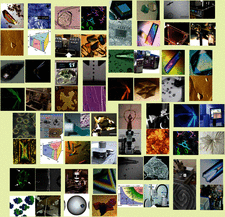
Cover illustration: A selection of images from the IYCr crystallization series.
IYCr crystallization series


Free 
The IYCr crystallization series comes to an end.
research communications


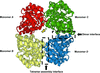
The enzyme dihydrodipicolinate synthase catalyzes the committed step in the synthetic pathway for- the intermediate diaminopimelate and the essential amino acid lysine in bacteria and plants. Here, the crystallization and X-ray diffraction analysis of dihydrodipicolinate synthase from the human pathogenic bacterium B. henselae, the causative bacterium of cat-scratch disease, are presented.
PDB reference: dihydrodipicolinate synthase, 3si9
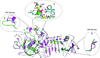
The crystal structure of a thermostable serralysin from Serratia sp. FS14 was solved at 1.10 Å resolution.
PDB reference: serralysin, 5d7w
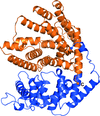
γ-Terpinene synthase from T. vulgaris was characterized. The crystal structure was elucidated to almost 1.5 Å resolution.
PDB reference: TvTPS1, 5c05
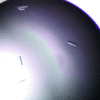
The aspartic protease from N. gracilis was crystallized in complex with the inhibitor pepstatin A using a newly formulated low-pH screen. X-ray diffraction data showed that the crystals diffracted to 2.8 Å resolution.
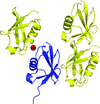
Ubiquitin is a signalling protein that has been reported to crystallize in the presence of metal ions. Here, the first crystallographic structure of human ubiquitin in the presence of magnesium is reported.
PDB reference: human ubiquitin in space group P1, 5dk8
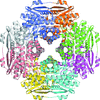
The structural elucidation of a unique lactone cycloisomerase involved in pectin degradation is reported.
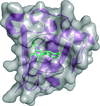
Crystallographic analysis of the histidine triad nucleotide protein (HINT) from H. pylori is reported.
PDB reference: HINT, 4zgl
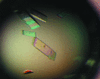
The N-terminal domain of translocated intimin receptor (Tir-N) plays a key role in pathogenic E. coli infection. Tir-N was cloned, expressed, purified and crystallized.
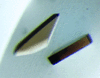
The hydrogenase unit of the Hyd-2-type [NiFe]-hydrogenase from Citrobacter sp. S-77 was purified using an improved procedure and was then crystallized. Diffraction data sets from crystals of the samples with and without trypsin treatment were collected at resolutions of 1.60 and 2.00 Å, respectively.
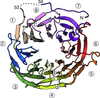
The crystal structure of Sqt1p is presented and its biophysical properties are explored.
PDB reference: Sqt1p, 5ams
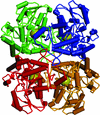
The crystal structure of pyridoxal 5′-phosphate-dependent methionine γ-lyase from C. sporogenes was solved at 2.37 Å resolution. The cofactor- and substrate-binding sites and the oligomeric organization of the enzyme are described.
PDB reference: methionine γ-lyase, 5dx5
![[publBio]](/logos/publbio.gif)


