


 journal menu


issue contents
September 2025 issue
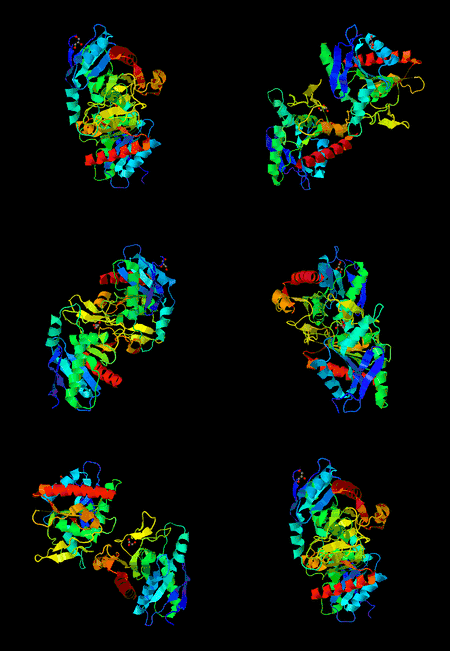
Cover illustration: The crystal structure of the N-terminal domain 1 of virulence protein J from Brucella abortus, which is associated with the type IV secretion system, at a resolution of 1.7 Å shows that it adopts an α/β-hydrolase fold but lacks the characteristic catalytic triad [Dugelay et al. (2025), Acta Cryst. F81, 374–380].
research communications


Open  access
access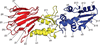
We present the 2.4 Å resolution X-ray crystal structure of the N-terminal folded domains of S. cerevisiae Xrs2, confirming a tandem FHA–BRCT1–BRCT2 domain architecture similar to that of Schizosaccharomyces pombe Nbs1. Comparative structural analyses and electrostatic surface mapping suggest that the FHA and tandem BRCT domains serve as a key binding site for phosphorylated protein partners.
PDB reference: folded domains of Xrs2 from S. cerevisiae, 9ee7
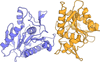
Virulence protein J (VirJ) is produced by the bacterial pathogen Brucella abortus and contains two domains, D1 and D2. The crystal structure of VirJD1 is presented at a resolution of 1.7 Å and displays an α/β-hydrolase fold with a central β-sheet surrounded by α-helices. Structural comparison with other members of the family suggests that VirJD1 lacks the characteristic catalytic triad.
PDB reference: VirJD1, 9rc4
SASBDB reference: VirJD1, SASDX75
Open access
access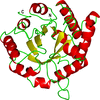
Triosephosphate isomerase from Fasciola hepatica: high-resolution crystal structure as a drug target
The high-resolution crystal structure of triosephosphate isomerase from F. hepatica was solved at 1.51 Å resolution in its monoclinic form, revealing details of the dimer interface critical for enzyme function. Molecular docking with the fasciolocide triclabendazole suggests selective binding near nonconserved residues, highlighting this enzyme as a promising parasite-specific drug target.
Open access
access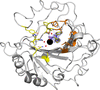
We determined high-resolution crystal structures of the histone deacetylase inhibitor vorinostat bound to both human carbonic anhydrase II and a carbonic anhydrase IX active-site mimic. Thermal shift assays using differential scanning fluorimetry showed minimal stabilization of either carbonic anhydrase by vorinostat, in contrast to the potent carbonic anhydrase inhibitor acetazolamide.
Open access
access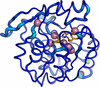
The crystal structure of HNL6V, a seven-substitution variant of hydroxynitrile lyase from rubber tree, reveals that engineered mutations designed to mimic the homologous esterase SABP2 shift the catalytic atom positions intermediate between those of the parent enzyme and the target esterase.
![[publBio]](/logos/publbio.gif)


