

 journal menu


issue contents
April 2026 issue
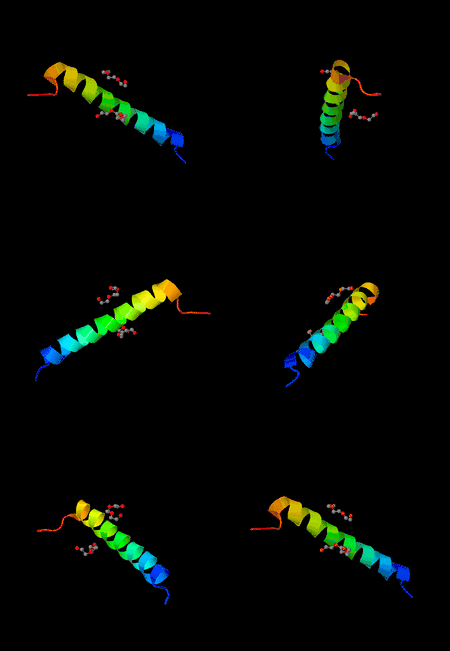
Cover illustration: Crystallization was explored in the context of assessing its feasibility as a preparative strategy for a GLP-1/GIP lipopeptide, and led to what is believed to be the first reported crystal structure of an unbound (non-receptor-complexed) GLP-1/GIP analogue [Mitchell et al. (2026), Acta Cryst. F82, 114–124].
topical reviews


Open  access
access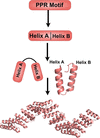
A number of crystal, cryo-EM and solution structures of pentatricopeptide repeat proteins have been solved, revealing details of how they interact with single-stranded RNA and other proteins, as well as their conformational repertoire.
research communications

Open access
access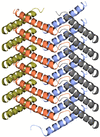
The 1.6 Å resolution diffraction and subsequent structure solution of an acylated GLP-1/GIP analogue lipopeptide is reported. This represents the first published data on the crystal structure of an unbound GLP-1 and/or GIP analogue lipopeptide.
PDB reference: acylated GLP-1/GIP analogue peptide, 9tb1
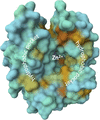
High-resolution X-ray structures of carbonic anhydrase II in complex with two 1,3-oxazole-containing sulfonamide inhibitors define the interactions responsible for their exceptional inhibitory potency and reveal how subtle ligand instability can influence electron-density interpretation and model refinement.
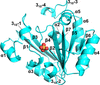
Crystal structures of the poly-γ-glutamate hydrolase from bacteriophage PM1 were determined in both apo and zinc-bound forms, revealing for the first time a zinc-activated water molecule positioned for nucleophilic attack at the catalytic center. This observation supports a zinc-dependent, water-mediated catalytic mechanism for phage-encoded poly-γ-glutamate hydrolases implicated in loss of viscosity in natto fermentation.
methods communications
Open access
access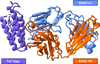
Here, we document the generation of a T7 Express ΔcybC strain allowing contaminant-free expression of the anti-BRIL Fab BAG2. We also report the crystal structure of BAG2 in complex with native cytochrome b562, a complex arising from expression in canonical Escherichia coli strains.
![[publBio]](/logos/publbio.gif)


