

 menu
menu


issue contents
September 2026 issue
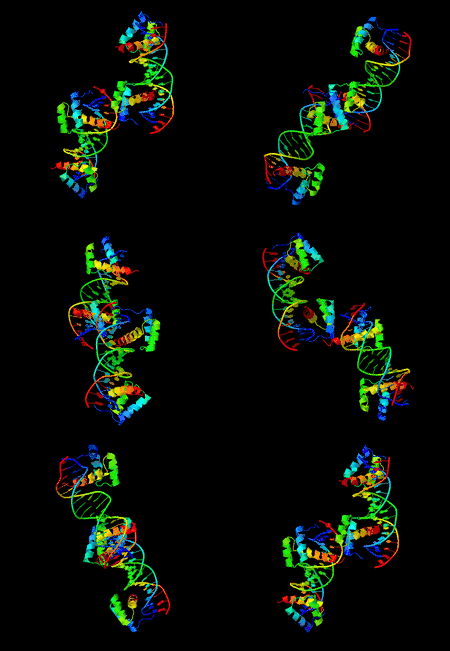
Cover illustration: The crystal structure of the NKX2-1 homeodomain bound to a 19 bp DNA duplex containing two palindromically arranged NK2-recognition motifs [Mohandas & Nam (2026), Acta Cryst. F82, 295–300]. NKX2-1 (thyroid transcription factor 1, TTF-1) is a homeodomain transcription factor that plays critical roles in the development and function of the thyroid, lung and forebrain. The structure provides a structural basis for sequence-specific DNA recognition by NKX2-1 and a framework for interpreting the effects of disease-associated variants.
research communications


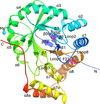
Crystal structures of rice L-galactose dehydrogenase in apo and NAD+-bound forms reveal a conserved architecture and flexible loop regions that are involved in cofactor and substrate binding.
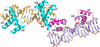
The crystal structure of the NKX2-1 homeodomain bound to DNA reveals the arrangement of two homeodomains on a palindromic NK2-recognition sequence and provides insight into disease-associated variants.
PDB reference: NKX2-1 homeodomain, 36nb
Open  access
access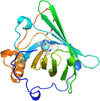
Structural and binding studies of the engineered lipocalin CL31d towards the chelate complexes of 11 different lanthanide and main-group metal(III) ions, whose radioisotopes are useful for nuclear medicine, with a functionalized DTPA revealed a surprisingly broad tolerance towards varying ionic radii, thus enabling flexible radionuclide-targeting strategies.
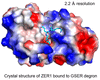
We present the ZER1–NLRP1 Gly/N-degron structure, revealing a conserved binding cavity for N-terminal glycine recognition. ZER1 binds more weakly than ZYG11B due to distinct interactions at position 3, providing mechanistic insights into NLRP1 inflammasome regulation.
PDB reference: ZER1 bound to GSER degron, 9uyb
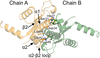
The crystal structure of peptidyl-tRNA hydrolase 2 from Candidatus Lokiarchaeum sp. GC14_75 (LokiPth2) shows conformational rearrangements that may be associated with substrate recognition and catalysis. In addition, analysis of the optimal temperature for LokiPth2 activity suggests that this archaeon is a moderate thermophile.
![[publBio]](/logos/publbio.gif)
