


 menu
menu


issue contents
October 2026 issue
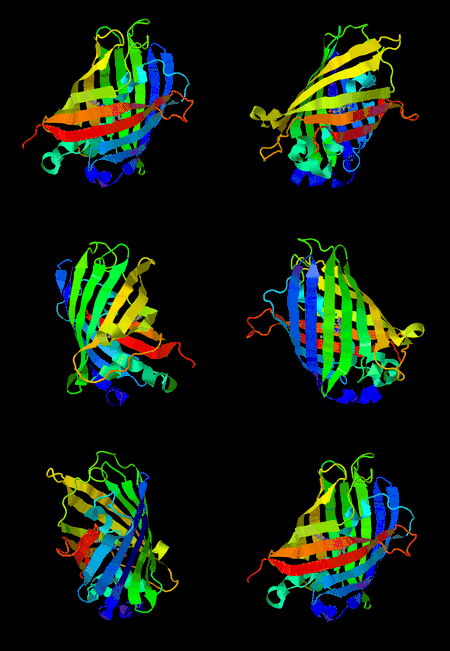
Cover illustration: The high-resolution X-ray structure of mJuniper, a recently developed monomeric cyan fluorescent protein optimized for bacterial imaging, was obtained serendipitously during an attempted structural characterization of CagG, an essential component of the Helicobacter pylori Cag type IV secretion system [Aydin et al. (2026), Acta Cryst. F82, 356–361].
early career research


Open  access
access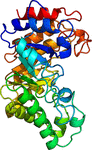
The high-resolution structure of the T. aurantiacus xylanase TaXyn10 expressed in Escherichia coli shows that recombinant production combined with split-intein-based purification recovers the native fold of TaXyn10 and permits the formation of an N-terminal pyroglutamate. These results demonstrate that this approach can enable recombinant proteins to adopt their native mature state in E. coli, including physiologically relevant post-translational modifications such as N-terminal pyroglutamate formation.
PDB reference: Thermoascus aurantiacus xylanase TaXyn10, 31ct
research communications
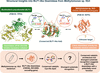
The crystal structure of a putative BLF1-like deamidase from Methylomonas sp. Kb3 reveals conservation of the catalytic cysteine–histidine dyad despite extensive sequence variation. These findings expand the diversity of BLF1-like deamidases and provide a structural framework for understanding their evolution and potential functions.
PDB reference: putative BLF1-like deamidase from Methylomonas sp. Kb3, 9vfk
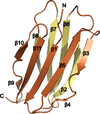
Crystal structures of the sweet-tasting protein honey truffle active component are reported at resolutions ranging from 1.23 to 1.70 Å. The structures correlate well with a previously reported NMR solution-phase protein structure and reveal side-chain configurations that are critical in binding of the protein to the human sweet taste receptor and are also involved in ligand interactions in solution and self-association.
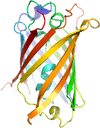
We report the crystal structure of mJuniper, a rapidly maturing cyan fluorescent protein.
PDB reference: mJuniper, 29zn
Open access
access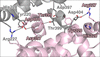
The crystal structure of the catalytic domain of E. coli dihydrolipoamide succinyltransferase in space group F432 identifies a sulfate-compatible intratrimeric junction associated with Lys196 and α1-helix positioning near the active-site pocket.
![[publBio]](/logos/publbio.gif)
