

 journal menu


- 1. Introduction
- 2. Theoretical background
- 3. Single-particle structure reconstruction workflow
- 4. xFrame: a Python implementation of the reconstruction workflow
- 5. Reconstructions from simulated data using xFrame
- 6. Summary and conclusions
- B1. Expansion via orthogonal polynomials
- B2. Cosine/sine series expansion approximation
- B3. Zernike polynomial expansion approximation
- B4. Direct approximation of the Hankel integrals using the midpoint rule
- B5. Hankel transform of the radial part of the 3D Zernike polynomial
- Supporting information
- References


- 1. Introduction
- 2. Theoretical background
- 3. Single-particle structure reconstruction workflow
- 4. xFrame: a Python implementation of the reconstruction workflow
- 5. Reconstructions from simulated data using xFrame
- 6. Summary and conclusions
- B1. Expansion via orthogonal polynomials
- B2. Cosine/sine series expansion approximation
- B3. Zernike polynomial expansion approximation
- B4. Direct approximation of the Hankel integrals using the midpoint rule
- B5. Hankel transform of the radial part of the 3D Zernike polynomial
- Supporting information
- References
research papers
 | JOURNAL OF APPLIED CRYSTALLOGRAPHY |
 access
A workflow for single-particle via iterative phasing of rotational invariants in fluctuation X-ray scattering

aEuropean XFEL, Holzkoppel 4, 22869 Schenefeld, Germany, bI. Institute of Theoretical Physics, University of Hamburg, Notkestraße 9-11, 22607 Hamburg, Germany, cInstitute of Experimental Physics, TU Bergakademie Freiberg, Leipziger Straße 23, 09599 Freiberg, Germany, and dCenter for Efficient High Temperature Processes and Materials Conversion (ZeHS), TU Bergakademie Freiberg, Winklerstrasse 5, 09599 Freiberg, Germany
*Correspondence e-mail: [email protected]
This article is part of a collection of articles from the IUCr 2023 Congress in Melbourne, Australia, and commemorates the 75th anniversary of the IUCr.
Fluctuation X-ray scattering (FXS) offers a complementary approach for nano- and bioparticle imaging with an X-ray free-electron laser (XFEL), by extracting structural information from correlations in scattered XFEL pulses. Here a workflow is presented for single-particle using FXS. The workflow includes procedures for extracting the rotational invariants from FXS patterns, performing structure reconstructions via iterative phasing of the invariants, and aligning and averaging multiple reconstructions. The reconstruction pipeline is implemented in the open-source software xFrame and its functionality is demonstrated on several simulated structures.
Keywords: fluctuation X-ray scattering; single-particle imaging; iterative phasing; X-ray free-electron lasers.
1. Introduction
Advances in X-ray sources and instrumentation over recent decades (Jaeschke et al., 2016![[Jaeschke, E. J., Khan, S., Schneider, J. R. & Hastings, J. B. (2016). Editors. Synchrotron Light Sources and Free-Electron Lasers. Springer Cham.]](../../../../../../logos/arrows/j_arr.gif "Jaeschke, E. J., Khan, S., Schneider, J. R. & Hastings, J. B. (2016). Editors. Synchrotron Light Sources and Free-Electron Lasers. Springer Cham.") ) have been accompanied by an extensive development of techniques and methods for X-ray diffraction and imaging (Chapman et al., 2006; Rodenburg, 2008; Nugent, 2010; Nakasako et al., 2020). The emergence of high-power X-ray free-electron lasers (XFELs) (Ueda, 2018) opened new horizons for crystallographic studies of biological materials (Chapman et al., 2011; Boutet et al., 2012; Wiedorn et al., 2018), most importantly in the time domain (Pandey et al., 2020; Orville, 2020). At the same time, intense and ultrashort X-ray pulses produced by an XFEL made it possible to carry out `diffraction before destruction' experiments on individual bioparticles (Bogan et al., 2008; Mancuso et al., 2010; Seibert et al., 2011; Hantke et al., 2014; Kimura et al., 2014; Ekeberg et al., 2015; Rose et al., 2018), as it was previously envisioned (Solem & Baldwin, 1982; Neutze et al., 2000; Gaffney & Chapman, 2007). Such experiments open up the possibility of imaging particles for which it is difficult or impossible to obtain crystals. At the same time, while serial crystallography with an XFEL allows for high-resolution structure determination of proteins and macromolecules, single-particle imaging (SPI) is a developing way to provide biologically significant structural information (Aquila et al., 2015; Chapman, 2019; Bielecki et al., 2020).
) have been accompanied by an extensive development of techniques and methods for X-ray diffraction and imaging (Chapman et al., 2006; Rodenburg, 2008; Nugent, 2010; Nakasako et al., 2020). The emergence of high-power X-ray free-electron lasers (XFELs) (Ueda, 2018) opened new horizons for crystallographic studies of biological materials (Chapman et al., 2011; Boutet et al., 2012; Wiedorn et al., 2018), most importantly in the time domain (Pandey et al., 2020; Orville, 2020). At the same time, intense and ultrashort X-ray pulses produced by an XFEL made it possible to carry out `diffraction before destruction' experiments on individual bioparticles (Bogan et al., 2008; Mancuso et al., 2010; Seibert et al., 2011; Hantke et al., 2014; Kimura et al., 2014; Ekeberg et al., 2015; Rose et al., 2018), as it was previously envisioned (Solem & Baldwin, 1982; Neutze et al., 2000; Gaffney & Chapman, 2007). Such experiments open up the possibility of imaging particles for which it is difficult or impossible to obtain crystals. At the same time, while serial crystallography with an XFEL allows for high-resolution structure determination of proteins and macromolecules, single-particle imaging (SPI) is a developing way to provide biologically significant structural information (Aquila et al., 2015; Chapman, 2019; Bielecki et al., 2020).
Several approaches have been proposed so far for structure determination of bioparticles from scattering measurements with an XFEL. The most common approach is based on iterative phasing of the measured single-particle intensity patterns (Fienup, 1982; Marchesini, 2007), which enables ab initio high-throughput imaging of 2D structure projections (Seibert et al., 2011; Hantke et al., 2014; Kimura et al., 2014). Since, generally, a complete 3D structure of a particle is of interest, it is necessary to assemble the 3D scattered intensity distribution from 2D diffraction patterns, measured from reproducible particles in unknown orientations (Ekeberg et al., 2015; Rose et al., 2018; Nakano et al., 2018; Assalauova et al., 2020). The latter is known as the orientation determination problem and is often solved using Bayesian methods (Loh & Elser, 2009; Flamant et al., 2016) or other approaches (Bortel & Tegze, 2011; Yefanov & Vartanyants, 2013; Fung et al., 2009; Giannakis et al., 2012; Kassemeyer et al., 2013; Nakano et al., 2017). Such a two-step SPI approach, involving orientation determination and iterative phasing, can only be applied to the diffraction snapshots measured from individual particles. This might be challenging to accomplish in practice for arbitrary small bioparticles such as proteins, for which the individual snapshots are weak and noisy (Ekeberg et al., 2022).
One of the possible ways to study weakly scattering noncrystalline particles is to perform X-ray measurements on a multiparticle system, as realized in biological small-angle X-ray scattering (SAXS) (Chaudhuri et al., 2017; Vela & Svergun, 2020). Such solution scattering measurements are, however, associated with loss of information caused by the rotational averaging of intensities from individual particles in the ensemble, and typically result in a low-resolution fit of the particle structure. At the same time, taking solution scattering snapshots by XFEL pulses which are shorter than the characteristic rotational diffusion time of the particles allows one to measure structural information that is usually inaccessible in traditional SAXS at synchrotron sources. This additional information is hidden in the scattered intensity fluctuations defined by an instantaneous configuration of the ensemble of particles, and can be extracted by means of angular cross-correlation functions (CCFs). The fluctuation X-ray scattering (FXS) approach thus seeks to determine the structure of a single particle, by using statistically averaged CCFs measured from a dilute multiparticle system (Kam, 1977, 1980; Kam et al., 1981). Therefore, FXS can potentially bridge the gap between conventional imaging and crystallographic methods.
FXS is a natural extension of SAXS because it also relies on rotationally invariant descriptions of the 3D single-particle intensity distribution (Kurta et al., 2017). Similarly to SAXS, forward modeling approaches are also applicable to FXS data, where the reciprocal-space constraints are expressed by CCFs (Liu et al., 2013; Malmerberg et al., 2015; Kurta et al., 2017). In fact, the information content of FXS measurements is substantially higher as compared with SAXS. For instance, in the case of 2D structure determination, it has been shown that the information accessible via FXS is equivalent to complete knowledge of the 2D single-particle intensity pattern (Kurta et al., 2013; Pedrini et al., 2013). Moreover, despite the limited information content of two-point CCFs (Elser, 2011), they are sufficient to produce successful ab initio 3D structure reconstructions (Donatelli et al., 2015; Kurta et al., 2017; Pande et al., 2018).
Although the idea of biological FXS was formulated almost half a century ago (Kam, 1977), it was first put into practice only recently with the advent of XFELs (Kurta et al., 2017; Pande et al., 2018). Progress in the development of X-ray instrumentation and sample delivery systems has led to a recent surge in FXS-related activity (Wochner et al., 2009; Altarelli et al., 2010; Saldin et al., 2010, 2011; Kirian et al., 2011; Kurta et al., 2012; Starodub et al., 2012; Mendez et al., 2016; Martin, 2017). At the same time, practical applications of FXS are still quite rare compared with the more traditional SPI or SAXS (Kurta et al., 2016). The availability of relevant practical algorithms and open-source software that implement the quite involved and often obscure mathematical apparatus of FXS may help to advance in this direction. Here we present a workflow for single-particle structure determination via iterative phasing based on rotational invariants which are accessible in FXS. The workflow is implemented in the open-source software suite xFrame, which includes methods for computing the CCF, extracting rotational invariants and performing structure reconstructions, as well as subsequent alignment and averaging of multiple reconstructions.
2. Theoretical background
2.1. Fluctuation X-ray scattering
We first define the real-space single-particle electron density by ρ(r) and the corresponding scattered X-ray intensity distribution in reciprocal space by I(q), where r and q are the real- and reciprocal-space vectors, respectively. Within the kinematic X-ray scattering approximation the density ρ(r) is related to the scattered intensity I(q) in the far field via the absolute square of its Fourier transform  ,
,

where K(q) is a q-dependent term which encompasses relevant experimental factors, e.g. polarization of X-rays, incident intensity fluctuations etc. [see, for instance, a review of possible intensity corrections in SAXS experiments (Pawn, 2013)]. Hereafter, we assume that each experimental image can be properly corrected for K(q), so that the resulting scaled I(q) is defined only by the electron density of the sample. We also assume that any background scattering present in realistic measurements (e.g. solvent scattering or parasitic scattering from beamline components), which is neglected in equation (1), can also be properly corrected. We can then consider realizations of an ensemble of Np ≥ 1 reproducible particles, randomly positioned and oriented in space. Similarly to conventional SAXS from dilute solutions of biological particles (Vela & Svergun, 2020), we assume scattering conditions such that interference scattering between different particles can be neglected. Furthermore, let us denote the electron density of a particular instance of the dilute multiparticle system by ρω(r) and its scattered intensity by Iω(q), where ω stands for the orientation states of all contained Np particles. In a typical FXS experiment (Fig. 1), the instantaneous scattered intensity  measured on a large-area detector represents a 2D cut of the 3D scattered intensity Iω(q) defined by a portion of the Ewald sphere Eλ, where λ denotes the wavelength of the incident X-ray beam, indicating the dependence of the radius on the photon energy. This geometric condition can be formulated in spherical coordinates (q ≥ 0, 0 ≤ θ ≤ π, 0 ≤ ϕ < 2π) as a q dependence of the polar angle θ (Saldin et al., 2009),

where κ = 2π/λ is the angular wavenumber, q =  =
=  is the magnitude of the scattering vector, α is the scattering angle, and thus
  =
=  [see Fig. 1(b)]. By slight abuse of notation, we shall from now on use Iω to denote both the full 3D intensity distribution of a sample and its 2D cut
  along the Ewald sphere.
![[Figure 1]](yr5118fig1thm.gif) | Figure 1 Scattering geometry of an FXS experiment. (a) The incident X-ray beam is diffracted from a sample solution (or aerosol) and recorded in the far field on a 2D detector. Here  corresponds to the illuminated portion of the dilute sample and corresponds to the illuminated portion of the dilute sample and  denotes the scattered intensity. (b) Measured diffraction pattern mapped on the Ewald sphere denotes the scattered intensity. (b) Measured diffraction pattern mapped on the Ewald sphere  , where , where  is the scattering vector, is the scattering vector,  is the wavevector of the incident X-ray pulse, is the wavevector of the incident X-ray pulse,  is the wavevector of the scattered pulse and is the wavevector of the scattered pulse and  . . |
The central idea of FXS is that from a collection of M scattering images  , i = 1, …, M, corresponding to M random realizations of the multiparticle system, information about the single-particle electron density ρ(r) [equation (1)] can be extracted. This can be accomplished using the angular CCFs (Kam, 1977, 1980). In the present study we employ the average two-point CCF defined at distinct momentum transfer magnitudes q and q′ as (Kam, 1977)

where 0 ≤ Δ < 2π is the angular coordinate and statistical averaging is performed over M scattering patterns.
2.2. Rotational invariants in fluctuation X-ray scattering
In order to establish the connection between the single-particle intensity I(q) [equation (1)] and CM(q, q′, Δ) [equation (3)], it is customary to express I(q) using a suitable orthonormal basis. In this work we consider two cases of practical interest, which we shall call the 2D and 3D cases: they correspond to uniform distributions of particle orientations ωi over (a) the rotation group SO(2) in two dimensions or (b) the rotation group SO(3) in three (see Fig. 2). Using circular harmonics in the 2D case and spherical harmonics in the 3D case, it is possible to show that I(q) and CM(q, q′, Δ) can be related via the rotational invariants Bn and Bl, respectively (Kam, 1977; Saldin et al., 2009; Altarelli et al., 2010, 2012; Donatelli et al., 2015; Kurta et al., 2016).
![[Figure 2]](yr5118fig2thm.gif) | Figure 2 Snapshots of the samples corresponding to the (a), (b) 2D and (c), (d) 3D cases (see Section 2.2 ). Particle orientations are uniformly distributed (a), (b) over the rotation group SO(2) about the z axis (which is parallel to the incident X-ray beam direction) and (c), (d) over the rotation group SO(3). Here (a) and (c) are the bulk 3D samples, while (b) and (d) are the planar 2D samples. |
2.2.1. 2D case: rotational invariants Bn
In the 2D case we are interested in a 2D projection of the 3D particle structure, under the constraint that orientations of the particles composing a dilute system can only differ from each other by rotations around axes parallel to the incident X-ray beam [Figs. 2(a) and 2(b)]. Experimentally such situations have been realized in a study of nanoparticles deposited on a membrane (Pedrini et al., 2013). According to the projection-slice theorem, the 2D projection of the structure is related to the scattered intensity distribution measured in a plane that cuts reciprocal space orthogonal to the incident-beam direction and passes through the reciprocal-space origin. Such measurements can only be performed at `flat Ewald sphere' conditions, e.g. in SAXS geometry, when θ(q) ≃ π/2 [see equation (2)].
Considering the 2D single-particle scattering intensity [equation (1)] in polar coordinates (q, ϕ), the circular harmonic expansion (Fourier series expansion) of I(q, ϕ) can be specified as


where In(q) are circular harmonic expansion coefficients of the single-particle scattering intensity.
Using equation (4a) in (3), the average CCF at M → ∞ can be written as (Kurta et al., 2013)

which identifies the invariants Bn(q, q′) as circular harmonic expansion coefficients of  . Similar to the 3D case, this result is valid for a dilute system of particles (Np ≥ 1), with Bn(q, q′) expressed as

where the asterisk `*' denotes complex conjugation.
Note that equation (6) provides a direct connection between the experimentally accessible invariants Bn and the harmonic expansion coefficients In(q) of the 2D single-particle intensity. The rotational invariance of Bn is a direct consequence of the Fourier shift theorem. It implies that a rotation  by an angle φ acts on the harmonic coefficients In(q) by multiplication with a phase factor, i.e.

2.2.2. 3D case: rotational invariants Bl
In the 3D case we are interested in the 3D structure of particles, while the orientations of the particles composing a dilute system are uniformly distributed over SO(3) [Figs. 2(c) and 2(d)]. This situation corresponds to typical conditions in conventional biological SAXS measurements. The spherical harmonic expansion of the single-particle scattered intensity I(q, θ, ϕ) [equation (1)] can be specified as


where  are spherical harmonics and Ilm(q) denote the expansion coefficients. By substituting equation (8a) into (3), the average CCF at M → ∞ can be expressed via (Kam, 1977; Saldin et al., 2009)

where Bl(q, q′) represent the rotational invariants and Fl(q, q′, Δ) is defined using Legendre polynomials Pl via

in which the angles θ and θ′ are related to q and q′ using equation (2). Importantly, equation (9) is also valid when averaging CM(q, q′, Δ) over scattering intensities from a dilute system of (Np ≥ 1) particles and the invariants Bl(q, q′) can be expressed in terms of the expansion coefficients Ilm(q) by

The rotational invariance of Bl(q, q′) is a direct consequence of the fact that for a given order l the spherical harmonics satisfy

which, as a constant, is invariant under rotations. Alternatively, consider that a rotation  in SO(3) defined by Euler angles (α, β, γ) acts on the expansion coefficients Ilm(q) via the Wigner D matrices
  , i.e.

which satisfy the orthogonality condition

 is the Kronecker delta (Rose, 1957
2.3. Information content of Bn and Bl
For simplicity, we shall proceed by considering the single-particle case (Np = 1). Before making use of the invariants Bn and Bl [equations (6) and (11)] for single-particle structure recovery, it is instructive to understand how much information they retain about the single-particle intensity I(q). Considering a discretization of the momentum transfer variable q [see equation (47) in Appendix A], it is possible to treat the harmonic coefficients as complex matrices, that is In for fixed n is a matrix of size N × 1 (i.e. a column vector) with elements In(qk), and Il for fixed l is a matrix of size N × (2l + 1) with elements Ilm(qk). This allows one to express the invariants for fixed orders n and l as matrix products,

where the symbol `†' denotes the conjugate transpose. By construction, these are positive semi-definite Hermitian matrices, and thus diagonalizable with positive eigenvalues (Saldin et al., 2009; Donatelli et al., 2015). The maximal rank of Bn is 1, while the maximal rank of Bl is Nl = min(2l + 1, N). Together this means that there exists a complex vector vn of length N and a positive eigenvalue λn, as well as a complex N × Nl matrix Vl and a diagonal matrix Λl of eigenvalues  , such that

Equations (13) and (14) show two different decompositions of the same positive semi-definite matrices Bn and Bl in the 2D and 3D cases, respectively. Since such decompositions are unique up to unitary transformations (Kam, 1977), there exists a complex phase factor un such that uu† = 1 (here the phase factor is a complex number with an absolute value of 1 or, equivalently, a complex unitary matrix u of size 1 × 1, i.e. a singleton matrix), as well as a complex matrix Ul of size Nl × (2l + 1) such that  (hereafter `id' stands for the identity matrix), which satisfy

where for brevity we defined  and
and  . One may notice the formal analogy of the expressions for In and Il. The information contained in each invariant is thus enough to specify the corresponding intensity harmonic coefficients, In(q) or Ilm(q), up to a unitary matrix for each expansion order. In the present context, the problem of determining these unknown unitary matrices is analogous to solving the orientation determination problem in SPI.
In coherent X-ray diffraction imaging (CXDI), and particularly in SPI, to reconstruct the real-space structure one seeks to solve the phase problem using the measured scattering intensities as constraints (Chapman et al., 2006). The inverse problem in FXS can be solved in a similar way, by employing the measured invariants Bn and Bl as constraints. The main approaches to solving the inverse problem in FXS include analytical phasing (Kurta et al., 2013; Pedrini et al., 2013), iterative phasing (Donatelli et al., 2015; Kurta et al., 2017; Pande et al., 2018) and optimization (Saldin et al., 2011; von Ardenne et al., 2018). The single-particle structure reconstruction workflow presented below is based on the multitiered iterative phase retrieval algorithm (MTIP) (Donatelli et al., 2015). The MTIP algorithm represents a generalization of conventional iterative phasing schemes employed in CXDI and enables ab initio 2D and 3D single-particle structure recovery (e.g. without symmetry constraints) from the rotational invariants Bn and Bl.
3. Single-particle structure reconstruction workflow
A complete workflow for single-particle from diffraction patterns measured in an FXS experiment includes a number of procedures:
(i) Statistical averaging of the angular two-point CCF.
(ii) Extraction of rotational invariants (Bn or Bl) from the CCF.
(iii) Reconstruction of the single-particle density ρ(r) and intensity I(q) via iterative phasing using the invariants.
(iv) Alignment and averaging of the reconstruction results.
A detailed description of the procedures implemented in our reconstruction workflow is provided in the following subsections.
3.1. Calculation of the average two-point CCF
In practical calculations of the angular CCF (3) we consider a uniform polar grid. The angular grid points, Δt and ϕt, are given by Δt = ϕt = t2π/Nϕ, where Nϕ is the number of angular grid points, and the radial sampling points are defined in equation (47). The average two-point CCF can be determined on this grid as
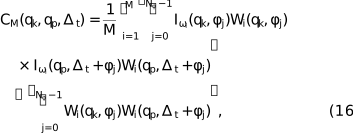
where Wi(qk, ϕj) is a binary mask for the ith image (Zaluzhnyy et al., 2017). The mask has the value of 0 for all sampling points (qk, ϕj) for which image data should be excluded (masked) from the analysis, and the value of 1 otherwise. Equation (16) suggests that, in practice, the CCF can be successfully determined even if many pixels are masked on individual diffraction patterns (see Section S4 of the supporting information), in the limiting case allowing measurements to be made using two-point detectors [see, for instance, Clark et al. (1983)].
3.2. Extraction of the rotational invariants
In the 2D case, equation (5) directly identifies the invariants Bn(q, q′) as the coefficients of the circular harmonic expansion of the averaged CCF , and thus their determination is straightforward. In the 3D case, the relation between the invariants Bl(q, q′) and , given by equations (9) and (10), is more complicated. At flat Ewald sphere conditions (small-angle approximation) equation (10) simplifies to  . In this case equation (9) represents the Legendre series expansion of
  , and the invariants Bl(q, q′) can be extracted by applying the inverse Legendre transform to . In general, at curved Ewald sphere conditions [θ(q) ≠ π/2], the inverse Legendre transform extraction is not applicable since Fl(q, q′, Δ) do not satisfy the orthogonality property of Legendre polynomials; therefore other approaches need to be applied.
A common way of extracting the invariants Bl(q, q′) is to consider equation (9), for each pair of fixed q and q′ and discretized angular coordinate Δ [see CM(qk, qp, Δt) in equation (16)], as a system of NΔ linear equations. By treating the CCF at fixed q and q′ as a vector  of size NΔ, the invariant Bl(q, q′) as a vector Bl of size L + 1, and Fl(q, q′, Δ) as an NΔ × (L + 1) matrix
  , it is possible to specify this system of linear equations as

where L is the maximal considered invariant order, defined by the complexity of the particle structure and extent of the measured correlation data in In practical applications, usually NΔ > L; therefore, the matrix is not square, and the overdetermined system of linear equations (17) may only be solved approximately. Usually least-squares methods such as the pseudo-inversion (Ford, 2014), based on a singular value decomposition of , are used to solve such linear systems.
Here we propose a different extraction method for the invariants Bl which is based on the circular harmonic expansion coefficients of the averaged CCF. It is possible to express Fl(q, q′, Δ) in equation (9) in terms of spherical harmonics as (Saldin et al., 2009)

while the spherical harmonics can be specified using the associated Legendre polynomials  as
as

By combining equations (18) and (19) with (9), the averaged CCF can be expressed as

From this equation one may see that the circular harmonic expansion coefficients  ×
×  take the form

with

Since the associated Legendre polynomials  vanish for l < |n|, the summation in equation (21) involves only orders l ≥ |n|. This means that Bl for a given l is completely determined by the circular harmonic expansion coefficients
  , up to the order n = l. Considering a cutoff order L we obtain a linear system of equations that can be written in matrix form as

where n, l ≤ L, and  is the (L + 1) × (L + 1) upper-triangular matrix whose elements are

The upper-triangular linear system (23) can be directly solved using back-substitution (Ford, 2014). The computational complexity of the proposed method of extraction of Bl, including calculation of the Fourier coefficients  , is given by
  , as opposed to
  when solving equation (17) directly using singular value decomposition.
Note that B0(q, q′) can be directly determined from the measured SAXS intensity profiles,  ×
×  [see equation (3)], as B0(q, q′) = 4πISAXS(q)ISAXS(q′), where the 4π factor is due to the chosen normalization of the spherical harmonics [see equation (19)]. This way of determining B0(q, q′) should be preferred in the case of noisy diffraction patterns, and is unavoidable if more complex forms of the CCFs are applied to mitigate background scattering [see, for instance, Kurta et al. (2017)].
3.3. Iterative phasing using the MTIP algorithm
For ab initio single-particle from the extracted invariants Bn or Bl, we employ the MTIP algorithm (Donatelli et al., 2015; Kommera et al., 2021) with certain modifications (see Sections 3.3.3 and 3.3.4). Similarly to other iterative phasing methods used in CXDI/SPI, the single-particle structure is recovered by iteratively enforcing constraints in real and reciprocal spaces. Details of the implemented iterative phasing loop are described in the following subsections.
3.3.1. Real-space constraints
A finite size of a particle leads to the formulation of the commonly used real-space support constraint, which defines a region of space where the electron density is expected to have nonzero values. Each reconstruction run starts with an initial random guess for the electron density ρ(r) of a particle. In our implementation the initial support function S(r) is defined as a sphere, which can be optimally set to the expected size of the reconstruction target. As the reconstruction progresses the support constraint is systematically updated according to the shrinkwrap (SW) algorithm (Marchesini et al., 2003), that is the updated support is determined as an isosurface at a specified threshold of the convolution between the current density guess ρ′(r) and a Gaussian function, i.e.

Here  denotes convolution, and the free parameters σ and γ define the standard deviation of the Gaussian function and a relative threshold, respectively. Usually, the initial value of σ is chosen to be slightly above the expected full-period resolution of the reconstructed density and gradually decreases as the reconstruction progresses. The threshold γ is defined relative to the maximum density value
  in the current phasing iteration and remains constant.
An often encountered set of real-space constraints used in X-ray imaging can be formulated as a (density) value projection PV, implemented here in the following general form:

with

and

Re(·) and Im(·) define the real and imaginary parts of the corresponding arguments, and  ,
,  ,
,  and
and  are free parameters. Depending on a particular choice of these four parameters, it is possible to set arbitrary bounds on the real and imaginary parts of ρ(r), particularly to impose reality or non-negativity. The value projection of ρ′(r) on the support function can then be defined as

The real-space domain incorporates the well known X-ray imaging algorithms, such as error reduction (ER) (Gerchberg & Saxton, 1972) and hybrid input–output (HIO) (Fienup, 1982). Iterative update of ρ(r) by these methods can be expressed using the projection PSV. In the ER scheme, the input electron density in the (i + 1)th iteration is defined using the output of the ith iteration as (see Fig. 3)

while for the HIO algorithm we have

where β ∈ (0, 1] is a free parameter that regulates the strength of the negative feedback (Fienup, 1982; Donatelli et al., 2015).
![[Figure 3]](yr5118fig3thm.gif) | Figure 3 A scheme of the implemented MTIP loop. The filled orange squares mark the entry points for constraints, and the black square denotes the initial density guess. The quantities labeled on the scheme (ρ, I, In/ Ilm etc.) should be interpreted as iterative estimates of the corresponding theoretical quantities defined in equations (4) –(11). |
3.3.2. Reciprocal-space constraints
The main reciprocal-space constraint is realized by means of the correlation projection PC (see Fig. 3), which takes the current approximation of the single-particle intensity harmonic coefficients In or Ilm and determines the closest function, in the discrete L2 norm, whose harmonic coefficients comply with equation (15).
In the 2D case this corresponds to finding the complex phase factors un (with |un| = 1) for which the discrete L2 distance between In and  becomes minimal (Donatelli et al., 2015), that is

|| · ||q and 〈 ·, · 〉q are the L2 norm and scalar product, respectively, weighted by qk in order to comply with a continuous L2 norm defined on a spherical grid. In the derivation of equation (30) it was considered that the maximal real part of the scalar product  is obtained for the phase factor un that forces it to become real. Using the latter result, it is possible to formulate the correlation projection PC in the 2D case as

Analogously, in the 3D case one seeks to minimize (Donatelli et al., 2015)

over all unitary matrices Ul of size 2l + 1, where  is the Frobenius norm (Ford, 2014) weighted by the square of the radial points qk2. The weighting factors qk2 are again present to comply with the L2 norm defined on a spherical grid. Such a minimization problem is known as a unitary Procrustes problem (Gower & Dijksterhuis, 2004). Instead of zero padding
  in the case of Nl ≤ (2l + 1), we alter the minimization constraint of equation (32) in requiring Ul to be a semi-unitary matrix, by which we mean an Nl × (2l + 1) matrix that satisfies . A solution to the minimization problem (32) is found using the singular value decomposition
  of the Nl × (2l + 1) matrix
  , where
  is the conjugate transpose of defined in equation (15), D is the N × N diagonal matrix of radial grid points D = diag(q0, …, qN−1), while
  and
and  are unitary matrices of sizes Nl × Nl and Nl × (2l + 1), respectively, and
  is an Nl × Nl diagonal matrix of non-negative singular values. The minimizing matrix Ul is then given by

and consequently the correlation projection PC in the 3D case can be specified as

The other projection applied in reciprocal space is the intensity projection PI defined as

This is formulated similarly to the Fourier modulus projection, which serves as the main reciprocal-space constraint in conventional CXDI/SPI. Note that the described formalism differs from conventional SPI in that here I′(q) is not the experimentally measured scattered intensity but rather its current approximation, which is, along with the real-space density  , iteratively refined using the measured invariants Bn and Bl as constraints.
3.3.3. Polar and spherical Fourier transforms
Since the main reciprocal projection PC is formulated in terms of harmonic coefficients of the scattered intensity, the need arises to implement the complete phasing loop (see Fig. 3) on a polar/spherical grid (including the Fourier transforms), in order to avoid the inaccuracies and performance limitations which would be imposed otherwise by repeated interpolations between Cartesian and polar/spherical grids. There is, however, no discrete Fourier transform in polar or spherical coordinates which would allow for repeated forward and inverse transforms. The approach applied here, as proposed by Donatelli et al. (2015), is to numerically approximate Hankel transforms, which connect the harmonic expansion of a function to the harmonic expansion of its Fourier transform. Consider ρn(r) and  to be the harmonic expansion coefficients of an electron density in polar and spherical coordinates, and let
  and
and  be the expansion coefficients of the respective scattering amplitudes (Fourier transformed densities). The connection between ρn(r) and
  in the 2D case is then given by the Hankel transform


where Jm are Bessel functions of the first kind on integer order m. In the spherical (3D) case one finds


where jl are spherical Bessel functions. One approach to numerically approximate the continuous Hankel transforms given in equations (36) and (37) is to expand the harmonic coefficients ρm(r) or (and their reciprocal-space counterparts) in some orthogonal basis, thereby shifting the Hankel integral to the expansion functions (see Appendix B). In the original version of MTIP this is accomplished using the cosine/sine series expansions (Donatelli et al., 2015) (see Appendix B2). We also developed another approximation based on Zernike polynomial expansions, which allowed us to obtain closed-form expressions for the quadrature weights of the discretized Hankel transform (see Appendix B3). Further investigation, however, showed that both approaches converge to direct approximations of the integrals in equations (36) and (37) using a Riemann sum (see Appendices B1 and B4). We therefore employ the midpoint rule as a default approximation scheme for the Hankel integrals in our reconstruction workflow (see Appendix B4). In the 2D case, the Hankel transform (36) can thus be approximated on a discrete polar grid as


with the quadrature weights ωm(p, k) being defined by

In the 3D case, the spherical Hankel transform (37) is approximated by


using the quadrature weights

Note that the weights in the inverse transforms (38b) and (39b) are determined by transposing the parameters p and k in the weight functions specified for the forward transforms in equations (38c) and (39c), respectively.
3.3.4. Fourier transform stabilization
We empirically found that stabilizing the Fourier transforms in the iterative loop by the following procedure may improve the convergence of reconstructions. The basic idea behind this operation is to reduce possible errors due to approximating the continuous Fourier transform in each MTIP iteration (see Section 3.3.3). Using the notation in Fig. 3 this correction can be expressed by modifying the definition of  as
as

where FT−1 denotes the inverse Fourier transform. In the limit of a completely converged MTIP reconstruction, i.e. when  , meaning that the reciprocal-space projections do not change the intensity anymore, this definition ensures that the modified density ρ′ coincides with the input density ρ of the current iteration. Without this procedure ρ′ and ρ would differ due to the applied Fourier transform approximations.
3.3.5. Error metrics
The evolution of the iterative phasing process can be tracked using several metrics, which may serve as convergence and error estimates. In analogy to error metrics commonly used in conventional X-ray imaging (Fienup, 1978, 1982), we define the relative normalized errors in reciprocal and real space as (see Fig. 3)


where PSV is the density projection defined in equation (27). Here  denotes the L2 norm in polar/spherical coordinates, that is

and

for square integrable functions f(r, ϕ) and g(r, θ, ϕ). Since, as previously mentioned, the single-particle scattered intensity is initially unknown in FXS and reconstructed during the phasing process, the metrics Ereciprocal and Ereal can only serve as convergence indicators and do not directly estimate the deviation of the current solution from experimental observables. For this reason, we also define metrics for determining the relative difference in the L2 norm on the level of the invariants as


where Bn(q, q′) and Bl(q, q′) denote the input invariants employed as constraints, while  and
and  are the invariants calculated from the harmonic coefficients In(q) and Iml(q) corresponding to the current phasing loop iteration (see Fig. 3).
3.4. Alignment and averaging of reconstructions
The invariants Bn or Bl, employed as input data in the phasing process, do not contain (by definition) any information about the absolute position, orientation and point inversion of a particle in space. Therefore, individual reconstructions ρ(r) initiated from a random density guess may vary in these properties. Similarly to conventional iterative phasing schemes, the MTIP algorithm may also produce nonunique solutions (Donatelli et al., 2015). Therefore, it is customary to present the final solution as an average of selected and aligned individual reconstructions.
Combining the action of rotations on the intensity harmonic coefficients in two [equation (7)] and three dimensions [equation (12)], in their matrix form, with equation (15) allows one to examine their action on the level of the unknowns un and Ul via


where we interpret Dl(α, β, γ) for each l as a (2l + 1) × (2l + 1) matrix. Since in the 2D case un is itself a phase factor, the rotational freedom in φ allows us to freely specify  for a single chosen order n during the iterative phasing process. This condition causes the number of possible orientation states an individual reconstruction can attain to become finite. This, in turn, enables a posteriori algebraic orientation determination on the level of individual 2D reconstructions (see Section S2 of the supporting information).
In the 3D case, the restriction posed by equation (43b) is not strong enough to fix any of the unknown matrices  during the reconstruction process. Therefore, orientational alignment of 3D reconstructions is performed after completing the iterative phasing as follows. First, all reconstructions are centered at their respective centers of density and a reference reconstruction ρref is selected. All reconstructions are then orientationally aligned with respect to this reference using fast Fourier transforms on the special orthogonal group SO(3) as described by Kostelec & Rockmore (2008). This procedure enables efficient calculations of the rotational cross-correlation
  between the reference ρref(r, θ, ϕ) and any other reconstructed density ρ(r, θ, ϕ), which is given by

 is a rotation in SO(3) and
  is a rotated version of the reconstructed density ρ(r, θ, ϕ).
The cross-correlation is maximal at the rotation  for which the rotated density
  optimally matches the corresponding reference ρref. To facilitate structure alignment it is helpful to limit the range (rmin, rmax) to regions of the reconstructed densities that are not spherically symmetric. In order to correct for a possible point inversion in the reconstructions, we apply this alignment procedure to each 3D reconstruction ρ, as well as its point-inverse ρinv, resulting in two aligned candidates per reconstruction. Finally, we determine the relative distance of the two candidates
  from the reference density ρref using the L2 norm,

and select the candidate ρrot with the lowest distance for subsequent averaging.
Note that, in the 2D case, after centering and aligning the reconstructions according to the procedure described in Section S2 of the supporting information, we also use equation (45) to correct for point inversion.
The presented algorithm allows one to select the reconstructions to be used in the final average on the basis of their error metrics (41) and (42), as well as their distance (45) from the reference structure. Finally a resolution estimate of the average can be computed using a generalized version of the phase retrieval transfer function (PRTF) (Kurta et al., 2017),

where 〈·〉i denotes averaging over the selected collection of aligned reconstructions and FT[ρi(r)] is the Fourier transform of the ith aligned electron density (see Fig. 3). If we assume that  are identical in all individual reconstructions, as is the case in conventional CXDI [where
  and I(q) is the experimentally determined intensity], expression (46) reduces to the conventional PRTF formula [see e.g. Chapman et al. (2006)].
4. xFrame: a Python implementation of the reconstruction workflow
The reconstruction workflow described in Section 3 is implemented in the open-source software suite xFrame available at https://github.com/European-XFEL/xFrame. The software consists of the back-end framework, which takes care of technical details unrelated to the reconstruction process (e.g. multiprocessing, GPU access, data storage, input settings etc.), and the fxs project which implements various routines of the reconstruction pipeline (calculations of the CCF, extraction of invariants, iterative phasing, averaging of reconstructions).
4.1. Dependencies
Table 1 lists xFrame dependencies and their usage. For computationally expensive operations such as the Fourier and harmonic transforms, we use existing software that references to C or Fortran routines wherever possible. In all other cases we rely on numpy vectorization and GPU acceleration using OpenCL. Although xFrame depends exclusively on cross-platform packages, it has currently only been tested on Linux-based operating systems.
|
4.2. Input/output data formats
xFrame requires input data in the form of a set of diffraction patterns in binary format or a statistically averaged two-point CCF CM(q, q′, Δ) in HDF5 format. Human-readable YAML files are used to specify the input settings for different xFrame routines. The output data produced by xFrame are stored in four standard formats, which are HDF5, YAML, VTK and PNG. The HDF5 format is used for general-purpose data storage, e.g. to save calculated metrics and reconstruction results, and the output YAML files are used to store the input settings associated with a particular reconstruction. Finally, VTK files and PNG images target visualization of reconstruction results. Specifically, the open-source VTK file format allows one to examine the reconstructed densities on their native spherical or polar grid without any further postprocessing.
4.3. xFrame usage
A typical reconstruction pipeline using the command-line interface of xFrame is shown in Fig. 4. It is possible to enter the workflow at different points, by running xframe fxs correlate to compute the CCF (16) from a set of input diffraction patterns, or extracting the rotational invariants Bn or Bl from the two-point CCF (by running xframe fxs extract with a specified input CCF in HDF5 format), or directly running reconstructions using the extracted invariants (xframe fxs reconstruct), which can then be aligned and averaged in a final step using xframe fxs average. Apart from the command-line interface it is also possible to use xFrame directly as a Python module. Details on the installation process as well as tutorials can be found at https://xframe-fxs.readthedocs.io.
![[Figure 4]](yr5118fig4thm.gif) | Figure 4 Diagram of a typical reconstruction workflow (left) using the command-line tools (right) of xFrame. Each of the xFrame commands takes as an argument a human-readable settings file that specifies all relevant options. |
The iterative phasing process is implemented in a way that allows one to run a single reconstruction per available CPU core using the Python multiprocessing module, while at the same time access to the GPU resources is shared among all parallel reconstructions (see Section S1 in the supporting information).
5. Reconstructions from simulated data using xFrame
Here we demonstrate single-particle structure recovery from simulated FXS data using xFrame. The scattering intensities (1) were simulated assuming ideal kinematic X-ray scattering without noise. We considered dilute limit approximation, where inter-particle interference can be neglected, and simulated 105 diffraction patterns for each of the considered model structures presented in Fig. 5. Diffraction patterns were computed up to a maximum momentum transfer Qmax = 0.32 Å−1 for model A, and up to Qmax = 0.42 Å−1 for models B and C. The diffraction patterns were then used to determine the averaged CCF (16), and subsequently the invariants Bn and Bl.
![[Figure 5]](yr5118fig5thm.gif) | Figure 5 Three model structures (models A–C) considered for reconstructions using xFrame: (a)–(d) a pentagonal cluster consisting of spheres of uniform density with a diameter of 140 nm, with the red spheres being of doubled density as compared with the blue spheres; (e)–(h) the human apoptosome (PDB entry 3j2t; Yuan et al., 2013 ); (i)–(l) the mechanosensitive ion channel Piezo1 (PDB entry 6b3r; Guo & MacKinnon, 2017). The two upper rows show distinct views of the 3D structures. The third row displays 2D slices through the centers of the respective 3D models, and the bottom row displays 2D projections on the image plane, which were produced using the electron-density maps generated in UCSF Chimera (Pettersen et al., 2004) for the corresponding 3D models. The white scale bars shown in the two bottom rows correspond to 5 nm. |
We first consider the reconstruction results for the single-particle case (Np = 1), where the input set of diffraction patterns was simulated from single particles in random orientations in two or three dimensions. For instance, the invariants extracted [by solving equation (23)] from the 2D and 3D FXS data sets simulated for a single pentagonal cluster of spheres (model A) are shown in Fig. 6.
![[Figure 6]](yr5118fig6thm.gif) | Figure 6 Absolute values of the rotational invariants  and and  of orders n, l = 2, 4, 6 and 8, determined for model A in the 2D case (right) and 3D case (left). The invariants Bn(q1,q2) show features in the form of straight lines, which is a direct consequence of the fact that each of orders n, l = 2, 4, 6 and 8, determined for model A in the 2D case (right) and 3D case (left). The invariants Bn(q1,q2) show features in the form of straight lines, which is a direct consequence of the fact that each  is a matrix of rank 1. The invariants Bl(q1,q2) display more complex features since the respective matrix is a matrix of rank 1. The invariants Bl(q1,q2) display more complex features since the respective matrix  can have a rank higher than 1 (see Section 2.3). can have a rank higher than 1 (see Section 2.3). |
The complete iterative phasing process in xFrame is divided into the main and stages, where the electron density with the lowest error metric obtained during the main phasing stage is further optimized in the stage. xFrame allows one to separately set up the number, sequence and parameters of ER, HIO and SW procedures (see Section 3.3.1) in the main and refinement stages. For the 3D reconstructions shown in Fig. 7 the main stage consisted of blocks of 60× HIO, followed by 1× SW and 40× ER steps. The number of used iteration blocks varied from five in the case of model A to 30 for model B and model C. The 3D part consisted of a single block of 1× SW followed by 200× ER steps for all considered models.
![[Figure 7]](yr5118fig7thm.gif) | Figure 7 Averaged 2D and 3D reconstructions obtained using xFrame for three different model structures shown in Fig. 5 . The two upper rows show two distinct views of the reconstructed 3D structures, and the third row displays 2D slices through the centers of the respective 3D reconstructions. The bottom row displays averaged 2D reconstructions, which correspond to the 2D projections shown in the bottom row in Fig. 5. The first two rows show isosurfaces at 15% of the maximal reconstructed electron-density value, and the last two rows display density values higher than 15% of the maximal density value. The 2D slices in (c), (g) and (k) are taken at approximately the same regions of the electron density as given for the model structures in (c), (g) and (k) of Fig. 5, respectively. The white scale bars shown in the two bottom rows correspond to 5 nm. |
The obtained 2D reconstructions [Figs. 7(d), 7(h) and 7(l)] were produced using ten main stage iteration blocks consisting of 500× HIO followed by 1× SW and 200× ER steps, while the refinement part consisted of 1× SW step followed by 200× ER iterations. The HIO parameter β was determined in the ith iteration as β(i) = a exp(bi) + c, with parameters a, b and c chosen in such a way that β(i) was exponentially decreasing during the reconstruction process from 0.5 down to 0.14 for the 3D reconstructions, and from 0.1 down to 0.01 for the 2D reconstructions. The SW threshold value γ [equation (25)] was set to 0.11, and the standard deviation σ was linearly decreasing from 2 nm to 1.5 nm during the reconstruction for all models. The density value projection [equations (26)] was parameterized as  ,
,  ,
,  and
and  . We empirically found that allowing small nonzero values of and results in improved convergence rates of reconstructions. The Fourier transform stabilization has been applied as described in Section 3.3.4. The presented 3D reconstructions were obtained considering spherical harmonic expansion orders up to
  , while the 2D reconstructions used circular harmonic orders up to
  . The reciprocal projection used invariants Bn and Bl up to the same maximal orders while setting all odd-order invariants to 0. The considered number of radial steps was N = 256 for all models, and the angular sampling was chosen such that the maximal harmonic order could be resolved (see Appendix A). To follow the reconstruction progress we used the error metric Ereal defined in equation (41b).
Individual reconstructions were classified as `converged' or `not converged' according to the histograms of the final values of the error metric Ereal (see Fig. 8 and Table 2). Note the different convergence rates for different structures in Table 2. The reconstructed structures shown in Fig. 7 were obtained by aligning and averaging 100 converged reconstructions for each model using xframe fxs average. The corresponding PRTF curves [equation (46)] computed for the single-particle reconstructions are shown in Fig. 9, indicating that the resolution is Fourier limited, i.e. limited by the extent of the simulated FXS data in The impact of the maximum considered spherical harmonic expansion order lmax on the resolution of the obtained 3D reconstructions is illustrated in Fig. S4 of the supporting information.
| ||||||||||||||||||||||||||
![[Figure 8]](yr5118fig8thm.gif) | Figure 8 Normalized histograms of the final error metric values Ereal [equation (41b) ] shown for all individual 2D and 3D reconstructions listed in Table 2. For most of the models the reconstructions cluster into two groups separated by at least half an order of magnitude in their final error value, which allows one to identify converged reconstructions by introducing a threshold. The thresholds for each model are signified by the dashed green lines, placed at  for the 2D model B, and at for the 2D model B, and at  for all other models. Thus, the parts of the histograms shown in light-blue and orange colors correspond to converged and not converged reconstructions, respectively. For the 2D model A all computed reconstructions have approximately similar values of Ereal and were considered to be converged. The 3D model A has a total of three reconstructions with error values around for all other models. Thus, the parts of the histograms shown in light-blue and orange colors correspond to converged and not converged reconstructions, respectively. For the 2D model A all computed reconstructions have approximately similar values of Ereal and were considered to be converged. The 3D model A has a total of three reconstructions with error values around  that did not converge. that did not converge. |
![[Figure 9]](yr5118fig9thm.gif) | Figure 9 PRTF curves determined for the averaged 2D (bottom) and 3D (top) reconstructions shown in Fig. 7 . The red lines define a cutoff value of 1/e, used to estimate the reconstruction resolution by PRTF. Since all PRTF curves are above this threshold, the resolution of the reconstructed structures is limited by the momentum transfer cutoffs in the respective input data, which are 0.32 Å−1 for model A and 0.42 Å−1 for models B and C. |
The ability to perform X-ray scattering measurements from just individual particles (Np = 1) in solution at near-physiological conditions represents an ideal scenario for FXS analysis, although it might be challenging to achieve in practice for weakly scattering bioparticles. The invariant-based FXS approach offers the possibility to perform reconstructions based on multiparticle (Np > 1) X-ray scattering (see Sections 2.1 and 2.2), in which the total scattering from bioparticles is enhanced compared with single-particle measurements. According to equations (6) and (11), a scaled version of the single-particle invariants can be extracted from such multiparticle FXS data. Under the assumption that Np is known, the invariants extracted from the multiparticle scattering data can be normalized, i.e. the zero harmonic order by  and all higher orders by Np, and used to perform single-particle structure recovery as described above. Reconstruction results for the multiparticle scattering case (Np = 10) presented in Fig. S5 of the supporting information look very similar to those obtained in the single-particle case (Fig. 7). The sensitivity of the reconstruction results to the accuracy of the determined scaling factors Np is demonstrated in Fig. S6 of the supporting information.
6. Summary and conclusions
In this work, we presented a workflow for single-particle from FXS measurements. The workflow consists of several steps, including calculation of the average two-point CCF from a set of diffraction patterns, extraction of rotational invariants from the CCF, iterative phasing of rotational invariants using the MTIP algorithm, and selection, alignment and averaging of individual reconstructions. We proposed a new method for extracting rotational invariants from the angular Fourier spectra of the CCF (see Section 3.2). We also introduced several modifications to the original version of the MTIP algorithm published by Donatelli et al. (2015), including discrete versions of the Hankel transform (Section 3.3.3) and additional measures to improve phasing stability (Sections 3.3.4 and 3.4).
We considered different approximations of the Hankel transform (see Appendix B) using orthogonal basis expansions, including formulations based on the cosine/sine series expansion (Appendix B2) and Zernike polynomial expansion (Appendix B3), as well as direct approximation of Hankel integrals with Riemann sums using the midpoint rule (Appendix B4). As a byproduct, we derived a closed-form expression for the Hankel transform of the radial part of the 3D Zernike polynomials (Appendix B5). Our results show that the Hankel transform, defined via orthogonal basis expansion of density, produces results that converge to the results of direct approximation of the continuous Hankel integral with a Riemann sum (Appendix B1).
The proposed workflow has been implemented in the open-source software suite xFrame. xFrame features a multiprocessing scheme that allows for parallel reconstruction runs on a multi-core CPU while at the same time enabling GPU acceleration of time-consuming steps within each of the parallel reconstructions (see Section S1 in the supporting information). Successful reconstructions can be identified using distinct error metrics (Section 3.3.5), and subsequently aligned and averaged (Section 3.4). In the 2D case, the alignment routine is partially incorporated into the MTIP loop and completed a posteriori (see Section 3.4 and Section S2 of the supporting information). We demonstrated the functionality of xFrame by performing 2D and 3D reconstructions from simulated single-particle scattering data for several structures (Section 5). The results show successful ab initio recovery of the particle shapes and internal density distribution without the need to apply symmetry constraints. Reconstructions from multiparticle scattering data are also possible, while the feasibility of such reconstructions relies on accurate knowledge of the number of particles  contributing to X-ray snapshots (see Section S3 of the supporting information).
FXS was originally proposed for single-particle from multiparticle solution X-ray scattering; thus, it complements traditional SAXS and SPI techniques. The inverse problem in FXS is solved using iterative phase retrieval, in which two phase problems are tackled simultaneously. The first involves finding unknown unitary matrices to determine the single-particle scattered intensity, which is equivalent to solving the orientation determination problem in conventional SPI. The second is related to finding optimal phases of the single-particle scattering amplitudes, similar to conventional iterative phase retrieval used in SPI or CXDI. At the same time, FXS may naturally expand the information content of traditional solution SAXS experiments if X-ray scattering measurements are performed on timescales faster than the rotation diffusion time of particles in solution. Such multiparticle measurements, however, require very precise detector corrections to be able to detect weak intensity fluctuations about orientationally averaged SAXS (see Section S4 of the supporting information for a brief summary of challenges related to experimental measurements and data processing). If such requirements can be fulfilled, FXS may potentially close the gap between conventional SPI, SAXS and crystallographic particularly in time-resolved studies with an XFEL (Kurta et al., 2023).
Although the single-particle structure reconstruction workflow is presented here in the context of biological applications, it may also serve as an alternative way for 2D and 3D structure determination of arbitrary molecules, nanoparticles, engineered nanostructures etc., provided that FXS data of sufficient quality can be measured. We hope that the presented open-source software xFrame can facilitate efforts in this direction.
APPENDIX A
Discrete polar and spherical grids
In practical applications data acquisition and processing are realized on a finite discrete grid, and hence our reconstruction workflow is implemented on a discrete polar/spherical grid. We define the extent and sampling of the radial coordinates in real and as

where the sets rp and qk of N radial points sample real and (in spherical or polar coordinates) up to a maximum extent Rmax and Qmax, respectively. In practice, Qmax is usually determined by the maximum extent of the measured scattered intensity on a detector (or quality of the CCF), while the real-space cutoff Rmax can be justified by the finite dimensions of the particle, so that the centered at the origin of the coordinate system satisfies the condition ρ(Rmax) = 0. The chosen discretization is compatible with the midpoint rule applied in this work for approximating integrals with Riemann sums (Hughes-Hallett et al., 2012). We use the reciprocity relation RmaxQmax = πN in computations of the discrete Fourier transforms.
As for the angular coordinates, in the 2D polar grid we consider the angle ϕ to be uniformly sampled from 0 to 2π. In the case of the 3D spherical grid, this also applies to the azimuthal angle ϕ, while the polar angle θ is sampled from 0 to π on Gauss–Legendre nodes, i.e.  , where xLi is the ith zero of the Legendre polynomial of the order
  , and lmax is the maximal spherical harmonic order considered in the expansion (8a).
APPENDIX B
Hankel transform approximations
In this appendix we consider different methods for approximating the continuous Hankel transforms in equations (36) and (37).
B1. Expansion via orthogonal polynomials
One of the approaches to derive a discrete version of the Hankel transforms in equations (36) and (37) is to expand ρm(r) or using an orthogonal basis ξi(r) of all square integrable functions on the interval [0, Rmax], e.g. in the 2D case


where ρm,i are the expansion coefficients. This allows one to shift the Hankel integration from ρm(r) to the expansion functions ξi(r), i.e. using equation (48b) in (36a) we get

The integral in equation (49) can be precomputed once independently of the considered function ρm(r), and then used for all subsequent Hankel transform computations. The remaining integral in (48a) in the determination of the expansion coefficients ρm,i can then be approximated by using one of the available methods, e.g. the trapezoidal rule (Donatelli et al., 2015) or midpoint rule (present work), to derive a discrete form of equations (36) and (37). In the present case, equation (49) can be approximated in the following general form,

where Am are constants, ωm(k, q) are quadrature weights defined by the integral in equation (49), and rp and qk are discrete coordinates in real and [see equation (47)]. Such an approach has been implemented by Donatelli et al. (2015) using a cosine/sine series expansion. An example of the cosine/sine approach, using the midpoint rule to approximate the expansion coefficients, is presented in Appendix B2. In this work we also developed an approximation of the Hankel transforms by employing Zernike polynomials as the orthogonal basis functions ξi(r). The advantage of the obtained expressions is that, in this case, the integral in (49) can be evaluated analytically (see Appendix B3) and thus does not require numerical approximation as in the case of a cosine/sine series expansion (see Appendix B2).
At the same time, analysis of expression (49) defined in terms of an arbitrary orthogonal basis ξi(r) reveals further aspects of such an expansion. By applying the midpoint rule to approximate the integral in (48b) on a discrete grid defined in Appendix A, and substituting the result into (49), we obtain

where  . Considering that
  is a real function, the integral in (51) defines, in fact, the complex conjugated coefficients
  of expansion of in the basis ξi(r), that is [see equation (48a)]

Using the latter result in (51) and rearranging the terms we get

One may recognize that the expression in square brackets is exactly the series expansion of  in terms of ξi(rp) [see equation (48b)]. In the limit of infinite expansion orders (i → ∞) such an approximation scheme is, therefore, independent of the chosen orthogonal basis ξi and results in the following expression:

Note that equation (54) corresponds exactly to simple numeric evaluation of the continuous Hankel transform using a Riemann sum in the integration bounds [0, Rmax] [see equation (69) in Appendix B4]. Similar derivations can be performed for the inverse Hankel transform, and also in the 3D case. This conclusion is supported numerically for the 3D case in Fig. S7 of the supporting information, where it is shown that the Zernike [equation (68)] and cosine/sine [equations (56)] weights approach the weights obtained by directly approximating the Hankel integrals using the midpoint rule [equation (39c)]. In our reconstruction workflow, we therefore employ the quadrature weights from the midpoint formulation (see Appendix B4) as a default option, while the Zernike approximation is available for testing.
B2. Cosine/sine series expansion approximation
The quadrature weights given by Donatelli et al. (2015) are determined by employing a cosine/sine series expansion of ρm(r) or , and their reciprocal-space counterparts. Using the definitions in Appendix A and applying the midpoint rule for approximating the integrals, the weights for the 2D case take the following form for odd orders m,
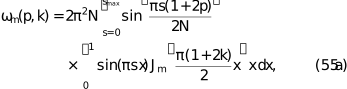
and for even orders m,
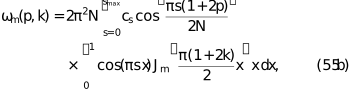
where smax defines the maximum expansion order in the cosine/sine series, cs = 1/2 for s = 0, and cs = 1 otherwise.
In the 3D case the weights for odd orders l are
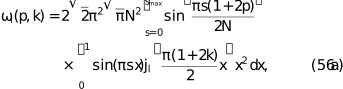
and for even orders l,
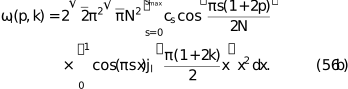
The quadrature weights (55) and (56) can be directly used in forward transforms (38a) and (39a), respectively, while for the inverse transforms (38b) and (39b) the corresponding weight functions should be transposed with respect to p and k.
B3. Zernike polynomial expansion approximation
Here we derive the quadrature weights ωm(p, k) and ωl(p, k) by employing the radial parts of the Zernike polynomials (Zernike, 1934; Born & Wolf, 2019) as the basis functions ξi(r) in the expansion (48).
The radial parts RD,sh(r) of the D-dimensional Zernike polynomials (Zernike & Brinkman, 1935) can be defined using Jacobi polynomials  as
as
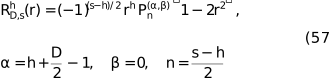
for even s − h, and  otherwise, where s and h are non-negative integers.
The radial polynomials RD,sh(r) form a set of orthogonal polynomials on the interval [0, 1], with the orthogonality condition given for an arbitrary h by

This implies that any sufficiently smooth function f(r) that is defined on a finite interval [0, Rmax] has a series expansion in the polynomials RD,sh(r), i.e.


The advantage of Zernike expansions is that the Hankel transform of RD,sh can be evaluated exactly. In the 2D case (D = 2) for h = m one finds

whereas in the 3D case (D = 3) for h = l we have

for q ≠ 0. A proof of equation (60) can be found in Appendix VII of Born & Wolf (2019), and equation (61) is derived in this work in Appendix B5. Since we are interested in approximating the Hankel transforms of a function defined on a finite interval [0, Rmax], for an arbitrary positive Rmax, we use scaled versions of the integrals (60) and (61),

and

Let us now consider the Hankel transform for the 2D case, as specified in equation (49), and obtain its discrete version in the form of equation (50). By considering the expansion (59) of f(r) = ρm(r) up to the maximum order s = smax, with each expansion coefficient ρm,s approximated using the midpoint rule, we can write
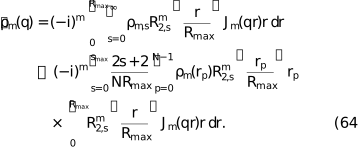
Since ρm(r) is finitely supported, the integration range reduces from [0, ∞) to [0, Rmax]. Note that equation (64) is already represented as a weighted sum with weights that are independent of the function ρm(r). Using the integral relation from equation (62), we arrive at (for q ≠ 0)
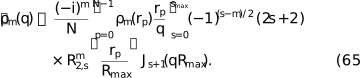
Considering the definitions in equation (47), we finally obtain the discrete version of the Hankel transform in the 2D case in the form of (50),

with the quadrature weights determined as
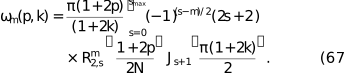
Following a similar procedure, the Zernike weights for the 3D case can be specified as
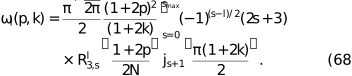
The quadrature weights (67) and (68) can be directly used in the forward transforms (38a) and (39a), respectively, while for the inverse transforms (38b) and (39b) the corresponding weights are obtained by transposing ωm(p, k) and ωl(p, k) with respect to p and k.
B4. Direct approximation of the Hankel integrals using the midpoint rule
Here we consider direct approximations of the Hankel transforms given in equations (36) and (37) with Riemann sums.
In the 2D case the integral in (36a) can be approximated using the midpoint rule as

Using the definitions in Appendix A, we can present equation (69) in the form

where  and the quadrature weights ωm(p, k) are given in equation (38c).
Similarly, in the 3D case the integral in (37a) can be approximated as

where  and the quadrature weights ωl(p, k) are given in equation (39c). Approximations for the inverse Hankel transforms (36b) and (37b) can be obtained in a similar way, producing the discrete forward and inverse Hankel transforms given in equations (38) and (39), respectively.
B5. Hankel transform of the radial part of the 3D Zernike polynomial
Here we provide a proof of equation (61) for the 3D Zernike polynomials, which closely follows the derivation of equation (60) given by Born & Wolf (2019). We shall need the Rodrigues' formula for Jacobi polynomials  and the series expansion of spherical Bessel functions jl(r), which can be obtained from 10.2.2, 10.47.3 and 18.5(ii) of NIST (2023):

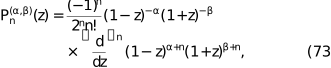
where  denotes the gamma function and n! is the factorial of a non-negative integer number n.
By substituting z = 1 − 2r2 in equation (73) and considering in equation (57) Jacobi polynomials for β = 0, the radial part of the Zernike polynomials for D = 3 yields

with α = l + 1/2 and n = (s − l)/2. By expressing the spherical Bessel function in equation (72) in terms of the argument z = qr, and using equations (72) and (74) in the left-hand side of equation (61), we find the following expansion for the integral:
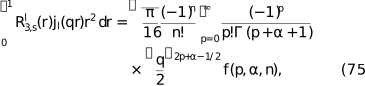
with

The integral in (76) can be reformulated by introducing the variable u = r2, which yields

We shall now perform integration by parts in equation (77) for two cases, p ≥ n and p < n. Notice that a single application of integration by parts results in
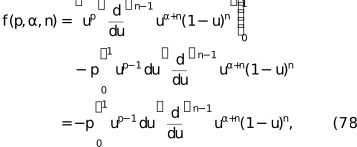
taking into account that n − 1 < n and α > 0.
For p ≥ n we can then perform integration by parts n times in (77), which results in

One may recognize the remaining integral as the beta function [see 5.12.1 in NIST (2023)], which finally yields for p ≥ n

In the case of p < n, it is possible to perform integration by parts only p times in (77), which gives

Using equations (80) and (81) in (75), the latter can be rewritten as
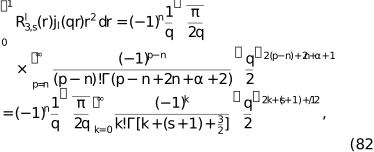
where in the last step we considered that  and introduced a variable k = p − n. Note that the sum in equation (82), including the prefactor
  , is precisely the series expansion of a spherical Bessel function js+1(q) of the order s + 1 [see equation (72)]. This finally yields

which completes the proof of equation (61).
Supporting information
Supporting text and illustrations. DOI: https://doi.org/10.1107/S1600576724000992/yr5118sup1.pdf
Acknowledgements
We are grateful to Alexander Lichtenstein for valuable discussions and supporting the project. We also thank Patrick Adams and Steffen Hauf for helpful discussions. Open access funding enabled and organized by Projekt DEAL.
References
 Altarelli, M., Kurta, R. P. & Vartanyants, I. A. (2010). Phys. Rev. B, 82, 104207. Web of Science CrossRef Google Scholar
Altarelli, M., Kurta, R. P. & Vartanyants, I. A. (2012). Phys. Rev. B, 86, 179904. Web of Science CrossRef Google Scholar
Aquila, A., Barty, A., Bostedt, C., Boutet, S., Carini, G., dePonte, D., Drell, P., Doniach, S., Downing, K. H., Earnest, T., Elmlund, H., Elser, V., Gühr, M., Hajdu, J., Hastings, J., Hau-Riege, S. P., Huang, Z., Lattman, E. E., Maia, F. R. N. C., Marchesini, S., Ourmazd, A., Pellegrini, C., Santra, R., Schlichting, I., Schroer, C., Spence, J. C. H., Vartanyants, I. A., Wakatsuki, S., Weis, W. I. & Williams, G. J. (2015). Struct. Dyn. 2, 041701. Web of Science CrossRef PubMed Google Scholar
Ardenne, B. von, Mechelke, M. & Grubmüller, H. (2018). Nat. Commun. 9, 2375. Web of Science PubMed Google Scholar
Assalauova, D., Kim, Y. Y., Bobkov, S., Khubbutdinov, R., Rose, M., Alvarez, R., Andreasson, J., Balaur, E., Contreras, A., DeMirci, H., Gelisio, L., Hajdu, J., Hunter, M. S., Kurta, R. P., Li, H., McFadden, M., Nazari, R., Schwander, P., Teslyuk, A., Walter, P., Xavier, P. L., Yoon, C. H., Zaare, S., Ilyin, V. A., Kirian, R. A., Hogue, B. G., Aquila, A. & Vartanyants, I. A. (2020). IUCrJ, 7, 1102–1113. Web of Science CrossRef CAS PubMed IUCr Journals Google Scholar
Bielecki, J., Maia, F. R. N. C. & Mancuso, A. P. (2020). Struct. Dyn. 7, 040901. Web of Science CrossRef PubMed Google Scholar
Bogan, M. J., Benner, W. H., Boutet, S., Rohner, U., Frank, M., Barty, A., Seibert, M. M., Maia, F., Marchesini, S., Bajt, S., Woods, B., Riot, V., Hau-Riege, S. P., Svenda, M., Marklund, E., Spiller, E., Hajdu, J. & Chapman, H. N. (2008). Nano Lett. 8, 310–316. Web of Science CrossRef PubMed CAS Google Scholar
Born, M. & Wolf, E. (2019). Principles of Optics, 60th Anniversary Ed. Cambridge University Press. Google Scholar
Bortel, G. & Tegze, M. (2011). Acta Cryst. A67, 533–543. Web of Science CrossRef CAS IUCr Journals Google Scholar
Boutet, S., Lomb, L., Williams, G. J., Barends, T. R. M., Aquila, A., Doak, R. B., Weierstall, U., DePonte, D. P., Steinbrener, J., Shoeman, R. L., Messerschmidt, M., Barty, A., White, T. A., Kassemeyer, S., Kirian, R. A., Seibert, M. M., Montanez, P. A., Kenney, C., Herbst, R., Hart, P., Pines, J., Haller, G., Gruner, S. M., Philipp, H. T., Tate, M. W., Hromalik, M., Koerner, L. J., van Bakel, N., Morse, J., Ghonsalves, W., Arnlund, D., Bogan, M. J., Caleman, C., Fromme, R., Hampton, C. Y., Hunter, M. S., Johansson, L. C., Katona, G., Kupitz, C., Liang, M., Martin, A. V., Nass, K., Redecke, L., Stellato, F., Timneanu, N., Wang, D., Zatsepin, N. A., Schafer, D., Defever, J., Neutze, R., Fromme, P., Spence, J. C. H., Chapman, H. N. & Schlichting, I. (2012). Science, 337, 362–364. Web of Science CrossRef CAS PubMed Google Scholar
Bradski, G. (2000). Dr Dobb's J. Softw. Tools, 25(11), 122–125. Google Scholar
Chapman, H. N. (2019). Annu. Rev. Biochem. 88, 35–58. Web of Science CrossRef CAS PubMed Google Scholar
Chapman, H. N., Barty, A., Marchesini, S., Noy, A., Hau-Riege, S. P., Cui, C., Howells, M. R., Rosen, R., He, H., Spence, J. C. H., Weierstall, U., Beetz, T., Jacobsen, C. & Shapiro, D. (2006). J. Opt. Soc. Am. A, 23, 1179–1200. Web of Science CrossRef Google Scholar
Chapman, H. N., Fromme, P., Barty, A., White, T. A., Kirian, R. A., Aquila, A., Hunter, M. S., Schulz, J., DePonte, D. P., Weierstall, U., Doak, R. B., Maia, F. R. N. C., Martin, A. V., Schlichting, I., Lomb, L., Coppola, N., Shoeman, R. L., Epp, S. W., Hartmann, R., Rolles, D., Rudenko, A., Foucar, L., Kimmel, N., Weidenspointner, G., Holl, P., Liang, M., Barthelmess, M., Caleman, C., Boutet, S., Bogan, M. J., Krzywinski, J., Bostedt, C., Bajt, S. L., Gumprecht, L., Rudek, B., Erk, B., Schmidt, C., Hömke, A., Reich, C., Pietschner, D., Strüder, L., Hauser, G., Gorke, H., Ullrich, J., Herrmann, S., Schaller, G., Schopper, F., Soltau, H., Kühnel, K.-U., Messerschmidt, M., Bozek, J. D., Hau-Riege, S. P., Frank, M., Hampton, C. Y., Sierra, R. G. D., Starodub, J., Williams, G., Hajdu, J., Timneanu, N., Seibert, M. M., Andreasson, J., Rocker, A., Jönsson, O., Svenda, M., Stern, S., Nass, K., Andritschke, R., Schröter, C.-D., Krasniqi, F., Bott, M., Schmidt, K. E., Wang, X. I., Grotjohann, I., Holton, J. M., Barends, T. R. M., Neutze, R., Marchesini, S., Fromme, R., Schorb, S., Rupp, D., Adolph, M., Gorkhover, T., Andersson, I., Hirsemann, H., Potdevin, G., Graafsma, H., Nilsson, B. & Spence, J. C. H. (2011). Nature, 470, 73–77. Web of Science CrossRef CAS PubMed Google Scholar
Chaudhuri, B., Muñoz, I. G., Qian, S. & Urban, V. S. (2017). Editors. Biological Small Angle Scattering: Techniques, Strategies and Tips, Advances in Experimental Medicine and Biology, Vol. 1009. Singapore: Springer. Google Scholar
Clark, N. A., Ackerson, B. J. & Hurd, A. J. (1983). Phys. Rev. Lett. 50, 1459–1462. CrossRef CAS Web of Science Google Scholar
Da Vela, S. & Svergun, D. I. (2020). Curr. Res. Struct. Biol. 2, 164–170. Web of Science CrossRef PubMed Google Scholar
Donatelli, J. J., Zwart, P. H. & Sethian, J. A. (2015). Proc. Natl Acad. Sci. USA, 112, 10286–10291. Web of Science CrossRef CAS PubMed Google Scholar
Ekeberg, T., Assalauova, D., Bielecki, J., Boll, R., Daurer, B. J., Eichacker, L. A., Franken, L. E., Galli, D. E., Gelisio, L., Gumprecht, L., Gunn, L. H., Hajdu, J., Hartmann, R., Hasse, D., Ignatenko, A., Koliyadu, J., Kulyk, O., Kurta, R., Kuster, M., Lugmayr, W., Lübke, J., Mancuso, A. P., Mazza, T., Nettelblad, C., Ovcharenko, Y., Rivas, D. E., Rose, M., Samanta, A. K., Schmidt, P., Sobolev, E., Timneanu, N., Usenko, S., Westphal, D., Wollweber, T., Worbs, L., Xavier, P. L., Yousef, H., Ayyer, K., Chapman, H. N., Sellberg, J. A., Seuring, C., Vartanyants, I. A., Küpper, J., Meyer, M. & Maia, F. R. N. C. (2022). bioRxiv:2022.03.09.483477. Google Scholar
Ekeberg, T., Svenda, M., Abergel, C., Maia, F. R. N. C., Seltzer, V., Claverie, J.-M., Hantke, M., Jönsson, O., Nettelblad, C., van der Schot, G., Liang, M., DePonte, D. P., Barty, A., Seibert, M. M., Iwan, B., Andersson, I., Loh, N. D., Martin, A. V., Chapman, H., Bostedt, C., Bozek, J. D., Ferguson, K. R., Krzywinski, J., Epp, S. W., Rolles, D., Rudenko, A., Hartmann, R., Kimmel, N. & Hajdu, J. (2015). Phys. Rev. Lett. 114, 098102. Web of Science CrossRef PubMed Google Scholar
Elser, V. (2011). Ultramicroscopy, 111, 788–792. Web of Science CrossRef CAS PubMed Google Scholar
Fienup, J. R. (1978). Opt. Lett. 3, 27–29. CrossRef PubMed CAS Web of Science Google Scholar
Fienup, J. R. (1982). Appl. Opt. 21, 2758–2769. CrossRef CAS PubMed Web of Science Google Scholar
Flamant, J., Le Bihan, N., Martin, A. V. & Manton, J. H. (2016). Phys. Rev. E, 93, 053302. Google Scholar
Ford, W. (2014). Numerical Linear Algebra with Applications, 1st ed. Academic Press. Google Scholar
Fung, R., Shneerson, V., Saldin, D. K. & Ourmazd, A. (2009). Nat. Phys. 5, 64–67. Web of Science CrossRef CAS Google Scholar
Gaffney, K. J. & Chapman, H. N. (2007). Science, 316, 1444–1448. Web of Science CrossRef PubMed CAS Google Scholar
Gerchberg, R. W. & Saxton, W. O. (1972). Optik, 35, 227–246. Google Scholar
Giannakis, D., Schwander, P. & Ourmazd, A. (2012). Opt. Express, 20, 12799–12826. Web of Science CrossRef PubMed Google Scholar
Gower, J. C. & Dijksterhuis, G. B. (2004). Procrustes Problems, Oxford Statistical Science Series, Vol. 30. Oxford University Press. Google Scholar
Guo, Y. R. & MacKinnon, R. (2017). eLife, 6, e33660. Web of Science CrossRef PubMed Google Scholar
Hantke, M. F., Hasse, D., Maia, F. R. N. C., Ekeberg, T., John, K., Svenda, M., Loh, N. D., Martin, A. V., Timneanu, N., Larsson, D. S. D., van der Schot, G., Carlsson, G. H., Ingelman, M., Andreasson, J., Westphal, D., Liang, M., Stellato, F., DePonte, D. P., Hartmann, R., Kimmel, N., Kirian, R. A., Seibert, M. M., Mühlig, K., Schorb, S., Ferguson, K., Bostedt, C., Carron, S., Bozek, J. D., Rolles, D., Rudenko, A., Epp, S., Chapman, H. N., Barty, A., Hajdu, J. & Andersson, I. (2014). Nat. Photon. 8, 943–949. Web of Science CrossRef CAS Google Scholar
Harris, C. R., Millman, K. J., van der Walt, S. J., Gommers, R., Virtanen, P., Cournapeau, D., Wieser, E., Taylor, J., Berg, S., Smith, N. J., Kern, R., Picus, M., Hoyer, S., van Kerkwijk, M. H., Brett, M., Haldane, A., del Río, J. F., Wiebe, M., Peterson, P., Gérard-Marchant, P., Sheppard, K., Reddy, T., Weckesser, W., Abbasi, H., Gohlke, C. & Oliphant, T. E. (2020). Nature, 585, 357–362. Web of Science CrossRef CAS PubMed Google Scholar
Hughes-Hallett, D., Gleason, A. M., McCallum, W. G., Flath, D. E., Lock, P. F., Gordon, S. P., Lomen, D. O., Lovelock, D., Osgood, B. G., Pasquale, A., Quinney, D., Tecosky-Feldman, J., Thrash, J., Rhea, K. R. & Tucker, T. W. (2012). Calculus: Single and Multivariable, 6th ed. John Wiley & Sons. Google Scholar
Hunter, J. D. (2007). Comput. Sci. Eng. 9, 90–95. Web of Science CrossRef Google Scholar
Jaeschke, E. J., Khan, S., Schneider, J. R. & Hastings, J. B. (2016). Editors. Synchrotron Light Sources and Free-Electron Lasers. Springer Cham. Google Scholar
Kam, Z. (1977). Macromolecules, 10, 927–934. CrossRef CAS Web of Science Google Scholar
Kam, Z. (1980). J. Theor. Biol. 82, 15–39. CrossRef CAS PubMed Web of Science Google Scholar
Kam, Z., Koch, M. H. J. & Bordas, J. (1981). Proc. Natl Acad. Sci. USA, 78, 3559–3562. CrossRef CAS PubMed Web of Science Google Scholar
Kassemeyer, S., Jafarpour, A., Lomb, L., Steinbrener, J., Martin, A. V. & Schlichting, I. (2013). Phys. Rev. E, 88, 042710. Web of Science CrossRef Google Scholar
Kimura, T., Joti, Y., Shibuya, A., Song, C., Kim, S., Tono, K., Yabashi, M., Tamakoshi, M., Moriya, T., Oshima, T., Ishikawa, T., Bessho, Y. & Nishino, Y. (2014). Nat. Commun. 5, 3052. Web of Science CrossRef PubMed Google Scholar
Kirian, R. A., Schmidt, K. E., Wang, X., Doak, R. B. & Spence, J. C. H. (2011). Phys. Rev. E, 84, 011921. Web of Science CrossRef Google Scholar
Kommera, P. R., Ramakrishnaiah, V., Sweeney, C., Donatelli, J. & Zwart, P. H. (2021). J. Appl. Cryst. 54, 1179–1188. Web of Science CrossRef CAS IUCr Journals Google Scholar
Kostelec, P. J. & Rockmore, D. N. (2008). J. Fourier Anal. Appl. 14, 145–179. Web of Science CrossRef Google Scholar
Kurta, R. P., Altarelli, M. & Vartanyants, I. A. (2016). Adv. Chem. Phys. 161, 1–39. CAS Google Scholar
Kurta, R. P., Altarelli, M., Weckert, E. & Vartanyants, I. A. (2012). Phys. Rev. B, 85, 184204. Web of Science CrossRef Google Scholar
Kurta, R. P., Donatelli, J. J., Yoon, C. H., Berntsen, P., Bielecki, J., Daurer, B. J., DeMirci, H., Fromme, P., Hantke, M. F., Maia, F. R. N. C., Munke, A., Nettelblad, C., Pande, K., Reddy, H. K. N., Sellberg, J. A., Sierra, R. G., Svenda, M., van der Schot, G., Vartanyants, I. A., Williams, G. J., Xavier, P. L., Aquila, A., Zwart, P. H. & Mancuso, A. P. (2017). Phys. Rev. Lett. 119, 158102. Web of Science CrossRef PubMed Google Scholar
Kurta, R. P., Dronyak, R., Altarelli, M., Weckert, E. & Vartanyants, I. A. (2013). New J. Phys. 15, 013059. Web of Science CrossRef Google Scholar
Kurta, R. P., van Driel, T. B., Dohn, A. O., Berberich, T. B., Nelson, S., Zaluzhnyy, I. A., Mukharamova, N., Lapkin, D., Zederkof, D. B., Seaberg, M., Pedersen, K. S., Kjaer, K. S., Rippy, G. I., Biasin, E., Møller, K. B., Gelisio, L., Haldrup, K., Vartanyants, I. A. & Nielsen, M. M. (2023). Phys. Chem. Chem. Phys. 25, 23417–23434. Web of Science CrossRef CAS PubMed Google Scholar
Liu, H., Poon, B. K., Saldin, D. K., Spence, J. C. H. & Zwart, P. H. (2013). Acta Cryst. A69, 365–373. Web of Science CrossRef IUCr Journals Google Scholar
Loh, N. D. & Elser, V. (2009). Phys. Rev. E, 80, 026705. Web of Science CrossRef Google Scholar
Malmerberg, E., Kerfeld, C. A. & Zwart, P. H. (2015). IUCrJ, 2, 309–316. Web of Science CrossRef CAS PubMed IUCr Journals Google Scholar
Mancuso, A. P., Gorniak, T., Staier, F., Yefanov, O. M., Barth, R., Christophis, C., Reime, B., Gulden, J., Singer, A., Pettit, M. E., Nisius, T., Wilhein, T., Gutt, C., Grübel, G., Guerassimova, N., Treusch, R., Feldhaus, J., Eisebitt, S., Weckert, E., Grunze, M., Rosenhahn, A. & Vartanyants, I. A. (2010). New J. Phys. 12, 035003. Web of Science CrossRef Google Scholar
Marchesini, S. (2007). Rev. Sci. Instrum. 78, 011301. Web of Science CrossRef PubMed Google Scholar
Marchesini, S., He, H., Chapman, H., Hau-Riege, S., Noy, A., Howells, M., Weierstall, U. & Spence, J. (2003). Phys. Rev. B, 68, 140101. Google Scholar
Martin, A. V. (2017). IUCrJ, 4, 24–36. Web of Science CrossRef CAS PubMed IUCr Journals Google Scholar
Mendez, D., Watkins, H., Qiao, S., Raines, K. S., Lane, T. J., Schenk, G., Nelson, G., Subramanian, G., Tono, K., Joti, Y., Yabashi, M., Ratner, D. & Doniach, S. (2016). IUCrJ, 3, 420–429. Web of Science CrossRef CAS PubMed IUCr Journals Google Scholar
Nakano, M., Miyashita, O., Jonic, S., Song, C., Nam, D., Joti, Y. & Tama, F. (2017). J. Synchrotron Rad. 24, 727–737. Web of Science CrossRef IUCr Journals Google Scholar
Nakano, M., Miyashita, O., Jonic, S., Tokuhisa, A. & Tama, F. (2018). J. Synchrotron Rad. 25, 1010–1021. Web of Science CrossRef CAS IUCr Journals Google Scholar
Nakasako, M., Kobayashi, A., Takayama, Y., Asakura, K., Oide, M., Okajima, K., Oroguchi, T. & Yamamoto, M. (2020). Biophys. Rev. 12, 541–567. CrossRef PubMed Google Scholar
Neutze, R., Wouts, R., van der Spoel, D., Weckert, E. & Hajdu, J. (2000). Nature, 406, 752–757. Web of Science CrossRef PubMed CAS Google Scholar
NIST (2023). NIST Digital Library of Mathematical Functions. https://dlmf.nist.gov/, release 1.1.9 of 2023-03-15. Edited by F. W. J. Olver, A. B. Olde Daalhuis, D. W. Lozier, B. I. Schneider, R. F. Boisvert, C. W. Clark, B. R. Miller, B. V. Saunders, H. S. Cohl & M. A. McClain. NIST, Gaithersburg, MD, USA. Google Scholar
Nugent, K. A. (2010). Adv. Phys. 59, 1–99. Web of Science CrossRef Google Scholar
Orville, A. M. (2020). Curr. Opin. Struct. Biol. 65, 193–208. Web of Science CrossRef CAS PubMed Google Scholar
Pande, K., Donatelli, J. J., Malmerberg, E., Foucar, L., Bostedt, C., Schlichting, I. & Zwart, P. H. (2018). Proc. Natl Acad. Sci. USA, 115, 11772–11777. Web of Science CrossRef CAS PubMed Google Scholar
Pandey, S., Bean, R., Sato, T., Poudyal, I., Bielecki, J., Cruz Villarreal, J., Yefanov, O., Mariani, V., White, T. A., Kupitz, C., Hunter, M., Abdellatif, M. H., Bajt, S., Bondar, V., Echelmeier, A., Doppler, D. M., Emons, M., Frank, M., Fromme, R., Gevorkov, Y., Giovanetti, G., Jiang, M., Kim, D., Kim, Y., Kirkwood, H., Klimovskaia, A., Knoska, J., Koua, F. H. M., Letrun, R., Lisova, S., Maia, L., Mazalova, V., Meza, D., Michelat, T., Ourmazd, A., Palmer, G., Ramilli, M., Schubert, R., Schwander, P., Silenzi, A., Sztuk-Dambietz, J., Tolstikova, A., Chapman, H. N., Ros, A., Barty, A., Fromme, P., Mancuso, A. P. & Schmidt, M. (2020). Nat. Methods, 17, 73–78. Web of Science CrossRef PubMed Google Scholar
Pawn, B. R. (2013). J. Phys. Condens. Matter, 25, 383201. Web of Science PubMed Google Scholar
Pedrini, B., Menzel, A., Guizar-Sicairos, M., Guzenko, V. A., Gorelick, S., David, C., Patterson, B. D. & Abela, R. (2013). Nat. Commun. 4, 1647. Web of Science CrossRef PubMed Google Scholar
Pettersen, E. F., Goddard, T. D., Huang, C. C., Couch, G. S., Greenblatt, D. M., Meng, E. C. & Ferrin, T. E. (2004). J. Comput. Chem. 25, 1605–1612. Web of Science CrossRef PubMed CAS Google Scholar
Rodenburg, J. M. (2008). Adv. Imaging Electron. Phys. 150, 87–184. Web of Science CrossRef Google Scholar
Rose, M. (1957). Elementary Theory of Angular Momentum, Structure of Matter Series. New York: John Wiley & Sons. Google Scholar
Rose, M., Bobkov, S., Ayyer, K., Kurta, R. P., Dzhigaev, D., Kim, Y. Y., Morgan, A. J., Yoon, C. H., Westphal, D., Bielecki, J., Sellberg, J. A., Williams, G., Maia, F. R. N. C., Yefanov, O. M., Ilyin, V., Mancuso, A. P., Chapman, H. N., Hogue, B. G., Aquila, A., Barty, A. & Vartanyants, I. A. (2018). IUCrJ, 5, 727–736. Web of Science CrossRef CAS PubMed IUCr Journals Google Scholar
Saldin, D. K., Poon, H. C., Schwander, P., Uddin, M. & Schmidt, M. (2011). Opt. Express, 19, 17318–17335. Web of Science CrossRef CAS PubMed Google Scholar
Saldin, D. K., Poon, H. C., Shneerson, V. L., Howells, M., Chapman, H. N., Kirian, R. A., Schmidt, K. E. & Spence, J. C. H. (2010). Phys. Rev. B, 81, 174105. Web of Science CrossRef Google Scholar
Saldin, D. K., Shneerson, V. L., Fung, R. & Ourmazd, A. (2009). J. Phys. Condens. Matter, 21, 134014. Google Scholar
Schaeffer, N. (2013). Geochem. Geophys. Geosyst. 14, 751–758. Web of Science CrossRef Google Scholar
Schroeder, W., Martin, K. & Lorensen, B. (2006). The Visualization Toolkit: an Object-Oriented Approach to 3D Graphics. Kitware. Google Scholar
Seibert, M. M., Ekeberg, T., Maia, F. R. N. C., Svenda, M., Andreasson, J., Jönsson, O., Odić, D., Iwan, B., Rocker, A., Westphal, D., Hantke, M., DePonte, D. P., Barty, A., Schulz, J., Gumprecht, L., Coppola, N., Aquila, A., Liang, M., White, T. A., Martin, A., Caleman, C., Stern, S., Abergel, C., Seltzer, V., Claverie, J.-M., Bostedt, C., Bozek, J. D., Boutet, S., Miahnahri, A. A., Messerschmidt, M., Krzywinski, J., Williams, G., Hodgson, K. O., Bogan, M. J., Hampton, C. Y., Sierra, R. G., Starodub, D., Andersson, I., Bajt, S., Barthelmess, M., Spence, J. C. H., Fromme, P., Weierstall, U., Kirian, R., Hunter, M., Doak, R. B., Marchesini, S., Hau-Riege, S. P., Frank, M., Shoeman, R. L., Lomb, L., Epp, S. W., Hartmann, R., Rolles, D., Rudenko, A., Schmidt, C., Foucar, L., Kimmel, N., Holl, P., Rudek, B., Erk, B., Hömke, A., Reich, C., Pietschner, D., Weidenspointner, G., Strüder, L., Hauser, G., Gorke, H., Ullrich, J., Schlichting, I., Herrmann, S., Schaller, G., Schopper, F., Soltau, H., Kühnel, K.-U., Andritschke, R., Schröter, C.-D., Krasniqi, F., Bott, M., Schorb, S., Rupp, D., Adolph, M., Gorkhover, T., Hirsemann, H., Potdevin, G., Graafsma, H., Nilsson, B., Chapman, H. N. & Hajdu, J. (2011). Nature, 470, 78–81. Web of Science CrossRef CAS PubMed Google Scholar
Solem, J. & Baldwin, G. (1982). Science, 218, 229–235. CrossRef PubMed CAS Web of Science Google Scholar
Starodub, D., Aquila, A., Bajt, S., Barthelmess, M., Barty, A., Bostedt, C., Bozek, J. D., Coppola, N., Doak, R. B., Epp, S. W., Erk, B., Foucar, L., Gumprecht, L., Hampton, C. Y., Hartmann, A., Hartmann, R., Holl, P., Kassemeyer, S. N., Kimmel, N., Laksmono, H., Liang, M., Loh, N. D., Lomb, L., Martin, A. V., Nass, K., Reich, C., Rolles, D., Rudek, B., Rudenko, A., Schulz, J., Shoeman, R. L., Sierra, R. G., Soltau, H., Steinbrener, J., Stellato, F., Stern, S., Weidenspointner, G., Frank, M., Ullrich, J., Strüder, L., Schlichting, I., Chapman, H. N., Spence, J. C. H. & Bogan, M. J. (2012). Nat. Commun. 3, 1276. Web of Science CrossRef PubMed Google Scholar
The HDF Group, Koziol, Q. & US DOE Office of Science (2020). HDF5-Version 1.12.0, https://www.osti.gov/biblio/1631295. Google Scholar
Ueda, K. (2018). Editor. Applied Sciences. Special Issue `X-ray Free-Electron Laser'. MDPI. Google Scholar
Virtanen, P., Gommers, R., Oliphant, T. E., Haberland, M., Reddy, T., Cournapeau, D., Burovski, E., Peterson, P., Weckesser, W., Bright, J., van der Walt, S. J., Brett, M., Wilson, J., Millman, K. J., Mayorov, N., Nelson, A. R. J., Jones, E., Kern, R., Larson, E., Carey, C. J., Polat, İ., Feng, Y., Moore, E. W., VanderPlas, J., Laxalde, D., Perktold, J., Cimrman, R., Henriksen, I., Quintero, E. A., Harris, C. R., Archibald, A. M., Ribeiro, A. H., Pedregosa, F., van Mulbregt, P., Vijaykumar, A., Bardelli, A. P., Rothberg, A., Hilboll, A., Kloeckner, A., Scopatz, A., Lee, A., Rokem, A., Woods, C. N., Fulton, C., Masson, C., Häggström, C., Fitzgerald, C., Nicholson, D. A., Hagen, D. R., Pasechnik, D. V., Olivetti, E., Martin, E., Wieser, E., Silva, F., Lenders, F., Wilhelm, F., Young, G., Price, G. A., Ingold, G., Allen, G. E., Lee, G. R., Audren, H., Probst, I., Dietrich, J. P., Silterra, J., Webber, J. T., Slavič, J., Nothman, J., Buchner, J., Kulick, J., Schönberger, J. L., de Miranda Cardoso, J. V., Reimer, J., Harrington, J., Rodríguez, J. L. C., Nunez-Iglesias, J., Kuczynski, J., Tritz, K., Thoma, M., Newville, M., Kümmerer, M., Bolingbroke, M., Tartre, M., Pak, M., Smith, N. J., Nowaczyk, N., Shebanov, N., Pavlyk, O., Brodtkorb, P. A., Lee, P., McGibbon, R. T., Feldbauer, R., Lewis, S., Tygier, S., Sievert, S., Vigna, S., Peterson, S., More, S., Pudlik, T., Oshima, T., Pingel, T. J., Robitaille, T. P., Spura, T., Jones, T. R., Cera, T., Leslie, T., Zito, T., Krauss, T., Upadhyay, U., Halchenko, Y. O. & Vázquez-Baeza, Y. (2020). Nat. Methods, 17, 261–272. Web of Science CrossRef CAS PubMed Google Scholar
Wiedorn, M. O., Oberthür, D., Bean, R., Schubert, R., Werner, N., Abbey, B., Aepfelbacher, M., Adriano, L., Allahgholi, A., Al-Qudami, N., Andreasson, J., Aplin, S., Awel, S., Ayyer, K., Bajt, S., Barák, I., Bari, S., Bielecki, J., Botha, S., Boukhelef, D., Brehm, W., Brockhauser, S., Cheviakov, I., Coleman, M. A., Cruz-Mazo, F., Danilevski, C., Darmanin, C., Doak, R. B., Domaracky, M., Dörner, K., Du, Y., Fangohr, H., Fleckenstein, H., Frank, M., Fromme, P., Gañán-Calvo, A. M., Gevorkov, Y., Giewekemeyer, K., Ginn, H. M., Graafsma, H., Graceffa, R., Greiffenberg, D., Gumprecht, L., Göttlicher, P., Hajdu, J., Hauf, S., Heymann, M., Holmes, S., Horke, D. A., Hunter, M. S., Imlau, S., Kaukher, A., Kim, Y., Klyuev, A., Knoška, J., Kobe, B., Kuhn, M., Kupitz, C., Küpper, J., Lahey-Rudolph, J. M., Laurus, T., Le Cong, K., Letrun, R., Xavier, P. L., Maia, L., Maia, F. R. N. C., Mariani, V., Messerschmidt, M., Metz, M., Mezza, D., Michelat, T., Mills, G., Monteiro, D. C. F., Morgan, A., Mühlig, K., Munke, A., Münnich, A., Nette, J., Nugent, K. A., Nuguid, T., Orville, A. M., Pandey, S., Pena, G., Villanueva-Perez, P., Poehlsen, J., Previtali, G., Redecke, L., Riekehr, W. M., Rohde, H., Round, A., Safenreiter, T., Sarrou, I., Sato, T., Schmidt, M., Schmitt, B., Schönherr, R., Schulz, J., Sellberg, J. A., Seibert, M. M., Seuring, C., Shelby, M. L., Shoeman, R. L., Sikorski, M., Silenzi, A., Stan, C. A., Shi, X., Stern, S., Sztuk-Dambietz, J., Szuba, J., Tolstikova, A., Trebbin, M., Trunk, U., Vagovic, P., Ve, T., Weinhausen, B., White, T. A., Wrona, K., Xu, C., Yefanov, O., Zatsepin, N., Zhang, J., Perbandt, M., Mancuso, A. P., Betzel, C., Chapman, H. & Barty, A. (2018). Nat. Commun. 9, 4025. Web of Science CrossRef PubMed Google Scholar
Wochner, P., Gutt, C., Autenrieth, T., Demmer, T., Bugaev, V., Ortiz, A. D., Duri, A., Zontone, F., Grübel, G. & Dosch, H. (2009). Proc. Natl Acad. Sci. USA, 106, 11511–11514. Web of Science CrossRef CAS PubMed Google Scholar
Yefanov, O. M. & Vartanyants, I. A. (2013). J. Phys. B At. Mol. Opt. Phys. 46, 164013. Web of Science CrossRef Google Scholar
Yuan, S., Topf, M., Reubold, T. F., Eschenburg, S. & Akey, C. W. (2013). Biochemistry, 52, 2319–2327. Web of Science CrossRef CAS PubMed Google Scholar
Zaluzhnyy, I. A., Kurta, R. P., André, A., Gorobtsov, O. Y., Rose, M., Skopintsev, P., Besedin, I., Zozulya, A. V., Sprung, M., Schreiber, F., Vartanyants, I. A. & Scheele, M. (2017). Nano Lett. 17, 3511–3517. Web of Science CrossRef CAS PubMed Google Scholar
Zernike, F. (1934). Physica, 1, 689–704. CrossRef Google Scholar
Zernike, F. & Brinkman, H. C. (1935). Proc. Akad. Wet. Amsterdam, 38, 161–170. Google Scholar
This is an open-access article distributed under the terms of the Creative Commons Attribution (CC-BY) Licence, which permits unrestricted use, distribution, and reproduction in any medium, provided the original authors and source are cited.
| JOURNAL OF APPLIED CRYSTALLOGRAPHY |


