

 journal menu


issue contents
October 2025 issue
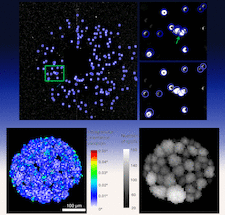
Cover illustration: Zhang et al. [J. Appl. Cryst. (2025), 58, 1742–1752] present a new laboratory-based 3D X-ray micro-beam diffraction (Lab-3DµXRD) technique. Lab-3DµXRD combines the use of a focused polychromatic beam with a scanning-tomographic data acquisition routine to enable depth-resolved crystallographic orientation characterization.
editorial


Open  access
access
The virtual special issue related to the 19th International Small Angle Scattering Conference (SAS2024, Taipei, Taiwan) is introduced. The articles included here were originally published in recent regular issues of Journal of Applied Crystallography and Journal of Synchrotron Radiation. The SAS2024 special issue is available at https://journals.iucr.org/special_issues/2025/sas2024/.
research papers

Open access
access
Small-angle neutron scattering is used to detect signals from the photosynthetic membranes of symbiotic algae living inside and outside their host corals and anemones. A model is constructed for the scattering that allows the architecture of the triple membrane stack be understood in living organisms, with implications for their physiology.
Open access
access
It is demonstrated that, when a semiflexible polymer is under external forces, these forces and the bending modulus, along with conformation variables of the polymer, can be extracted from the scattering function using a machine learning inversion method.

Data interpretation in anomalous small-angle X-ray scattering is achieved by the use of atomic scattering factors determined via sample absorption measurement and the Kramers–Kronig relations.

This paper introduces a novel desmearing methodology utilizing the central moment expansion technique to correct resolution smearing in two-dimensional small-angle neutron scattering (SANS) data, particularly for anisotropic patterns in rheological SANS experiments. This model-free approach accurately reconstructs true intensity distributions, effectively recovers structural features and quantifies experimental uncertainties, enhancing the quantitative analysis of SANS data for complex fluid systems.
Open access
access
A simple approximative approach is presented to model ultra small-angle neutron scattering and ultra small-angle X-ray scattering data when coherent multiple scattering is present. The underlying principles, exact solutions – similar to Mie scattering – and approximations are presented.
Open access
access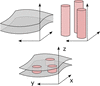
A general mathematical construction is proposed to add protein-like inclusions to any pre-existing membrane model and calculate the resulting small-angle scattering. The approach is suitable for both elastic and inelastic scattering data analysis.
Open access
access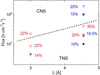
The performance of the small-angle neutron scattering (SANS) diffractometer KWS-2 is evaluated by measurements and McStas simulations under the condition that only the thermal neutron source is available at the FRM II reactor. This is compared with the established performance with cold neutrons provided by the cold neutron source.

A new compact nested rotating sextupole permanent magnet lens, with a total length of 200 mm, was developed and tested on the very small angle neutron scattering instrument at the China Spallation Neutron Source. Aberration-free focusing of pulsed neutrons with wavelengths between 11.0 and 15.5 Å was achieved for the first time.
Open access
access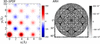
This study uses computational models to compare the three-dimensional difference pair distribution function and atomic resolution holography for analyzing three-dimensional disorder, revealing their complementary strengths in quantitative pair correlation analysis versus chemical specificity and advocating for a combined approach to tackle complex materials.

Download citation


Download citation
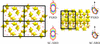
This paper demonstrates the benefits and challenges of high-temperature single-crystal X-ray diffraction studies, which allow not only determination of the thermal behavior of a material but also direct evaluation of the crystal-chemical mechanism.
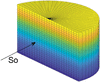
The paper extends the Wuensch and Prewitt numerical calculation algorithm for neutron absorption correction for arbitrary shapes to support multiple coaligned samples as well as samples with re-entrant angles (concave surfaces). The algorithm is versatile and can be adapted for more complex scenarios, such as capillaries, annular containers and pressure cells, simply by reinterpreting the path lengths.
Open access
access
The isobaric thermal expansion coefficient of LaB6 at 1 atm was assessed from 298 to 998 K. We propose it as a temperature calibration standard for high-temperature X-ray diffraction work owing to its high temperature stability.
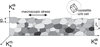
A simplified method for calculating the surface effect in X-ray elastic constants (XECs) is presented together with a comparison between common XEC models and experimental data.
Open access
access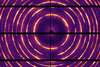
The ultimate shot-noise-limited sensitivity of model-free angular moment analysis for Bragg peak characterization in X-ray diffraction is theoretically determined and validated across three experimental setups. Uncertainty formulae to rapidly infer achievable sensitivities from a single diffraction frame are provided and limitations at ultra-low and high photon count rates are discusssed.
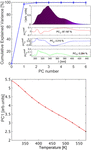
Principal component analysis is applied here to the luminescence spectra of a Ce3+-doped BaF2 single crystal, enhancing temperature sensitivity and enabling high-precision luminescence thermometry. This approach overcomes the limitations of traditional methods, offering a practical solution for non-contact temperature sensing with a high average resolution across a broad temperature range.
Open access
access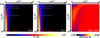
A three-parameter function is derived empirically, based on the inelastic scattering factors of Bird & King [Acta Cryst. (1990), A46, 202–208], for incorporating atom-localized and non-local phenomenological absorption into quantitative electron diffraction and imaging, with and without electron-optical energy filtering.
Download citation
Download citation
Open access
access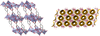
We present LibraEDT, a program that automates and optimizes 3D electron diffraction experiments. This approach allows the accurate structure determination of materials such as beam-sensitive organic crystals and metal–organic frameworks. The current implementation was developed to optimize experiments on the Zeiss Libra 120 kV microscope and Timepix1 detector, but the algorithms and proposed workflow can be adapted to other setups.
Open access
access
This article presents the fundamental concepts and equations implemented in the program MagStREXS to determine magnetic structures based on resonant elastic X-ray scattering diffraction data.
Open access
access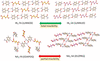
A new application of quantitative chemometric models (principal component regression and partial least-squares regression) to powder X-ray diffraction data is tested. The approach allows evaluation of the relative composition of solid solutions via the characteristic profile shift. A method relying on Bragg–Brentano geometry measurements is presented, along with different alignment strategies to treat experimental error due to sample displacement.

Open access
access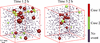
This study evaluates four methods for detecting grain-scale plastic deformation using far-field high-energy diffraction microscopy on a Ti–7Al alloy under room-temperature creep testing. High validation rates among these detection methods support confidence in detecting plastic events without a ground truth. Two types of events – showing sharp or gradual stress relaxation – suggest different deformation mechanisms, and spatial–temporal mapping reveals clustered activity and intergranular propagation.
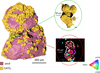
A combined scanning 3D X-ray diffraction and phase contrast tomography study of calcite obtained through microbially induced calcite precipitation (MICP) permits unravelling of the hierarchical crystallographic structure of calcite and its preferred orientation at the surface of biocemented sand. These findings provide insights into the role of the crystallographic properties of calcite in the development of the mechanical properties of biocemented sand.
Open access
access
A novel laboratory-based 3D X-ray micro-beam diffraction technique has been developed and successfully validated. The setup enables the detection of grains as small as 10 µm, with an intragranular orientation uncertainty of 0.01°.
Open access
access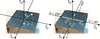
Energy-dispersive diffraction using a two-detector setup in horizontal scattering geometry is applied for depth-resolved residual stress analysis. Data evaluation based on a modified fundamental equation is discussed via measurements performed on a unidirectionally ground ferritic steel sample.
Open access
access
A nanocrystalline Fe–1.8%Cr steel powder is proposed as a reference material for testing different powder diffraction instruments and configurations, as well as different data-analysis methodologies.
Open access
access
A method is presented for achieving high-quality anomalous X-ray powder diffraction with an extended Q range using a flat-panel imaging detector that scans over a large angular range, coupled with transmission X-ray absorption spectroscopy. When combined with the in situ sample environment, this approach enables the isolation of specific elements within long-range and local structures, while tracking their evolution during reactions.
Open access
access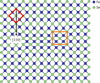
The properties of the nematic phase are analysed from the crystallographic point of view. A close correlation between the microstructural and physical properties of the nematic phase is found.
teaching and education
Open access
access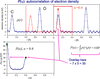
Implemented in many crystallography programs, the Patterson function can be challenging to explain to non-mathematically trained students. I provide a customizable animated PowerPoint slide deck to help students to intuitively grasp the concept of autocorrelation and its interpretation.
Open access
access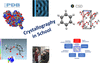
Preconditions and applications for teaching crystallography in high school chemistry classes are presented.
computer programs
Open access
access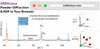
XRDlicious is an online tool for calculating powder X-ray and neutron diffraction patterns, as well as (partial) radial distribution functions, from crystal structures uploaded by users or retrieved from major structural databases. Its browser-based interface allows structure modification, data format conversion and simultaneous plotting for comparison, making it accessible for both research and educational purposes without the need for software installation.
Open access
access
This work describes recent updates in the SUNBIM software Version 4.0, particularly for the reduction of small- and wide-angle X-ray scattering microscopy data acquired in scanning mode. The paper also presents case studies where the new routines have been applied.
Open access
access
Software optimized to fit ruby fluorescence spectra, automatically extract the peak positions and calculate the pressure according to the Ruby2020 gauge is presented.
Open access
access
The MUMOTT Python package facilitates the analysis of small- and wide-angle X-ray scattering tensor tomography data, using CPU and GPU acceleration to simplify complex computational tasks. Designed for ease of use, extensibility and efficiency, MUMOTT aims to lower barriers to adopting tensor tomography methods within the wider research community.
Open access
access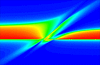
The DXRD program suite consisting of a series of dynamical theory programs (particularly, rigorous multiple-beam diffraction programs) with interactive graphical user interfaces is introduced for computing arbitrary two- and N-beam X-ray diffraction from single crystals.
laboratory notes

The work presented bridges the gap between synchrotron and laboratory-based in situ powder diffraction.