menu
menu


issue contents
19th International Small Angle Scattering Conference (SAS2024)
Guest editors: U-Ser Jeng, Jan Ilavsky and Elliot Paul Gilbert
Guest co-editors: Judith E. Houston, Florian Meneau and Dmitri I. Svergun
The articles in this virtual special issue represent some highlights of the 19th International Small Angle Scattering Conference (SAS2024), held at the Taipei International Convention Center, Taiwan, from 3 to 8 November 2024.

Cover illustration: 19th International Small Angle Scattering Conference (SAS2024).
editorial


Open  access
access
The virtual special issue related to the 19th International Small Angle Scattering Conference (SAS2024, Taipei, Taiwan) is introduced. The articles included here were originally published in recent regular issues of Journal of Applied Crystallography and Journal of Synchrotron Radiation. The SAS2024 special issue is available at https://journals.iucr.org/special_issues/2025/sas2024/.
biosaxs

Open access
access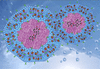
Chain-length-dependent membrane changes in PEGylated liposomes induced by doxorubicin loading are revealed using small- and wide-angle X-ray scattering and cryo-EM.
Open access
access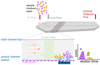
By coupling asymmetrical-flow field-flow fractionation to small-angle X-ray scattering (AF4–SAXS), we enable precise, size-resolved analysis of polydisperse samples. Our automated AF4–SAXS system at the EMBL P12 beamline streamlines workflows, making advanced characterization accessible to both novice and experienced users, with principles adaptable to other facilities.
Open access
access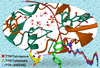
The structures and stabilities of transthyretin tetramers and their complexes with tolcapone or tafamidis bound at the T4-site, in aqueous solutions without and with 8 M urea, are revealed using SEC-SWAXS and NMR.
Open access
access
Small-angle neutron scattering is used to detect signals from the photosynthetic membranes of symbiotic algae living inside and outside their host corals and anemones. A model is constructed for the scattering that allows the architecture of the triple membrane stack be understood in living organisms, with implications for their physiology.
Open access
access
Predicted protein structures containing flexible regions, or solved structural units linked by disordered segments, will not have a unique conformation in solution. Starting from a single structure, the SAXS-A-FOLD webserver can generate thousands of conformations using a Monte Carlo method. It can compare their calculated SAXS profiles against experimental data, resulting in an ensemble of representative models.
Open access
access
ATSAS is a comprehensive software suite for the processing, visualization, analysis and modeling of small-angle scattering data. This article describes developments in the ATSAS-4 release series.
polymers amd polymer complexes
Open access
access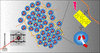
In this study, electrically responsive hydrogels were developed with enhanced on-demand drug release by combining poly(3,4-ethylenedioxythiophene):poly(benzenesulfonate) with Pluronic F127 micelles functionalized with negatively charged benzenesulfonate groups, forming conductive nanonetworks. Evaluations using piroxicam and advanced structural analyses (including rheological small-angle X-ray scattering, rheo-SAXS) revealed that blade-coating fabrication improves conductivity and voltage-triggered drug release efficiency, showcasing the potential for on-demand transdermal drug delivery patches.
Open access
access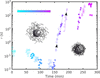
The effect of hydrostatic pressure on the structure and dynamics of concentrated silica-PNIPAm (poly-N-isopropylacrylamide) nanogels reveals characteristics similar to those found in temperature-induced phase transitions. However, significant aging is seen in glass and gel samples, which is absent in the liquid state.
Open access
access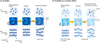
By using in situ X-ray scattering, the introduction of 3-hydroxyhexanoate (3HH) to the eco-friendly polymer poly[(R)-3-hydroxybutyrate] [P(3HB)] was found to reduce both the density fluctuations on the submicrometre scale and the stability of the crystals, resulting in a reduction of the brittleness.
Open access
access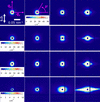
This study investigated how comonomer species and content affect strain-induced density fluctuations in linear low-density polyethylene. It was found that increased spatial homogeneity before stretching, influenced by the type and amount of comonomer, suppressed the strength of density fluctuation induction during strain.

Open access
access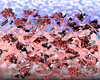
Combined 100 ms-resolved grazing-incidence small/wide-angle X-ray scattering and optical interferometry reveal that the additive diiodooctane can double the solvent evaporation rate, thereby effectively suppressing the rapid spinodal decomposition process in the early stage of spin-coating, favouring slow phase segregation kinetics with nucleation and growth.
Open access
access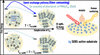
This study tunes the energy landscape of the syndiotactic poly(methyl methacrylate) (st-PMMA)/C60/toluene complex system and finds the efficient pathway to form the thermodynamically favored st-PMMA/C60 complex by temperature modulation. This st-PMMA/C60 complex architecture further acts as a photoreduction site for yielding the Ag surface-enhanced Raman scattering (SERS)-active substrate for advanced chemical sensing applications.
Open access
access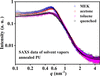
Small-angle X-ray scattering was applied to polyether polyurethane to investigate the effects of solvent vapor annealing on the microphase separation. Among the solvents studied, methyl ethyl ketone induced the greatest degree of phase separation in polyurethane compared with the thermally annealed state.
Open access
access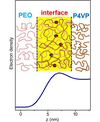
The electron density distribution along the lamellar normal in a block copolymer, as determined by small-angle X-ray scattering, reveals segmental densification at the domain interface. This interfacial densification is attributed to the negative mixing volume in the segmental mixture of the constituent blocks, a distinct characteristic of block copolymers exhibiting lower critical ordering transition or hourglass phase behavior.
methods
Open access
access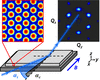
A perspective is given on the opportunities provided by near-surface small-angle neutron scattering for the characterization of nanoscale magnetic phenomena near surfaces and their extension into nano-confined volumes in the thin-film limit.
Open access
access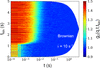
This article presents an application of X-ray photon correlation spectroscopy (XPCS) to probe the out-of-equilibrium dynamics in a driven colloidal system. XPCS enables the investigation of direction-dependent non-equilibrium dynamics and the gradual return of the suspension to equilibrium Brownian behaviour. The influence of such transient non-equilibrium dynamics needs to be taken into consideration when dynamic scattering methods are used for micrometre-range particle measurement.
Open access
access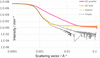
We present the first combined analysis of X-ray dark-field signals and small-angle X-ray scattering curves from several samples representing different sources of scattering.
modelling
Open access
access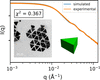
A new tool for form factor analysis of any n-sided nanoprism is presented. Shape analysis of various gold and/or silver nanoprisms (n = 3, 4, 5) is conducted using small-angle X-ray scattering experimental data. Our method compares well with transmission electron microscopy image analysis, providing additional details about the nanoprisms, and significantly reduces computation time compared with all-atom simulations.
Open access
access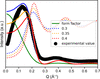
Structure factors of disks that are randomly packed in 2D, equivalent to parallel cylinders, are given as a function of the area fraction. This structure factor can be used to interpret scattering features from densely packed fibrous systems.
Open access
access
Here, we determine the optimal weights and priors to use when simultaneously fitting small-angle X-ray and neutron scattering data.
Open access
access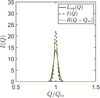
A strategy based on the central moment expansion approach is proposed for addressing the resolution discrepancy inherent in cross-sectional measurements obtained via small-angle scattering experiments.
Open access
access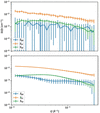
A novel method is proposed to improve the estimation of partial scattering functions from contrast variation small-angle neutron scattering (CV-SANS) data, based on Gaussian process regression using prior knowledge about the smoothness and flatness of S(Q). The method is demonstrated using computational core–shell and experimental polyrotaxane SANS data.
Open access
access
We present SAStutorials.org, a website that hosts online tutorials for small-angle scattering data analysis through active learning.
Open access
access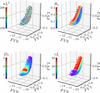
We have used machine-learning-informed scattering correlation analysis to extract polydispersity and microscopic rearrangements from scattering data, enabling precise insights into dynamic processes in colloidal dispersions
Open access
access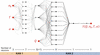
This study employs Kolmogorov–Arnold networks to analyze neutron and X-ray scattering from distorted lamellar phases within a wave field representation, identifying topological defects and structural transitions. It offers insights into defect structures and their impact on material properties.
instrumentation
Open access
access
Upgrades at the KWS-2 small-angle neutron scattering (SANS) diffractometer at Jülich Centre for Neutron Science (JCNS) for an optimal sample quality for biological systems [in-beam size-exclusion chromatography (SEC) complementarity], controlled humidity and temperature (RH/T) on ionic conductive samples and biological membranes, and diffraction capability (wide-angle neutron scattering, WANS) are reported.
Open access
access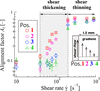
A new 1–2 plane shear cell has been developed to observe structural changes and concentration fluctuations under flow fields depending on the velocity gradient, which cannot be measured by the Rheo-SANS small-angle neutron scattering technique.
Open access
access
A pioneering vertical-geometry small-angle X-ray scattering setup is available at beamline 14, Very Small Angle Neutron Scattering Instrument, at the China Spallation Neutron Source. Small-angle X-ray and neutron scattering can thus be performed at the same time.
Open access
access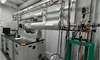
Laboratory small-angle X-ray scattering (SAXS) equipment was employed at the SAXS station at NanoTerasu (Sendai, Japan) for SAXS and wide-angle X-ray diffraction (WAXD) measurements.
Open access
access
We present an easily assembled, low-cost beam-tilting extension for synchrotron-based ultra-small-angle X-ray scattering (USAXS) / small-angle X-ray scattering (SAXS) beamlines enabling grazing-incidence (GIUSAXS) and transmitted (GTUSAXS) experiments on liquid surfaces with negligible loss of X-ray flux. The setup is implemented at the sample stage with ∼0.5 m of additional space and provides incidence angles up to ∼0.6°, corresponding to approximately twice the critical angle of typical reflector materials.
Open access
access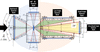
Various neutron detection approaches for industrial use at the time-of-flight small-angle neutron scattering instrument iMATERIA (J-PARC) are described here.