


 journal menu


issue contents
 access
March 2026 issue
scientific commentaries


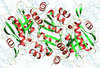
The paper by Gilski et al. in this issue [IUCrJ (2026), 13, 132–145] focuses on the stereochemical analysis of the catalytic mechanism of asparaginases with the aim of resolving key ambiguities in the mechanism. These enzymes have found truly remarkable therapeutic success in the treatment of childhood leukemias.
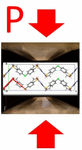
Kinetic effects can be a critical factor in the study of high-pressure phase transitions. X-ray diffraction experiments on the timescales of the laboratory and the synchrotron can provide complementary results on such transformations.
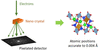
Now a common technique in crystallography, three-dimensional electron diffraction (3D ED) is on track to bridge the gap with X-ray diffraction in terms of structural accuracy.
research papers
BIOLOGY | MEDICINE

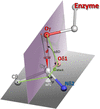
Stereochemical analysis based on the principle of structure correlations has been carried out to identify the primary nucleophile residue in each of the three classes of L-asparaginases and in a group of classless enzymes, helping to confirm their classification.
CHEMISTRY | CRYSTENG

Download citation


Download citation
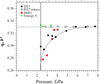
Catching new modulated high-pressure phases of δ-chlorpropamide: when the experimental setup matters
Commensurately and incommensurately modulated phases of chlorpropamide have been obtained for the first time on hydrostatic compression of its δ polymorph.
B-IncStrDB reference: V9VuwNzvTbh
BIOLOGY | MEDICINE
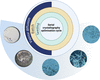
An automated, low-volume microbatch-under-oil crystallization approach is described that rapidly maps phase diagram boundaries. This approach rationalizes the production of microcrystal suspensions for serial crystallography by explicitly distinguishing metastable from nucleation zones, thereby replacing empirical trial and error with a quantitative guide to sample optimization.
BIOLOGY | MEDICINE
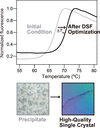
Differential scanning fluorimetry (DSF) assesses protein thermal stability in solution using a standard real-time PCR instrument. Optimizing the protein buffer composition and crystallization conditions through DSF can significantly enhance crystal quality.
BIOLOGY | MEDICINE
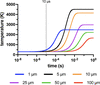
Modelling of radiation damage and beam-induced heating at extremely high flux macromolecular crystallography beamlines is presented.
ELECTRON CRYSTALLOGRAPHY
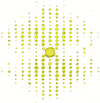
This blind test uses three known samples to determine the accuracy limits of 3D electron diffraction and to assess various challenges. The study aims to evaluate how well different users with diverse experimental setups can perform tasks such as hydrogen-atom detection, mixed occupancy analysis and absolute structure determination. By comparing results across multiple participants and platforms, we can gauge the reliability of the method and identify potential areas for improvement in 3D electron diffraction techniques.
CCDC references: 2528653; 2528654; 2528655; 2528656; 2528657; 2528658; 2528659; 2528660; 2528661; 2528662; 2528663; 2528664; 2528665; 2528666; 2528667; 2528668; 2528669; 2528670; 2528671; 2528672; 2528673; 2528674; 2528675; 2528676; 2528677; 2528678; 2528679; 2528680; 2528681; 2528682; 2528683; 2528684; 2528685; 2528686; 2528687; 2528688; 2528689; 2528690; 2528691; 2528692; 2528693


