


 journal menu


issue contents
November 2025 issue
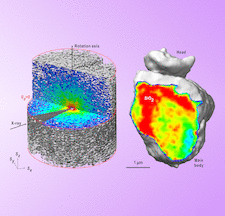
Cover illustration: Three-dimensional distribution of diffraction intensity and reconstructed electron density of a printer toner particle obtained using cryogenic X-ray diffraction imaging tomography (see Harada, Takayama and Nakasako, pages 1491–1502).
facility information




editorial


Open  access
access
The newest seven members of the Editorial Board of Journal of Synchrotron Radiation are introduced.
research papers
Open access
access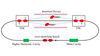
A novel method employing a double RF system and transverse deflecting cavities is proposed to generate tunable double X-ray pulses with adjustable transverse separation and time delay in electron storage rings. This approach offers new experimental possibilities such as X-ray pump and X-ray probe studies.
Open access
access
We present a compact differential pumping unit with apertures ≥500 µm. It allows windowless operation for in-air sample environments as well as to connect low-quality in-vacuum sample environments to the beamline UHV section. The unit also protects the UHV section from accidental venting. The overall footprint is restricted to 368 mm on the beam axis.
Open access
access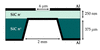
The use of ultra-thin (<2 µm) silicon carbide membranes as in-line beam intensity and position monitors for soft and tender X-ray beamlines is investigated. Experimental results and theoretical simulations highlight the limitations of four-quadrant sensor designs, and alternative solutions for high-resolution and minimally interfering beam monitoring are proposed.
Open access
access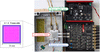
Digital pulse processors (DPPs) have revolutionized X-ray spectroscopy through their advanced real-time signal processing and analysis capabilities. This paper presents a detailed evaluation of the performance of an ARDESIA-16 silicon-drift-detector-based fluorescence detector with two state-of-the-art DPP systems, DANTE+ and FalconX, examining their performance in high-throughput X-ray spectroscopy applications.
Open access
access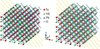
At the SIRIUS beamline of Synchrotron SOLEIL, the use of the DAFS technique has been extended to the tender X-ray range. We present a study of the Nb L3-edge in PbSc0.5Nb0.5O3 relaxor ferroelectric oxide, where the use of superstructure reflections provides access to the ordered part of the sample.

Open access
access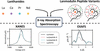
This study uses X-ray absorption spectroscopy (XAS) to observe the structural and electronic differences of coordination complexes of lanthanides (La, Ce, Pr and Nd) bound by lanmodulin-derived peptides and other organic chelators in aqueous solution. The reported sensitivity of XAS for subtle changes in lanthanide coordination environment supports its use in designing more selective REE-binding ligands for separations.
Open access
access
PC 12 neuron-like cells were exposed to terahertz (THz) radiation of variable beam incident power intensity from 0.25 to 1.0 W m−2. THz irradiation activated the CaN complex, ribosome biogenesis and DNA damage reparation.
Open access
access
This study develops the energy-resolved photoemission electron microscopy imaging and micro-zone X-ray absorption spectroscopy (XAS) method. By integrating X-ray magnetic circular dichroism, X-ray magnetic linear dichroism and micro-zone XAS, we have achieved spatially resolved electronic structure mapping and magnetic property analysis at the nanoscale level. We have also developed a gap–monochromator linkage control system to optimize photon flux and its stability.

Open access
access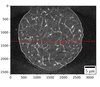
A full-field, X-ray nano-laminography system implemented with the transmission X-ray microscope at beamline 32-ID of the upgraded Advanced Photon Source at Argonne National Laboratory is demonstrated.
Open access
access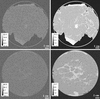
A biomedical X-ray imaging quality characteristic, suitable for quantitative assessment of X-ray images of biological samples, is introduced and then applied to analysis of propagation-based X-ray phase-contrast computed tomography images of mastectomy samples.
Open access
access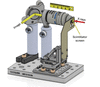
We developed compact soft X-ray imaging systems optimized for ultra-high-vacuum environments, achieving micrometer-level spatial resolution with high collection efficiency. Characterization confirmed excellent sensitivity and linearity, with applications demonstrated in caustic measurements and grating interferometry for wavefront analysis.
Open access
access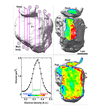
The nonuniform internal structure of a printer-toner particle with an approximate size of 5 µm was visualized at a resolution of 141 nm using cryogenic X-ray diffraction imaging tomography.
Open access
access
Multi-modal measurements combining X-ray diffraction, X-ray fluorescence and optical microscopy allow dynamic crystal recovery effects around martensitic steel crack tips to be studied. The measured strain field around the crack tip shows a significant departure from the predictions of linear elastic fracture mechanics.
Open access
access
A method for in situ imaging of human-sized animal lungs using the Imaging and Medical Beamline (IMBL) at the Australian Synchrotron is presented.
Open access
access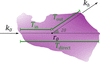
We investigate the effect of anisotropic absorption of scattered X-rays in X-ray diffraction tomography and show that the detrimental effect on reconstruction is small in the range of absorption coefficients and scattering angles commonly used.
short communications
Open access
access
An automated alignment system for nanofocusing Kirkpatrick–Baez mirrors has been developed at SACLA. A wavefront optimization technique routinely provides nanofocused XFEL beams.
beamlines
Open access
access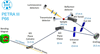
A comprehensive description of the technical details and science case of the recently opened beamline for time-resolved VUV spectroscopy at DESY, PETRA III, is presented.
Open access
access
The Ultrafast Transient Experimental Facility at Chongqing University is developing an advanced ARPES beamline capable of 0.4 meV energy resolution within the 10–40 eV photon energy range, featuring photon flux over 1012 photons s−1, tunable polarization and ultra-low temperatures below 1.5 K. Leveraging a 0.5 GeV, 500–1000 mA storage ring, the design employs a dual-endstation setup for ultra-high-resolution and high-flux spin-resolved experiments.
Open access
access
A laser reaction chamber has been developed for in situ/operando X-ray diffraction measurements on the NSLS-II 28-ID-2 beamline, allowing for rapid sample heating under various gas and vacuum conditions. This capability has enabled the tracking of chemical reaction kinetics in polycrystalline iron oxide and a reversible phase transformation in WTe2 with 1 s time resolution, expanding the opportunities for dynamic studies in both bulk and single-crystal materials.
Open access
access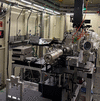
The High Energy Photon Source (HEPS) is the first fourth-generation synchrotron radiation source in China. In this paper, the diagnostic process of the Tender X-ray Beamline (TEX), the first bending magnet beamline of HEPS, and its performance are introduced in detail.
Open access
access
The BL46XU beamline at SPring-8 has been restructured for hard X-ray photoelectron spectroscopy (HAXPES), featuring two specialized HAXPES instruments and advanced X-ray optics for high-throughput and ambient-pressure measurements. This article outlines the beamline design, performance and recent scientific achievements enabled by these upgrades.
computer programs
Open access
access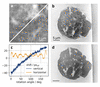
We present HoToPy, a toolbox for X-ray holo-tomography in Python. It offers state-of-the-art phase retrieval methods for synchrotron and laboratory sources as well as tomographic reconstruction and alignment methods.


