


 journal menu


issue contents
September 2025 issue
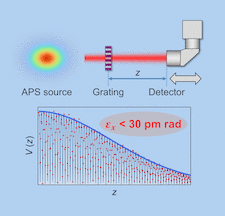
Cover illustration: Source property characterization of the upgraded Advanced Photon Source using grating interferometry, where interferogram visibility decay with propagation distance is measured to determine source size (see Shi, Lin, Zhao, Toellner, Hu, Seifert, Lee, Grizolli, Wojcik, Rebuffi, Assoufid and Sajaev, pages 1152–1161). The results demonstrate a world-record horizontal emittance below 30 pm rad.
facility information



research papers


Open  access
access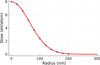
A scheme is proposed to calculate an effective fluence of a spatially non-uniform pump pulse such that the observable of interest calculated with the effective fluence is very close to the volume-integrated observable. This approach simplifies computational simulations of X-ray irradiated solids.
Open access
access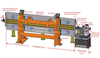
The origin and composition of the stray radiation at the EuXFEL undulator system are investigated. This is essential for machine protection, as the stray radiation can damage the undulator permanent magnets as well as the correction and diagnostic equipment along the beamline.

Open access
access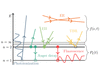
Plasma simulations with detailed modeling of unbound electron dynamics predict that heavy elements contribute significantly to radiation damage suffered by proteins in serial femtosecond crystallography. New methods to mitigate radiation damage in this regime are highlighted.
Open access
access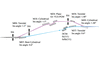
The concept of the energy-switchable storage ring, designed for wide-wavelength range applications and efficient power consumption, is presented.
Open access
access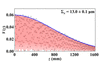
This study presents source emittance and beam coherence measurements at the upgraded Advanced Photon Source using grating interferometry. The results confirm world-record emittance values, validate design parameters, and offer key insights into coherence preservation and beamline optimization.
Open access
access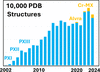
This review examines two decades of continuous development in macromolecular crystallography beamlines at the Swiss Light Source, along with recent contributions from SwissFEL, in the broader context of the evolution of macromolecular crystallography at synchrotron and X-ray free-electron laser facilities.
Open access
access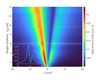
Optical force-based control of liquid micro-droplets in vacuum enables precise, low-waste sample delivery for ultrafast soft X-ray experiments.
Open access
access
Nanofabrication enables extremely precise and highly efficient variable line spacing diffraction gratings for X-rays.

Open access
access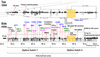
The design, development and performance of an X-ray beamline for utilizing intense, high-energy undulator radiation are presented.
Open access
access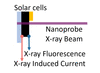
X-ray beam-induced current (XBIC) measurements were implemented on the Hard X-ray Nanoprobe at Diamond Light Source, allowing simultaneous XBIC and nano X-ray fluorescence mapping of photovoltaic devices.
Open access
access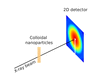
A proof-of-principle of a nanosecond time-resolved experiment is demonstrated using a TEMPUS detector. The concept exploits an event driven mode of the detector and cross-correlation analysis to overcome pixel dead time, and offers new opportunities for time-resolved studies.
Open access
access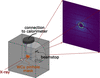
A setup enabling in situ X-ray total scattering combined with fast scanning calorimetry is demonstrated at beamline ID15A of the ESRF, allowing for the retrieval of detailed structural evolution with changes in thermodynamic conditions.
Open access
access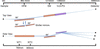
A versatile resonant inelastic X-ray scattering spectrometer seamlessly switches between high throughput and broad spatial-resolution modes: (i) the high throughput mode enhances signal intensity threefold while achieving 2.7 µm resolution within a 16 µm range; (ii) the broad spatial-resolution mode achieves entire optical footprint resolution at the expense of throughput. This innovative system, featuring a resolving power exceeding 12000, is poised to enhance experimental capabilities in energy materials research.
Open access
access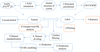
We introduce XASDAML, an open-source machine-learning framework that integrates the complete X-ray absorption spectroscopy analytical workflow, enabling efficient extraction of spectral and structural descriptors and rapid prediction of structural parameters. Demonstrated through a copper system, the framework significantly streamlines X-ray absorption spectroscopy data analysis and enhances model accuracy and interpretability, facilitating deeper insight into materials characterization.
Open access
access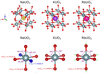
High-energy resolved fluorescence-detected X-ray absorption spectroscopy at the uranium L3 edge and relativistic quantum chemistry calculations are combined to study in detail the uranium valence electronic structure in NaUO3, KUO3 and RbUO3. The impact of the structural distortion of the oxygen octahedra around uranium on the contribution of uranium and oxygen states in observed spectral features is discussed.
Open access
access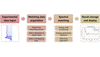
A comprehensive database for experimental X-ray absorption spectroscopy data is presented. This integrated and user-friendly platform combines spectrum visualization, raw data processing, spectrum matching and downloading.
Open access
access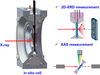
An innovative electrochemical cell is introduced, optimized for in situ X-ray diffraction and X-ray absorption spectroscopy studies of electrocatalysts, featuring an adjustable aqueous electrolyte window to minimize X-ray absorption and a flow system for efficient gas product removal during operando testing.
Open access
access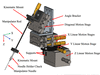
An environmental cell with fluid flow-through capability for performing in situ nano-mechanical experiments at X-ray nanotomography beamlines and a sample manipulator for mounting nanotomography samples are described.
Open access
access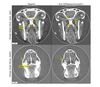
A new iterative phase retrieval algorithm, Eikonal Phase Retrieval, tackles large phase gradients and yields higher-quality propagation-based X-ray tomography of strongly heterogeneous biological samples.
Open access
access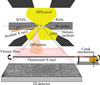
This study demonstrates the first application and feasibility of X-ray fluorescence holography under high-pressure conditions.
Open access
access
A thickness metrology method based on X-ray phase contrast imaging is proposed. By precisely retrieving the phase shift of X-rays passing through the sample, high-precision arbitrary thickness profile measurement can be achieved with a single X-ray projection. A measurement case of a microlens array is presented to demonstrate the effectiveness of this method.
Open access
access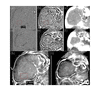
Application of 3D phase retrieval in a multi-step, masking framework allows for strong phase retrieval to be applied near highly attenuating materials without compromising spatial resolution. Demonstrations in brain computed tomography imaging show up to a 6.8-fold improvement in signal-to-noise ratio over standard phase retrieval processes, further broadening its dose-reduction potential in potential clinical applications.
beamlines
Open access
access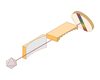
The design and performance of a soft X-ray RIXS instrument at the Veritas beamline at the MAX IV laboratory in Lund, Sweden, are presented.
Open access
access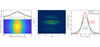
A start-to-end FEL pulse propagation method has been developed to evaluate grating monochromator performance, quantifying the impacts of longitudinal source jitter, finite-aperture diffraction, and thermal deformation on resolving power, thereby offering realistic guidance for FEL beamline design and optimization.
Open access
access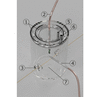
Design and implementation of an in situ climate chamber for nanotomography allowing the analysis of moisture sensitive specimens at different relative humidity and temperature settings at the nanotomography imaging station of beamline P05 (operated by Hereon, at the PETRA III storage ring, DESY, Germany).
computer programs
Open access
access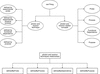
This evolution of PaNET builds on the initial foundational work, which established the infrastructure and incorporated domain expert knowledge, by introducing logical frameworks that provide enhanced reasoning capabilities, and is proposed to address the limitations of the current version of the ontology. This under-the-hood development has resulted in a more complete and robust knowledge representation system for use in data catalogue services within the photon and neutron community.
Open access
access
FoamQuant is an open-source Python package for analyzing large time-resolved three-dimensional datasets of foam-like cellular materials, enabling automated extraction of structural and mechanical parameters over time. It is demonstrated through case studies on plastic event orientation in flowing foam and bubble tracking in coarsening albumin foam.


