

 journal menu


research papers
 | JOURNAL OF SYNCHROTRON RADIATION |
 access
X-ray fluorescence microscopy exposure estimates using a single excitation energy

aApplied Physics Program, Northwestern University, Evanston, IL 60208, USA, bDepartment of Microbiology, Genetics and Immuology, Michigan State University, East Lansing, MI 48824, USA, cDepartment of Chemistry, Michigan State University, East Lansing, MI 48824, USA, dElemental Health Institute, Michigan State University, East Lansing, MI 48824, USA, eDepartment of Physics and Astronomy, Northwestern University, Evanston, IL 60208, USA, and fChemistry of Life Processes Institute, Northwestern University, Evanston, IL 60208, USA
*Correspondence e-mail: [email protected]
Scanning fluorescence X-ray microscopy is widely used for quantitative mapping of elemental concentrations, including in studies of essential but low-concentration metals in cells, tissues, and organs. Practical studies often use a single incident photon energy to excite fluorescence from many elements. We present calculations of the number of incident photons per pixel required to detect a specified areal concentration of an element in the case of far-from-threshold excitation, along with the calculated radiation dose consequently imparted in a simple model tissue. We also show how certain approximations can lead to less accurate estimates. These calculations are not specific to one particular experiment, though we also provide a comparison with one experimental result. These results can be used to guide experimental planning for studies of the role of low-concentration elements in biological tissues.
1. Introduction
X-ray fluorescence (XRF) allows for the identification of specific chemical elements, as was understood more than a century ago (Barkla, 1911 ; Moseley, 1913; Moseley, 1914). Scanning a small X-ray beam allows for the imaging of elemental content (Horowitz & Howell, 1972; Sparks, 1980; Jones et al., 1984) in an approach which we refer to here as scanning fluorescence X-ray microscopy (SFXM). This approach shows wide utility including in research of the roles of essential but low-concentration metals in biological functions in 2D (Paunesku et al., 2006; Fahrni, 2007; Pushie et al., 2014), and in 3D via X-ray fluorescence tomography (de Jonge & Vogt, 2010).
In transmission X-ray microscopy using absorption and phase contrast, there is rich literature on calculations of X-ray photon fluence requirements for achieving a specified spatial resolution (Sayre et al., 1977; Rudolph et al., 1990; Schneider, 1998; Howells et al., 2009; Du & Jacobsen, 2018), and similar calculations exist for imaging based on coherent scattering (Shen et al., 2004; Schropp & Schroer, 2010). (While photometry defines fluence in terms of energy per area, these other studies use photon fluence or photons per area for calculations in which Poisson statistics of photon counts are important.) However, while there have been careful studies of the achieved elemental detection limits in specific synchrotron-based SFXM measurements (De Samber et al., 2016; Adams et al., 2011), there are no recent calculations predicting the off-threshold illumination required to achieve a specified level of detection. Several early studies used approximate values for the relevant interaction coefficients to compare X-ray-induced X-ray fluorescence against other elemental detection methods such as electron- or proton-induced X-ray emission, and electron energy-loss spectroscopy (Kirz et al., 1978; Kirz, 1980a). This methodology was also used to predict X-ray illumination requirements for SFXM (Kirz, 1980b). More recent work considered radiation dose limits for imaging hydrated cells (Fayard et al., 2009). However, these studies assumed illumination at a photon energy just above the relevant absorption edge of each element, which is not the practice of most studies today.
Today, SFXM is often carried out using a single incident photon energy (often 10–12 keV in the case of many biological studies) to excite the emission of X-ray fluorescence from multiple elements simultaneously, even though these elements have absorption edges and emission lines at photon energies well below the illumination photon energy. Photon counting at energies characteristic of the elements of interest, coupled with spectrum analysis, background correction, and mass calibration standardization, leads to quantitative elemental maps of the sample. For biologists interrogating tissue and cell-based samples, the pixel-by pixel quantitative resolution of heterogeneity in these elemental maps provides powerful insights into fundamental biological processes, as well as etiology of disease states (Zee et al., 2022). To model this common practice and better understand limitations in the quantitative results, one must account for far-from-threshold excitation.
In most SFXM experiments, energy-dispersive spectrometry (EDS) detectors are used in conjunction with analysis programs (Vogt, 2003; Solé et al., 2007; Ryan et al., 2010; Crawford et al., 2019) that account for the energy resolution of such detectors, and backgrounds including X-ray scattering and incomplete charge collection from the detector (Van Grieken & Markowicz, 2002). Fluorescence spectrum analysis is simplified if one instead uses wavelength dispersive spectrometry (WDS) detectors (De Pauw et al., 2024), but WDS is limited in solid angle coverage and wavelength range so that it is usually not employed unless chemical state information is required.
With these developments, we revisit the question of illumination requirements for SFXM imaging of elemental concentrations. We account for illumination photon energies that can be far from thresholds for specific element excitation, and we make use of easy computer access to accurate tabulations of the relevant X-ray interaction coefficients as is described in Section 2. This allows us to predict the incident photon fluence  (given here in photons cm−2; see Table 1) at a single incident photon energy Einc required to detect specific elements at a specific areal mass concentration ρ′. We note that the mass per area ρ′ is distinct from the density ρ of mass per volume; this follows the notation used in Section 9.2 of a recent text (Jacobsen, 2020) (see Section 3.4 of this manuscript for conversions to other metrics). Such calculations are especially interesting when considering a specified minimal value
  , which sets the limit of detection (LOD) for an element. We can then use this photon fluence to calculate the radiation skin dose Dskin necessarily imparted to the incident-beam-facing surface of a specified matrix material (for example, for detection of an element located in a biological cell with some average composition), since dose can set limits on the imaging of radiation-sensitive materials. We show xraylib-based (Schoonjans et al., 2011) calculations for a wide range of trace elements at different incident energies using an X-ray fluorescence forward model that considers the excitation dependence of mass photoionization cross sections, Coster–Kronig transitions, cascade effects, the presence of an EDS detector entrance window, and the presence of any gas in the sample environment.
|
||||||||||||||||||||||||||||||||||||||||||||||||||||||||||||||||||


These results can be used for experimental planning. If one knows the absolute incident photon energy Einc, incident flux (in photons s−1), focal spot size, and solid angle of detection of an energy-dispersive detector, one can calculate the per-pixel exposure time required to reach an incident number of photons per pixel  as needed to obtain a certain detectable mass per area ρ′ for a specified element.
2. The X-ray fluorescence forward model
In a typical SFXM experiment, the specimen is meant to be illuminated with  incident photons per pixel at energy Einc (per-pixel statistical fluctuations will be distributed around ). Some fraction of the incident photons are absorbed by a target element of atomic number Z, leading ultimately to a mean number of detected photons of
  corresponding to X-ray fluorescence line ij, where i and j are initial and the final electron vacancy states, respectively. (For notational simplicity, we do not explicitly indicate the energy dependence of each variable, but this is shown in Table 1; see also Section S1 in the supporting information for information on relating transitions ij to conventional X-ray nomenclature.) For a specimen sufficiently thin that there is neither scattering of the incident signal nor self-absorption of the fluorescence signal, the mean number of detected fluorescence photons per pixel can be expressed as (Sherman, 1955; Schoonjans et al., 2011; Kirz et al., 1978; Sparks, 1980)

where  is the mass X-ray fluorescence production cross section (e.g. cm2 g−1) at energy Einc, ρ′ is the local areal mass density (e.g. g cm−2), and ηij is the net detection efficiency for line ij [equation (5)].
In this work, we use mass cross sections (typically given in cm2 g−1), which are distinct from atomic cross sections σij (typically given in barns per atom, where 1 barn = 10−24 cm2). Mass cross sections are more common to find in fundamental parameter databases (Thompson et al., 2009), but they are related to atomic cross sections via

where σij is the atomic XRF production cross section, NA is Avogadro's number, and Ar is the relative atomic mass (molar mass) of the absorbing element. Mass XRF production cross sections are related to the probability of fluorescence line ij being emitted due to subshell i being excited by an incident X-ray photon; this can be calculated via (Schoonjans et al., 2011)

where  is the mass photoionization partial cross section of subshell i, ωi is the subshell fluorescence yield, and Fij is the fractional yield or branching ratio which is the fraction of ωi emitted fluorescence photons corresponding to the ij line. For , care is generally taken when determining what values to use. The simplest assumption is that, as one crosses the threshold energy for removing an electron from a specific subshell, the fractional increase in absorption tells one the fractional increase in fluorescence events resulting from that subshell. This gives rise to the jump ratio approximation ri for subshell i (Martin, 1927; Compton & Allison, 1935; Sherman, 1955). This approximation generally holds well for K shell excitations, with the fraction of absorption events that go towards creating K shell vacancies given by

where τ′ is the total mass photoionization cross section. For the L shell and beyond, the excitation-dependent nature of photoionization becomes more important at higher Einc relative to the respective subshell absorption edge (Scofield, 1973; Hönicke et al., 2014; Hönicke et al., 2016; Hönicke, 2023). Therefore, the jump ratio approximation of equation (4) loses accuracy when applied to L shell fluorescence, as illustrated in Section 4. Two additional phenomena (Bambynek et al., 1972; Schoonjans et al., 2011) play important roles for those shells:
(i) Coster–Kronig (CK) transitions: special cases of Auger electron emission where electron vacancies are filled by electrons in higher subshells within the same shell, causing electrons to be emitted from either higher shells or from the same shell. In the latter case, the CK transition becomes a super Coster–Kronig (SCK) transition.
(ii) Cascade effects: vacancies created due to general Auger emission, electrons emitted due to (S)CK transitions, and/or XRF events involving lower shells.
Together, these phenomena can affect the values of , especially as Einc goes well beyond edge energies  [where i′ = 1, 2, 3 (similar considerations apply to M edges and beyond)]; this is illustrated in calculations shown in Section 3.1.
Detection efficiencies η for X-ray fluorescence typically consider the solid angle fraction Ω/(4π) that a fluorescence detector subtends. Most hard X-ray fluorescence experiments use EDS detectors, and in most cases the cooled detection elements are protected from contamination by being placed behind thin windows. These windows of thickness tw are often fabricated of beryllium so as to minimize the absorption of fluorescence at energies of a few keV or above. In addition to detector entrance windows, we also account for signal absorption in a gas path (air, helium, etc.) over a distance dg between the sample and detector window. Therefore, we modify the efficiency η to include window and gas attenuation factors, giving ηij for a particular fluorescence line ij of
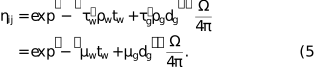
In the above equation,  and
and  are the total mass photoionization cross sections of the window material and gas, respectively, Eij is the fluorescence energy of line ij of an emitting element, and ρw and ρg are the densities of the window material and gas, respectively. [The second form of equation (5) uses the energy-dependent window and gas material linear absorption coefficients μw =
  and μg =
  , respectively.] We show in Section S3 of the supporting information how a beryllium window and air can change the minimum number of incident photons per pixel required to detect a given number of fluorescence photons per pixel at a specified areal mass concentration . Incomplete charge collection (Van Grieken & Markowicz, 2002) of electron–hole separation events in the detector can also effectively reduce the number of detected photons; however, to simplify calculations, we ignore this factor.
3. Calculations of minimum photon exposure and radiation dose
We now use equation (1) to solve for the required number of incident photons per area. We do so based on a requirement to detect  fluorescence photons per pixel in an image.
3.1. Minimum number of incident photons per pixel
To obtain the theoretical minimum number of incident photons per pixel for detecting fluorescent photons per pixel, all fluorescence line contributions calculated using equation (1) can be summed up via

From basic considerations of false-positive and false-negative error rates in detection (Currie, 1968), it is often sufficient to detect

in order to detect the presence of an element at low concentration when the background is sufficiently low. The choice of = 5 photons per pixel is somewhat arbitrary, though it is consistent with the Rose criterion (Rose, 1946) for image recognition in the case of zero background signal. The assumption of near-zero background indeed applies to the case of detecting low-concentration essential metals in biological specimens when using full-spectrum fitting methods to remove background signals; in our case we used the program M-BLANK (Crawford et al., 2019) to obtain experimental histograms of detected photons with near-zero background signal as shown in Fig. 2 and discussed in Section 3.5.
With a specified requirement for , one can rearrange equation (6) to solve for the required number of incident photons per pixel . We do so at a specified minimum value of detectable mass density corresponding to an LOD; this gives

This result allows us to predict the number of photons at photon energy Einc required per pixel when attempting to detect a mass concentration  of any specified element.
3.2. Corresponding radiation dose to a matrix material
In many studies, one is measuring a low mass concentration  of a specified element present in a higher-concentration matrix material; one example involves study of the role of zinc in oocytes and embryos during fertilization (Que et al., 2015; Kong et al., 2015; Balough et al., 2025). High radiation doses can lead to morphological changes and mass loss in the organic materials in cells and tissues (Jacobsen, 2020), so it is also important to provide an estimate of the radiation dose imparted to a matrix material (which we denote with the subscript `mat') associated with irradiation with photons per area. To do so, we first consider the incident photon fluence of

where Abeam is the area of the incident beam [which equals π(dbeam/2)2 for a uniform circular beam spot of diameter dbeam]. Inserting the result of equation (8) into this expression yields

where  is also known as the minimum detectable mass
mmin (Kirz et al., 1978). Skin dose Dskin is the radiation dose delivered to the beam-facing surface of a matrix material; it can be found from (Kirz et al., 1978; Jacobsen, 2020)
is also known as the minimum detectable mass
mmin (Kirz et al., 1978). Skin dose Dskin is the radiation dose delivered to the beam-facing surface of a matrix material; it can be found from (Kirz et al., 1978; Jacobsen, 2020)

where (Jacobsen, 2020)

and where the final form of equation (11) comes from equation (9). In the above two equations,  is the total mass photoionization cross section of the sample matrix, and
  is the weighting coefficient accounting for the atom number fraction of each element Z′ present in the matrix material (that is, for each Z′ ∈ mat). If the sample is tilted by angle θ relative to the transverse of the incident beam (so as to balance between XRF self-absorption minimization and beam broadening), then the beam width as seen by the tilted sample pixels along one direction increases by a factor of
  . In this case, equation (11) becomes

leading to a factor drop in the skin dose. Substituting equation (10) into the above equation results in

as the skin dose.
It is common in X-ray imaging calculations to represent biological specimens as comprising a model protein with the compositional average of all 20 amino acids, with a stoichiometric composition of H48.6C32.9N8.9O8.9S0.6 (London et al., 1989) (the density does not need to be specified; see Section S2 in the supporting information). We used that protein as the matrix material in the skin dose calculations described in Section 3.3.
3.3. Numerical example: low-concentration elements in a protein matrix
In Section 3.1, we derived the minimum number of incident X-ray photons per pixel [equation (8)] required for detection of an elemental concentration . As noted in Section 3.1, those derivations were performed under the assumption that the detection of = 5 photons per pixel is sufficient for elemental detection (this point is discussed further in Section 3.5). Because this covers most SFXM studies today, our calculations only include X-ray fluorescence from K and L subshells; our approach could be extended to M subshells and beyond if desired. From the calculations of , we also computed the corresponding matrix material skin dose Dskin [equation (14)] as described in Section 3.2. We used those results to obtain numerical estimates representative of typical experiments while assuming the following:
(i) The specimen matrix is the model protein of stoichiometric composition H48.6C32.9N8.9O8.9S0.6 as discussed in Section 3.2.
(ii) The specimen is illuminated with a single incident photon energy Einc.
(iii) The specimen contains trace elements Z ∈ [10, 92], all at an areal mass concentration of = 0.05 µg cm−2. This value of is representative of the limit of detection in an SFXM experiment. Conversions to other metrics for elemental sensitivity are given in Section 3.4.
(iv) The specimen is housed in a vacuum environment so that dg = 0.
(v) For each element Z, a fluorescence signal with = 5 photons per pixel must be counted by a windowless detector with an acceptance solid angle of Ω = 1.35 steradians (sr).
These assumptions were sufficient to calculate the required number of incident photons per pixel. For computing the resulting skin dose Dskin in the matrix material, we used a value of Abeam corresponding to a circular beam focus dbeam = 40 nm in diameter, and we assumed that the specimen was at normal incidence to the beam so that θ = 0.
Our calculations utilized tabulations provided by the xraylib fundamental parameter database (Schoonjans et al., 2011). That database contains information relevant for K-, L-, and M-shell fluorescence and involves a complete XRF forward model that accounts for the excitation dependence of mass photoionization partial cross sections (PCSs), CK transitions, and cascade effects. The xraylib database does not include some weak fluorescence lines, like Kα3 and Lβ2, that are formally forbidden by selection rules in single electron theory (Dyson, 1973) (though they can in fact be weakly present). The database also does not include non-radiative transitions such as SCK transitions. These omitted parameters would not lead to noticeable changes in our results if they were somehow to be included.
With the above assumptions and fundamental parameter tabulations in hand, we show in Fig. 1 our calculated values of (a) and Dskin (b) as a function of atomic number Z, as well as a function of individual incident photon energies Einc over the range 4 to 34 keV. The values of and Dskin are shown using a false color map, with the color map scale shown on the right. One can think of this as a topographical map of terrain, with contour lines at altitude intervals. The contour lines are labeled with numbers C, which correspond to values of 10C for and Dskin. The calculations utilized K and L fluorescence lines only, so the white region at lower right reflected incident photon energies Einc that were too low to reach the threshold for exciting L line fluorescence. In a similar fashion, the plots showed a `topographical cliff', or sharp decrease, in both (a) and Dskin (b) when Einc increased to reach the threshold for exciting K fluorescence; this cliff started at (Z = 20, Einc = 4 keV) and rose to (Z = 54, Einc = 34 keV).
![[Figure 1]](ing5024fig1thm.gif)
|
Figure 1
Combined false color maps and contour plots of the expected minimum number of incident photons per pixel (a) and skin dose Dskin in Gray imparted (b) for element detection in vacuum. These values are shown versus trace element atomic number Z and individual incident photon energies Einc. These calculations were carried out for a limit of detection of = 0.05 µg cm−2 and for the detection of = 5 X-ray photons per pixel summed over all accessible K and L fluorescence emission lines. We assumed that the X-ray fluorescence detector was windowless and had a solid angle of collection of Ω = 1.35 sr. The skin dose Dskin (b) associated with was calculated assuming a model protein composition of H48.6C32.9N8.9O8.9S0.6 (London et al., 1989) and a focused beam diameter of dbeam = 40 nm. These calculations included all the effects related to photoionization partial cross sections as described in Section 3.1. As Z increased, the contributions to and Dskin for a particular subshell abruptly changed when Einc hit and exceeded that subshell's absorption edge (labeled `thresh.'). The white regions in each panel exist due to an individual value of Einc not being high enough to excite the L3 subshell, as well as due to the exclusion of XRF events stemming from shells greater than L3 from our calculations. This calculation employed tabulated data from xraylib (Schoonjans et al., 2011). Contour values correspond to base-10 exponents. |
Limits on radiation dose to the specimen depend very much on specimen preparation conditions. For room-temperature hydrated specimens, radiation doses as low as 105 Gy can lead to mass loss of organic components and shrinkage, even in chemically fixed specimens (Williams et al., 1993). Frozen hydrated samples imaged at liquid nitrogen temperature are far more robust, with little change seen between successive 20 nm resolution images at radiation doses of about 3 × 10⁷ Gy (Deng et al., 2017). Even at these doses, the damage is mainly in the form of bond breaking in organic materials, with minimal mass loss (Beetz & Jacobsen, 2003). For studies of elemental distributions in biological samples, samples that have been rapidly frozen (often via plunge-freezing in liquid ethane or propane) and then freeze-dried show excellent retention of low-concentration metals (Perrin et al., 2015; Jin et al., 2017). Samples in such a condition show little mass loss at doses probably up to about 109 Gy, though there is a lack of systematic studies exploring this. Since Fig. 1 showed that radiation doses above 108 Gy are rarely required, one can expect that radiation dose will not usually impede X-ray fluorescence microscopy studies of elemental distributions.
While radiation damage depends mainly on total dose rather than dose rate, sample heating depends mainly on both dose rate and heat conduction in the specimen and to the specimen mount. Sample heating has not often been observed in X-ray microscopy of biological specimens, but finite element analysis calculations have suggested that nanofocused hard X-ray beams can lead to localized specimen heating at incident photon fluxes above about 1011 photons s−1 (Wallander & Wallentin, 2017).
3.4. Other equivalent measures of elemental detection
We have carried out our calculations based on areal mass density ρ′ since that is the quantity that is directly useful for the forward model described in Section 2. However, many users of SFXM prefer to use other metrics for elemental detection. As noted in Section 3.2, the minimum detectable mass
mmin is

If the beam intensity is uniform in a circle of diameter dbeam, we have

which gives
mmin = 0.628 ag (i.e. 6.28 × 10⁻¹⁹ g) for = 0.05 µg cm−2 and dbeam = 40 nm. The minimum number of detectable atoms  for a fluorescing element with molar mass Ar is then

For = 0.05 µg cm−2, dbeam = 40 nm, and a molar mass of Ar = 40.08 g mol−1 for Ca, this gives a minimum number of detected atoms of = 9440 atoms. If this number of atoms is in a matrix material of density ρmat, thickness tmat, and molar mass Ar,mat, the number of matrix atoms Natom,mat is given by

where mmat is the absolute mass of the matrix. A matrix of carbon with ρmat = 2.26 g cm−3, Ar,mat = 12.011 g mol−1, and thickness tmat = 10 µm thus has Nmat = 1.4 × 10⁹ atoms in the illuminated region. From equations (17) and (18), one can calculate the atomic parts-per-million sensitivity  as
as

where

is the traditional mass parts-per-million sensitivity. For this example here of calcium in a carbon matrix, these two equations yield = 6.63 p.p.m. and  = 22.1 p.p.m., respectively.
3.5. Experimental validation
The calculations of the minimum number of incident photons per pixel of equation (8) assumed zero background when detecting fluorescence photons per pixel. In a typical SFXM experiment, scattering in the forms of elastic (Rayleigh) and inelastic (Compton) scattering can lead to spectral background peaks at and slightly below incident energy Einc, respectively, and incomplete charge collection in energy-dispersive detectors can also appear as a background signal (Van Grieken & Markowicz, 2002). However, as mentioned in Section 1, full-spectrum analysis programs are capable of correcting for these backgrounds (Ryan, 2000; Vogt, 2003; Solé et al., 2007; Crawford et al., 2019). While there are many reports of minimum detection limits in SFXM (Adams et al., 2011; De Samber et al., 2016), they usually are not accompanied by absolute measurements of photon fluence as required to compare experiments with these calculations for number of incident photons per pixel and a minimum detected areal mass concentration  .
.
We compare here with one recent experiment (Roter et al., 2026) of K fluorescence of five low-concentration elements present in an SFXM experiment. This experiment involved a 10 µm-thick section of dehydrated mouse kidney tissue mounted on a Si3N4 window, imaged at beamline 8-BM-B at the Advanced Photon Source at Argonne National Laboratory, USA. In a typical scan with a per-pixel imaging time of tdwell = 50 ms, the sample was illuminated with  = 3.9 × 10⁸ photons per pixel (±5%) at Einc = 10 keV photon energy. The full fluorescence spectrum was obtained using a seven-element energy-dispersive detector with an entrance window of tw = 25 µm-thick beryllium and with a vacuum gap of dv = 0.4 cm between the central detector sensor and the beryllium window. Unfortunately, the sample-to-detector plane distance

(where dg is the air gap between the sample and beryllium window) was not directly measured due to the presence of a collimator guarding against stray X-ray scattering; instead, an inverse-square law fit of the signal at three different detector distances (Roter et al., 2026) was used to obtain an estimate of the sample-to-sensor distance. This gave an estimate of dsdp = 0.98 cm for the center detector sensor element, corresponding to an acceptance solid angle of Ω = 1.35 sr [see Section S3 of the supporting information of Roter et al. (2026); this estimate is discussed below]. The values of Ω and Einc here correspond to the calculation assumptions described in Section 3.3. The recorded spectrum was analyzed with the M-BLANK software package (Crawford et al., 2019) using spectral data obtained from a sample-free Si3N4 window for background subtraction, as well as elemental areal mass concentrations obtained by comparison with fluorescence signals obtained from an AXO 10X thin film standard (RF8-200-S2454, Applied X-ray Optics, GmbH). In that experiment, P, S, Ca, Fe, and Ni were all present in a wide range of concentrations. The forward model of equation (1) assumed no background other than from Poisson fluctuations stemming from the detection of fluorescence photons themselves; this well approximated the case of the selected elements since their true XRF signals were either originally much stronger than that of the experimental background or enough of the background was subtracted out when initially fitting raw fluorescence spectra.
For the five selected elements, we defined the limit of detection via background-corrected fits to the fluorescence of the Si3N4 window. After measuring the fluorescence emitted from an empty Si3N4 window, we averaged the resulting spectrum over all pixels to acquire a representative background spectrum. This average background was then subtracted at every pixel of the kidney section scan, and we fit the acquired difference spectra using the same M-BLANK parameterized peak model employed for the sample data (Crawford, 2020). This yielded a population of fitted, background-corrected signals (expressed as calibrated areal mass concentrations ρ′) across all substrate pixels for each element. We took the standard deviations  of those distributions as the noise levels, and defined the LOD to be =
  . This approach provided an element-specific, data-driven estimate of under the same experimental conditions and fitting model as the sample measurements.
To obtain measures of the total number of fluorescence photons Nfluor collected at each pixel within 1% of the per-element determined above, we defined energy windows for summing Kα and Kβ photons using xraylib tabulated line energies Eij (Schoonjans et al., 2011) combined with an empirically calibrated detector response function. We specified the nominal photon energies of the Kα1, Kα2, Kβ1, and (where relevant) Kβ2 lines and treated those values as line centroids. Afterward, for each detector element, we parameterized the line energy resolution ΔEij as an energy-dependent full width at half-maximum (FWHM) via a standard Fano-limited model of (Schlosser et al., 2010)

In the above equation, s0 and s1 are detector element-specific parameters obtained by fitting the measured detector element response to multiple fluorescence lines in the same dataset. We then defined the integration window bounds  for each fluorescence line ij according to

Because all values of s0 and s1 were extracted directly from Si3N4 scans rather than from a fixed lookup table, the resulting energy windows accurately reflected the actual detector performance under the specific beamline and low-count-rate conditions used in the experiment. For calcium, where the Kα peaks have some overlap with potassium Kβ lines when the peak broadening of the energy-dispersive detector is taken into account, we mitigated interference by excluding pixels in which the fitted potassium concentration map exceeded its own value of scaled up by the expected XRF intensity ratio FKα/FKβ = 8.65 (Schoonjans et al., 2011). This ensured that the calcium photon statistics near the calcium limit of detection were not dominated by potassium Kβ spill-over (Crawford et al., 2018).
After calculating all energy windows, we summed up the total number of photons collected over all detector elements for each pixel within those windows to obtain an aggregate number Nfluor of XRF photons collected over all detector elements for each pixel around . Ultimately, all of this resulted in a distribution of collected fluorescence photons Nfluor across all selected pixels, shown as histograms in Fig. 2. From these histograms of probability densities for each element, we obtained the mean number of XRF photons collected per pixel. In some cases, these mean values were slightly less than the somewhat arbitrary assumption of = 5 used as the basis for our calculations, highlighting the very low background that remains after using full-spectrum X-ray fluorescence analysis programs (Vogt, 2003; Solé et al., 2007; Ryan et al., 2010; Crawford et al., 2019).
![[Figure 2]](ing5024fig2thm.gif)
|
Figure 2
The distribution of total X-ray fluorescence photons detected in each pixel around different elemental LODs in our experiment at beamline 8-BM-B (Roter et al., 2026). Shown here are histograms of probability densities for several elements with respect to the total number Nfluor of XRF photons detected for sample pixels within 1% of each element's LOD, which we obtained by summing up the contributions from all detector elements. From those distributions, we were able to calculate the mean minimum number of X-ray fluorescence photons detected per pixel. |
In Table 2, we show for the five selected elements both the limits of detection and the mean number of detected X-ray fluorescence photons obtained from experimental data using the procedures described above. The table also shows corresponding values of as calculated from equation (8) for those sample elements with two different distances dg in air. We compared these results via the ratio  while using the previously reported value of
  = 3.9 × 10⁸ photons per pixel (Roter et al., 2026).
|
||||||||||||||||||||||||||||||||||||||||||||
As noted earlier, we were unable to directly measure the sample-to-detector plane distance dsdp of equation (21) for the central detector sensor element; therefore, we fit the signal to an inverse-square law at three different detector displacements Δd and estimated that value to be dsdp = 0.98 cm [see Section S3 of the supporting information of Roter et al. (2026)]. If the distance dsdp were in fact to be a larger value, this would both increase the air gap distance dg of equation (21) and decrease the detector's solid angle of collection from the assumed value of Ω = 1.35 sr. Unlike the case of our theoretical calculations, which assumed a vacuum environment between the sample and detector (Section 3.3), the experimental result (Roter et al., 2026) used an air environment, so one has greater absorption of fluorescence emission over the air gap distance dg at lower photon energies relative to higher photon energies. It is possible that our three-distance inverse-square law fit for estimating dsdp = 0.98 cm was erroneous. If instead we assume dsdp = 4.5 cm, then the detector solid angle would drop to Ω = 0.13 sr, and the ratio would be much closer to 1 for all detected fluorescence signals as discussed in Section S4 of the supporting information.
4. Effects of subshell excitation models
The calculation results shown in Table 2 incorporated the excitation dependence of subshell mass photoionization cross sections , the existence of CK transitions, and the existence of both radiative and nonradiative cascade effects (see Sections 1 and 2). We now consider the changes that would arise with less-exact calculations. For these illustrations, we used a single incident photon energy of Einc = 10 keV, and we assumed that = 5 fluorescent photons per pixel were required to detect an areal concentration of = 0.05 µg cm−2 when using a windowless EDS detector.
To illustrate the shortcomings of using the simpler `jump ratio' model of equation (4), we show in Fig. 3 differences in requirements for the minimum number of excitation photons with and without this simpler model. As can be seen, the `jump ratio' approximation leads to only small differences in when detecting K fluorescence lines, but it leads to erroneously high estimates of for the L shell. This was especially true when relying on the L1 line emission for elemental detection, as CK transitions cannot occur in that subshell. For that case, the error increased with greater differences between the incident photon energy Einc and the absorption edge energy
EL1 of a particular element. Differences like these have been experimentally observed (Hönicke et al., 2014; Hönicke, 2023). In one example, inaccurate quantification of the thickness of a palladium (Pd) thin film was observed as the incident photon energy Einc was increased well beyond the energy of each of the three L absorption edges; this demonstrated the inaccuracy of the jump ratio approach, in particular when using L1 fluorescence emission lines (Hönicke et al., 2016).
![[Figure 3]](ing5024fig3thm.gif)
|
Figure 3
Subshell-specific calculations of the minimum number of incident photons per pixel for a fixed incident photon energy of Einc = 10 keV, with and without the `jump ratio' approximation. The (E-D PCS + CK) calculations were carried out using excitation-dependent mass photoionization partial cross sections, while the less-accurate (JR + CK) calculations were carried out using the `jump ratio' approximation of equation (4). In both cases, Coster–Kronig transitions were included (CK). As can be seen, the `jump ratio' approximation leads to inaccurately high calculated values of , in particular when considering fluorescence from L1 lines when the excitation energy Einc is well above the edge energy
EL1. We assumed a windowless EDS detector and a vacuum environment for these calculations so as to not affect at lower L fluorescence emission energies. Tabulated data from xraylib (Schoonjans et al., 2011). |
The exclusion of cascade effects can also lead to erroneous estimates of the required number of incident photons when considering L fluorescence emission lines, as shown in Fig. 4. For that comparison, was lower for all values up until Z = 30, at which point Einc = 10 keV is too low to excite the K edges of higher-Z elements. Because SCK transitions in the L shell were omitted, all values of above Z = 30 were the same as their non-cascading counterparts. (Again, those values would not change significantly if they were included somehow.)
![[Figure 4]](ing5024fig4thm.gif)
|
Figure 4
Subshell-specific calculations of the minimum number of incident photons per pixel for a fixed incident photon energy of Einc = 10 keV with and without the incorporation of cascade effects. Cascading due to K shell photoionization ceased when the K edge energy (labeled `K cutoff') exceeded Einc, which occurs for Z ≥ 31 when Einc = 10 keV. Double vacancies caused by electrons emitted during L-shell super Coster–Kronig transitions were omitted; thus, there were no cascade effects at all past the `K cutoff' shown. Shown here are the results when cascade effects (both radiative and nonradiative) are both considered (E-D PCS + CK + C) and ignored (E-D PCS + CK). In both cases, we used energy-dependent partial cross sections (E-D PCS) and included Coster-Kronig transitions (CK). We assumed a windowless EDS detector and a vacuum environment for these calculations so as to not affect at lower L fluorescence emission energies. Tabulated data from xraylib (Schoonjans et al., 2011). |
In Figs. 3 and 4, we observed differences in the estimates of based only on considering L subshells. However, those differences effectively disappeared when considering the sum of all K and L shell fluorescence contributions.
5. Discussion
In our calculation results shown in Fig. 1 for detecting = 5 XRF photons per pixel at an LOD of = 0.05 µg cm−2, the minimum number of incident photons per pixel decreased with increasing atomic number Z for a given incident energy Einc, matching the expected trend: as Einc reaches and exceeds an element's absorption edge, the total mass photoionization cross section τ′ for that element increases, making photoionization (and therefore X-ray fluorescence) more probable. Correspondingly, the empirical XRF histograms of Fig. 2 showed that detecting roughly three to six fluorescence photons per pixel was consistently sufficient to reach the operational limits of detection across all elements examined. Therefore, our assumption of = 5 photons per pixel [equation (7)] was reasonable.
Comparison with experiment showed that our calculations are not disconnected from reality. While there are examples of experimental determination of achieved elemental sensitivity (Adams et al., 2011; De Samber et al., 2016), these examples do not provide sufficient information on absolute incident photon flux for a comparison like that shown in Table 2. The experimental results (Roter et al., 2026) used for the comparison in Table 2 were also not perfect from the point of view of determining absolute incident flux, in that a photodiode measurement of incident flux was carried out as a separate measurement rather than during actual fluorescence sample scanning. In addition, we did not directly measure the distance between sample and detector entrance window dg as discussed in Section 3.5; if we assume a revised value of dsdp = 4.5 cm (leading to dg = 4.1 cm) as discussed in Section S4 of the supporting information, Table 2 gives good agreement between experiment and calculations. This potential discrepancy, and its possible resolution, highlights the value of careful measurements of absolute incident flux, sample-to-detector distance, and fluorescence detector solid angle of signal collection in future work.
The calculated results of of equation (6) and Dskin of equation (13) are easy to adjust for parameter choices other than those used in Section 3.3 since both and Dskin have a linear dependence on most of the input parameters. Thus, one can easily adjust the numerical values shown in Fig. 1 in a linear way to account for different values of the required number of detected fluorescent photons per pixel, the detector's solid angle acceptance Ω, and the elemental limit of areal mass detection . The material and thickness of any detector window or gas path in the experiment between specimen and detector appear in a nonlinear fashion in equations (6) and (13).
6. Conclusion
We have presented here an approach to estimate the minimum number of incident photons per pixel required for the detection of low-concentration elements when using a single incident photon energy Einc to excite X-ray fluorescence from many different elements Z, which is representative of most experiments in SFXM. Earlier calculations (Kirz, 1980b) assumed the use of an incident photon energy just above an element's absorption edge, ideal for detecting just one element. In addition, we made use of xraylib (Schoonjans et al., 2011), which provides computer-accessible tabulations of all relevant parameters and thus allows for more complete calculations. As a result, our model accounted for the incident energy dependence of mass photoionization partial cross sections, CK transitions, cascade effects, and attenuation due to detector windows and gas within a sample environment. As technology upgrades at synchrotrons lead to higher photon brightness, estimates of the limits of detection play an increasingly important role in the planning of SFXM experiments, laying the groundwork for next-generation discoveries in many areas including inorganic physiology.
7. Related literature
The following references, not cited in the main body of the paper, have been cited in the supporting information: Deslattes (1969); Henke et al. (1993); Jenkins et al. (1991); McCullough (1975); Siegbahn (1925).
Supporting information
Sections S1 to S4 including Figures S1 and S2. DOI: https://doi.org/10.1107/S1600577526004923/ing5024sup1.pdf
Acknowledgements
We thank Philipp Hönicke for discussions that led us to appreciate the factors that come into play when using excitation energies Einc that are well above the absorption edges of particular elements, especially when L fluorescence lines are considered.
Conflict of interest
The authors declare no conflicts of interest.
Data availability
Experimental data used in this manuscript can be found in our previous work (Roter et al., 2026). The code we developed for our calculations can be found on Github: https://github.com/bwr0835/xray_fluor_contrast.
Funding information
This material is based upon work supported by the Air Force Office of Scientific Research under award number FA9550-23-1-0284. Any opinions, findings, and conclusions or recommendations expressed in this material are those of the author(s) and do not necessarily reflect the views of the United States Air Force. We also thank the National Institute of General Medical Services of the National Institutes for Health for support under grant P41GM135018.
References
 Adams, F., Vekemans, B., Silversmit, G., De Samber, B. & Vincze, L. (2011). Handbook of Nuclear Chemistry edited by A. Vértes, S. Nagy, Z. Klencsár, R. G. Lovas, & F. Rösch, ch. 34, pp. 1737–1759. Springer.
Google Scholar
Adams, F., Vekemans, B., Silversmit, G., De Samber, B. & Vincze, L. (2011). Handbook of Nuclear Chemistry edited by A. Vértes, S. Nagy, Z. Klencsár, R. G. Lovas, & F. Rösch, ch. 34, pp. 1737–1759. Springer.
Google Scholar
Balough, J. L., O'Halloran, T. V., Duncan, F. E. & Woodruff, T. K. (2025). bioRxiv:2025.05.14.654061.
Google Scholar
Bambynek, W., Crasemann, B., Fink, R. W., Freund, H.-U., Mark, H., Swift, C. D., Price, R. E. & Rao, P. V. (1972). Rev. Mod. Phys. 44, 716–813.
CrossRef
CAS
Web of Science
Google Scholar
Barkla, C. G. (1911). London Edinb. Dubl. Philos. Mag. J. Sci. 22, 396–412.
CrossRef
CAS
Google Scholar
Beetz, T. & Jacobsen, C. (2003). J. Synchrotron Rad. 10, 280–283.
Web of Science
CrossRef
CAS
IUCr Journals
Google Scholar
Compton, A. H. & Allison, S. K. (1935). X-rays in Theory and Experiment, 2nd ed. New York: D. Van Nostrand.
Google Scholar
Crawford, A. M. (2020). Advances in X-ray Analysis edited by L. Brehm & M. Schmeling, Vol. 63, pp. 180–193. JCPDS International Centre for Diffraction Data.
Google Scholar
Crawford, A. M., Deb, A. & Penner-Hahn, J. E. (2019). J. Synchrotron Rad. 26, 497–503.
Web of Science
CrossRef
IUCr Journals
Google Scholar
Crawford, A. M., Sylvain, N. J., Hou, H., Hackett, M. J., Pushie, M. J., Pickering, I. J., George, G. N. & Kelly, M. E. (2018). J. Synchrotron Rad. 25, 1780–1789.
Web of Science
CrossRef
IUCr Journals
Google Scholar
Currie, L. A. (1968). Anal. Chem. 40, 586–593.
CrossRef
CAS
Web of Science
Google Scholar
de Jonge, M. D. & Vogt, S. (2010). Curr. Opin. Struct. Biol. 20, 606–614.
Web of Science
CrossRef
CAS
PubMed
Google Scholar
Deng, J., Vine, D. J., Chen, S., Jin, Q., Nashed, Y. S. G., Peterka, T., Vogt, S. & Jacobsen, C. (2017). Sci. Rep. 7, 445.
Web of Science
CrossRef
PubMed
Google Scholar
De Pauw, E., Tack, P. & Vincze, L. (2024). J. Anal. At. Spectrom. 39, 310–329.
CrossRef
CAS
Google Scholar
De Samber, B., Niemiec, M. J., Laforce, B., Garrevoet, J., Vergucht, E., De Rycke, R., Cloetens, P., Urban, C. F. & Vincze, L. (2016). PLoS One 11, e0165604.
CrossRef
PubMed
Google Scholar
Deslattes, R. D. (1969). Acta Cryst. A25, 89–93.
CrossRef
IUCr Journals
Web of Science
Google Scholar
Du, M. & Jacobsen, C. (2018). Ultramicroscopy 184, 293–309.
Web of Science
CrossRef
CAS
PubMed
Google Scholar
Dyson, N. A. (1973). X-rays in Atomic and Nuclear Physics, 2nd ed. Cambridge University Press.
Google Scholar
Fahrni, C. (2007). Curr. Opin. Chem. Biol. 11, 121–127.
Web of Science
CrossRef
PubMed
CAS
Google Scholar
Fayard, B., Salomé, M., Takemoto, K., Kihara, H. & Susini, J. (2009). J. Electron Spectrosc. Relat. Phenom. 170, 19–24.
Web of Science
CrossRef
CAS
Google Scholar
Henke, B. L., Gullikson, E. M. & Davis, J. C. (1993). Atomic Data and Nuclear Data Tables 54, 181–342.
CrossRef
CAS
Google Scholar
Hönicke, P. (2023). New J. Phys. 25, 073012.
Google Scholar
Hönicke, P., Kolbe, M. & Beckhoff, B. (2016). X-ray Spectrom. 45, 207–211.
Google Scholar
Hönicke, P., Kolbe, M., Müller, M., Mantler, M., Krämer, M. & Beckhoff, B. (2014). Phys. Rev. Lett. 113, 163001.
PubMed
Google Scholar
Horowitz, P. & Howell, J. A. (1972). Science 178, 608–611.
CrossRef
CAS
PubMed
Web of Science
Google Scholar
Howells, M. R., Beetz, T., Chapman, H. N., Cui, C., Holton, J. M., Jacobsen, C., Kirz, J., Lima, E., Marchesini, S., Miao, H., Sayre, D., Shapiro, D. A., Spence, J. C. H. & Starodub, D. (2009). J. Electron Spectrosc. Relat. Phenom. 170, 4–12.
CrossRef
CAS
Google Scholar
Jacobsen, C. (2020). X-ray Microscopy. Cambridge University Press.
Google Scholar
Jenkins, R., Manne, R., Robin, R. & Senemaud, C. (1991). Pure Appl. Chem. 63, 735–746.
CrossRef
CAS
Google Scholar
Jin, Q., Paunesku, T., Lai, B. P., Gleber, S.-C., Chen, S., Finney, L., Vine, D., Vogt, S., Woloschak, G. & Jacobsen, C. (2017). J. Microsc. 265, 81–93.
CrossRef
CAS
PubMed
Google Scholar
Jones, K. W., Gordon, B. M., Hanson, A. L., Hastings, J. B., Howells, M. R., Kraner, H. W. & Chen, J. R. (1984). Nucl. Instrum. Methods Phys. Res. B 3, 225–231.
CrossRef
Web of Science
Google Scholar
Kirz, J. (1980a). Scanning Electron Microscopy Vol. 2, pp. 239–249. Chicago: SEM Inc.
Google Scholar
Kirz, J. (1980b). Ann. N. Y. Acad. Sci. 342, 273–287.
CrossRef
CAS
Google Scholar
Kirz, J., Sayre, D. & Dilger, J. (1978). Ann. N. Y. Acad. Sci. 306, 291–305.
CrossRef
CAS
Google Scholar
Kong, B. Y., Duncan, F. E., Que, E. L., Xu, Y., Vogt, S., O'Halloran, T. V. & Woodruff, T. K. (2015). Dev. Dyn. 244, 935–947.
CrossRef
CAS
PubMed
Google Scholar
London, R. A., Rosen, M. D. & Trebes, J. E. (1989). Appl. Opt. 28, 3397–3404.
CrossRef
CAS
PubMed
Web of Science
Google Scholar
Martin, L. H. (1927). Proc. R. Soc. A 115, 420–442.
CAS
Google Scholar
McCullough, E. C. (1975). Med. Phys. 2, 307–320.
CrossRef
PubMed
CAS
Google Scholar
Moseley, H. G. J. (1913). London Edinb. Dubl. Philos. Mag. J. Sci. 26, 1024–1034.
CrossRef
Google Scholar
Moseley, H. G. J. (1914). London Edinb. Dubl. Philos. Mag. J. Sci. 27, 703–713.
CrossRef
CAS
Google Scholar
Paunesku, T., Vogt, S., Maser, J., Lai, B. & Woloschak, G. (2006). J. Cell. Biochem. 99, 1489–1502.
Web of Science
CrossRef
PubMed
CAS
Google Scholar
Perrin, L., Carmona, A., Roudeau, S. & Ortega, R. (2015). J. Anal. At. Spectrom. 30, 2525–2532.
Web of Science
CrossRef
CAS
Google Scholar
Pushie, M. J., Pickering, I. J., Korbas, M., Hackett, M. J. & George, G. N. (2014). Chem. Rev. 114, 8499–8541.
Web of Science
CrossRef
CAS
PubMed
Google Scholar
Que, E. L., Bleher, R., Duncan, F. E., Kong, B. Y., Gleber, S.-C., Vogt, S., Chen, S., Garwin, S. A., Bayer, A. R., Dravid, V. P., Woodruff, T. K. & O'Halloran, T. V. (2015). Nat. Chem. 7, 130–139.
CrossRef
CAS
PubMed
Google Scholar
Rose, A. (1946). J. Soc. Motion Picture Eng. 47, 273–294.
CrossRef
Google Scholar
Roter, B., Crawford, A. M., Jin, Q., Glowacki, A. T., Lai, B., Marin, F. S., Maxey, E., Shi, X., Culotta, V. C., Wildeman, A. S., Patel, N. K., O'Halloran, T. V. & Jacobsen, C. (2026). J. Synchrotron Rad. 33, 319–330.
CrossRef
IUCr Journals
Google Scholar
Rudolph, D., Schmahl, G. A. & Niemann, B. (1990). Modern Microscopies, edited by P. J. Duke & A. G. Michette, pp. 59–67. New York: Plenum.
Google Scholar
Ryan, C. G. (2000). Int. J. Imaging Syst. Tech. 11, 219–230.
Web of Science
CrossRef
Google Scholar
Ryan, C. G., Kirkham, R., Hough, R. M., Moorhead, G. F., Siddons, D. P., de Jonge, M. D., Paterson, D. J., De Geronimo, G., Howard, D. L. & Cleverley, J. S. (2010). Nucl. Instrum. Methods Phys. Res. A 619, 37–43.
CrossRef
CAS
Google Scholar
Sayre, D., Kirz, J., Feder, R., Kim, D. M. & Spiller, E. A. (1977). Ultramicroscopy 2, 337–349.
CrossRef
CAS
PubMed
Google Scholar
Schlosser, D. M., Lechner, P., Lutz, G., Niculae, A., Soltau, H., Strüder, L., Eckhardt, R., Hermenau, K., Schaller, G., Schopper, F., Jaritschin, O., Liebel, A., Simsek, A., Fiorini, C. & Longoni, A. (2010). Nucl. Instrum. Methods Phys. Res. A 624, 270–276.
CrossRef
CAS
Google Scholar
Schneider, G. (1998). Ultramicroscopy 75, 85–104.
CrossRef
CAS
PubMed
Google Scholar
Schoonjans, T., Brunetti, A., Golosio, B., Sánchez Del Rio, M., Solé, V. A., Ferrero, C. & Vincze, L. (2011). At. Spectrosc. 66, 776–784.
CrossRef
CAS
Google Scholar
Schropp, A. & Schroer, C. G. (2010). New J. Phys. 12, 035016.
Web of Science
CrossRef
Google Scholar
Scofield, J. H. (1973). Theoretical Photoionization Cross Sections From 1 To 1500 keV. Technical Report UCRL-51326. University of California, USA.
Google Scholar
Shen, Q., Bazarov, I. & Thibault, P. (2004). J. Synchrotron Rad. 11, 432–438.
Web of Science
CrossRef
IUCr Journals
Google Scholar
Sherman, J. (1955). Spectrochim. Acta 7, 283–306.
CrossRef
CAS
Web of Science
Google Scholar
Siegbahn, M. (1925). The Spectroscopy of X-rays. Oxford University Press.
Google Scholar
Solé, V. A., Papillon, E., Cotte, M., Walter, P. & Susini, J. (2007). At. Spectrosc. 62, 63–68.
Google Scholar
Sparks, C. J. Jr (1980). Synchrotron Radiation Research, edited by H. Winick & S. Doniach, ch. 14, pp. 459–512. New York: Plenum Press.
Google Scholar
Thompson, A. C., Attwood, D. T., Gullikson, E., Howells, M. R., Kim, K.-J., Kirz, J., Kortright, J., Lindau, I., Liu, Y., Pianetta, P., Robinson, A., Scofield, J., Underwood, J., Williams, G. & Winick, H. (2009). X-ray Data Booklet, revised 3rd ed. Lawrence Berkeley National Laboratory, Berkeley, CA, USA.
Google Scholar
Van Grieken, R. A. & Markowicz, A. A. (2002). Handbook of X-ray Spectrometry, 2nd ed., Vol. 29 of Practical Spectroscopy. New York: Marcel Dekker.
Google Scholar
Vogt, S. (2003). J. Phys. IV (Paris) 104, 635–638.
CAS
Google Scholar
Wallander, H. & Wallentin, J. (2017). J. Synchrotron Rad. 24, 925–933.
Web of Science
CrossRef
IUCr Journals
Google Scholar
Williams, S. P., Zhang, X., Jacobsen, C., Kirz, J., Lindaas, S., Van't Hof, J. & Lamm, S. S. (1993). J. Microsc. 170, 155–165.
CrossRef
Google Scholar
Zee, D. Z., MacRenaris, K. W. & O'Halloran, T. V. (2022). Curr. Opin. Chem. Biol. 69, 102152.
Web of Science
CrossRef
PubMed
Google Scholar
This is an open-access article distributed under the terms of the Creative Commons Attribution (CC-BY) Licence, which permits unrestricted use, distribution, and reproduction in any medium, provided the original authors and source are cited.
| JOURNAL OF SYNCHROTRON RADIATION |


