menu
menuilluminating the structure of matter
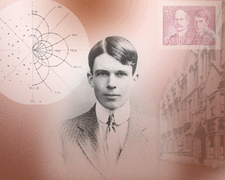
Crystal structure analysis began in 1912 with the first papers of William Lawrence Bragg. Just three years later in 1915, William Lawrence Bragg and his father, William Henry Bragg, were jointly awarded the Nobel Prize in Physics for their work in formulating the relationship between the atomic structure of a crystal and its X-ray diffraction pattern. Their work has revolutionised our understanding of the structure of matter ranging from minerals, pharmaceutical materials and catalysts to DNA, proteins and viruses.
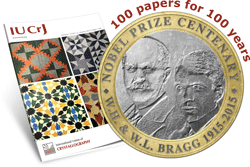
In celebration of 100 years since the award of the Nobel Prize to the Braggs, IUCr Journals are making a number of Physics-related articles free of charge for a period of time (see below). We strive for high quality and we encourage physicists, chemists and biologists and to report the best of their structural studies in our journals.
To find out more about our journals visit us at IUCr Journals Online.
100 papers for 100 years
In 2014, as part of the celebrations for the International Year of Crystallography, the IUCr launched IUCrJ. This is a fully open-access journal that aims to attract high-quality science papers of broad scientific significance from across all the scientific communities that use results obtained from diffraction methods. The goal for 2015 is to publish 100 articles (in line with the 100-year celebration of the Braggs) in IUCrJ.
The first 100 articles submitted to IUCrJ using the voucher code below, and accepted for publication following peer review, will be published as platinum open access (i.e. there will be no charges for open-access publication).
Voucher code: dis-63gwUYye619PkvwixPj
Physics articles from IUCr Journals
A selection of recent physics research articles in IUCr journals that are currently free to download are presented below.
 | Acta Crystallographica Section A Acta Crystallographica Section A FOUNDATIONS AND ADVANCES |
Diffuse
multiple scattering
Nisbet, A. G. A.,
Beutier, G., Fabrizi, F., Moser, B. & Collins, S. P. (2015). Acta
Cryst. A71, 20-25.
Structure
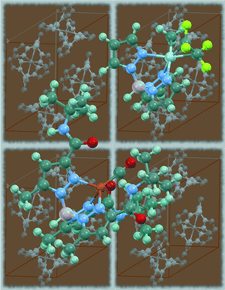
refinement using precession electron diffraction tomography and
dynamical diffraction: theory and implementation
Palatinus, L.,
Petricek, V. & Correa, C. A. (2015). Acta Cryst. A71,
doi:10.1107/S2053273315001266
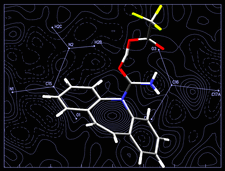
Nuclear-weighted
X-ray maximum entropy method – NXMEM
Christensen, S.,
Bindzus, N., Christensen, M. & Brummerstedt Iversen, B. (2015).
Acta Cryst. A71, 9-19.

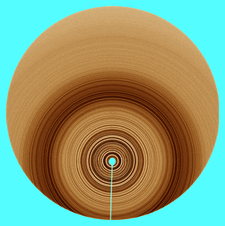
Cascading
time evolution of dissipative structures leading to unique
crystalline textures
Hashimoto, T. &
Murase, H. (2015). IUCrJ, 2, 59-73.
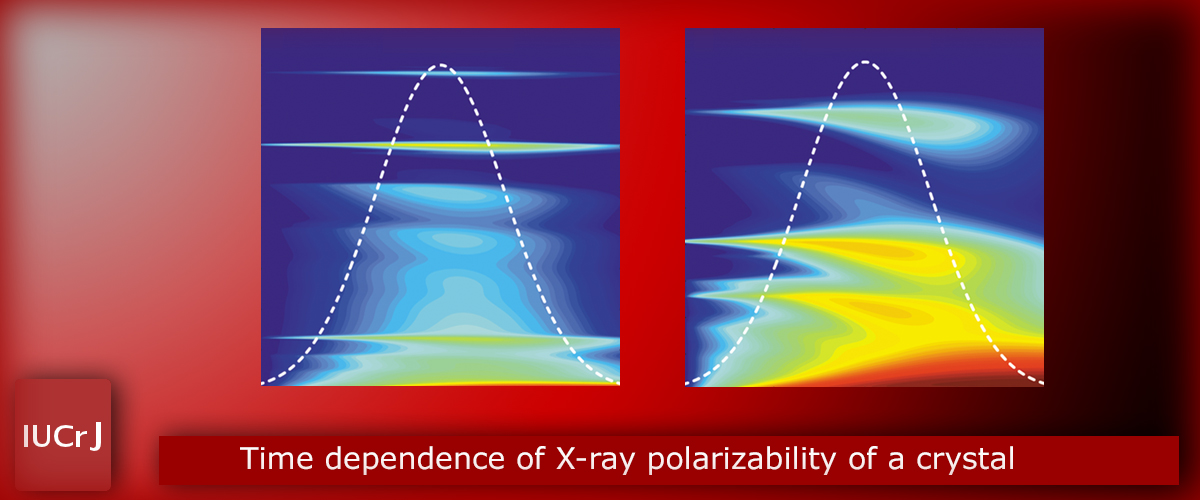
Time
dependence of X-ray polarizability of a crystal induced by an intense
femtosecond
X-ray pulse
Leonov, A.,
Ksenzov, D., Benediktovitch, A., Feranchuk, I. & Pietsch, U.
(2014). IUCrJ, 1, 402-417.
 | Journal of Applied Crystallography Journal of Applied Crystallography |
Determining
the Bravais lattice using a single electron backscatter diffraction
pattern
Li, L. & Han,
M. (2015). J. Appl. Cryst. 48, 107-115.
An
accurate projection model for diffraction image formation and
inversion using a polychromatic cone beam
van Aarle, W.,
Ludwig, W., King, A. & Penumadu, D. (2015). J. Appl. Cryst.
48, doi:10.1107/S1600576715000928
Exotic
X-ray back-diffraction: a path toward a soft inelastic X-ray
scattering spectrometer
Honnicke, M. G.,
Conley, R., Cusatis, C., Kakuno, E. M., Zhou, J., Bouet, N., Marques,
J. B. & Vicentin, F. C. (2014). J. Appl. Cryst. 47,
1658-1665.
 |
Journal of Synchrotron Radiation
Journal of Synchrotron Radiation |
Kirkpatrick-Baez
mirrors to focus hard X-rays in two dimensions as fabricated, tested
and installed at the Advanced Photon Source
Kujala, N.,
Marathe, S., Shu, D., Shi, B., Qian, J., Maxey, E., Finney, L.,
Macrander, A. & Assoufid, L. (2014). J. Synchrotron Rad.
21, 662-668.
Optics
for coherent X-ray applications
Yabashi, M.,
Tono, K., Mimura, H., Matsuyama, S., Yamauchi, K., Tanaka, T.,
Tanaka, H., Tamasaku, K., Ohashi, H., Goto, S. & Ishikawa, T.
(2014). J. Synchrotron Rad. 21, 976-985.
Brightness
of synchrotron radiation from undulators and bending magnets
Geloni, G.,
Kocharyan, V. & Saldin, E. (2015). J. Synchrotron Rad. 22,
doi:10.1107/S1600577514026071