|
 |
Dear Colleague
Platinum celebration
|
To celebrate the first impact factor for IUCrJ, which will be reported in June 2016, we are offering you the chance to publish a platinum open-access article in the journal.
The first 30 articles submitted before 30 June 2016 with the following voucher code:
Voucher code:
dis-63gwUYye619PkvwixPj
and accepted for publication following peer review, will be published platinum open access (i.e. there will be no charge for open-access publication).
The contents of the latest issue of the journal are given below.
We look forward to receiving your submissions.
Best wishes
|
 |
 Peter Strickland
Executive Managing Editor
 Jonathan Agbenyega
Business Development Manager
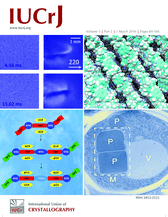
latest issue (March 2016)
editorial

An exciting future is outlined in which new approaches complementary to conventional X-ray crystallography will substantially widen the reach of structural biology. Primary among these are the recent advances in cryoelectron microscopy and the growing applications of free electron lasers.
|
scientific commentaries
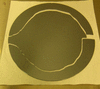
Ultra-fast diffraction and phase contrast imaging experiments on crack propagation in silicon, reported in the current issue of IUCrJ, are reviewed in the light of our present knowledge and its industrial importance.
|
research letters
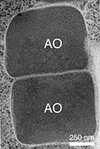
The application of serial femtosecond crystallography to naturally occurring peroxisomal protein crystals within yeast cells is described. The concept of utilizing peroxisomes for the production of protein nanocrystals is outlined.
|
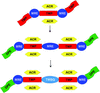
A logic driven synthetic approach is used in this first report of the isolation of stoichiometric four-component molecular solids. A possible extension to a five-component solid is also described.
|
research papers
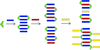
A combinatorial synthetic approach is described for the isolation of quaternary cocrystals. The strategy outlines chemical and geometrical modulations in the long-range synthon Aufbau modules (LSAMs) to systematically increase the number of components.
|
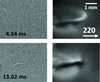
Crack propagation in an Si wafer under thermal stress is depicted by combining diffraction and transmission X-ray imaging. The use of synchrotron radiation allows for the high imaging frame rates required to follow the crack dynamics in real time.
|
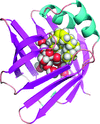
E. I. Howard, B. Guillot, M. P. Blakeley, M. Haertlein, M. Moulin, A. Mitschler, A. Cousido-Siah, F. Fadel, W. M. Valsecchi, T. Tomizaki, T. Petrova, J. Claudot and A. Podjarny
Neutron and high-resolution X-ray crystallography were used to determine fully the structure of the internal water cluster in H-FABP. Analysis of the orientation and electrostatic properties of the water molecules showed significant alignment of the permanent dipoles of the water molecules with the protein electrostatic field.
|
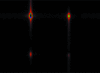
Extracting structure-factor moduli from diffraction patterns of protein nanocrystals is one of the critical issues of serial femtosecond X-ray crystallography. Unlike a conventional crystallography experiment, serial femtosecond crystallography combines data from hundreds or thousands of crystals of varying size and quality, a situation reminiscent of powder diffraction. Here the whole-pattern fitting technique, originally designed for one-dimensional powder diffraction crystallography, has been reconsidered and applied to the analysis of higher-dimensional serial femtosecond X-ray crystallography data. For nanocrystals with a small number of unit cells, the whole-pattern fitting approach is shown to be more accurate than integration-based Monte Carlo methods.
|
The protocols of the crystalline sponge method, particularly those in the soaking, data collection and refinement processes, are considerably improved to give reliable structural information.
|
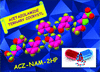
The first report of a ternary cocrystal acetazolamide–nicotinamide–pyridone (1:1:1) for a sulfonamide drug with amide coformers.
|
The
IUCr is a scientific union serving the interests of
crystallographers and other scientists employing crystallographic
methods.
|
|


