

 journal menu


issue contents
2017 issue
Proceedings of the CCP4 Study Weekend
Guest editors: Charles Ballard, Judit Debreczeni and Paul Emsley
This virtual special issue of Acta Crystallographica Section D brings together the proceedings of the CCP-4 Study Weekend held at Nottingham University in January 2016.
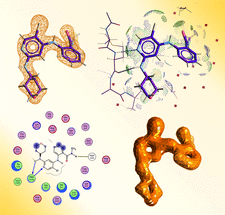
Cover illustration: Coot representations of ligand CQ8 in the PDB entry 4zzn.
introduction


Open  access
access
An introduction to the Proceedings of the 2016 CCP4 Study Weekend on protein-ligand complex structures.
research papers
Open access
access
This article aims to guide efforts in protein–ligand complex crystal structure generation, with special consideration of protein construct design, and summarizes different approaches to co-crystallization and crystal soaking. Common problems and pitfalls are highlighted.
Open access
access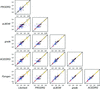
An overview of the process of ligand restraint generation for macromolecular crystallographic refinement is given.
Open access
access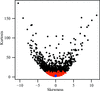
The entries from a freely available small-molecule database, the Crystallography Open Database, have been validated and a reliable subset of molecules has been selected for the extraction of molecular-geometry information. The atom types and corresponding bond and angle classes derived from this database have been subjected to validation, the results of which are used by AceDRG in the derivation of new ligand descriptions.

Open access
access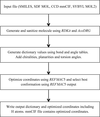
The program AceDRG generates accurate stereochemical descriptions, and one or more conformations, of a given ligand. The program also analyses entries and extracts local environment-dependent atom types, bonds and angles from the Crystallography Open Database.
Open access
access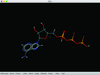
Obtaining a restraint dictionary for novel ligands or improving restraints for known ligands can require their manual modification. This can be tedious and error-prone. REEL is a restraints editor that provides quick, easy and accurate development, allowing global changes and fine-tuning of individual restraints.
Open access
access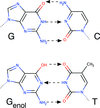
H atoms are `hard to see' in X-ray crystal structures of protein–ligand complexes. This paper discusses the problem of identifying the correct tautomeric form(s) of protein-bound ligands.

Open access
access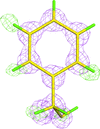
The use of neutron crystallography and in situ spectroscopy to study enzyme mechanism is discussed.
Open access
access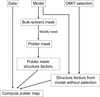
Residual OMIT maps can be improved by the selective exclusion of bulk solvent from the OMIT region.
Open access
access
The process of ligand fitting with CCP4 is reviewed, including identifying ligand density in the map, ligand fitting, refinement and subsequent validation. Recent developments are discussed, and are illustrated using instructive examples demonstrating practical application.
Open access
access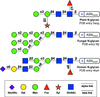
This article addresses many of the typical difficulties that a structural biologist may face when dealing with carbohydrates, with an emphasis on problem solving in the resolution range where X-ray crystallography and cryo-electron microscopy are expected to overlap in the next decade.

Open access
access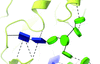
With structural glycoscience finally gaining popularity, the need for a clear way of depicting glycans and their interactions in three dimensions is more pressing than ever. Here the Glycoblocks representation is introduced, which combines a simplified bonding-network depiction with the familiar two-dimensional glycan notation brought into three-dimensions.
Open access
access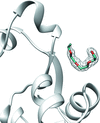
The use of the protein–ligand interaction energy as an additional parameter for the automated identification of crystallographic ligands and its applicability to structure validation are described.
Open access
access
The current tools of Coot for ligand validation and comparison in are presented. The user-selected ligand is assessed by ligand-distortion and map-correlation metrics, and compared with those of ligands of the wwPDB to create a percentile rank.
Open access
access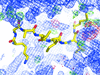
The potential causes of the misinterpretation of peptide density in a significant number of protein–peptide complex structures are analyzed, together with suggestions for good practice and specific education aimed at minimizing overinterpretation and mistakes in protein–peptide complex structure models.
Open access
access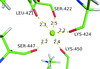
The metal-site validation tool CheckMyMetal is described, with examples to follow.
Open access
access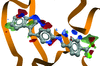
A guide to how the Cambridge Structural Database can be used to aid macromolecular crystallography.
Open access
access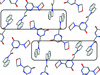
Small-molecule crystal structures are of tremendous value in understanding protein–ligand complexes, both individually and as a collection.
Open access
access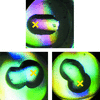
A high-throughput method is described for crystal soaking using acoustic droplet ejection, and its effectiveness is demonstrated.
Open access
access
The importance of modelling the superpositions of ligand-bound and unbound states that commonly occur in crystallographic data sets is emphasized and demonstrated. The generation of an ensemble that models not only the state of interest is important for the high-quality refinement of low-occupancy ligands, as well as to explain the observed density more completely.
Open access
access
XChemExplorer is a graphical workflow and data-management tool for the parallel determination of protein–ligand complexes. Its implementation, usage and application are described here.
Open access
access
The background to and development of WONKA and OOMMPPAA, tools for structure-based drug design, are described.