journal menu


issue contents
 | FOUNDATIONS ADVANCES |
ISSN: 2053-2733
The crystal lattice revisited
New approaches to a fundamental concept
This virtual issue of Acta Crystallographica Section A collects together a number of recent articles on the topic of crystal lattices. Articles will be added to the collection during 2024 and 2025.
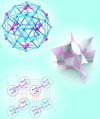
Cover illustration: Geometric relationships between different lattices.


Open  access
access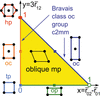
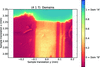
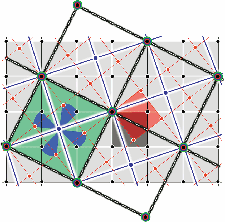
Continuous invariant-based maps visualize for the first time all two-dimensional lattices extracted from hundreds of thousands of known crystal structures in the Cambridge Structural Database.
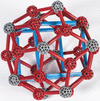
It is shown that from a skewed, skeletal (edges and vertices), truncated octahedron, skewed skeletons can be derived of the other four convex parallelohedra found by Fedorov in 1885.
Open access
access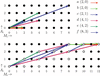
The number of Wyckoff sequences of a given subdivision complexity is calculated by means of a generating polynomial approach and a dynamic programming approach. The result depends on the choice of space-group symmetry (which is obligatory) and Wyckoff sequence length (which is optional). It also takes into account specified values for the total number of combinatorial and coordinational degrees of freedom, thereby representing crystal structures of invariant subdivision complexity.
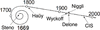
Starting from a Niggli-reduced cell, a crystallographic lattice may be characterized by seven parameters describing the Dirichlet cell: the three shortest non-coplanar lattice vector lengths, the three shorter of each pair of face-diagonal lengths and the shortest body-diagonal length, from which the Niggli-reduced cell may be recovered.
Open access
access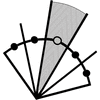
A method is proposed for transforming unit cells for a group of crystals so that they all appear as similar as possible to a selected cell.
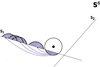
Unit cells are used to represent crystallographic lattices. Calculations measuring the differences between unit cells are used to provide metrics for measuring meaningful distances between three-dimensional crystallographic lattices. This is a surprisingly complex and computationally demanding problem. A review is presented of the current best practice using Delaunay-reduced unit cells in the six-dimensional real space of Selling scalar cells S6 and the equivalent three-dimensional complex space C3.

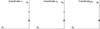
The space C3 is explained in more detail than in the original description. Boundary transformations of the fundamental unit are described in detail. A graphical presentation of the basic coordinates is described and illustrated.
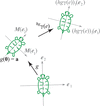
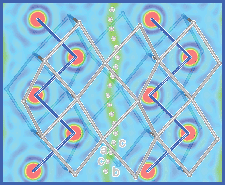
Crystal nets are popular discrete representations of crystal structures, and a recent generalization of voltage graphs allows for a representation of a crystal net as a component of a graph derived from a putative quotient graph labeled by voltages and point groups; this component is realized by successively generating its edges and vertices.
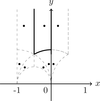
Error-stable Bravais lattice determination algorithms for 2D and 3D lattices are presented.
Open access
access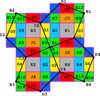
For any periodic tilings of the plane by congruent polygons, growth functions are derived that count the numbers of vertices, edges and faces as the coverage expands. The functions are computed as polynomial formulas in a Python program and analyzed graphically using orphic diagrams.