menu
menu


issue contents
CommDat special virtual issue on the raw diffraction data workshop and microsymposia at IUCr2023
Edited by Loes Kroon-Batenburg
Papers from the CommDat workshop on ‘Raw Diffraction Data Reuse: the Good, the Bad and the Challenging’ at the IUCr2023 Congress in Melbourne as well as the CommDat-organized microsymposia ‘Raw Diffraction Data Reuse: Warts and All’ and ‘Interoperability of Crystallographic Data and Databases’ are collected in this special virtual issue.
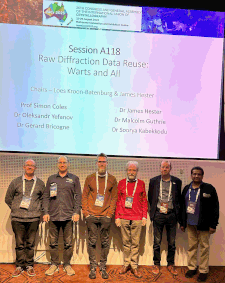
Cover illustration: The speakers at Microsymposium A118 at the Melbourne Congress.


Open  access
access
Papers from the CommDat workshop on ‘Raw Diffraction Data Reuse: the Good, the Bad and the Challenging' and microsymposia at the IUCr2023 Congress in Melbourne are presented.

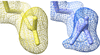
Various approaches for lossless and lossy compression are evaluated, and suitable quality assessment metrics for serial crystallographic data – used in combination with lossy data reduction – are described.
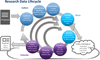
The German project DAPHNE4NFDI together with the European Synchrotron and Free Electron Laser User Organization (ESUO), the European Neutron Scattering Association (ENSA), and European synchrotron and neutron facilities continue the development of FAIR data handling procedures laid out by the EU-funded projects PaNOSC and ExPaNDS. Written by members of these organizations, this `white paper' documents the current status of this discussion.
Open access
access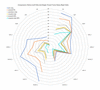
Many macromolecular crystallography beamlines are now fitted with DECTRIS Eiger detectors, which are all delivered with optimized compression algorithms by default; they perform well with current framing rates and typical diffraction data. However, better lossless compression algorithms have been developed and are now available to the research community.
Open access
access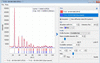
Conventional d-spacing and relative intensity data found in the Powder Diffraction File database are enhanced with the inclusion of raw diffraction data, especially in characterizing samples with poor crystallinity, disorder, and interesting microstructure.
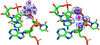
Recent updates to CheckMyMetal have significantly enhanced its capability to efficiently handle large datasets, including those generated from cryo-EM structural analyses.

The IUCr 75th Congress in Melbourne hosted a workshop on raw data reuse, continuing efforts to promote discussions and plans within crystallography, diffraction and scattering communities. These initiatives build on earlier IUCr funded workshops, aiming to establish ground truth obtained from research results through raw data archiving potential.
Open access
access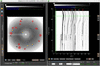
Tools have been implemented for rapid X-ray diffraction data processing and analysis for dynamic compression experiments using a diamond anvil cell.
Open access
access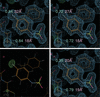
The final models for macromolecular X-ray crystallography studies are usually not only the result of refinement against some version of scaled and merged reflection data, but are often also analysed and validated purely against such merged data. Here, various examples are presented to show how the availability and use of unmerged reflection data can lead to better model analysis and improved model parametrization, as well as providing a path to better data processing and scaling.
Open access
access
We share personal experience in the fields of materials science and high-pressure research, discussing which parameters are important to control and document in order to make deposited powder diffraction data reusable, reproducible and replicable.
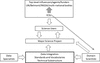
Interoperability of scientific data within crystallography has been achieved to a high level by the adoption of standard exchange formats and protocols. Extending such interoperability across other disciplines is a goal of the International Science Council Committee CODATA, to which the IUCr has been a leading contributor. Our article combines a description of the importance of interoperability for addressing grand challenges with a desire to stimulate the crystallographic community to continue exploring this topic.