

 journal menu


issue contents
 | JOURNAL OF SYNCHROTRON RADIATION |
ISSN: 1600-5775
50th Anniversary of the Stanford SSRL synchrotron radiation and protein crystallography initiative led by Keith Hodgson
Edited by John R. Helliwell and Marian Szebenyi
Current and future perspectives for macromolecular crystallography instrumentation, methods and applications from the world's synchrotron radiation and X-ray laser sources.
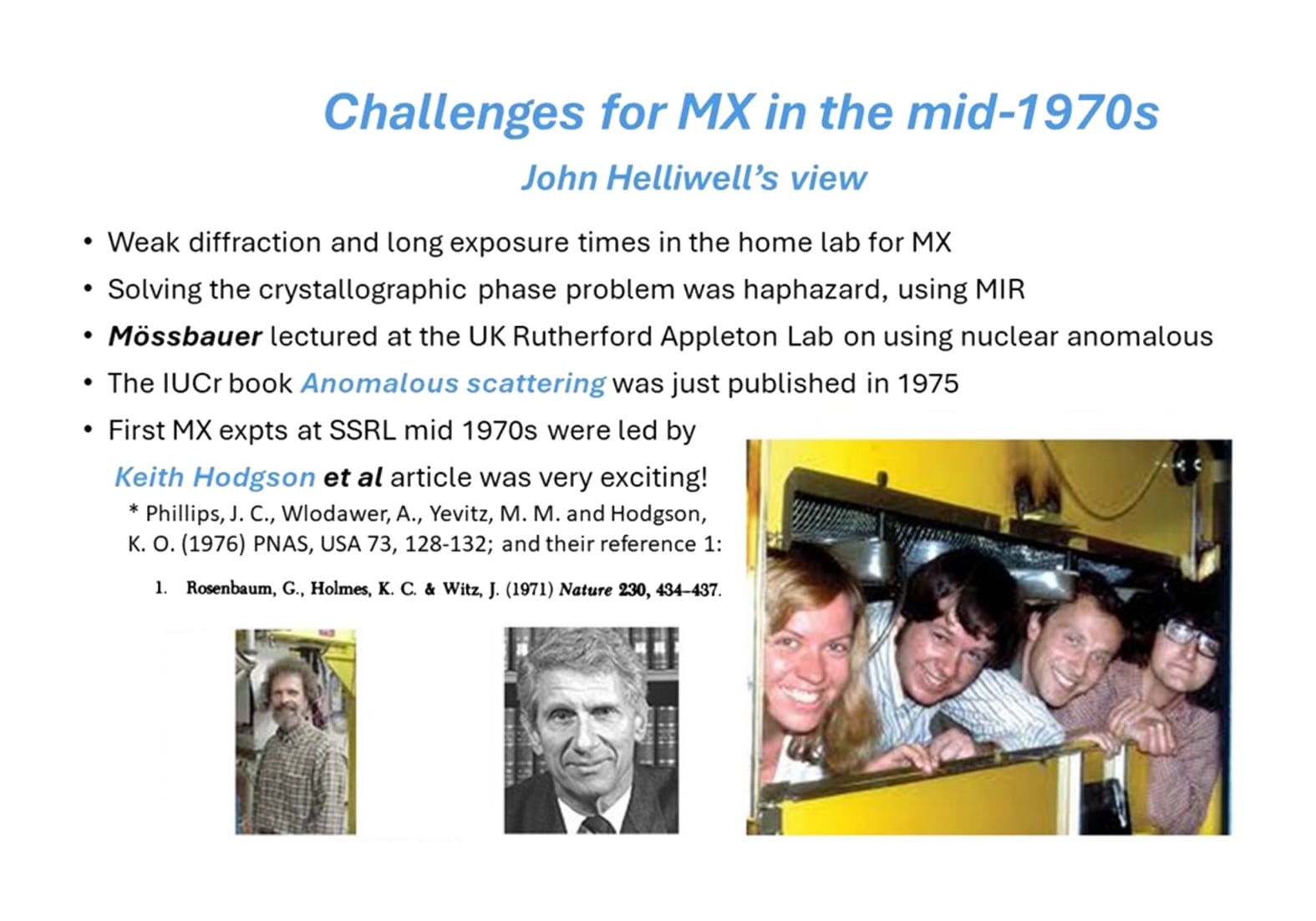
Cover illustration: Challenges for macromolecular crystallography in the mid-1970s
facility information


overview


Open  access
access
We provide a historical introduction and our thoughts on the current trends including some based on papers in this special issue of Journal of Synchrotron Radiation celebrating the 50th Anniversary of the Stanford SSRL synchrotron radiation and protein crystallography initiative led by Keith Hodgson.
perspectives
Open access
access
It has been 50 years since the publication in PNAS of our first results on the utilization and demonstrated benefits of synchrotron radiation for macromolecular crystallography. In this brief article, I offer some personal observations and comments about that early research at Stanford and the Stanford Synchrotron Radiation Project (SSRP, later renamed SSRL), how it evolved, and consider key factors in how and why synchrotron radiation ultimately catalyzed a new and transformational paradigm for study of the structure of biomolecules.
industry

Open access
access
Structure-based drug design has been a critical component of drug discovery for over 30 years, contributing to numerous approved drugs. The paper discusses the approach taken by AstraZeneca (Sweden) to synchrotron data collection for supporting a large portfolio of drug discovery projects and provides examples to demonstrate the continued importance of experimental structures.
asia
Open access
access
The current status and emerging trends of the MX beamlines at SSRF are described.
Open access
access
The Structural Biology Research Center at the High Energy Accelerator Research Organization has developed advanced systems for macromolecular crystallography, including an automated crystallization screening system, a long-wavelength crystallography beamline and an automated data-collection system.
Open access
access
This paper presents the development of instrumentation and macromolecular crystallography methods at the third-generation synchrotron facility SPring-8 and X-ray free electron laser facility SACLA. The aim is to facilitate rapid structural analysis from highly challenging protein crystals.
Open access
access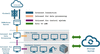
The SPXF has revolutionized structural biology research through its advanced light sources, enabling crucial breakthroughs in disease research. The facility's integration of automation and cutting-edge techniques provides world-class resources for global researchers.
europe
Open access
access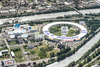
Details on the current status of the experimental techniques available at the ESRF–EBS and ILL research infrastructures are provided. Major contributions made by the EMBL, ESRF, ILL and IBS to the structural biology field are described, including future prospects at the EPN campus
Open access
access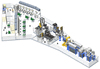
The history, current state and future directions of the three MX beamlines BL14.1, BL14.2 and BL14.3 of the Helmholtz-Zentrum Berlin at the BESSY II electron storage ring are described.
Open access
access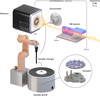
Facilities for structural biology investigations at DESY and the European XFEL are described.
Open access
access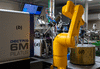
The XRD2 beamline at Elettra-Sincrotrone Trieste has been in operation since 2018 and is dedicated to macromolecular crystallography for both academic and industrial research, a role partially fulfilled, before 2018, by XRD1, a general-purpose diffraction beamline. With the upcoming Elettra 2.0 upgrade, based on a six-bend enhanced achromat lattice, the synchrotron will offer a brighter, more powerful beam to address evolving challenges in crystallography.
Open access
access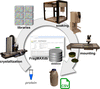
A comprehensive overview of the protein crystallography beamlines BioMAX and MicroMAX is given. This work introduces FragMAX, a platform for early drug discovery as well potential opportunities for protein crystallography at FemtoMAX, a beamline dedicated to ultrafast experiments.
Open access
access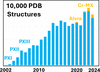
This review examines two decades of continuous development in macromolecular crystallography beamlines at the Swiss Light Source, along with recent contributions from SwissFEL, in the broader context of the evolution of macromolecular crystallography at synchrotron and X-ray free-electron laser facilities.
canada/usa
Open access
access
An open-source software system for managing user office operations at a large-scale research facility is presented.
Open access
access
A description of the beamlines within the structural biology ALS-ENABLE P30 resource at the Advanced Light Source synchrotron at Lawrence Berkeley National Laboratory is given, highlighted through the biophysical characterization of the SpyCatcher–SpyTag protein system.
Open access
access
The significant advancements in biological research enabled by the Linac Coherent Light Source (LCLS) are explored. By offering ultra-bright, coherent X-ray pulses with femtosecond durations, LCLS has revolutionized the study of biological molecules and their dynamic processes. Techniques such as serial femtosecond crystallography leverage these unique properties, allowing researchers to image complex biomolecular structures at atomic resolutions and in near-native conditions. The ability to perform time-resolved studies and observe real-time interactions at the molecular level provides deeper insights into mechanisms underlying biological functions. The discussions presented highlight key studies and innovations facilitated by LCLS, underlining its critical role in advancing both fundamental biological knowledge and applied sciences such as drug development.
Open access
access
We describe the structural biology resources available at the National Synchrotron Light Source II at Brookhaven National Laboratory and ponder the future for automated experiments, micro-focusing crystallography and structure prediction to inform structural biology studies.


