


 menu
menu


issue contents
Special collection from the 27th Congress of the IUCr
Calgary, Canada
11–18 August 2026
The triennial congresses of the IUCr are the major international scientific meetings for structural scientists worldwide. This virtual issue showcases research that was reported at the 27th Congress in Calgary, Canada, 11–18 August 2026.
The issue is open to submissions until the end of 2026, and articles will be added to the issue throughout 2026 and 2027.




Crystal Engineering, the designed synthesis of functional molecular solids, is poised as a major branch of research in crystallography and chemistry. The centrality of this disciple is illustrated in this lead article.

Open  access
access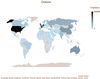
Open Science is the movement to make scientific research, the data and their dissemination available to any member of an inquiring society, from professionals to citizens, irrespective of their economic situation. The IUCr provides fully open educational resources to Global South and Global North readers and authors.
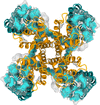
Protein dynamics are often manifested as disappearing densities in cryo-EM structures. Making sense of such disappearing densities in order to understand their biological implications requires approaches beyond high-resolution structures.
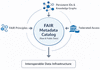
Metadata catalogs are essential for implementing FAIR data principles in photon and neutron (PaN) science, enabling experimental data to become findable, accessible, interoperable and reusable. This work provides an analysis of current catalog systems in the PaN field and offers practical recommendations to advance interoperability and build a federated FAIR-compliant data infrastructure.
Open access
access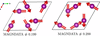
STENSOR automatically computes symmetry-adapted tensors under spin and magnetic point groups. It generates tensors for both spin and magnetic point groups from structural data files or spin-group generators. The comparison permits separation of the effects due to spin–orbit coupling from non-relativistic contributions, as illustrated by examples.
Open access
access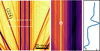
We introduce a Python package with parallel computing capabilities designed for the refinement of convergent-beam electron diffraction (CBED) or large-angle CBED patterns.
Open access
access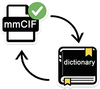
The mmCIF Validator provides real-time automated validation of mmCIFs against a valid PDBx/mmCIF dictionary. The validator is available as both a Visual Studio Code extension and a standalone Python script for integration into automated workflows.
Open access
access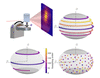
A dynamic sampling strategy is presented to reduce the measurement time required for SAXS tensor tomography while maintaining reconstruction quality.
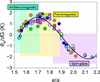
This review summarizes recent experimental and theoretical advances in the magnetism of quasicrystals and their approximant crystals, and formulates three complementary and hierarchical design principles – valence electron concentration, crystal electric field-induced anisotropy and structural control of magnetic frustration – as primary tools for systematically tuning the magnetic ground states in these compounds.

