


 journal menu


issue contents
December 2009 issue
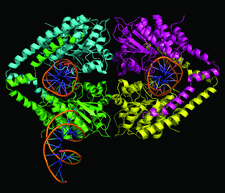
Cover illustration: The crystal structure of HindIII complexed with its cognate-DNA at 2.0 Å resolution. Two functional dimers and an extra free DNA duplex are in the asymmetric unit (p. 1326).
research papers


Download citation


Download citation

The HC1b is a new user-friendly humidity-control device that is compatible with standard X-ray beamlines. It is used to improve the diffraction properties of macromolecular crystals by optimizing their hydration state.
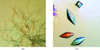
The key role of Pro20 in the crystal nucleation and growth rate of the α-spectrin SH3 domain has been investigated.
PDB reference: GDS mutant α-spectrin SH3 domain, 3i9q, r3i9qsf
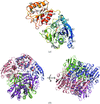
The crystal structure of H. pylori L-asparaginase in the presence of L-Asp was determined at 1.4 Å resolution and revealed changes in loops involved in the formation of the active site.
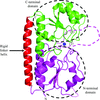
The crystal structure of a laminin-binding adhesin (Lmb) from S. agalactiae was determined at 2.5 Å resolution. The structure of Lmb will allow further investigations into the possible dual role of Lmb as an adhesin and in metal homeostasis.
PDB reference: laminin-binding adhesin, 3hjt, 3rhjtsf
A description is given of a robust procedure for the purification of 50S ribosomal subunits from D. radiodurans that consistently crystallize to form crystals that give diffraction patterns extending to 2.9 Å resolution. Factors that may influence the ability to form crystals are systematically evaluated and future areas of study aresuggested.
Open  access
access
Conventional and free R factors and their difference, as well as the ratio of the number of measured reflections to the number of atoms in the crystal, were studied as functions of the resolution at which the structures were reported. When the resolution was taken uniformly on a logarithmic scale, the most frequent values of these functions were quasi-linear over a large resolution range.
The structure of the X (ADRP) domain of nonstructural protein 3 from feline coronavirus has been determined in two crystal forms. The binding of glycerol-3-phosphate and ADP-ribose is described.
The crystal structure of the Taz2 zinc-finger domain of the human p300 transcriptional coactivator was determined using the anomalous diffraction signal of the bound Zn ions. Crystal contacts suggested a possible novel mode of Taz2–peptide ligand interactions.
PDB reference: Taz2 domain of p300, 3io2, r3io2sf
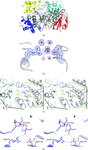
The crystal structure of apo sucrose hydrolase from X. campestris pv. campestris is reported.
PDB reference: sucrose hydrolase, 2wpg, r2wpgsf
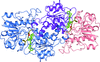
The crystal structures of the apo and holo forms of NAD+-dependent formate dehydrogenase (FDH) from the methylotrophic bacterium Moraxella sp. C-1 are reported. The structure of the apo form in the closed conformation provides insights into the mechanism of closure of the interdomain cleft in FDH.
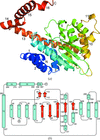
The crystal structure of the HindIII–cognate DNA complex was solved with and without metal cations.
short communications
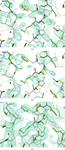
When properly applied, pseudosymmetry can be used to improve crystallographic phases through averaging and to facilitate crystal structure determination.
essays

The new developments in evolutionary biology are reviewed to encourage a fruitful dialog between structural and evolutionary biologists.