 | Acta Crystallographica Section E Acta Crystallographica Section E CRYSTALLOGRAPHIC COMMUNICATIONS |


 journal menu


metal-organic compounds
| CRYSTALLOGRAPHIC COMMUNICATIONS |
 access
4-(Dimethylamino)pyridinium trans-diaquabis[oxalato(2−)-κ2O1,O2]chromate(III)

aDepartment of Inorganic Chemistry, University of Yaounde I, POB 812 Yaounde, Cameroon, bDepartment of Chemistry, University of Dschang, POB 67, Dschang, Cameroon, and cInstitut für Anorganische Chemie, RWTH Aachen, D-52056 Aachen, Germany
*Correspondence e-mail: [email protected]
In the title salt, (C7H11N2)[Cr(C2O4)2(H2O)2], the asymmetric unit contains one half-cation and one half-anion. The Cr atom, the C and N atoms involved in C— N(exocyclic) bonding and the N and H atoms of N—H groups lie on twofold rotation axis. The CrIII atom of the complex anion is six-coordinated in a distorted (4 + 2) octahedral geometry with four equatorial O atoms of two nearly coplanar oxalate and two quasi-axial aqua O atoms. In the crystal, the protonated N atoms of the pyridine rings are hydrogen bonded to the carbonyl O atoms of the anions, forming chains along [010]. These chains are connected by lateral O—H⋯O hydrogen bonds, stabilizing the structure.
Related literature
For general background to the coordination chemistry of oxalate, see: Martin et al. (2007![[Martin, L., Day, P., Clegg, W., Harrington, R. W., Horton, P. N., Bingham, A., Hursthouse, M. B., McMillan, P. & Firth, S. (2007). J. Mater. Chem. 17, 3324-3329.]](../../../../../../logos/arrows/e_arr.gif "Martin, L., Day, P., Clegg, W., Harrington, R. W., Horton, P. N., Bingham, A., Hursthouse, M. B., McMillan, P. & Firth, S. (2007). J. Mater. Chem. 17, 3324-3329.") ). For related structures, see: Bélombé et al. (2009); Ghouili et al. (2010).
). For related structures, see: Bélombé et al. (2009); Ghouili et al. (2010).
![[Scheme 1]](bx2312scheme1.gif)
Experimental
Crystal data
|
Refinement
|
|
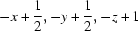 ; (ii)
  ; (iii)
 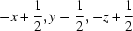 ; (iv)
  .
. Data collection: SMART (Bruker, 2004); cell refinement: SAINT (Bruker, 2004); data reduction: SAINT; program(s) used to solve structure: SHELXS97 (Sheldrick, 2008); program(s) used to refine structure: SHELXL97 (Sheldrick, 2008); molecular graphics: DIAMOND (Brandenburg, 2010); software used to prepare material for publication: WinGX (Farrugia, 1999).
Supporting information
contains datablocks I, global. DOI: https://doi.org/10.1107/S1600536810040353/bx2312sup1.cif
Structure factors: contains datablock I. DOI: https://doi.org/10.1107/S1600536810040353/bx2312Isup2.hkl
A mixture of 4-dimethylaminopyridine (1 mmol, 122.2 mg) and oxalic acid (2.2 mmol, 277.2 mg) was dissolved in 30 ml of water. The filtered solution was stirred at 328 K and an aqueous solution (20 ml) of CrCl3.6H2O (1 mmol, 266.5 mg) was added in successive small portions and stirred for 2 h continuously. The final red-violet solution obtained was left at room temperature and brown plate-like crystals suitable for X-ray diffraction were obtained after a few days.
The H atoms were positioned geometrically, with C—H, N—H distances of 0.96 and 0.86 Å respectively, and constrained to ride on their parent atoms, with Uiso(H) = 1.5Ueq(C) and 1.2Ueq(N). The water H atoms were first located in a difference Fourier map and refined with distance restraints of d(O–H1) = 0.81 (1) with all Uiso(H) refined freely.
The coordination chemistry of oxalate (C2O42-) continues receiving considerable attention, due to the ability of this ion to act as a remarkably flexible ligand system in complexations with a wide range of metal ions [Martin et al.,2007]. Recently, we published the structure of an organic-inorganic hybrid salt involving the quinolinium cation, [C9H8N]+and complex anion, [Cr(H2O)2(C2O4)2]- (Bélombé et al., 2009). We report here the of a homologous salt, with 4-Dimethylaminopyridinium as the organic cation. The Fig. 1 shows the 4-dimethylaminopyridinium cation, [C7H11N2]+, and the complex anion, [Cr(H2O)2(C2O4)2]-.The is formed by one-half cation and one-half anion. The geometrical parameters of the [C7H11N2]+ cation are in agreement with those found in salts with the same cationic entity (Ghouili et al., 2010). The CrIII ion of the complex anion adopts a distorted (4 + 2) octahedral coordination involving four equatorial O atoms (O2, O2i, O3, O3i) of two nearly coplanar oxalate and two quasi axial O atoms (O1, O1i) of water ligands (Fig. 1). The equatorial Cr–O distances are 1.9706 (13) Å (Cr–O(2), Cr–O(2i)) and 1.9468 (13) Å (Cr–O(3), Cr–O(3i)) respectively, and are significantly shorter than the axial Cr–O distance of 2.0055 (14)Å (Cr–O(1), Cr–O(1i)). The bond distances in the complex anion are comparable with those reported for the quinolinium compound (Bélombé et al., 2009).In the intermolecular N–H···O(carbonyl) hydrogen bonds connect the ionic entities, generating layers parallel to [010]. These layers are further connected by lateral O–H···O hydrogen bonds,stabilizing the structure (Table 1, Fig. 2)
For general background to the coordination chemistry of oxalate, see: Martin et al. (2007). For related structures, see: Bélombé et al. (2009); Ghouili et al. (2010).
Data collection: SMART (Bruker, 2004); cell SAINT (Bruker, 2004); data reduction: SAINT (Bruker, 2004); program(s) used to solve structure: SHELXS97 (Sheldrick, 2008); program(s) used to refine structure: SHELXL97 (Sheldrick, 2008); molecular graphics: DIAMOND (Brandenburg, 2010); software used to prepare material for publication: WinGX (Farrugia, 1999).
![[Figure 1]](./bx2312fig1thm.gif) | Fig. 1. A view of the title compound with the atom-numbering scheme. Displacement ellipsoids are drawn at the 50% probability level and H atoms are shown as small spheres of arbitrary radii. Unlabelled atoms are related two labeled atoms by the symmetry code for cation and anion are: 1-x,y,1/2-z; -x,y,1/2-z |
![[Figure 2]](./bx2312fig2thm.gif) | Fig. 2. Packing diagram of the title compound. Dotted lines show hydrogen bonding. |
| (C7H11N2)[Cr(C2O4)2(H2O)2] | F(000) = 796 |
| Mr = 387.25 | Dx = 1.731 Mg m−3 |
| Monoclinic, C2/c | Mo Kα radiation, λ = 0.71073 Å |
| Hall symbol: -C 2yc | Cell parameters from 1857 reflections |
| a = 11.524 (4) Å | θ = 2.0–28.3° |
| b = 20.372 (8) Å | µ = 0.83 mm−1 |
| c = 7.355 (2) Å | T = 293 K |
| β = 120.626 (6)° | Prism, dark-violet |
| V = 1485.9 (9) Å3 | 0.20 × 0.20 × 0.10 mm |
| Z = 4 |
| Bruker APEX CCD area-detector diffractometer | 1857 independent reflections |
| Radiation source: fine-focus sealed tube | 1739 reflections with I > 2σ(I) |
| Graphite monochromator | Rint = 0.046 |
| integration method scans | θmax = 28.3°, θmin = 2.0° |
| Absorption correction: multi-scan (SADABS; Bruker, 2004) | h = −15→15 |
| Tmin = 0.895, Tmax = 0.910 | k = −27→27 |
| 10203 measured reflections | l = −9→9 |
| Refinement on F2 | Secondary atom site location: difference Fourier map |
| Least-squares matrix: full | Hydrogen site location: inferred from neighbouring sites |
| R[F2 > 2σ(F2)] = 0.033 | H atoms treated by a mixture of independent and constrained refinement |
| wR(F2) = 0.089 | w = 1/[σ2(Fo2) + (0.0395P)2 + 1.1284P] where P = (Fo2 + 2Fc2)/3 |
| S = 1.16 | (Δ/σ)max < 0.001 |
| 1857 reflections | Δρmax = 0.37 e Å−3 |
| 127 parameters | Δρmin = −0.38 e Å−3 |
| 2 restraints | Extinction correction: SHELXL97 (Sheldrick, 2008), Fc*=kFc[1+0.001xFc2λ3/sin(2θ)]-1/4 |
| Primary atom site location: structure-invariant direct methods | Extinction coefficient: 0.0065 (6) |
| (C7H11N2)[Cr(C2O4)2(H2O)2] | V = 1485.9 (9) Å3 |
| Mr = 387.25 | Z = 4 |
| Monoclinic, C2/c | Mo Kα radiation |
| a = 11.524 (4) Å | µ = 0.83 mm−1 |
| b = 20.372 (8) Å | T = 293 K |
| c = 7.355 (2) Å | 0.20 × 0.20 × 0.10 mm |
| β = 120.626 (6)° |
| Bruker APEX CCD area-detector diffractometer | 1857 independent reflections |
| Absorption correction: multi-scan (SADABS; Bruker, 2004) | 1739 reflections with I > 2σ(I) |
| Tmin = 0.895, Tmax = 0.910 | Rint = 0.046 |
| 10203 measured reflections |
| R[F2 > 2σ(F2)] = 0.033 | 2 restraints |
| wR(F2) = 0.089 | H atoms treated by a mixture of independent and constrained refinement |
| S = 1.16 | Δρmax = 0.37 e Å−3 |
| 1857 reflections | Δρmin = −0.38 e Å−3 |
| 127 parameters |
Geometry. All e.s.d.'s (except the e.s.d. in the dihedral angle between two l.s. planes) are estimated using the full covariance matrix. The cell e.s.d.'s are taken into account individually in the estimation of e.s.d.'s in distances, angles and torsion angles; correlations between e.s.d.'s in cell parameters are only used when they are defined by crystal symmetry. An approximate (isotropic) treatment of cell e.s.d.'s is used for estimating e.s.d.'s involving l.s. planes. |
Refinement. Refinement of F2 against ALL reflections. The weighted R-factor wR and goodness of fit S are based on F2, conventional R-factors R are based on F, with F set to zero for negative F2. The threshold expression of F2 > σ(F2) is used only for calculating R-factors(gt) etc. and is not relevant to the choice of reflections for refinement. R-factors based on F2 are statistically about twice as large as those based on F, and R- factors based on ALL data will be even larger. |
| x | y | z | Uiso*/Ueq | ||
| Cr1 | 0.0000 | 0.148676 (17) | 0.2500 | 0.02141 (14) | |
| O1 | 0.10432 (13) | 0.15066 (6) | 0.5670 (2) | 0.0278 (3) | |
| H1A | 0.1841 (11) | 0.1603 (11) | 0.618 (4) | 0.038 (6)* | |
| H1B | 0.097 (2) | 0.1194 (8) | 0.626 (3) | 0.039 (6)* | |
| O2 | 0.11598 (12) | 0.22143 (6) | 0.2606 (2) | 0.0273 (3) | |
| O3 | 0.10971 (12) | 0.07688 (6) | 0.2448 (2) | 0.0275 (3) | |
| O4 | 0.12757 (13) | 0.33040 (6) | 0.2756 (2) | 0.0324 (3) | |
| O5 | 0.11585 (14) | −0.03196 (7) | 0.2324 (2) | 0.0394 (4) | |
| C1 | 0.06468 (17) | 0.01913 (8) | 0.2430 (3) | 0.0259 (4) | |
| C2 | 0.07080 (16) | 0.27821 (8) | 0.2608 (3) | 0.0236 (3) | |
| N11 | 0.5000 | 0.15711 (11) | 0.2500 | 0.0374 (5) | |
| N12 | 0.5000 | −0.04417 (12) | 0.2500 | 0.0393 (6) | |
| H12 | 0.5000 | −0.0864 | 0.2500 | 0.096 (17)* | |
| C11 | 0.3808 (3) | 0.19340 (12) | 0.2074 (5) | 0.0594 (7) | |
| H11C | 0.3998 | 0.2396 | 0.2191 | 0.121 (15)* | |
| H11D | 0.3548 | 0.1811 | 0.3077 | 0.088 (11)* | |
| H11E | 0.3087 | 0.1836 | 0.0671 | 0.077 (10)* | |
| C12 | 0.5000 | 0.09124 (12) | 0.2500 | 0.0263 (5) | |
| C13 | 0.38704 (18) | 0.05453 (10) | 0.2186 (3) | 0.0341 (4) | |
| H13 | 0.3097 | 0.0760 | 0.1967 | 0.049 (7)* | |
| C14 | 0.3915 (2) | −0.01145 (10) | 0.2204 (3) | 0.0394 (5) | |
| H14 | 0.3167 | −0.0349 | 0.2005 | 0.070 (9)* |
| U11 | U22 | U33 | U12 | U13 | U23 | |
| Cr1 | 0.0191 (2) | 0.0153 (2) | 0.0318 (2) | 0.000 | 0.01434 (16) | 0.000 |
| O1 | 0.0272 (7) | 0.0222 (6) | 0.0332 (7) | −0.0025 (5) | 0.0147 (6) | 0.0010 (5) |
| O2 | 0.0237 (6) | 0.0200 (6) | 0.0417 (7) | −0.0003 (4) | 0.0192 (6) | 0.0007 (5) |
| O3 | 0.0236 (6) | 0.0222 (6) | 0.0400 (7) | 0.0021 (5) | 0.0186 (5) | −0.0004 (5) |
| O4 | 0.0275 (6) | 0.0205 (6) | 0.0477 (8) | −0.0031 (5) | 0.0180 (6) | 0.0019 (5) |
| O5 | 0.0379 (8) | 0.0254 (7) | 0.0459 (8) | 0.0093 (5) | 0.0148 (6) | −0.0056 (6) |
| C1 | 0.0242 (8) | 0.0219 (8) | 0.0252 (8) | 0.0029 (6) | 0.0080 (7) | −0.0011 (6) |
| C2 | 0.0216 (8) | 0.0216 (8) | 0.0258 (8) | 0.0007 (6) | 0.0110 (6) | 0.0014 (6) |
| N11 | 0.0452 (14) | 0.0244 (11) | 0.0443 (14) | 0.000 | 0.0240 (12) | 0.000 |
| N12 | 0.0497 (15) | 0.0244 (12) | 0.0397 (13) | 0.000 | 0.0198 (11) | 0.000 |
| C11 | 0.0716 (18) | 0.0393 (13) | 0.0646 (16) | 0.0220 (12) | 0.0327 (15) | −0.0016 (11) |
| C12 | 0.0265 (12) | 0.0271 (12) | 0.0259 (11) | 0.000 | 0.0138 (10) | 0.000 |
| C13 | 0.0248 (9) | 0.0395 (10) | 0.0398 (10) | −0.0006 (7) | 0.0178 (8) | −0.0021 (8) |
| C14 | 0.0376 (11) | 0.0398 (11) | 0.0399 (11) | −0.0139 (8) | 0.0190 (9) | −0.0035 (8) |
| Cr1—O3i | 1.9466 (13) | N11—C12 | 1.342 (3) |
| Cr1—O3 | 1.9466 (13) | N11—C11ii | 1.447 (3) |
| Cr1—O2 | 1.9706 (13) | N11—C11 | 1.447 (3) |
| Cr1—O2i | 1.9706 (13) | N12—C14ii | 1.333 (3) |
| Cr1—O1i | 2.0067 (14) | N12—C14 | 1.333 (3) |
| Cr1—O1 | 2.0067 (14) | N12—H12 | 0.8600 |
| O1—H1A | 0.821 (10) | C11—H11C | 0.9600 |
| O1—H1B | 0.802 (10) | C11—H11D | 0.9600 |
| O2—C2 | 1.269 (2) | C11—H11E | 0.9600 |
| O3—C1 | 1.283 (2) | C12—C13 | 1.414 (2) |
| O4—C2 | 1.224 (2) | C12—C13ii | 1.414 (2) |
| O5—C1 | 1.218 (2) | C13—C14 | 1.345 (3) |
| C1—C1i | 1.546 (4) | C13—H13 | 0.9300 |
| C2—C2i | 1.557 (3) | C14—H14 | 0.9300 |
| O3i—Cr1—O3 | 82.57 (8) | O4—C2—C2i | 119.61 (10) |
| O3i—Cr1—O2 | 177.08 (5) | O2—C2—C2i | 114.16 (9) |
| O3—Cr1—O2 | 97.57 (6) | C12—N11—C11ii | 120.73 (15) |
| O3i—Cr1—O2i | 97.57 (6) | C12—N11—C11 | 120.73 (15) |
| O3—Cr1—O2i | 177.08 (5) | C11ii—N11—C11 | 118.5 (3) |
| O2—Cr1—O2i | 82.45 (7) | C14ii—N12—C14 | 120.0 (3) |
| O3i—Cr1—O1i | 91.57 (5) | C14ii—N12—H12 | 120.0 |
| O3—Cr1—O1i | 90.16 (5) | C14—N12—H12 | 120.0 |
| O2—Cr1—O1i | 91.35 (5) | N11—C11—H11C | 109.5 |
| O2i—Cr1—O1i | 86.91 (5) | N11—C11—H11D | 109.5 |
| O3i—Cr1—O1 | 90.16 (5) | H11C—C11—H11D | 109.5 |
| O3—Cr1—O1 | 91.57 (5) | N11—C11—H11E | 109.5 |
| O2—Cr1—O1 | 86.91 (5) | H11C—C11—H11E | 109.5 |
| O2i—Cr1—O1 | 91.35 (5) | H11D—C11—H11E | 109.5 |
| O1i—Cr1—O1 | 177.70 (7) | N11—C12—C13 | 121.92 (12) |
| Cr1—O1—H1A | 114.1 (17) | N11—C12—C13ii | 121.92 (12) |
| Cr1—O1—H1B | 116.7 (17) | C13—C12—C13ii | 116.2 (2) |
| H1A—O1—H1B | 110 (2) | C14—C13—C12 | 119.97 (19) |
| C2—O2—Cr1 | 114.53 (11) | C14—C13—H13 | 120.0 |
| C1—O3—Cr1 | 115.20 (11) | C12—C13—H13 | 120.0 |
| O5—C1—O3 | 125.28 (17) | N12—C14—C13 | 121.95 (19) |
| O5—C1—C1i | 121.26 (11) | N12—C14—H14 | 119.0 |
| O3—C1—C1i | 113.46 (9) | C13—C14—H14 | 119.0 |
| O4—C2—O2 | 126.23 (15) | ||
| O3i—Cr1—O2—C2 | −89.0 (10) | Cr1—O3—C1—C1i | −3.0 (2) |
| O3—Cr1—O2—C2 | 178.46 (12) | Cr1—O2—C2—O4 | 176.72 (14) |
| O2i—Cr1—O2—C2 | 1.40 (9) | Cr1—O2—C2—C2i | −3.4 (2) |
| O1i—Cr1—O2—C2 | 88.11 (12) | C11ii—N11—C12—C13 | 177.00 (16) |
| O1—Cr1—O2—C2 | −90.37 (12) | C11—N11—C12—C13 | −3.00 (16) |
| O3i—Cr1—O3—C1 | 1.22 (9) | C11ii—N11—C12—C13ii | −3.00 (16) |
| O2—Cr1—O3—C1 | 178.27 (12) | C11—N11—C12—C13ii | 177.00 (16) |
| O2i—Cr1—O3—C1 | −91.7 (10) | N11—C12—C13—C14 | −179.79 (14) |
| O1i—Cr1—O3—C1 | −90.34 (12) | C13ii—C12—C13—C14 | 0.21 (14) |
| O1—Cr1—O3—C1 | 91.18 (12) | C14ii—N12—C14—C13 | 0.22 (15) |
| Cr1—O3—C1—O5 | 177.34 (15) | C12—C13—C14—N12 | −0.4 (3) |
| Symmetry codes: (i) −x, y, −z+1/2; (ii) −x+1, y, −z+1/2. |
| D—H···A | D—H | H···A | D···A | D—H···A |
| O1—H1A···O4iii | 0.82 (1) | 1.91 (1) | 2.719 (2) | 171 (2) |
| O1—H1B···O5iv | 0.80 (1) | 1.91 (1) | 2.680 (2) | 160 (2) |
| N12—H12···O4v | 0.86 | 2.19 | 2.906 (3) | 141 |
| N12—H12···O4vi | 0.86 | 2.19 | 2.906 (3) | 141 |
| Symmetry codes: (iii) −x+1/2, −y+1/2, −z+1; (iv) x, −y, z+1/2; (v) −x+1/2, y−1/2, −z+1/2; (vi) x+1/2, y−1/2, z. |
Experimental details
| Crystal data | |
| Chemical formula | (C7H11N2)[Cr(C2O4)2(H2O)2] |
| Mr | 387.25 |
| Crystal system, space group | Monoclinic, C2/c |
| Temperature (K) | 293 |
| a, b, c (Å) | 11.524 (4), 20.372 (8), 7.355 (2) |
| β (°) | 120.626 (6) |
| V (Å3) | 1485.9 (9) |
| Z | 4 |
| Radiation type | Mo Kα |
| µ (mm−1) | 0.83 |
| Crystal size (mm) | 0.20 × 0.20 × 0.10 |
| Data collection | |
| Diffractometer | Bruker APEX CCD area-detector |
| Absorption correction | Multi-scan (SADABS; Bruker, 2004) |
| Tmin, Tmax | 0.895, 0.910 |
| No. of measured, independent and observed [I > 2σ(I)] reflections | 10203, 1857, 1739 |
| Rint | 0.046 |
| (sin θ/λ)max (Å−1) | 0.668 |
| Refinement | |
| R[F2 > 2σ(F2)], wR(F2), S | 0.033, 0.089, 1.16 |
| No. of reflections | 1857 |
| No. of parameters | 127 |
| No. of restraints | 2 |
| H-atom treatment | H atoms treated by a mixture of independent and constrained refinement |
| Δρmax, Δρmin (e Å−3) | 0.37, −0.38 |
Computer programs: SMART (Bruker, 2004), SAINT (Bruker, 2004), SHELXS97 (Sheldrick, 2008), SHELXL97 (Sheldrick, 2008), DIAMOND (Brandenburg, 2010), WinGX (Farrugia, 1999).
| D—H···A | D—H | H···A | D···A | D—H···A |
| O1—H1A···O4i | 0.821 (10) | 1.905 (11) | 2.719 (2) | 171 (2) |
| O1—H1B···O5ii | 0.802 (10) | 1.912 (12) | 2.680 (2) | 160 (2) |
| N12—H12···O4iii | 0.86 | 2.19 | 2.906 (3) | 140.8 |
| N12—H12···O4iv | 0.86 | 2.19 | 2.906 (3) | 140.8 |
| Symmetry codes: (i) −x+1/2, −y+1/2, −z+1; (ii) x, −y, z+1/2; (iii) −x+1/2, y−1/2, −z+1/2; (iv) x+1/2, y−1/2, z. |
Acknowledgements
The authors thank Pr. Barthelemy Nyasse (Organic Chemistry Department, University of Yaounde I) for the donation of 4-dimethylaminopyridine and Klaus Kruse (RWTH Aachen) for his technical support during the X-ray experiments.
References
 Bélombé, M. M., Nenwa, J. & Emmerling, F. (2009). Z. Kristallogr. New Cryst. Struct. 224, 239–240. Google Scholar
Brandenburg, K. (2010). DIAMOND. Crystal Impact GbR, Bonn, Germany. Google Scholar
Bruker (2004). SMART, SAINT and SADABS. Bruker AXS Inc., Madison, Wisconsin, USA. Google Scholar
Farrugia, L. J. (1999). J. Appl. Cryst. 32, 837–838. CrossRef CAS IUCr Journals Google Scholar
Ghouili, A., Chaari, N. & Zouari, F. (2010). X-ray Struct. Anal. Online, 26, x21–x22. CSD CrossRef Google Scholar
Martin, L., Day, P., Clegg, W., Harrington, R. W., Horton, P. N., Bingham, A., Hursthouse, M. B., McMillan, P. & Firth, S. (2007). J. Mater. Chem. 17, 3324–3329. Web of Science CSD CrossRef CAS Google Scholar
Sheldrick, G. M. (2008). Acta Cryst. A64, 112–122. Web of Science CrossRef CAS IUCr Journals Google Scholar
This is an open-access article distributed under the terms of the Creative Commons Attribution (CC-BY) Licence, which permits unrestricted use, distribution, and reproduction in any medium, provided the original authors and source are cited.
| CRYSTALLOGRAPHIC COMMUNICATIONS |


The coordination chemistry of oxalate (C2O42-) continues receiving considerable attention, due to the ability of this ion to act as a remarkably flexible ligand system in complexations with a wide range of metal ions [Martin et al.,2007]. Recently, we published the structure of an organic-inorganic hybrid salt involving the quinolinium cation, [C9H8N]+and complex anion, [Cr(H2O)2(C2O4)2]- (Bélombé et al., 2009). We report here the crystal structure of a homologous salt, with 4-Dimethylaminopyridinium as the organic cation. The Fig. 1 shows the 4-dimethylaminopyridinium cation, [C7H11N2]+, and the complex anion, [Cr(H2O)2(C2O4)2]-.The asymmetric unit is formed by one-half cation and one-half anion. The geometrical parameters of the [C7H11N2]+ cation are in agreement with those found in salts with the same cationic entity (Ghouili et al., 2010). The CrIII ion of the complex anion adopts a distorted (4 + 2) octahedral coordination involving four equatorial O atoms (O2, O2i, O3, O3i) of two nearly coplanar oxalate and two quasi axial O atoms (O1, O1i) of water ligands (Fig. 1). The equatorial Cr–O distances are 1.9706 (13) Å (Cr–O(2), Cr–O(2i)) and 1.9468 (13) Å (Cr–O(3), Cr–O(3i)) respectively, and are significantly shorter than the axial Cr–O distance of 2.0055 (14)Å (Cr–O(1), Cr–O(1i)). The bond distances in the complex anion are comparable with those reported for the quinolinium compound (Bélombé et al., 2009).In the crystal structure, intermolecular N–H···O(carbonyl) hydrogen bonds connect the ionic entities, generating layers parallel to [010]. These layers are further connected by lateral O–H···O hydrogen bonds,stabilizing the structure (Table 1, Fig. 2)