 | Acta Crystallographica Section E Acta Crystallographica Section E CRYSTALLOGRAPHIC COMMUNICATIONS |


 journal menu


metal-organic compounds
| CRYSTALLOGRAPHIC COMMUNICATIONS |
 access
Tetraaqua(2,2′-bipyridine-κ2N,N′)magnesium(II) bis(4-bromobenzoate)

aCollege of Material Science and Chemical Engineering, Jinhua College of Profession and Technology, Jinhua, Zhejiang 321017, People's Republic of China, and bMunicipal Key Laboratory of Inorganic Materials Chemistry, Institute for Solid State Chemistry, Ninbo University, Ningbo, 315211, People's Republic of China
*Correspondence e-mail: [email protected]
In the complex cation of the title compound, [Mg(C10H8N2)(H2O)4](C7H4BrO2)2, the MgII atom is coordinated by two N atoms from a 2,2′-bipyridine ligand and four water O atoms in a distorted MgN2O4 octahedral geometry. The cation is located on a special position on a twofold rotation axis which passes through the MgII atom and the centroid of the 2,2′-bipyridine ligand. The 2,2′-bipyridine ligands exhibit nearly perfect coplanarity (r.m.s. deviation = 0.0035 Å) . In the crystal, O—H⋯O and C—H⋯O, C—H⋯Br hydrogen bonds and π–π stacking interactions [mean interplanar distance of 3.475 (6) Å between adjacent 2,2′-bipyridine ligands] link the cations and anions into a three-dimensional supramolecular network. One Br atom is disordered over two sites with occupancy factors of 0.55 and 0.45.
Related literature
For related magnesium(II) complexes with 1.10-phenanthroline and pyridine ligands, see: Halut-Desportes (1981![[Halut-Desportes, S. (1981). Rev. Chim. Miner. 18, 199.]](../../../../../../logos/arrows/e_arr.gif "Halut-Desportes, S. (1981). Rev. Chim. Miner. 18, 199.") ); Hao et al. (2008); Zhang (2004).
); Hao et al. (2008); Zhang (2004).
![[Scheme 1]](rk2240scheme1.gif)
Experimental
Crystal data
|
Refinement
|
|
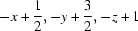 ; (ii)
 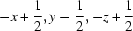 ; (iii)
 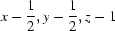 ; (iv)
  ; (v)
; (v) 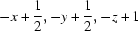 .
. Data collection: RAPID-AUTO (Rigaku, 1998); cell refinement: RAPID-AUTO; data reduction: CrystalStructure (Rigaku/MSC, 2002); program(s) used to solve structure: SHELXS97 (Sheldrick, 2008); program(s) used to refine structure: SHELXL97 (Sheldrick, 2008); molecular graphics: SHELXTL (Sheldrick, 2008); software used to prepare material for publication: SHELXL97.
Supporting information
contains datablocks I, New_Global_Publ_Block. DOI: https://doi.org/10.1107/S1600536810041474/rk2240sup1.cif
Structure factors: contains datablock I. DOI: https://doi.org/10.1107/S1600536810041474/rk2240Isup2.hkl
MgCl2.6H2O (0.11 g, 0.54 mmol) was dissolved in appropriate amount of water, and then 1M Na2CO3 solution was added. MgCO3 was obtained by filtration, which was then washed with distilled water for 5 times. The freshly prepared MgCO3, 4-bromobenzoic acid (0.0508 g, 0.24 mmol), 2,2'-bipyridine (bipy) (0.0394 g, 0.22 mmol ), CH3OH/H2O (v/v = 1:2, 15 ml) were mixed and stirred for 2.0 h. Subsequently, the resulting cream suspension was heated in a 23 ml teflon-lined stainless steel autoclave at 433 K for 5800 minutes. After the autoclave was cooled to room temperature according to the procedure at 2600 minutes. the solid was filtered off. The resulting filtrate was allowed to stand at room temperature, and slow evaporation for 4 months afforded colourless block single crystals.
C-bound H atoms were placed in calculated positions, with C—H = 0.93Å and Uiso(H) = 1.2Ueq(C), and were refined using the riding-model approximation. The H atoms of the water molecule were located in a difference Fourier map and refined with an O—H distance restraint of 0.82 (1)Å and Uiso(H) = 1.5Ueq(O). The Br1 atom during anisotropic procedure became prolate and was splitted on two positions with occupancy factors of 0.55 and 0.45.
Magnesium(II) ions with 1.10-phenanthroline (phen) and pyridine (py) ligands can form tetraaqua(L)nMagnesium(II) (L = phen, n = 1; L = py, n = 2) complex cation ( Halut-Desportes, 1981; Hao et al., 2008; Zhang, 2004). In this paper we report synthesis and structure of the title compound. The of title compound consists of [Mg(H2O)4(2,2'-bipy)]2+ complex cations and 4-bromobenzoate anion (Fig. 1). The cation placed in special position on twofold axis, which passes through MgII atom and middle C5—C5i bond of 2,2'-bipy molecule. Symmetry code: (i) -x, y, -z+1/2. In the cation, the MgII atom is coordinated by two N atoms from one 2,2'-bipy ligands, four O atoms from four different water molecules, completing a distorted MgN2O4 octahedral geometry. The Mg—N bond length is 2.199 (4)Å and Mg—O bond lengths are 2.035 (3)Å and 2.042Å. The chelating bipy ligands exhibit nearly perfect coplanarity (r.m.s. deviations = 0.0035Å ). The mean interplanar distances of 3.475 (6)Å between adjacent bipy ligands indicate π···π stacking interactions (Fig. 2). The complex cations and 4-bromobenzoate anins are connected via π···π stacking interactions and O—H···O and C—H···O, C—H···Br hydrogen bonds (Table 1) into a three-dimensional supramolecular network.
For related magnesium(II) complexes with 1.10-phenanthroline and pyridine ligands, see: Halut-Desportes (1981); Hao et al. (2008); Zhang (2004).
Data collection: RAPID-AUTO (Rigaku, 1998); cell RAPID-AUTO (Rigaku, 1998); data reduction: CrystalStructure (Rigaku/MSC, 2002); program(s) used to solve structure: SHELXS97 (Sheldrick, 2008); program(s) used to refine structure: SHELXL97 (Sheldrick, 2008); molecular graphics: SHELXTL (Sheldrick, 2008); software used to prepare material for publication: SHELXL97 (Sheldrick, 2008).
![[Figure 1]](./rk2240fig1thm.gif) | Fig. 1. The molecule structure of the title compound showing the atom-labelling scheme. Displacement ellipsoids are drawn at the 40% probability level. Symetry code: (i) -x, y, -z+1/2. H atoms are presented as a small spheres of arbitrary radius. Only major position of Br1 atom is drawn. Selected hydrogen bonds are drawn by dashed lines. |
![[Figure 2]](./rk2240fig2thm.gif) | Fig. 2. A packing diagram of the title complex, viewed down the c axis. The O—H···O, C—H···O and C—H···Br hydrogen bonds are drawn by dashed lines. |
| [Mg(C10H8N2)(H2O)4](C7H4BrO2)2 | F(000) = 1312 |
| Mr = 652.56 | Dx = 1.581 Mg m−3 |
| Monoclinic, C2/c | Mo Kα radiation, λ = 0.71073 Å |
| Hall symbol: -C 2yc | Cell parameters from 6277 reflections |
| a = 30.275 (6) Å | θ = 3.2–25.0° |
| b = 12.308 (3) Å | µ = 3.03 mm−1 |
| c = 7.5785 (15) Å | T = 290 K |
| β = 103.90 (3)° | Block, colourless |
| V = 2741.2 (11) Å3 | 0.31 × 0.27 × 0.19 mm |
| Z = 4 |
| Rigaku R-AXIS RAPID diffractometer | 2412 independent reflections |
| Radiation source: fine-focus sealed tube | 1505 reflections with I > 2σ(I) |
| Graphite monochromator | Rint = 0.063 |
| ω–scans | θmax = 25.0°, θmin = 3.2° |
| Absorption correction: multi-scan (ABSCOR; Higashi, 1995) | h = −35→35 |
| Tmin = 0.406, Tmax = 0.562 | k = −14→14 |
| 10517 measured reflections | l = −9→7 |
| Refinement on F2 | Primary atom site location: structure-invariant direct methods |
| Least-squares matrix: full | Secondary atom site location: difference Fourier map |
| R[F2 > 2σ(F2)] = 0.056 | Hydrogen site location: inferred from neighbouring sites |
| wR(F2) = 0.174 | H-atom parameters constrained |
| S = 1.08 | w = 1/[σ2(Fo2) + (0.0695P)2 + 6.5977P] where P = (Fo2 + 2Fc2)/3 |
| 2412 reflections | (Δ/σ)max < 0.001 |
| 171 parameters | Δρmax = 0.88 e Å−3 |
| 1 restraint | Δρmin = −0.49 e Å−3 |
| [Mg(C10H8N2)(H2O)4](C7H4BrO2)2 | V = 2741.2 (11) Å3 |
| Mr = 652.56 | Z = 4 |
| Monoclinic, C2/c | Mo Kα radiation |
| a = 30.275 (6) Å | µ = 3.03 mm−1 |
| b = 12.308 (3) Å | T = 290 K |
| c = 7.5785 (15) Å | 0.31 × 0.27 × 0.19 mm |
| β = 103.90 (3)° |
| Rigaku R-AXIS RAPID diffractometer | 2412 independent reflections |
| Absorption correction: multi-scan (ABSCOR; Higashi, 1995) | 1505 reflections with I > 2σ(I) |
| Tmin = 0.406, Tmax = 0.562 | Rint = 0.063 |
| 10517 measured reflections |
| R[F2 > 2σ(F2)] = 0.056 | 1 restraint |
| wR(F2) = 0.174 | H-atom parameters constrained |
| S = 1.08 | Δρmax = 0.88 e Å−3 |
| 2412 reflections | Δρmin = −0.49 e Å−3 |
| 171 parameters |
Geometry. All s.u.'s (except the s.u. in the dihedral angle between two l.s. planes) are estimated using the full covariance matrix. The cell s.u.'s are taken into account individually in the estimation of s.u.'s in distances, angles and torsion angles; correlations between s.u.'s in cell parameters are only used when they are defined by crystal symmetry. An approximate (isotropic) treatment of cell s.u.'s is used for estimating s.u.'s involving l.s. planes. |
Refinement. Refinement of F2 against ALL reflections. The weighted R-factor wR and goodness of fit S are based on F2, conventional R-factors R are based on F, with F set to zero for negative F2. The threshold expression of F2 > 2σ(F2) is used only for calculating R-factors(gt) etc. and is not relevant to the choice of reflections for refinement. R-factors based on F2 are statistically about twice as large as those based on F, and R-factors based on ALL data will be even larger. |
| x | y | z | Uiso*/Ueq | Occ. (<1) | |
| Mg1 | 0.0000 | 0.29391 (14) | 0.2500 | 0.0366 (5) | |
| Br1 | 0.2137 (3) | 0.9201 (5) | 0.0828 (12) | 0.1255 (19) | 0.55 |
| Br1' | 0.2127 (4) | 0.8733 (7) | 0.0939 (16) | 0.1255 (19) | 0.45 |
| N1 | 0.04459 (13) | 0.1518 (3) | 0.2599 (5) | 0.0410 (9) | |
| O1 | 0.05190 (12) | 0.4001 (2) | 0.2564 (4) | 0.0521 (9) | |
| H1A | 0.0561 | 0.4561 | 0.3166 | 0.078* | |
| H1B | 0.0512 | 0.4061 | 0.1480 | 0.078* | |
| O2 | −0.01205 (11) | 0.2973 (2) | −0.0269 (4) | 0.0494 (8) | |
| H2A | −0.0376 | 0.3009 | −0.0944 | 0.074* | |
| H2B | 0.0036 | 0.3273 | −0.0868 | 0.074* | |
| O3 | 0.43473 (11) | 0.9050 (2) | 0.5752 (4) | 0.0480 (8) | |
| O4 | 0.40497 (12) | 0.7957 (3) | 0.7472 (5) | 0.0646 (10) | |
| C1 | 0.08821 (17) | 0.1562 (4) | 0.2545 (6) | 0.0514 (12) | |
| H1 | 0.1024 | 0.2237 | 0.2649 | 0.062* | |
| C2 | 0.11341 (18) | 0.0657 (4) | 0.2343 (7) | 0.0543 (12) | |
| H2 | 0.1438 | 0.0717 | 0.2302 | 0.065* | |
| C3 | 0.09216 (19) | −0.0333 (4) | 0.2203 (7) | 0.0591 (13) | |
| H3 | 0.1081 | −0.0959 | 0.2060 | 0.071* | |
| C4 | 0.04759 (18) | −0.0403 (4) | 0.2274 (6) | 0.0510 (12) | |
| H4 | 0.0332 | −0.1074 | 0.2198 | 0.061* | |
| C5 | 0.02400 (15) | 0.0542 (3) | 0.2461 (5) | 0.0393 (10) | |
| C6 | 0.35589 (17) | 0.8637 (4) | 0.4824 (6) | 0.0466 (11) | |
| C7 | 0.32382 (19) | 0.7824 (4) | 0.4683 (7) | 0.0623 (14) | |
| H7 | 0.3305 | 0.7209 | 0.5411 | 0.075* | |
| C8 | 0.2819 (2) | 0.7917 (6) | 0.3469 (9) | 0.0837 (19) | |
| H8 | 0.2609 | 0.7353 | 0.3331 | 0.100* | |
| C9 | 0.2716 (2) | 0.8849 (7) | 0.2471 (8) | 0.089 (2) | |
| C10 | 0.3022 (2) | 0.9671 (7) | 0.2613 (8) | 0.089 (2) | |
| H10 | 0.2946 | 1.0301 | 0.1932 | 0.106* | |
| C11 | 0.34477 (19) | 0.9563 (5) | 0.3780 (7) | 0.0640 (14) | |
| H11 | 0.3661 | 1.0117 | 0.3863 | 0.077* | |
| C12 | 0.40163 (16) | 0.8535 (3) | 0.6125 (6) | 0.0423 (10) |
| U11 | U22 | U33 | U12 | U13 | U23 | |
| Mg1 | 0.0387 (12) | 0.0345 (10) | 0.0359 (10) | 0.000 | 0.0074 (9) | 0.000 |
| Br1 | 0.0583 (7) | 0.219 (6) | 0.0842 (12) | 0.038 (3) | −0.0128 (6) | 0.011 (3) |
| Br1' | 0.0583 (7) | 0.219 (6) | 0.0842 (12) | 0.038 (3) | −0.0128 (6) | 0.011 (3) |
| N1 | 0.043 (2) | 0.0397 (19) | 0.0380 (19) | 0.0001 (17) | 0.0041 (16) | 0.0003 (15) |
| O1 | 0.064 (2) | 0.0470 (17) | 0.0468 (18) | −0.0141 (15) | 0.0161 (17) | −0.0094 (14) |
| O2 | 0.047 (2) | 0.0625 (19) | 0.0367 (16) | −0.0069 (16) | 0.0061 (14) | 0.0051 (14) |
| O3 | 0.045 (2) | 0.0515 (17) | 0.0492 (18) | −0.0063 (15) | 0.0136 (15) | −0.0062 (14) |
| O4 | 0.052 (2) | 0.078 (2) | 0.056 (2) | −0.0141 (19) | −0.0018 (17) | 0.0225 (18) |
| C1 | 0.042 (3) | 0.054 (3) | 0.057 (3) | −0.004 (2) | 0.008 (2) | 0.000 (2) |
| C2 | 0.040 (3) | 0.062 (3) | 0.060 (3) | 0.015 (2) | 0.012 (2) | 0.003 (2) |
| C3 | 0.060 (4) | 0.054 (3) | 0.059 (3) | 0.016 (3) | 0.007 (3) | −0.002 (2) |
| C4 | 0.053 (3) | 0.042 (2) | 0.055 (3) | 0.004 (2) | 0.008 (2) | −0.001 (2) |
| C5 | 0.042 (3) | 0.041 (2) | 0.033 (2) | 0.0058 (19) | 0.0037 (19) | 0.0007 (18) |
| C6 | 0.041 (3) | 0.059 (3) | 0.040 (2) | 0.006 (2) | 0.011 (2) | 0.002 (2) |
| C7 | 0.049 (3) | 0.073 (3) | 0.063 (3) | −0.010 (3) | 0.011 (3) | −0.002 (3) |
| C8 | 0.050 (4) | 0.122 (5) | 0.076 (4) | −0.020 (4) | 0.008 (3) | −0.023 (4) |
| C9 | 0.046 (4) | 0.164 (7) | 0.054 (3) | 0.023 (4) | 0.009 (3) | 0.008 (4) |
| C10 | 0.063 (4) | 0.140 (6) | 0.067 (4) | 0.035 (4) | 0.023 (3) | 0.039 (4) |
| C11 | 0.052 (3) | 0.081 (4) | 0.062 (3) | 0.009 (3) | 0.019 (3) | 0.022 (3) |
| C12 | 0.040 (3) | 0.042 (2) | 0.046 (3) | −0.004 (2) | 0.013 (2) | −0.009 (2) |
| Mg1—O1 | 2.035 (3) | C2—C3 | 1.371 (7) |
| Mg1—O1i | 2.035 (3) | C2—H2 | 0.9300 |
| Mg1—O2 | 2.042 (3) | C3—C4 | 1.366 (7) |
| Mg1—O2i | 2.042 (3) | C3—H3 | 0.9300 |
| Mg1—N1i | 2.199 (4) | C4—C5 | 1.390 (6) |
| Mg1—N1 | 2.199 (4) | C4—H4 | 0.9300 |
| Mg1—H1B | 2.3424 | C5—C5i | 1.468 (9) |
| Br1—C9 | 1.939 (10) | C6—C7 | 1.380 (7) |
| Br1'—C9 | 1.885 (11) | C6—C11 | 1.382 (7) |
| N1—C1 | 1.332 (6) | C6—C12 | 1.500 (7) |
| N1—C5 | 1.346 (5) | C7—C8 | 1.382 (8) |
| O1—H1A | 0.8200 | C7—H7 | 0.9300 |
| O1—H1B | 0.8200 | C8—C9 | 1.367 (9) |
| O2—H2A | 0.8199 | C8—H8 | 0.9300 |
| O2—H2B | 0.8201 | C9—C10 | 1.358 (10) |
| O3—C12 | 1.274 (5) | C10—C11 | 1.384 (8) |
| O4—C12 | 1.228 (5) | C10—H10 | 0.9300 |
| C1—C2 | 1.379 (7) | C11—H11 | 0.9300 |
| C1—H1 | 0.9300 | ||
| O1—Mg1—O1i | 100.12 (19) | C1—C2—H2 | 121.1 |
| O1—Mg1—O2 | 87.58 (13) | C4—C3—C2 | 120.2 (5) |
| O1i—Mg1—O2 | 90.94 (13) | C4—C3—H3 | 119.9 |
| O1—Mg1—O2i | 90.94 (13) | C2—C3—H3 | 119.9 |
| O1i—Mg1—O2i | 87.58 (13) | C3—C4—C5 | 119.2 (4) |
| O2—Mg1—O2i | 177.69 (19) | C3—C4—H4 | 120.4 |
| O1—Mg1—N1i | 167.24 (14) | C5—C4—H4 | 120.4 |
| O1i—Mg1—N1i | 92.61 (13) | N1—C5—C4 | 121.0 (4) |
| O2—Mg1—N1i | 91.39 (13) | N1—C5—C5i | 116.2 (2) |
| O2i—Mg1—N1i | 90.45 (13) | C4—C5—C5i | 122.8 (3) |
| O1—Mg1—N1 | 92.61 (13) | C7—C6—C11 | 118.9 (5) |
| O1i—Mg1—N1 | 167.24 (14) | C7—C6—C12 | 120.8 (4) |
| O2—Mg1—N1 | 90.45 (13) | C11—C6—C12 | 120.3 (4) |
| O2i—Mg1—N1 | 91.39 (13) | C6—C7—C8 | 120.5 (5) |
| N1i—Mg1—N1 | 74.7 (2) | C6—C7—H7 | 119.7 |
| O1—Mg1—H1B | 20.1 | C8—C7—H7 | 119.7 |
| O1i—Mg1—H1B | 100.5 | C9—C8—C7 | 119.3 (6) |
| O2—Mg1—H1B | 67.5 | C9—C8—H8 | 120.4 |
| O2i—Mg1—H1B | 111.0 | C7—C8—H8 | 120.4 |
| N1i—Mg1—H1B | 155.1 | C10—C9—C8 | 121.4 (6) |
| N1—Mg1—H1B | 91.7 | C10—C9—Br1' | 129.1 (6) |
| C1—N1—C5 | 118.5 (4) | C8—C9—Br1' | 109.5 (6) |
| C1—N1—Mg1 | 124.9 (3) | C10—C9—Br1 | 112.2 (6) |
| C5—N1—Mg1 | 116.0 (3) | C8—C9—Br1 | 126.4 (7) |
| Mg1—O1—H1A | 124.7 | Br1'—C9—Br1 | 17.5 (4) |
| Mg1—O1—H1B | 101.6 | C9—C10—C11 | 119.4 (6) |
| H1A—O1—H1B | 116.4 | C9—C10—H10 | 120.3 |
| Mg1—O2—H2A | 123.4 | C11—C10—H10 | 120.3 |
| Mg1—O2—H2B | 126.4 | C6—C11—C10 | 120.4 (6) |
| H2A—O2—H2B | 102.4 | C6—C11—H11 | 119.8 |
| N1—C1—C2 | 123.4 (5) | C10—C11—H11 | 119.8 |
| N1—C1—H1 | 118.3 | O4—C12—O3 | 124.1 (4) |
| C2—C1—H1 | 118.3 | O4—C12—C6 | 118.3 (4) |
| C3—C2—C1 | 117.7 (5) | O3—C12—C6 | 117.6 (4) |
| C3—C2—H2 | 121.1 |
| Symmetry code: (i) −x, y, −z+1/2. |
| D—H···A | D—H | H···A | D···A | D—H···A |
| O1—H1A···O3ii | 0.82 | 1.89 | 2.702 (4) | 172 |
| O1—H1B···O3iii | 0.82 | 1.84 | 2.640 (4) | 165 |
| O2—H2A···O4iv | 0.82 | 1.86 | 2.679 (7) | 175 |
| O2—H2B···O3iii | 0.82 | 2.08 | 2.790 (5) | 145 |
| C2—H2···Br1v | 0.93 | 3.00 | 3.525 (7) | 117 |
| C2—H2···Br1′v | 0.93 | 3.11 | 3.612 (7) | 116 |
| C3—H3···O4vi | 0.93 | 2.53 | 3.239 (6) | 133 |
| Symmetry codes: (ii) −x+1/2, −y+3/2, −z+1; (iii) −x+1/2, y−1/2, −z+1/2; (iv) x−1/2, y−1/2, z−1; (v) x, −y+1, z+1/2; (vi) −x+1/2, −y+1/2, −z+1. |
Experimental details
| Crystal data | |
| Chemical formula | [Mg(C10H8N2)(H2O)4](C7H4BrO2)2 |
| Mr | 652.56 |
| Crystal system, space group | Monoclinic, C2/c |
| Temperature (K) | 290 |
| a, b, c (Å) | 30.275 (6), 12.308 (3), 7.5785 (15) |
| β (°) | 103.90 (3) |
| V (Å3) | 2741.2 (11) |
| Z | 4 |
| Radiation type | Mo Kα |
| µ (mm−1) | 3.03 |
| Crystal size (mm) | 0.31 × 0.27 × 0.19 |
| Data collection | |
| Diffractometer | Rigaku R-AXIS RAPID |
| Absorption correction | Multi-scan (ABSCOR; Higashi, 1995) |
| Tmin, Tmax | 0.406, 0.562 |
| No. of measured, independent and observed [I > 2σ(I)] reflections | 10517, 2412, 1505 |
| Rint | 0.063 |
| (sin θ/λ)max (Å−1) | 0.594 |
| Refinement | |
| R[F2 > 2σ(F2)], wR(F2), S | 0.056, 0.174, 1.08 |
| No. of reflections | 2412 |
| No. of parameters | 171 |
| No. of restraints | 1 |
| H-atom treatment | H-atom parameters constrained |
| Δρmax, Δρmin (e Å−3) | 0.88, −0.49 |
Computer programs: RAPID-AUTO (Rigaku, 1998), CrystalStructure (Rigaku/MSC, 2002), SHELXS97 (Sheldrick, 2008), SHELXL97 (Sheldrick, 2008), SHELXTL (Sheldrick, 2008), SHELXL97 (Sheldrick, 2008).
| D—H···A | D—H | H···A | D···A | D—H···A |
| O1—H1A···O3i | 0.82 | 1.887 | 2.702 (4) | 172 |
| O1—H1B···O3ii | 0.82 | 1.840 | 2.640 (4) | 165 |
| O2—H2A···O4iii | 0.82 | 1.861 | 2.679 (7) | 175 |
| O2—H2B···O3ii | 0.82 | 2.080 | 2.790 (5) | 145 |
| C2—H2···Br1iv | 0.93 | 2.999 | 3.525 (7) | 117 |
| C2—H2···Br1'iv | 0.93 | 3.110 | 3.612 (7) | 116 |
| C3—H3···O4v | 0.93 | 2.530 | 3.239 (6) | 133 |
| Symmetry codes: (i) −x+1/2, −y+3/2, −z+1; (ii) −x+1/2, y−1/2, −z+1/2; (iii) x−1/2, y−1/2, z−1; (iv) x, −y+1, z+1/2; (v) −x+1/2, −y+1/2, −z+1. |
Acknowledgements
The authors gratefully acknowledge the financial support of the Education Office of Zhejiang Province (grant No. 20051316) and the Scientific Research Fund of Ningbo University (grant No. XKL09078).
References
 Halut-Desportes, S. (1981). Rev. Chim. Miner. 18, 199. Google Scholar
Hao, X.-M., Gu, C.-S., Song, W.-D. & Liu, J.-W. (2008). Acta Cryst. E64, m1052. Web of Science CSD CrossRef IUCr Journals Google Scholar
Higashi, T. (1995). ABSCOR. Rigaku Corporation, Tokyo, Japan. Google Scholar
Rigaku (1998). RAPID-AUTO. Rigaku Corporation, Tokyo, Japan. Google Scholar
Rigaku/MSC (2002). CrystalStructure. Rigaku/MS, The Woodlands Texas, USA. Google Scholar
Sheldrick, G. M. (2008). Acta Cryst. A64, 112–122. Web of Science CrossRef CAS IUCr Journals Google Scholar
Zhang, B.-S. (2004). Chin. J. Struct. Chem. 23, 1411–1415. CAS Google Scholar
This is an open-access article distributed under the terms of the Creative Commons Attribution (CC-BY) Licence, which permits unrestricted use, distribution, and reproduction in any medium, provided the original authors and source are cited.
| CRYSTALLOGRAPHIC COMMUNICATIONS |


Magnesium(II) ions with 1.10-phenanthroline (phen) and pyridine (py) ligands can form tetraaqua(L)nMagnesium(II) (L = phen, n = 1; L = py, n = 2) complex cation ( Halut-Desportes, 1981; Hao et al., 2008; Zhang, 2004). In this paper we report synthesis and structure of the title compound. The crystal structure of title compound consists of [Mg(H2O)4(2,2'-bipy)]2+ complex cations and 4-bromobenzoate anion (Fig. 1). The cation placed in special position on twofold axis, which passes through MgII atom and middle C5—C5i bond of 2,2'-bipy molecule. Symmetry code: (i) -x, y, -z+1/2. In the cation, the MgII atom is coordinated by two N atoms from one 2,2'-bipy ligands, four O atoms from four different water molecules, completing a distorted MgN2O4 octahedral geometry. The Mg—N bond length is 2.199 (4)Å and Mg—O bond lengths are 2.035 (3)Å and 2.042Å. The chelating bipy ligands exhibit nearly perfect coplanarity (r.m.s. deviations = 0.0035Å ). The mean interplanar distances of 3.475 (6)Å between adjacent bipy ligands indicate π···π stacking interactions (Fig. 2). The complex cations and 4-bromobenzoate anins are connected via π···π stacking interactions and O—H···O and C—H···O, C—H···Br hydrogen bonds (Table 1) into a three-dimensional supramolecular network.