 | Acta Crystallographica Section E Acta Crystallographica Section E CRYSTALLOGRAPHIC COMMUNICATIONS |


 journal menu


metal-organic compounds
| CRYSTALLOGRAPHIC COMMUNICATIONS |
 access
Hexakis(N,N′-dimethylthiourea-κS)nickel(II) nitrate

aDepartment of Chemistry, University of Engineering and Technology, Lahore 54890, Pakistan, bDivision of Science and Technology, University of Education, Township, Lahore, Pakistan, and cInstitute of Physics, University of Neuchâtel, rue Emile-Argand 11, CH-2000 Neuchâtel, Switzerland
*Correspondence e-mail: [email protected]
The title complex salt, [Ni(C3H8N2S)6](NO3)2, consists of an [Ni(Dmtu)6]2+ (Dmtu is N,N′-dimethylthiourea) dication and two nitrate counter-anions. The NiII atom (site symmetry  ) is coordinated by the S atoms of six Dmtu ligands within a slightly distorted octahedral environment. The crystal structure is characterized by weak intramolecular N—H⋯S interactions and by intermolecular N—H⋯O hydrogen bonds involving the nitrate anion (site symmetry 3.). These intermolecular interactions lead to the formation of two-dimensional networks lying parallel to the ab plane. The networks are linked via non-classical intermolecular C—H⋯O hydrogen bonds, forming a three-dimensional arrangement.
Related literature
For background to nickel(II) complexes of thiourea and its derivatives, see: Ambujam et al. (2006![[Ambujam, K., Thomas, P. C., Aruna, S., Anand, D. P. & Sagayaraj, P. (2006). Cryst. Res. Technol. 41, 1082-1088.]](../../../../../../logos/arrows/e_arr.gif "Ambujam, K., Thomas, P. C., Aruna, S., Anand, D. P. & Sagayaraj, P. (2006). Cryst. Res. Technol. 41, 1082-1088.") ); Basso et al. (1969); Bentley & Waters (1974); Chiesi et al. (1971); Crane & Herod (2004); Eaton & Zaw (1975); El-Bahy et al. (2003); Figgis & Reynolds (1986); Monim-ul-Mehboob et al. (2010); Sonar et al. (1979); Weininger et al. (1969); Weininger & Amma (1976). For the crystal structures of similar nickel(II) complexes, see: Bentley & Waters (1974); El-Bahy et al. (2003); Monim-ul-Mehboob et al. (2010); Weininger et al. (1969).
); Basso et al. (1969); Bentley & Waters (1974); Chiesi et al. (1971); Crane & Herod (2004); Eaton & Zaw (1975); El-Bahy et al. (2003); Figgis & Reynolds (1986); Monim-ul-Mehboob et al. (2010); Sonar et al. (1979); Weininger et al. (1969); Weininger & Amma (1976). For the crystal structures of similar nickel(II) complexes, see: Bentley & Waters (1974); El-Bahy et al. (2003); Monim-ul-Mehboob et al. (2010); Weininger et al. (1969).
![[Scheme 1]](wm2412scheme1.gif)
Experimental
Crystal data
|

Refinement
|
|
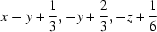 ; (ii)
 Data collection: X-AREA (Stoe & Cie, 2009); cell refinement: X-AREA; data reduction: X-RED32 (Stoe & Cie, 2009); program(s) used to solve structure: SHELXS97 (Sheldrick, 2008); program(s) used to refine structure: SHELXL97 (Sheldrick, 2008); molecular graphics: PLATON (Spek, 2009); software used to prepare material for publication: SHELXL97, PLATON and publCIF (Westrip, 2010).
Supporting information
contains datablocks I, global. DOI: https://doi.org/10.1107/S1600536810040031/wm2412sup1.cif
Structure factors: contains datablock I. DOI: https://doi.org/10.1107/S1600536810040031/wm2412Isup2.hkl
The title compound was prepared by adding 2 equivalents of N,N'-dimethylthiourea in 15 ml methanol to 0.29 g (1 mmol) of nickel(II) nitrate hexahydrate in 10 ml methanol. After stirring the mixture for 30 min the solution was filtered. The filtrate on slow evaporation yielded pale-green crystals, suitable for X-ray diffraction analysis.
The NH H-atoms were located in difference electron-density maps. In the final cycles of least-squares they was refined with a distance restraint of N—H = 0.87 (2) Å. The C-bound H-atoms were included in calculated positions and treated as riding atoms: C—H = 0.97 Å for CH3 H-atoms, with Uiso(H) = 1.5Ueq (parent C-atom).
Several studies have been focused on the synthesis and structural characterization of nickel(II) complexes with thiourea type ligands. These studies showed that nickel(II) can adopt a variety of coordination geometries (octahedral, tetragonal, square-planar and tetrahedral) both in the solid state and in solution, which were prepared by varying the ligands or the anions (Ambujam et al., 2006; Bentley et al., 1974; Chiesi et al., 1971; Eaton & Zaw, 1975; El-Bahy et al., 2003; Figgis & Reynolds, 1986; Monim-ul-Mehboob et al., 2010; Sonar et al., 1979; Weininger et al. 1969, Weininger & Amma, 1976). When the anion is chloride, bromide or iodide, the predominant coordination about the nickel(II) atom in the crystalline solid state is tetragonal with the halide anions in the apical positions, leading to [NiL4]X2 complexes (Ambujam et al., 2006; Chiesi et al., 1971; Crane et al., 2004; Figgis & Reynolds, 1986; Weininger & Amma, 1976), although [NiL6]X2 complexes are also formed (El-Bahy et al., 2003; Weininger et al., 1969). The formation (in the solid state) of the octahedral species NiL62+ is ascribed to crystal packing forces and extensive hydrogen bonding (Ambujam et al., 2006; El-Bahy et al., 2003; Monim-ul-Mehboob et al., 2010; Weininger et al., 1969). The coordination of nickel(II) in nitrate and the perchlorate salts is generally homoleptic octahedral in the solid state (Bentley et al., 1974; Monim-ul-Mehboob et al., 2010), but also can give such species as [NiL2(NO3)2] (Basso et al., 1969). We have recently reported on the of a thiourea (Tu) complex of nickel(II) nitrate, [Ni(Tu)6](NO3)2 (Monim-ul-Mehboob et al., 2010). Herein, we report on the of the title nickel(II) nitrate complex of dimethylthiourea, [Ni(Dmtu)6](NO3)2.
The molecular structure of the title complex is illustrated in Fig. 1. It is ionic and consists of a [Ni(Dmtu)6]2+ cationic unit (site symmetry 3) and two nitrate counter ions (site symmetry 3.). Atom Ni1 assumes a slightly distorted octahedral geometry, due to coordination with six sulfur atoms of the Dmtu ligands. In the cation there are weak N—H···S interactions linking adjacent ligand molecules (Table 1). The values of the bond lengths and bond angles observed in the title complex are comparable to those reported for related complexes (Ambujam et al., 2006; El-Bahy et al., 2003; Monim-ul-Mehboob et al., 2010; Weininger et al., 1969). In the only previously reported nickel(II) complex of N,N'-dimethylthiourea, [Ni(Dmtu)4]Br2 (Weininger & Amma, 1976), the nickel(II) atom is 4-coordinate, while in the title complex having the same ligand the nickel(II) atom is 6-coordinate, suggesting that in the presence of nitrate an octahedral coordination is preferred.
In the crystal of the title compound the [Ni(Dmtu)6]+2 cations and the NO3- ions are connected via N—H···O hydrogen bonds (Table 1) to form two-dimensional networks lying parallel to the ab-plane (Fig. 2). These two-dimensional sheets are linked via C—H···O hydrogen bonds (Table 1), resulting in the formation of a three-dimensional network.
For background to nickel(II) complexes of thiourea and its derivatives, see: Ambujam et al. (2006); Basso et al. (1969); Bentley & Waters (1974); Chiesi et al. (1971); Crane & Herod (2004); Eaton & Zaw (1975); El-Bahy et al. (2003); Figgis & Reynolds (1986); Monim-ul-Mehboob et al. (2010); Sonar et al. (1979); Weininger et al. (1969); Weininger & Amma (1976). For the crystal structures of similar nickel(II) complexes, see: Bentley & Waters (1974); El-Bahy et al. (2003); Monim-ul-Mehboob et al. (2010); Weininger et al. (1969).
Data collection: X-AREA (Stoe & Cie, 2009); cell X-AREA (Stoe & Cie, 2009); data reduction: X-RED32 (Stoe & Cie, 2009); program(s) used to solve structure: SHELXS97 (Sheldrick, 2008); program(s) used to refine structure: SHELXL97 (Sheldrick, 2008); molecular graphics: PLATON (Spek, 2009); software used to prepare material for publication: SHELXL97 (Sheldrick, 2008), PLATON (Spek, 2009) and publCIF (Westrip, 2010).
![[Figure 1]](./wm2412fig1thm.gif) | Fig. 1. The molecular structure of the title compound with the atomic numbering scheme. Displacement ellipsoids are drawn at the 50% probability level [Only one of the nitrate anions is shown; Symmetry codes: a = 1 - y,x-y,z; b = 1 - x + y,1 - x,z; c = 1/3 + y,-1/3 + x,1/6 - z; d = 4/3 - x,2/3 - x + y,1/6 - z; e = 1/3 + x-y,2/3 - y,1/6 - z; f = -y,x-y,z; g = -x + y,-x,z]. |
![[Figure 2]](./wm2412fig2thm.gif) | Fig. 2. The crystal packing of the title compound viewed along the c axis (the N—H···O and N—H···S hydrogen bonds are shown as dashed lines - see Table 1 for details; H-atoms not involved in hydrogen bonding have been omitted for clarity). |
| [Ni(C3H8N2S)6](NO3)2 | Dx = 1.398 Mg m−3 |
| Mr = 807.77 | Mo Kα radiation, λ = 0.71073 Å |
| Trigonal, R3c | Cell parameters from 2717 reflections |
| Hall symbol: -R 3 2"c | θ = 2.9–26.1° |
| a = 13.7166 (10) Å | µ = 0.88 mm−1 |
| c = 35.332 (3) Å | T = 223 K |
| V = 5756.9 (8) Å3 | Block, pale green |
| Z = 6 | 0.30 × 0.26 × 0.24 mm |
| F(000) = 2556 |
| Stoe IPDS 2 diffractometer | 1199 independent reflections |
| Radiation source: fine-focus sealed tube | 851 reflections with I > 2σ(I) |
| Graphite monochromator | Rint = 0.028 |
| φ + ω scans | θmax = 25.6°, θmin = 2.9° |
| Absorption correction: multi-scan (MULscanABS; Spek, 2009) | h = −4→14 |
| Tmin = 0.963, Tmax = 1.000 | k = −16→9 |
| 3491 measured reflections | l = −42→40 |
| Refinement on F2 | Primary atom site location: structure-invariant direct methods |
| Least-squares matrix: full | Secondary atom site location: difference Fourier map |
| R[F2 > 2σ(F2)] = 0.029 | Hydrogen site location: inferred from neighbouring sites |
| wR(F2) = 0.056 | H atoms treated by a mixture of independent and constrained refinement |
| S = 1.00 | w = 1/[σ2(Fo2) + (0.0271P)2] where P = (Fo2 + 2Fc2)/3 |
| 1199 reflections | (Δ/σ)max = 0.001 |
| 79 parameters | Δρmax = 0.17 e Å−3 |
| 2 restraints | Δρmin = −0.18 e Å−3 |
| [Ni(C3H8N2S)6](NO3)2 | Z = 6 |
| Mr = 807.77 | Mo Kα radiation |
| Trigonal, R3c | µ = 0.88 mm−1 |
| a = 13.7166 (10) Å | T = 223 K |
| c = 35.332 (3) Å | 0.30 × 0.26 × 0.24 mm |
| V = 5756.9 (8) Å3 |
| Stoe IPDS 2 diffractometer | 1199 independent reflections |
| Absorption correction: multi-scan (MULscanABS; Spek, 2009) | 851 reflections with I > 2σ(I) |
| Tmin = 0.963, Tmax = 1.000 | Rint = 0.028 |
| 3491 measured reflections |
| R[F2 > 2σ(F2)] = 0.029 | 2 restraints |
| wR(F2) = 0.056 | H atoms treated by a mixture of independent and constrained refinement |
| S = 1.00 | Δρmax = 0.17 e Å−3 |
| 1199 reflections | Δρmin = −0.18 e Å−3 |
| 79 parameters |
Geometry. Bond distances, angles etc. have been calculated using the rounded fractional coordinates. All su's are estimated from the variances of the (full) variance-covariance matrix. The cell e.s.d.'s are taken into account in the estimation of distances, angles and torsion angles |
Refinement. Refinement of F2 against ALL reflections. The weighted R-factor wR and goodness of fit S are based on F2, conventional R-factors R are based on F, with F set to zero for negative F2. The threshold expression of F2 > σ(F2) is used only for calculating R-factors(gt) etc. and is not relevant to the choice of reflections for refinement. R-factors based on F2 are statistically about twice as large as those based on F, and R- factors based on ALL data will be even larger. |
| x | y | z | Uiso*/Ueq | ||
| Ni1 | 0.66667 | 0.33333 | 0.08333 | 0.0208 (1) | |
| S1 | 0.50780 (4) | 0.25803 (5) | 0.03726 (1) | 0.0262 (1) | |
| N1 | 0.35924 (14) | 0.17766 (18) | 0.09365 (4) | 0.0319 (5) | |
| N2 | 0.29514 (15) | 0.09027 (15) | 0.03650 (5) | 0.0295 (5) | |
| C1 | 0.37831 (17) | 0.16823 (15) | 0.05723 (5) | 0.0246 (6) | |
| C2 | 0.25557 (19) | 0.10275 (19) | 0.11355 (6) | 0.0399 (7) | |
| C3 | 0.3066 (2) | 0.0703 (2) | −0.00341 (6) | 0.0409 (8) | |
| O1 | 0.05182 (15) | 0.10490 (12) | 0.05290 (4) | 0.0449 (5) | |
| N3 | 0.00000 | 0.00000 | 0.05255 (7) | 0.0300 (6) | |
| H1N | 0.4165 (16) | 0.2300 (15) | 0.1053 (5) | 0.029 (6)* | |
| H2A | 0.19490 | 0.11240 | 0.10370 | 0.0600* | |
| H2B | 0.26520 | 0.12040 | 0.14040 | 0.0600* | |
| H2C | 0.23750 | 0.02540 | 0.10990 | 0.0600* | |
| H2N | 0.2303 (14) | 0.0569 (17) | 0.0455 (5) | 0.021 (5)* | |
| H3A | 0.34410 | 0.14160 | −0.01680 | 0.0610* | |
| H3B | 0.23250 | 0.02290 | −0.01430 | 0.0610* | |
| H3C | 0.35070 | 0.03320 | −0.00570 | 0.0610* |
| U11 | U22 | U33 | U12 | U13 | U23 | |
| Ni1 | 0.0195 (2) | 0.0195 (2) | 0.0232 (2) | 0.0098 (1) | 0.0000 | 0.0000 |
| S1 | 0.0203 (2) | 0.0277 (3) | 0.0272 (2) | 0.0095 (3) | −0.0019 (2) | −0.0009 (3) |
| N1 | 0.0223 (8) | 0.0328 (11) | 0.0325 (7) | 0.0078 (10) | −0.0009 (6) | −0.0031 (9) |
| N2 | 0.0180 (9) | 0.0281 (10) | 0.0382 (8) | 0.0084 (8) | −0.0036 (8) | −0.0040 (8) |
| C1 | 0.0218 (10) | 0.0222 (11) | 0.0336 (9) | 0.0138 (8) | −0.0037 (7) | 0.0011 (7) |
| C2 | 0.0299 (12) | 0.0453 (15) | 0.0373 (10) | 0.0133 (11) | 0.0033 (9) | 0.0028 (9) |
| C3 | 0.0376 (14) | 0.0439 (15) | 0.0398 (11) | 0.0193 (12) | −0.0136 (10) | −0.0131 (10) |
| O1 | 0.0306 (10) | 0.0206 (7) | 0.0794 (10) | 0.0097 (9) | 0.0077 (10) | 0.0079 (7) |
| N3 | 0.0261 (9) | 0.0261 (9) | 0.0379 (13) | 0.0131 (5) | 0.0000 | 0.0000 |
| Ni1—S1 | 2.4929 (6) | N2—C3 | 1.460 (3) |
| Ni1—S1i | 2.4929 (7) | N2—C1 | 1.327 (3) |
| Ni1—S1ii | 2.4929 (5) | N1—H1N | 0.86 (2) |
| Ni1—S1iii | 2.4929 (5) | N2—H2N | 0.83 (2) |
| Ni1—S1iv | 2.4929 (6) | C2—H2B | 0.9700 |
| Ni1—S1v | 2.4929 (7) | C2—H2C | 0.9700 |
| S1—C1 | 1.727 (2) | C2—H2A | 0.9700 |
| O1—N3 | 1.2462 (14) | C3—H3B | 0.9700 |
| N1—C1 | 1.332 (2) | C3—H3C | 0.9700 |
| N1—C2 | 1.453 (3) | C3—H3A | 0.9700 |
| S1—Ni1—S1i | 81.98 (2) | C1—N2—H2N | 118.9 (13) |
| S1—Ni1—S1ii | 81.98 (2) | C3—N2—H2N | 116.8 (13) |
| S1—Ni1—S1iii | 99.78 (2) | O1—N3—O1vi | 119.99 (14) |
| S1—Ni1—S1iv | 177.39 (2) | O1vii—N3—O1vi | 119.99 (14) |
| S1—Ni1—S1v | 96.33 (2) | O1—N3—O1vii | 119.99 (14) |
| S1i—Ni1—S1ii | 81.98 (2) | N1—C1—N2 | 118.7 (2) |
| S1i—Ni1—S1iii | 96.34 (2) | S1—C1—N2 | 120.83 (15) |
| S1i—Ni1—S1iv | 99.78 (2) | S1—C1—N1 | 120.48 (16) |
| S1i—Ni1—S1v | 177.40 (2) | N1—C2—H2B | 109.00 |
| S1ii—Ni1—S1iii | 177.40 (3) | H2A—C2—H2C | 110.00 |
| S1ii—Ni1—S1iv | 96.33 (2) | N1—C2—H2C | 109.00 |
| S1ii—Ni1—S1v | 99.78 (2) | H2A—C2—H2B | 110.00 |
| S1iii—Ni1—S1iv | 81.98 (2) | N1—C2—H2A | 109.00 |
| S1iii—Ni1—S1v | 81.98 (2) | H2B—C2—H2C | 109.00 |
| S1iv—Ni1—S1v | 81.97 (2) | N2—C3—H3C | 109.00 |
| Ni1—S1—C1 | 113.77 (7) | H3A—C3—H3C | 109.00 |
| C1—N1—C2 | 124.68 (19) | H3B—C3—H3C | 110.00 |
| C1—N2—C3 | 123.7 (2) | H3A—C3—H3B | 109.00 |
| C1—N1—H1N | 113.7 (13) | N2—C3—H3A | 110.00 |
| C2—N1—H1N | 121.5 (13) | N2—C3—H3B | 109.00 |
| S1i—Ni1—S1—C1 | 124.24 (8) | Ni1—S1—C1—N2 | −154.41 (17) |
| S1ii—Ni1—S1—C1 | −152.79 (8) | C2—N1—C1—S1 | −176.58 (19) |
| S1iii—Ni1—S1—C1 | 29.15 (8) | C2—N1—C1—N2 | 4.9 (4) |
| S1v—Ni1—S1—C1 | −53.76 (8) | C3—N2—C1—S1 | 2.9 (3) |
| Ni1—S1—C1—N1 | 27.1 (2) | C3—N2—C1—N1 | −178.6 (2) |
| Symmetry codes: (i) −y+1, x−y, z; (ii) −x+y+1, −x+1, z; (iii) y+1/3, x−1/3, −z+1/6; (iv) −x+4/3, −x+y+2/3, −z+1/6; (v) x−y+1/3, −y+2/3, −z+1/6; (vi) −x+y, −x, z; (vii) −y, x−y, z. |
| D—H···A | D—H | H···A | D···A | D—H···A |
| N1—H1N···S1v | 0.86 (2) | 2.520 (19) | 3.367 (2) | 168.6 (17) |
| N2—H2N···O1vi | 0.83 (2) | 2.14 (2) | 2.947 (3) | 163.4 (18) |
| C3—H3B···O1viii | 0.97 | 2.41 | 3.180 (3) | 136 |
| Symmetry codes: (v) x−y+1/3, −y+2/3, −z+1/6; (vi) −x+y, −x, z; (viii) y, −x+y, −z. |
Experimental details
| Crystal data | |
| Chemical formula | [Ni(C3H8N2S)6](NO3)2 |
| Mr | 807.77 |
| Crystal system, space group | Trigonal, R3c |
| Temperature (K) | 223 |
| a, c (Å) | 13.7166 (10), 35.332 (3) |
| V (Å3) | 5756.9 (8) |
| Z | 6 |
| Radiation type | Mo Kα |
| µ (mm−1) | 0.88 |
| Crystal size (mm) | 0.30 × 0.26 × 0.24 |
| Data collection | |
| Diffractometer | Stoe IPDS 2 |
| Absorption correction | Multi-scan (MULscanABS; Spek, 2009) |
| Tmin, Tmax | 0.963, 1.000 |
| No. of measured, independent and observed [I > 2σ(I)] reflections | 3491, 1199, 851 |
| Rint | 0.028 |
| (sin θ/λ)max (Å−1) | 0.609 |
| Refinement | |
| R[F2 > 2σ(F2)], wR(F2), S | 0.029, 0.056, 1.00 |
| No. of reflections | 1199 |
| No. of parameters | 79 |
| No. of restraints | 2 |
| H-atom treatment | H atoms treated by a mixture of independent and constrained refinement |
| Δρmax, Δρmin (e Å−3) | 0.17, −0.18 |
Computer programs: X-AREA (Stoe & Cie, 2009), X-RED32 (Stoe & Cie, 2009), SHELXS97 (Sheldrick, 2008), SHELXL97 (Sheldrick, 2008), PLATON (Spek, 2009) and publCIF (Westrip, 2010).
| D—H···A | D—H | H···A | D···A | D—H···A |
| N1—H1N···S1i | 0.86 (2) | 2.520 (19) | 3.367 (2) | 168.6 (17) |
| N2—H2N···O1ii | 0.83 (2) | 2.14 (2) | 2.947 (3) | 163.4 (18) |
| C3—H3B···O1iii | 0.97 | 2.41 | 3.180 (3) | 136 |
| Symmetry codes: (i) x−y+1/3, −y+2/3, −z+1/6; (ii) −x+y, −x, z; (iii) y, −x+y, −z. |
Acknowledgements
We thank the staff of the X-ray Application Lab, CSEM, Neuchâtel, for access to the X-ray diffraction equipement.
References
 Ambujam, K., Thomas, P. C., Aruna, S., Anand, D. P. & Sagayaraj, P. (2006). Cryst. Res. Technol. 41, 1082–1088. Web of Science CrossRef CAS Google Scholar
Basso, S., Costamagna, J. A. & Levitus, R. (1969). J. Inorg. Nucl. Chem. 31, 1797–1805. CrossRef CAS Web of Science Google Scholar
Bentley, G. A. & Waters, J. M. (1974). J. Inorg. Nucl. Chem. 36, 2247–2252. CSD CrossRef CAS Web of Science Google Scholar
Chiesi, A., Mangia, A., Nardelli, M. & Pelizzi, G. (1971). J. Chem. Crystallogr. 1, 285–289. Google Scholar
Crane, J. D. & Herod, A. (2004). Inorg. Chem. Commun. 7, 38–41. Web of Science CSD CrossRef CAS Google Scholar
Eaton, D. R. & Zaw, K. (1975). Can. J. Chem. 53, 633–643. CrossRef CAS Web of Science Google Scholar
El-Bahy, G. M. S., El-Sayed, B. A. & Shabana, A. A. (2003). Vib. Spectrosc. 31, 101–107. Web of Science CrossRef CAS Google Scholar
Figgis, B. N. & Reynolds, P. A. (1986). J. Chem. Soc. Dalton Trans. pp. 125–134. CSD CrossRef Web of Science Google Scholar
Monim-ul-Mehboob, M., Akkurt, M., Khan, I. U., Sharif, S., Asif, I. & Ahmad, S. (2010). Acta Cryst. E66, i57–i58. Web of Science CrossRef IUCr Journals Google Scholar
Sheldrick, G. M. (2008). Acta Cryst. A64, 112–122. Web of Science CrossRef CAS IUCr Journals Google Scholar
Sonar, M. H., Hiremath, A. C. & Murty, A. S. (1979). Monatsh. Chem. 110, 167–175. CrossRef CAS Web of Science Google Scholar
Spek, A. L. (2009). Acta Cryst. D65, 148–155. Web of Science CrossRef CAS IUCr Journals Google Scholar
Stoe & Cie. (2009). X-AREA and X-RED32. Stoe & Cie GmbH, Darmstadt, Germany. Google Scholar
Weininger, M. S. & Amma, E. L. (1976). J. Coord. Chem. 5, 91–99. CrossRef CAS Web of Science Google Scholar
Weininger, M. S., O'Connor, J. E. & Amma, E. L. (1969). Inorg. Chem. 8, 424–431. CSD CrossRef CAS Web of Science Google Scholar
Westrip, S. P. (2010). J. Appl. Cryst. 43, 920–925. Web of Science CrossRef CAS IUCr Journals Google Scholar
This is an open-access article distributed under the terms of the Creative Commons Attribution (CC-BY) Licence, which permits unrestricted use, distribution, and reproduction in any medium, provided the original authors and source are cited.
| CRYSTALLOGRAPHIC COMMUNICATIONS |
access


Several studies have been focused on the synthesis and structural characterization of nickel(II) complexes with thiourea type ligands. These studies showed that nickel(II) can adopt a variety of coordination geometries (octahedral, tetragonal, square-planar and tetrahedral) both in the solid state and in solution, which were prepared by varying the ligands or the anions (Ambujam et al., 2006; Bentley et al., 1974; Chiesi et al., 1971; Eaton & Zaw, 1975; El-Bahy et al., 2003; Figgis & Reynolds, 1986; Monim-ul-Mehboob et al., 2010; Sonar et al., 1979; Weininger et al. 1969, Weininger & Amma, 1976). When the anion is chloride, bromide or iodide, the predominant coordination about the nickel(II) atom in the crystalline solid state is tetragonal with the halide anions in the apical positions, leading to [NiL4]X2 complexes (Ambujam et al., 2006; Chiesi et al., 1971; Crane et al., 2004; Figgis & Reynolds, 1986; Weininger & Amma, 1976), although [NiL6]X2 complexes are also formed (El-Bahy et al., 2003; Weininger et al., 1969). The formation (in the solid state) of the octahedral species NiL62+ is ascribed to crystal packing forces and extensive hydrogen bonding (Ambujam et al., 2006; El-Bahy et al., 2003; Monim-ul-Mehboob et al., 2010; Weininger et al., 1969). The coordination of nickel(II) in nitrate and the perchlorate salts is generally homoleptic octahedral in the solid state (Bentley et al., 1974; Monim-ul-Mehboob et al., 2010), but also can give such species as [NiL2(NO3)2] (Basso et al., 1969). We have recently reported on the crystal structure of a thiourea (Tu) complex of nickel(II) nitrate, [Ni(Tu)6](NO3)2 (Monim-ul-Mehboob et al., 2010). Herein, we report on the crystal structure of the title nickel(II) nitrate complex of dimethylthiourea, [Ni(Dmtu)6](NO3)2.
The molecular structure of the title complex is illustrated in Fig. 1. It is ionic and consists of a [Ni(Dmtu)6]2+ cationic unit (site symmetry 3) and two nitrate counter ions (site symmetry 3.). Atom Ni1 assumes a slightly distorted octahedral geometry, due to coordination with six sulfur atoms of the Dmtu ligands. In the cation there are weak N—H···S interactions linking adjacent ligand molecules (Table 1). The values of the bond lengths and bond angles observed in the title complex are comparable to those reported for related complexes (Ambujam et al., 2006; El-Bahy et al., 2003; Monim-ul-Mehboob et al., 2010; Weininger et al., 1969). In the only previously reported nickel(II) complex of N,N'-dimethylthiourea, [Ni(Dmtu)4]Br2 (Weininger & Amma, 1976), the nickel(II) atom is 4-coordinate, while in the title complex having the same ligand the nickel(II) atom is 6-coordinate, suggesting that in the presence of nitrate an octahedral coordination is preferred.
In the crystal of the title compound the [Ni(Dmtu)6]+2 cations and the NO3- ions are connected via N—H···O hydrogen bonds (Table 1) to form two-dimensional networks lying parallel to the ab-plane (Fig. 2). These two-dimensional sheets are linked via C—H···O hydrogen bonds (Table 1), resulting in the formation of a three-dimensional network.