 | Acta Crystallographica Section E Acta Crystallographica Section E CRYSTALLOGRAPHIC COMMUNICATIONS |


 journal menu


inorganic compounds
| CRYSTALLOGRAPHIC COMMUNICATIONS |
 access
Tetrayttrium(III) trisulfide disilicate

aDepartment of Chemistry, Northwestern University, 2145 Sheridan Road, Evanston, IL 60208-3113, USA
*Correspondence e-mail: [email protected]
Tetrayttrium(III) trisulfide disilicate, Y4S3(Si2O7), crystallizes in the Sm4S3(Si2O7) structure type. The structure consists of isolated (Si2O7)6− units (2mm. symmetry) and two crystallographically independent Y3+ cations bridged by one S and one O atom. The first Y atom (site symmetry .m.) is coordinated by three O atoms and three S atoms in a trigonal–prismatic arrangement whereas the second Y atom (site symmetry ..2) is coordinated by six O atoms and three S atoms in a tricapped trigonal–prismatic arrangement.
Related literature
For lanthanide sulfide disilicates of formula Ln4S3(Si2O7), see: Zeng et al. (1999![[Zeng, H.-Y., Mao, J.-G. & Huang, J.-S. (1999). J. Alloys Compd, 291, 89-93.]](../../../../../../logos/arrows/e_arr.gif "Zeng, H.-Y., Mao, J.-G. & Huang, J.-S. (1999). J. Alloys Compd, 291, 89-93.") ) for Ln = La; Hartenbach & Schleid (2002) for Ln = Ce; Sieke & Schleid (2000) for Ln = Pr; Grupe et al. (1992) for Ln = Nd, Er; Sieke & Schleid (1999) for Ln = Sm; Sieke et al. (2002) for Ln = Gd, Tb, Dy, Ho, Er, Tm; Range et al. (1996) for Ln = Yb. For lanthanide selenide disilicates of formula Ln4Se3(Si2O7), see: Deudon et al. (1993) for Ln = La; Grupe & Urland (1989) for Ln = Ce, Nd; Grupe et al. (1992) for Ln = Pr, Sm, Gd. Ionic radii were taken from Shannon (1976). For computational details, see: Gelato & Parthé (1987). For additional synthetic details, see: Larroque & Beauvy (1986).
) for Ln = La; Hartenbach & Schleid (2002) for Ln = Ce; Sieke & Schleid (2000) for Ln = Pr; Grupe et al. (1992) for Ln = Nd, Er; Sieke & Schleid (1999) for Ln = Sm; Sieke et al. (2002) for Ln = Gd, Tb, Dy, Ho, Er, Tm; Range et al. (1996) for Ln = Yb. For lanthanide selenide disilicates of formula Ln4Se3(Si2O7), see: Deudon et al. (1993) for Ln = La; Grupe & Urland (1989) for Ln = Ce, Nd; Grupe et al. (1992) for Ln = Pr, Sm, Gd. Ionic radii were taken from Shannon (1976). For computational details, see: Gelato & Parthé (1987). For additional synthetic details, see: Larroque & Beauvy (1986).
Experimental
Crystal data
|
Refinement
|
| |||||||||||||||||||||||||||||||||||||
 ; (ii)
  ; (iii)
  ; (iv)
  ; (v)
; (v) 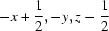 ; (vii)
  ; (viii)
  ; (ix)
  ; (x)
; (x)  .
. Data collection: APEX2 (Bruker, 2009); cell refinement: SAINT (Bruker, 2009); data reduction: SAINT; program(s) used to solve structure: SHELXS97 (Sheldrick, 2008b); program(s) used to refine structure: SHELXL97 (Sheldrick, 2008b); molecular graphics: CrystalMaker (Palmer, 2009); software used to prepare material for publication: SHELXL97.
Supporting information
contains datablocks I, global. DOI: 10.1107/S1600536810054607/wm2440sup1.cif
Structure factors: contains datablock I. DOI: 10.1107/S1600536810054607/wm2440Isup2.hkl
The compound was synthesized accidentally. ThO2 (Alfa-Aesar), Y2S3 (Strem, 99.9%) S (Alfa-Aesar, 99.99%), and Sb (Aldrich, 99.5%), were used as received. Sb2S3 was prepared from the direct reaction of the elements in a sealed fused-silica tube at 1123 K. ThOS was prepared from ThO2 and S following a modified procedure by Larroque et al. (1986). A fused-silica tube was loaded with ThOS (35 mg, 0.125 mmol) and Y2S3 (35.6 mg, 0.130 mmol), evacuated to near 10 -4 Torr, flame sealed, and placed in a computer-controlled furnace. It was heated to 1273 K in 24 h, kept at 1273 K for 168 h, cooled to 873 K in 198 h, and then rapidly cooled to 298 K in 5 h. The resulting tan powder (50 mg) was loaded with Sb2S3 (20 mg, 0.6 mmol) in a fused-silica tube and heated as before. The resulting tube was etched and contained clear crystals of composition Y/S/Si/O as determined by EDX analysis. The silicon and oxygen were abstracted from the silica tube and introduced into the reaction in the second step.
Origin choice 2 of I41/amd was used. The structure was standardized by means of the program STRUCTURE TIDY (Gelato & Parthé, 1987). The highest peak (0.61 (16) e Å-3) is 0.48 Å from atom O3 and the deepest hole (-0.77 (16) e Å-3) is 0.45 Å from atom Y1.
Data collection: APEX2 (Bruker, 2009); cell SAINT (Bruker, 2009); data reduction: SAINT (Bruker, 2009); program(s) used to solve structure: SHELXS97 (Sheldrick, 2008b); program(s) used to refine structure: SHELXL97 (Sheldrick, 2008b); molecular graphics: CrystalMaker (Palmer, 2009); software used to prepare material for publication: SHELXL97(Sheldrick, 2008b).
![[Figure 1]](./wm2440fig1thm.gif) | Fig. 1. View showing the local coordination environment of atoms Y1 and Y2 as well as the disilicate unit. The 95% probability displacement ellipsoids are depicted. |
![[Figure 2]](./wm2440fig2thm.gif) | Fig. 2. View down the b-axis (left) and down the c-axis (right). The disilicate units are staggered when viewed down the c-axis. Colour key: yttrium – blue, sulfur – brown, silicate tetrahedra – green. Unit cell is outlined. |
![[Figure 3]](./wm2440fig3thm.gif) | Fig. 3. Plot of axial length versus lanthanide crystal radius for a 9-coordinate lanthanide in the Ln4S3(Si2O7) structure family (Ln = lanthanide element). Axial length decreases as the of the lanthanide increases owing to the lanthanide contraction. Yttrium fits on the plot closest to holmium. |
| Y4S3(Si2O7) | Dx = 4.451 Mg m−3 |
| Mr = 620.00 | Mo Kα radiation, λ = 0.71073 Å |
| Tetragonal, I41/amd | Cell parameters from 2730 reflections |
| Hall symbol: -I 4bd 2 | θ = 2.3–27.6° |
| a = 11.6706 (16) Å | µ = 25.78 mm−1 |
| c = 13.5873 (19) Å | T = 100 K |
| V = 1850.6 (4) Å3 | Polyhedron, colorless |
| Z = 8 | 0.10 × 0.08 × 0.08 mm |
| F(000) = 2304 |
| Bruker APEXII CCD diffractometer | 668 independent reflections |
| Radiation source: fine-focus sealed tube | 587 reflections with I > 2σ(I) |
| Graphite monochromator | Rint = 0.066 |
| ω scans | θmax = 29.2°, θmin = 2.3° |
| Absorption correction: numerical [face-indexed using SADABS (Sheldrick, 2008a)] | h = −15→15 |
| Tmin = 0.191, Tmax = 0.238 | k = −15→15 |
| 10831 measured reflections | l = −18→18 |
| Refinement on F2 | Primary atom site location: structure-invariant direct methods |
| Least-squares matrix: full | Secondary atom site location: difference Fourier map |
| R[F2 > 2σ(F2)] = 0.020 | w = [1/[σ2(Fo2) + (0.0199*Fo2)2] |
| wR(F2) = 0.045 | (Δ/σ)max = 0.001 |
| S = 1.25 | Δρmax = 0.61 e Å−3 |
| 668 reflections | Δρmin = −0.77 e Å−3 |
| 47 parameters | Extinction correction: SHELXL97 (Sheldrick, 2008a), Fc*=kFc[1+0.001xFc2λ3/sin(2θ)]-1/4 |
| 0 restraints | Extinction coefficient: 0.00065 (7) |
| Y4S3(Si2O7) | Z = 8 |
| Mr = 620.00 | Mo Kα radiation |
| Tetragonal, I41/amd | µ = 25.78 mm−1 |
| a = 11.6706 (16) Å | T = 100 K |
| c = 13.5873 (19) Å | 0.10 × 0.08 × 0.08 mm |
| V = 1850.6 (4) Å3 |
| Bruker APEXII CCD diffractometer | 668 independent reflections |
| Absorption correction: numerical [face-indexed using SADABS (Sheldrick, 2008a)] | 587 reflections with I > 2σ(I) |
| Tmin = 0.191, Tmax = 0.238 | Rint = 0.066 |
| 10831 measured reflections |
| R[F2 > 2σ(F2)] = 0.020 | 47 parameters |
| wR(F2) = 0.045 | 0 restraints |
| S = 1.25 | Δρmax = 0.61 e Å−3 |
| 668 reflections | Δρmin = −0.77 e Å−3 |
| x | y | z | Uiso*/Ueq | ||
| Y1 | 0.0000 | 0.01464 (4) | 0.34012 (3) | 0.00768 (13) | |
| Y2 | 0.17360 (2) | 0.42360 (2) | 0.8750 | 0.00517 (13) | |
| S1 | 0.35327 (9) | 0.0000 | 0.0000 | 0.0096 (2) | |
| S2 | 0.0000 | 0.2500 | 0.3750 | 0.0089 (4) | |
| S3 | 0.0000 | 0.7500 | 0.1250 | 0.0052 (4) | |
| Si1 | 0.0000 | 0.12512 (10) | 0.09531 (9) | 0.0049 (2) | |
| O1 | 0.12244 (17) | 0.10968 (19) | 0.04018 (15) | 0.0082 (5) | |
| O2 | 0.0000 | 0.0169 (2) | 0.1724 (2) | 0.0062 (6) | |
| O3 | 0.0000 | 0.2500 | 0.1475 (3) | 0.0110 (10) |
| U11 | U22 | U33 | U12 | U13 | U23 | |
| Y1 | 0.0078 (2) | 0.0087 (2) | 0.0065 (2) | 0.000 | 0.000 | −0.00089 (16) |
| Y2 | 0.00547 (15) | 0.00547 (15) | 0.0046 (2) | 0.00152 (15) | 0.00013 (11) | −0.00013 (11) |
| S1 | 0.0059 (5) | 0.0152 (6) | 0.0077 (6) | 0.000 | 0.000 | 0.0041 (4) |
| S2 | 0.0098 (7) | 0.0098 (7) | 0.0072 (11) | 0.000 | 0.000 | 0.000 |
| S3 | 0.0048 (6) | 0.0048 (6) | 0.0062 (10) | 0.000 | 0.000 | 0.000 |
| Si1 | 0.0055 (6) | 0.0041 (5) | 0.0050 (6) | 0.000 | 0.000 | 0.0006 (4) |
| O1 | 0.0044 (10) | 0.0116 (11) | 0.0085 (12) | −0.0005 (9) | 0.0019 (8) | 0.0017 (9) |
| O2 | 0.0036 (14) | 0.0048 (14) | 0.0103 (18) | 0.000 | 0.000 | −0.0008 (12) |
| O3 | 0.020 (2) | 0.007 (2) | 0.006 (2) | 0.000 | 0.000 | 0.000 |
| Y1—O2 | 2.279 (3) | S1—Y1xvii | 2.7714 (8) |
| Y1—O1i | 2.428 (2) | S1—Y2xviii | 2.8420 (9) |
| Y1—O1ii | 2.428 (2) | S1—Y2vii | 2.8420 (9) |
| Y1—S1iii | 2.7714 (8) | S2—Y1x | 2.7874 (6) |
| Y1—S1iv | 2.7714 (8) | S2—Y1xviii | 2.7874 (6) |
| Y1—S2 | 2.7874 (6) | S2—Y1xix | 2.7874 (6) |
| Y1—Si1v | 3.4158 (8) | S3—Y2xii | 2.8652 (5) |
| Y1—Si1ii | 3.4158 (8) | S3—Y2xv | 2.8652 (6) |
| Y1—Y2vi | 3.7117 (5) | S3—Y2xx | 2.8652 (6) |
| Y1—Y2vii | 3.7117 (5) | S3—Y2xxi | 2.8652 (5) |
| Y1—Y2viii | 3.9830 (6) | Si1—O3 | 1.621 (2) |
| Y1—Y2ix | 3.9830 (6) | Si1—O1 | 1.623 (2) |
| Y2—O1x | 2.355 (2) | Si1—O1xxii | 1.623 (2) |
| Y2—O1xi | 2.355 (2) | Si1—O2 | 1.641 (3) |
| Y2—O2xii | 2.3884 (15) | Si1—Y2vi | 3.1303 (10) |
| Y2—O2xiii | 2.3884 (15) | Si1—Y2vii | 3.1303 (10) |
| Y2—O1xii | 2.530 (2) | Si1—Y1xxiii | 3.4158 (8) |
| Y2—O1xiv | 2.530 (2) | Si1—Y1xxiv | 3.4158 (8) |
| Y2—S1xii | 2.8419 (9) | O1—Y2xviii | 2.355 (2) |
| Y2—S1x | 2.8419 (9) | O1—Y1xxiii | 2.428 (2) |
| Y2—S3xv | 2.8652 (6) | O1—Y2vii | 2.530 (2) |
| Y2—Si1xiii | 3.1303 (10) | O2—Y2vi | 2.3884 (15) |
| Y2—Si1xii | 3.1303 (10) | O2—Y2vii | 2.3884 (15) |
| Y2—Y1xii | 3.7117 (5) | O3—Si1xix | 1.621 (2) |
| S1—Y1xvi | 2.7714 (8) | ||
| O2—Y1—O1i | 74.24 (7) | O1xi—Y2—S3xv | 72.79 (6) |
| O2—Y1—O1ii | 74.24 (7) | O2xii—Y2—S3xv | 73.89 (6) |
| O1i—Y1—O1ii | 84.81 (11) | O2xiii—Y2—S3xv | 73.89 (6) |
| O2—Y1—S1iii | 141.68 (2) | O1xii—Y2—S3xv | 116.11 (5) |
| O1i—Y1—S1iii | 126.41 (5) | O1xiv—Y2—S3xv | 116.11 (5) |
| O1ii—Y1—S1iii | 76.13 (5) | S1xii—Y2—S3xv | 138.038 (9) |
| O2—Y1—S1iv | 141.68 (2) | S1x—Y2—S3xv | 138.038 (9) |
| O1i—Y1—S1iv | 76.13 (5) | Y1xvi—S1—Y1xvii | 103.68 (4) |
| O1ii—Y1—S1iv | 126.41 (5) | Y1xvi—S1—Y2xviii | 154.823 (15) |
| S1iii—Y1—S1iv | 76.32 (4) | Y1xvii—S1—Y2xviii | 90.389 (13) |
| O2—Y1—S2 | 99.13 (7) | Y1xvi—S1—Y2vii | 90.389 (13) |
| O1i—Y1—S2 | 136.14 (5) | Y1xvii—S1—Y2vii | 154.823 (15) |
| O1ii—Y1—S2 | 136.14 (5) | Y2xviii—S1—Y2vii | 84.90 (3) |
| S1iii—Y1—S2 | 85.841 (11) | Y1x—S2—Y1xviii | 160.421 (18) |
| S1iv—Y1—S2 | 85.841 (11) | Y1x—S2—Y1xix | 91.657 (3) |
| O1x—Y2—O1xi | 145.57 (11) | Y1xviii—S2—Y1xix | 91.657 (3) |
| O1x—Y2—O2xii | 73.66 (8) | Y1x—S2—Y1 | 91.657 (3) |
| O1xi—Y2—O2xii | 96.72 (8) | Y1xviii—S2—Y1 | 91.657 (3) |
| O1x—Y2—O2xiii | 96.72 (8) | Y1xix—S2—Y1 | 160.420 (18) |
| O1xi—Y2—O2xiii | 73.66 (8) | Y2xii—S3—Y2xv | 180.0 |
| O2xii—Y2—O2xiii | 147.78 (12) | Y2xii—S3—Y2xx | 90.0 |
| O1x—Y2—O1xii | 127.80 (7) | Y2xv—S3—Y2xx | 90.0 |
| O1xi—Y2—O1xii | 69.36 (8) | Y2xii—S3—Y2xxi | 90.0 |
| O2xii—Y2—O1xii | 62.05 (8) | Y2xv—S3—Y2xxi | 90.0 |
| O2xiii—Y2—O1xii | 135.47 (8) | Y2xx—S3—Y2xxi | 180.0 |
| O1x—Y2—O1xiv | 69.36 (8) | O3—Si1—O1 | 107.56 (10) |
| O1xi—Y2—O1xiv | 127.80 (7) | O3—Si1—O1xxii | 107.56 (10) |
| O2xii—Y2—O1xiv | 135.47 (8) | O1—Si1—O1xxii | 123.34 (16) |
| O2xiii—Y2—O1xiv | 62.05 (8) | O3—Si1—O2 | 114.39 (18) |
| O1xii—Y2—O1xiv | 127.78 (9) | O1—Si1—O2 | 102.07 (10) |
| O1x—Y2—S1xii | 140.43 (6) | O1xxii—Si1—O2 | 102.07 (10) |
| O1xi—Y2—S1xii | 70.68 (5) | Si1—O1—Y2xviii | 132.95 (12) |
| O2xii—Y2—S1xii | 130.09 (7) | Si1—O1—Y1xxiii | 113.44 (11) |
| O2xiii—Y2—S1xii | 76.63 (6) | Y2xviii—O1—Y1xxiii | 101.79 (7) |
| O1xii—Y2—S1xii | 68.44 (5) | Si1—O1—Y2vii | 95.33 (10) |
| O1xiv—Y2—S1xii | 73.32 (5) | Y2xviii—O1—Y2vii | 103.46 (8) |
| O1x—Y2—S1x | 70.68 (5) | Y1xxiii—O1—Y2vii | 106.88 (8) |
| O1xi—Y2—S1x | 140.43 (6) | Si1—O2—Y1 | 130.32 (16) |
| O2xii—Y2—S1x | 76.63 (6) | Si1—O2—Y2vi | 100.30 (9) |
| O2xiii—Y2—S1x | 130.09 (7) | Y1—O2—Y2vi | 105.32 (8) |
| O1xii—Y2—S1x | 73.32 (5) | Si1—O2—Y2vii | 100.30 (9) |
| O1xiv—Y2—S1x | 68.44 (5) | Y1—O2—Y2vii | 105.32 (8) |
| S1xii—Y2—S1x | 83.925 (17) | Y2vi—O2—Y2vii | 116.05 (12) |
| O1x—Y2—S3xv | 72.79 (6) | Si1xix—O3—Si1 | 128.1 (3) |
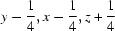
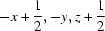
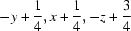
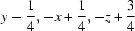
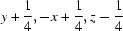
| Symmetry codes: (i) y−1/4, x−1/4, z+1/4; (ii) −y+1/4, x−1/4, z+1/4; (iii) −x+1/2, −y, z+1/2; (iv) x−1/2, y, −z+1/2; (v) y−1/4, −x−1/4, z+1/4; (vi) −y+1/4, x−1/4, z−3/4; (vii) x, y−1/2, −z+1; (viii) x−1/2, y−1/2, z−1/2; (ix) −y+3/4, x−1/4, −z+5/4; (x) −y+1/4, x+1/4, −z+3/4; (xi) x, −y+1/2, z+1; (xii) x, y+1/2, −z+1; (xiii) y+1/4, −x+1/4, z+3/4; (xiv) y+1/4, x+1/4, z+3/4; (xv) −x, −y+1, −z+1; (xvi) x+1/2, y, −z+1/2; (xvii) −x+1/2, −y, z−1/2; (xviii) y−1/4, −x+1/4, −z+3/4; (xix) −x, −y+1/2, z; (xx) y−1/4, −x+3/4, z−3/4; (xxi) −y+1/4, x+3/4, z−3/4; (xxii) −x, y, z; (xxiii) y+1/4, −x+1/4, z−1/4; (xxiv) −y−1/4, x+1/4, z−1/4. |
Experimental details
| Crystal data | |
| Chemical formula | Y4S3(Si2O7) |
| Mr | 620.00 |
| Crystal system, space group | Tetragonal, I41/amd |
| Temperature (K) | 100 |
| a, c (Å) | 11.6706 (16), 13.5873 (19) |
| V (Å3) | 1850.6 (4) |
| Z | 8 |
| Radiation type | Mo Kα |
| µ (mm−1) | 25.78 |
| Crystal size (mm) | 0.10 × 0.08 × 0.08 |
| Data collection | |
| Diffractometer | Bruker APEXII CCD diffractometer |
| Absorption correction | Numerical [face-indexed using SADABS (Sheldrick, 2008a)] |
| Tmin, Tmax | 0.191, 0.238 |
| No. of measured, independent and observed [I > 2σ(I)] reflections | 10831, 668, 587 |
| Rint | 0.066 |
| (sin θ/λ)max (Å−1) | 0.687 |
| Refinement | |
| R[F2 > 2σ(F2)], wR(F2), S | 0.020, 0.045, 1.25 |
| No. of reflections | 668 |
| No. of parameters | 47 |
| Δρmax, Δρmin (e Å−3) | 0.61, −0.77 |
Computer programs: APEX2 (Bruker, 2009), SAINT (Bruker, 2009), SHELXS97 (Sheldrick, 2008b), SHELXL97 (Sheldrick, 2008b), CrystalMaker (Palmer, 2009), SHELXL97(Sheldrick, 2008b).
| Y1—O2 | 2.279 (3) | Y2—O1iv | 2.530 (2) |
| Y1—O1i | 2.428 (2) | Y2—S1iv | 2.8419 (9) |
| Y1—S1ii | 2.7714 (8) | Y2—S3v | 2.8652 (6) |
| Y1—S2 | 2.7874 (6) | Si1—O3 | 1.621 (2) |
| Y2—O1iii | 2.355 (2) | Si1—O1 | 1.623 (2) |
| Y2—O2iv | 2.3884 (15) | Si1—O2 | 1.641 (3) |
| Y1vi—S1—Y2vii | 90.389 (13) | Si1x—O3—Si1 | 128.1 (3) |
| Y1viii—O1—Y2ix | 106.88 (8) |
| Symmetry codes: (i) y−1/4, x−1/4, z+1/4; (ii) −x+1/2, −y, z+1/2; (iii) −y+1/4, x+1/4, −z+3/4; (iv) x, y+1/2, −z+1; (v) −x, −y+1, −z+1; (vi) −x+1/2, −y, z−1/2; (vii) y−1/4, −x+1/4, −z+3/4; (viii) y+1/4, −x+1/4, z−1/4; (ix) x, y−1/2, −z+1; (x) −x, −y+1/2, z. |
Acknowledgements
This research was supported by the US Department of Energy, Basic Energy Sciences, Chemical Sciences, Biosciences, and Geosciences Division and Division of Materials Sciences and Engineering Grant ER-15522.
References
 Bruker (2009). APEX2 and SAINT. Bruker AXS Inc., Madison, Wisconsin, USA. Google Scholar
Deudon, C., Meerschaut, A. & Rouxel, J. (1993). J. Solid State Chem. 104, 282–288. CrossRef CAS Web of Science Google Scholar
Gelato, L. M. & Parthé, E. (1987). J. Appl. Cryst. 20, 139–143. CrossRef Web of Science IUCr Journals Google Scholar
Grupe, M., Lissner, F., Schleid, T. & Urland, T. (1992). Z. Anorg. Allg. Chem. 616, 53–60. CrossRef CAS Web of Science Google Scholar
Grupe, M. & Urland, W. (1989). Naturwissenschaften, 76, 327–329. CrossRef CAS Web of Science Google Scholar
Hartenbach, I. & Schleid, T. (2002). Z. Kristallogr. New Cryst. Struct. 217, 175–176. CAS Google Scholar
Larroque, R. C. & Beauvy, M. (1986). J. Less-Common Met. 121, 487–496. CAS Google Scholar
Palmer, D. (2009). CrystalMaker. CrystalMaker Software Ltd, Oxford, England. Google Scholar
Range, K.-J., Andratschke, M. & Gietl, A. (1996). Z. Kristallogr. 211, 816. CrossRef Web of Science Google Scholar
Shannon, R. D. (1976). Acta Cryst. A32, 751–767. CrossRef CAS IUCr Journals Web of Science Google Scholar
Sheldrick, G. M. (2008a). SADABS. University of Göttingen, Germany. Google Scholar
Sheldrick, G. M. (2008b). Acta Cryst. A64, 112–122. Web of Science CrossRef CAS IUCr Journals Google Scholar
Sieke, C., Hartenbach, I. & Schleid, T. (2002). Z. Naturforsch. Teil B, 57, 1427–1432. CAS Google Scholar
Sieke, C. & Schleid, T. (1999). Z. Anorg. Allg. Chem. 625, 131–136. CrossRef CAS Google Scholar
Sieke, C. & Schleid, T. (2000). Z. Anorg. Allg. Chem. 626, 196–201. CrossRef CAS Google Scholar
Zeng, H.-Y., Mao, J.-G. & Huang, J.-S. (1999). J. Alloys Compd, 291, 89–93. Web of Science CrossRef CAS Google Scholar
This is an open-access article distributed under the terms of the Creative Commons Attribution (CC-BY) Licence, which permits unrestricted use, distribution, and reproduction in any medium, provided the original authors and source are cited.
| CRYSTALLOGRAPHIC COMMUNICATIONS |


Tetrayttrium(III) trisulfide disilicate, Y4S3(Si2O7), crystallizes in the Sm4S3(Si2O7) structure type (Grupe et al., 1992). A view of the coordination environment of the atoms in Y4S3(Si2O7) is shown in Fig. 1. There are two crystallographically independent yttrium atoms. Atoms Y1 and Y2 are at sites of symmetry .m. and ..2, respectively. Atom Y1 is coordinated by three O atoms and three S atoms in a distorted trigonal-prismatic arrangement whereas atom Y2 is coordinated by six O atoms and three S atoms in the form of a distorted tri-capped trigonal prism. There are three crystallographically independent S atoms. Atoms S1, S2, and S3 are at sites of symmetry .2., 4m2, and 4m2, respectively. Atoms S1 and S2 are coordinated by four Y atoms in disphenoidal arrangements and atom S3 is coordinated by four Y atoms in a square-planar arrangement. There is one crystallographically independent Si atom at a site of symmetry .m. and three crystallographically independent O atoms at sites of symmetry 1, .m., and 2mm. . The disilicate (Si2O7)6- units (symmetry 2mm.) are made up of two corner-sharing silicate tetrahedra in the form of a bow-tie. These units stack in a staggered fashion along the c-axis as seen in Fig. 2.
There exist eleven Ln4Q3(Si2O7) analogues where Ln is a lanthanide and Q is S, specifically when Ln = La–Nd, Sm, Gd–Tm (Zeng et al., 1999; Hartenbach & Schleid, 2002; Sieke & Schleid, 1999; Grupe et al., 1992; Sieke & Schleid, 1998; Sieke et al., 2002; Range et al., 1996). There exist six Ln4Q3(Si2O7) analogues of the title compound where Q = Se, specifically when Ln = La—Nd, Sm, Gd (Deudon et al., 1993; Grupe & Urland, 1989; Grupe et al., 1992). No analogues where Q = Te were found in the literature.
The title compound crystallizes with eight formula units in space group I41/amd. The unit-cell dimensions are a = 11.6706 (16) Å and c = 13.5873 (19) Å. For the Ln4S3(Si2O7) analogues, the unit cell varies between a = 12.098 (3) Å and c = 14.379 (5) Å for Ln = La (Zeng et al., 1999) and a = 11.543 (1) Å and c = 13.322 (1) Å for Ln = Yb (Range et al., 1996). A plot of axis length versus lanthanide crystal radius (Shannon, 1976) leads to nearly linear curves (Sieke et al., 2002) and adding Ln = Y to the plot not surprisingly keeps the near linearity. The plot is shown in Fig. 3. The unit-cell dimensions of Y4S3(Si2O7) are closest to that of Ho4S3(Si2O7), where a = 11.6595 (10) Å and c = 13.5577 (12) Å (Sieke et al., 2002). In fact, of all the lanthanide radii, the crystal radius of Ho (1.212 Å) is closest to that of Y (1.215 Å) (Shannon, 1976).