

 journal menu


issue contents
April 2026 issue
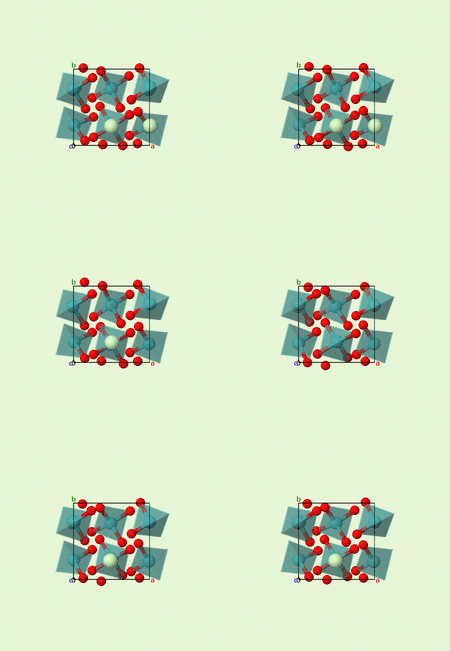
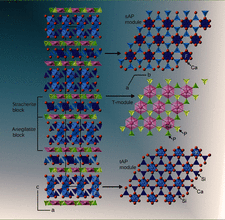
Cover illustration: The effect of cationic composition on the ordering of M+ /Pr3+ cations and vacancies for (3+1)D-modulated monoclinic M1/8Pr5/8□1/4MoO4 (M = Li, Na, K) structures is investigated by V. A. Morozov [(2026), Acta Cryst. B82, 120–130]. Refinement of the structures reveals that MoO42− tetrahedra in scheelite-type compounds demonstrate a flexible geometry.
current research in crystal growth and related characterization


Download citation


Download citation

Using the high-pressure Bridgman method, (Cr, Co, Fe)-co-doped ZnSe optical crystals are grown for the first time, and their physical properties related to the crystal structure are investigated.
CCDC reference: 2525391
Download citation
Download citation
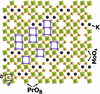
The effect of cation substitutions in the scheelite-type framework is investigated to understand the ordering of M+/Pr3+ cations and vacancies in the structure. The incommensurately modulated crystal structures of the scheelite-based M1/8Pr5/8MoO4 (M = Li, Na, K) phases were refined from synchrotron powder X-ray diffraction data.
B-IncStrDB reference: L8zZeSPwZg1
Download citation
Download citation
Open  access
access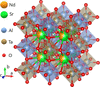
An emerging cubic substrate material (Nd,Sr)(Al,Ta)O3 (NSAT) has been structurally and spectroscopically characterized revealing that the nominally cubic NSAT consists of partially developed cubic superstructure domains with doubled unit-cell parameter. The spectroscopic features are consequently broad due to this partial order.
CCDC reference: 2529364
Download citation
Download citation
Open access
access
This study offers a comprehensive analysis of facet growth during directional solidification of salol, focusing on the dynamic evolution of the solid–liquid interface. A novel strategy was developed to identify the crystallographic nature of the observed facets, whose growth is mainly governed by two-dimensional nucleation, with deviations attributed to competitive growth processes.
CCDC reference: 2531769
Download citation
Download citation
Open access
access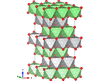
A breakthrough in the first successful single-crystal growth of LiNiO2 using the floating zone technique is reported. The as-grown single-crystal quality has been thoroughly analysed using laboratory and high-energy X-rays. Superlattice reflections are found, clearly seen using the laboratory diffractometer and resonant elastic X-ray scattering.
CCDC reference: 2527204
Download citation
Download citation
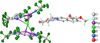
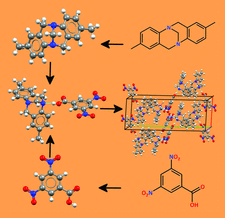
Two co-crystals of Ag3Pz3 and berberine hydrochloride were obtained by the crystalline mate strategy. The work provides valuable mechanistic clues for the rational design of multi-component co-crystals and the efficient preparation of ionic co-crystals from natural products.
Download citation
Download citation
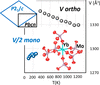
Phase transformations and the nature of negative thermal expansion (NTE) was studied at the atomic level using in-situ single-crystal and powder X-ray diffraction of Ho,Tm-doped Yb2Mo3O12 crystals grown by the flux-melt technique. The thermally enhanced emission was attributed to the material's NTE. The high-temperature luminescence study shows the potential of Yb3+, Ho3+, Tm3+-codoped crystalline systems for developing a highly sensitive ratiometric optical thermometer by exploiting efficient energy transfer.
research papers
Download citation
Download citation
Open access
access
A structural solution is presented of a primitive icosahedral ZnMgEr quasicrystal representing the Bergman-type family. The structure model is based on atomic decoration of the Ammann–Kramer–Neri tiling.
Download citation
Download citation
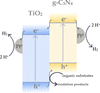
Development of a synthesis approach for g-C3N4/TiO2 composite photocatalysts based on laboratory-prepared TiO2 for H2 evolution.
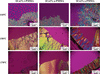
By controlling the tacticity of PMMA, the glass transition temperature of polymers is studied as an independent factor, while factors such as intermolecular interactions, molecular weight and end-group effects are excluded. The relationship between liquid dynamics and crystallization reveal that the effect of isotactic and atactic forms of PMMA on the crystal growth can be mainly attributed to a change in global mobility, while a decrease in global mobility cannot fully explain the inhibitory effects of syndiotactic PMMA on the crystallization of griseofulvin.
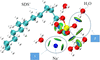
The molecular dynamics method was used to confirm that SDS can act as a hydrate promoter, and it was demonstrated that SDS causes the structure of hydrates to be different from the standard Type I structure.
Download citation
Download citation
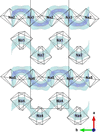
Hydrated sodium hypodiphosphates, Nax(H4–xP2O6)·nH2O (x = 1–3) were obtained by solution crystallization. Post-crystallization dehydration was used to obtain new crystalline anhydrous forms, which were characterized in terms of ionic conductivity.
Open access
access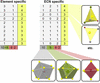
Crystal chemical rules are powerful tools to understand and rationalize inorganic crystal chemical structures. Using an automated approach, Beck's extended coordination number rule is proven to correctly rationalize the coordination within 82.2% of all ternary fluorides.
Download citation
Download citation
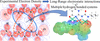
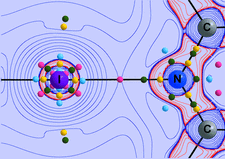
Energy decomposition analysis of experimental electron density provides a benchmark for theoretical methods that accurately describe long-range electrostatic interactions
addenda and errata
Free