

 journal menu


issue contents
October 2025 issue
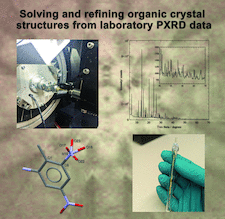
Cover illustration: A step-by-step outline for academic and industrial practitioners determining molecular organic crystal structures from powder X-ray diffraction data. See Kabova, Mersiyanova, Shankland, Shankland & Spillman [Acta Cryst. (2025), C81, 559–569].
best practice series


Open  access
access
A step-by-step outline for academic and industrial practitioners determining molecular organic crystal structures from powder X-ray diffraction data.
research papers

Download citation


Download citation
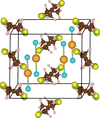
As a new structural series of the organic Dirac electron systems (ODES), BETS2AuX2 [BETS = bis(ethylenedithio)tetraselenafulvalene, and X = Cl and Br] were synthesized to reveal their crystal and band structures. The band structure calculation suggested that they should be a new family of ODES as the first example of purely organic two-dimensional Dirac electron systems.
Download citation
Download citation
Open access
access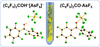
Protonated decafluorobenzophenone and the decafluorobenzophenone–arsenic pentafluoride adduct
Protonated decafluorobenzophenone (perfluorobenzophenone) and its corresponding AsF5 adduct were synthesized by reaction of the ketone with AsF5 using anhydrous HF and liquid SO2, respectively, as solvents, and their crystal structures were determined.
Download citation
Download citation
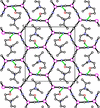
Six CuCN network structures with conjugate acids of N-alkylethanolamines as guest cations are presented, together with topographical analysis and thermal decomposition studies. Generally, each guest templates a different triperiodic structure, but in one case, two structures with different topologies were obtained from the same guest. Thermal decomposition usually leads to loss of HCN(g) and the free base by 200 °C, with a CuCN(s) residue.