

 menu
menu


issue contents
 | STRUCTURAL CHEMISTRY |
ISSN: 2053-2296
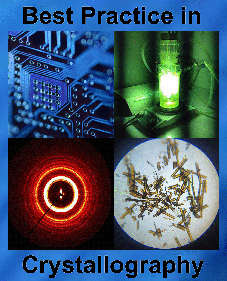
Best practice in crystallography series
An occasional series of invited lead articles on a general `how to do or why to do' theme. The collection will look at current best practices and topical perspectives over a range of subjects aimed at readers with an interest in structural chemistry.
editorial


Free 
The first three articles of the new `Best practice in crystallography' series have been published covering a guide to growing crystals for single-crystal diffraction studies, a guide to performing photocrystallography and a review detailing what aspects of crystal structure are of particular importance to determining electrical conductance in organic materials.
invited articles
Free
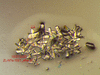
A catalog of techniques, tips, tricks, and encouragement for growing crystals suitable for X-ray crystallography.
Open access
access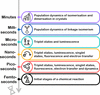
Over the last three decades, the technology that makes it possible to follow chemical processes in the solid state in real time has grown enormously. These studies have important implications for the design of new functional materials for applications in optoelectronics and sensors. Light–matter interactions are of particular importance, and photocrystallography has proved to be an important tool for studying these interactions.
Open access
access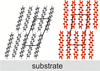
Knowledge of the molecular packing within the crystal structures of organic semiconductors has been instrumental in understanding their solid-state electronic properties. Crystal structures are thus becoming increasingly important for enabling engineering properties, understanding polymorphism in bulk and in thin films, exploring dynamics and elucidating phase-transition mechanisms.

Open access
access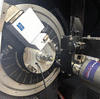
A step-by-step outline for academic and industrial practitioners determining molecular organic crystal structures from powder X-ray diffraction data.
Open access
access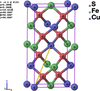
The Jmol Space Group Symmetry Visualizer (https://spacegroups.symotter.org) is an online resource for the visualization of crystallographic symmetry built around the versatile Jmol application and represents a unique resource for students and educators in crystallography and researchers using crystallographic methods.
Open access
access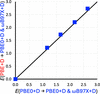
This article describes best practices for `zero Kelvin' energy calculations on molecular crystals and is targeted for non-experts who would like to perform their own calculations or assess the accuracy and validity of such calculations reported in the scientific literature.
scientific commentaries
Free
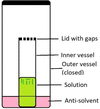
The article of Sommer [Acta Cryst. (2024), C80, 337–342] provides a concise and effective introduction to the subject of growing crystals suitable for structure determination.
Free

To broaden the community and encourage researchers to use photocrystallographic methods, review articles, such as that of Hatcher et al. [(2024). Acta Cryst. C80, 585–600], showing the fundamentals of the approaches, most significant examples of such studies, but also guiding the reader through various stages of sample preparation and experiment planning, are very much needed.
Free
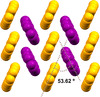
In their contribution to the `Best practice in crystallography' series, Schweicher et al. [(2024). Acta Cryst. C80, 601–611] present a compelling overview, describing the importance and influence of molecular structure, crystal packing and crystal lattice dynamics on both theoretical and experimental charge transport behaviour in crystalline environments.
Free
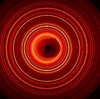
Powder diffraction is a widespread technique found in academic, forensic, industrial research and quality-control laboratories the world over. The recent article by Kabova et al. [(2025), Acta Cryst. C81, 559–569] provides step-by-step guidance on how to proceed and the software the authors use, from sample preparation and the powder diffraction measurement itself, to the verification of the final structure.
Free
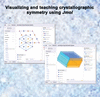
Jmol Space Group Symmetry Visualizer [Johnston & Hanson (2026). Acta Cryst. C82, 258–266] represents a valuable contribution to crystallographic education and practice. Its significance lies in making symmetry visible, manipulable and shareable in a browser-based environment.
Free
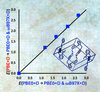
The tutorial on best practices in `0 K' DFT energy calculations on molecular crystal structures by van de Streek & Johnson [Acta Cryst. (2026), C82, 383–400] provides a highly accessible and practical guide for performing reliable periodic density functional theory calculations in organic crystals.

