


 journal menu


issue contents
December 2025 issue
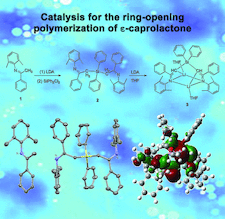
Cover illustration: A binuclear ansa-bis(1-azaallyl) lithium complex was prepared by treating the diimine [(2,6-Me2C6H3)N=C(Ph)CH2]2SiPh2 with lithium diisopropylamide and was characterized by X-ray diffraction techniques. Density functional theory calculations were used to investigate the catalytic properties of the binuclear complex towards the ring-opening polymerization of ɛ-caprolactone and the complex showed good catalytic activity. See Xue, Chen, Li, Chen, Guo, Bai & Pan [Acta Cryst. (2025), C81, 710–717].
research papers


Download citation


Download citation
Open  access
access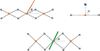
Three pyridine-based halide-bibridged polymers have been synthesized and their structures determined. The effect of the size of the halides on the crystal structures has been investigated.
Download citation
Download citation
Open access
access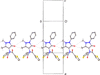
The structures of three doubly-acylated 4-aminoantipyrine compounds where the aryl substituent is varied are reported and analysed in terms of their relative conformation, intermolecular interactions and overall packing. The compounds were crystallized using the encapsulated nanodroplet crystallization (ENaCt) protocol.
Download citation
Download citation
Open access
access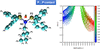
The molecular structures of two novel cobalt aminodiphosphine (PNP) complexes are reported, featuring variation in the N-atom substituent. A Cambridge Structural Database (CSD) survey, along with a noncovalent interaction (NCI) analysis of the analogous [TMCln(PNP)2] (where TM = transition metal and n = 1 or 2) core, revealed an inverse correlation between the P—TM—P bite angles and N⋯TM contact distances.
Download citation
Download citation
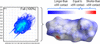
The crystal structure of a Knoevenagel-type indole derivative reveals a supramolecular framework stabilized by N—H⋯O hydrogen bonds, π–π stacking and C≡N⋯H interactions. Complementary Hirshfeld surface analysis, interaction energy calculations and spectroscopic studies provide a comprehensive description of its structural and electronic features.
CCDC reference: 2501645
Download citation
Download citation
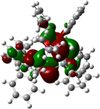
A binuclear ansa-bis(1-azaallyl) lithium complex was prepared by treating the diimine [(2,6-Me2C6H3)N=C(Ph)CH2]2SiPh2 with lithium diisopropylamide and was characterized by X-ray diffraction techniques. Density functional theory calculations were used to investigate the catalytic properties of the binuclear complex towards the ring-opening polymerization of ɛ-caprolactone and the complex showed good catalytic activity.
Download citation
Download citation
Open access
access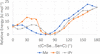
The structures of a cyclic selenourea ligand and two distorted tetrahedral cobalt(II) chloride complexes are disclosed, along with their computed electronic properties and thermochemistry.
Download citation
Download citation
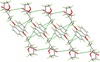
To unambiguously determine the stereochemical outcome of a highly stereospecific rearrangement of epoxides into tetrahydrofurans, single crystals of one of the products, (2R*,3R*)-2-(2-phenoxyethyl)tetrahydrofuran-3-yl acetate, were grown and analyzed. Based on the crystal structure data, we were able to show that the contiguous stereocenters of this molecule are in a syn configuration, and we now suggest with confidence a plausible mechanism for the rearrangement reaction.
CCDC reference: 2480439
Download citation
Download citation
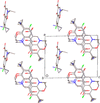
By recrystallization of pazufloxacinium mesylate from HCl solutions, two pazufloxacinium chlorides have been obtained and characterized by means of X-ray diffraction.
Download citation
Download citation
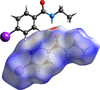
The supramolecular assemblies in two benzamide-based derivatives are stabilized by intermolecular hydrogen bonding between the amide groups. Strong directional connectivity provided by hydrogen bonds joins molecules into one-dimensional chains. Thermal analysis allowed us to propose a mechanism for the transformations of one of the derivatives on heating, including exothermic polymerization, amide-group abstraction and partial benzene abstraction.