


 journal menu


issue contents
July 2026 issue
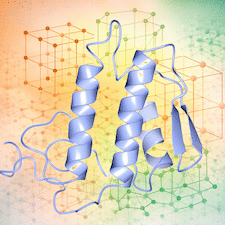
Cover illustration: Scotty, a tool within the Phasertng codebase, leverages Niggli-cell matches to identify similar crystallographic lattices and perform phasing with difference Fourier methods [McCoy et al. (2026), Acta Cryst. D82, 813–823].
radiation damage


Open  access
access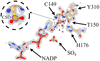
This work examines data contained within 118 215 structures in the Protein Data Bank for unmodelled difference density concomitant with unmodelled oxidatively damaged cysteines. This analysis demonstrates that site-specific oxidation of residues is a phenomenon of which the experimenter should be aware, and highlights the need for a suitable detection tool within refinement software.
Open access
access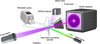
Adenylate kinase was used to quantify how experimental parameters influence radiation damage during time-resolved X-ray solution scattering (TR-XSS) at a multipurpose SAXS beamline. The study provides general guidelines for minimizing radiation artifacts in TR-XSS.
cryoem in the fast lane of structural biology
Open access
access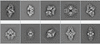
We introduce AlignPCA-2D, a PCA-space Euclidean alignment method for rapid and interpretable 2D classification of cryo-EM particle images. The approach preserves essential structural variability while greatly reducing computational cost, offering a lightweight alternative to existing large-scale cryo-EM classification pipelines.
research papers
Open access
access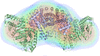
Human malate dehydrogenase forms a transient complex with citrate synthase.
ISDSB2025

Open access
access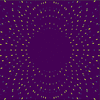
Monte Carlo simulations of neutron protein diffraction experiments provide useful data that models neutrons interacting with instrument components, as well as the crystal diffraction itself. These data can be applied to instrument development, such as the commissioning of the NMX Macromolecular Diffractometer at ESS.
research papers
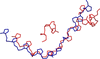
The Patterson map is used as prior information for estimating triplet invariants. The method makes use not only of the information contained in the individual Patterson peaks, but also of that contained in suitably selected triples of Patterson peaks: they provide a valuable additional contribution to the triplet invariant estimate.

Open access
access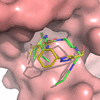
We identified BAZ2A-binding compounds assuming a peculiar, almost enclosed, conformation. These molecules pose a basis for the development of potent BAZ2A macrocyclic inhibitors, as performed for other bromodomains.
Open access
access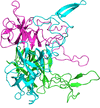
The marine tail-spike protein Dpo31 degrades the exopolysaccharide of its host and has structural features similar to those of other members of this protein class, despite similarity not being detected at the sequence level.
Open access
access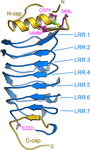
A crystallization screen that has enabled the structural analysis of various extracellular domains of plant membrane receptor kinases is described together with the structure of the LRR domain of the receptor SRF6.
Open access
access
Scotty is a tool that leverages Niggli-cell matches to identify similar crystallographic lattices and perform phasing with difference Fourier methods.
Open access
access
Scotty supports crystallographic comparisons of lattice coincidences, the interpretation of oligomeric assemblies and paracrystallinity.
Open access
access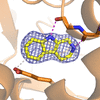
A structure of the flavin-dependent single-component tryptophan halogenase AetF bound to the non-native tricyclic substrate tryptoline reveals a binding pose analogous to L-tryptophan that directs C6-first halogenation. Product analysis identifies 6,8-dibromotryptoline as the final product.
obituaries
Free