journal menu


issue contents
August 2025 issue
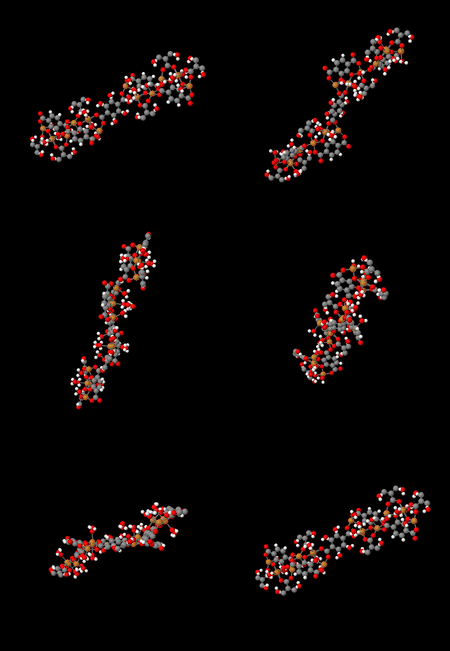
Cover illustration: Metal-organic frameworks (MOFs) are hybrid materials composed of metal ions or clusters linked by organic molecules to form crystalline, potentially porous structures. MOFs that are flexible and responsive, reacting to stimuli like heat, solvents, or pressure, are of particular interest for their possible applications. The present paper describes the synthesis and molecular structure of a new MOF made from CuII and 2,3-dihydroxyterephthalic acid (2,3-dhtp), which shows a flexible behaviour in response to changes in solvation. See: Main, Mackay & Morris [(2025). Acta Cryst. E81, 738–743].
research communications


Download citation


Download citation
In the title square-planar complex, the P atom of the tricyclohexylphosphine group coordinates to the metal atom in the trans position compared to the coordinating N atom. The complex shows significant catalytic ability and selectivity for hydrosilylation between phenylacetylene and triethylsilane.
CCDC reference: 2467161
Download citation
Download citation
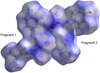
The title azo compound crystallizes in the triclinic space group P1 with two independent molecules in the asymmetric unit. Hirshfeld surface analysis and energy framework calculations revealed key non-covalent interactions such as C—H⋯π, C—H⋯Br, π–π stacking, and halogen bonding, which consolidate the crystal structure.
CCDC reference: 2465012
Download citation
Download citation
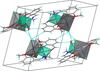
In the crystal the title compound exhibits full-molecule disorder [occupancy ratio 0.711 (6): 0.289 (6)], generated by a false twofold rotation about the shorter, Ni–Pb, axis of the molecule.
CCDC reference: 2467901
Download citation
Download citation
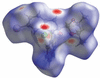
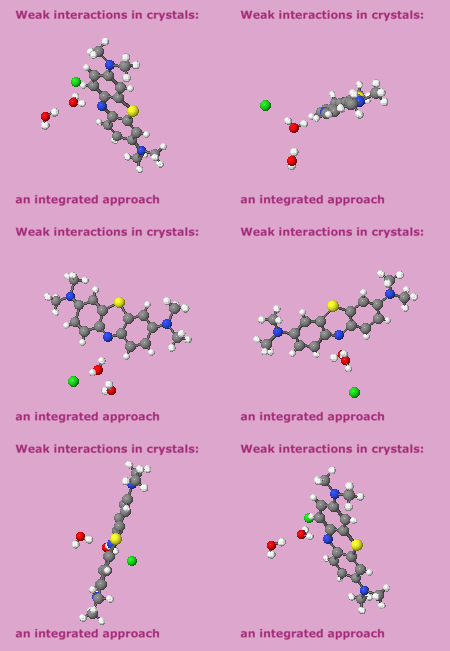
In the crystal of the title solvate, O—H⋯Cl and N—H⋯Cl hydrogen bonds link the cations and anions into centrosymmetric tetramers.
CCDC reference: 2467703
Download citation
Download citation
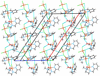
Two crystal structures of copper(II) complexes with a tridentate ligand are reported, new [Cu(N^N^N)(H2O)Cl][Cu(N^N^N)Cl2][CuCl4] and already known [Cu(N^N^N)(NCS)2]·0.3 H2O, (N^N^N = N1,N1-dimethyl-N2-(pyridin-2-ylmethyl)ethane-1,2-diamine), which exhibit a considerable range of intermolecular interactions and notable packing patterns that are being discussed.
Download citation
Download citation
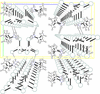
The structures of the isopropylammonium halidometallate salts (IPA+)3CoX5 (X = Cl, Br), (IPA+)2ZnCl4 and (IPA+)ZnCl3 are reported along with a survey of known isopropylammonium halidometallates, and a study of IPA+ cation geometry (both experimental and theoretical) juxtaposed with that of the trimethylammonium TMA+) cation.
Download citation
Download citation
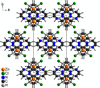
The syntheses and crystal structures of two new ZnCl2–2,3-dimethylpyrazine (C6H8N2) coordination compounds with the composition ZnCl2(C6H8N2)2 (1) and ZnCl2((C6H8N2) (2) are reported. Compound 1 consists of discrete complexes, whereas in compound 2 the Zn cations are linked by the 2,3-dimethylpyrazine ligands into helical [001] chains.
Download citation
Download citation
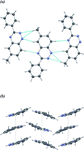
The crystal structures of two Blatter radical precursors, 6-methyl-3-phenylbenzo[e][1,2,4]triazine and 8-methyl-3-phenylbenzo[e][1,2,4]triazine, exhibit extended conjugated heteroaromatic frameworks, with unidimensional columnar arrangements governed by π–π stacking interactions with little impact from the methyl substituent position on the core geometry.
Download citation
Download citation
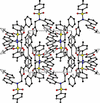
In the crystal, molecules are linked by C—H⋯O interactions, forming layers parallel to the (100) plane. In addition, π–π [centroid-to-centroid distance = 3.4961 (7) Å] and C—H⋯π interactions connect molecules within the layers. The layers are also bound to each other by van der Waals interactions.
CCDC reference: 2472590
Download citation
Download citation
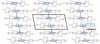
The molecular and crystal structure of the novel compound 4-(3,5-Dimethyl-1,7-diphenyl-1,7-dihydrodipyrazolo[3,4 − b:4′,3′-e]pyridin-4-yl)phenol are reported.
CCDC reference: 2472025
Download citation
Download citation
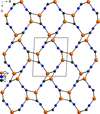
In the crystal structure of the title compound, the copper(I) cations are linked by the cyanide anions into layers that are additionally connected by the 2,6-dimethylpyrazine ligands into a 3D network. The title compound represents a new isomer of Cu2(CN)2(2,6-dimethylpyrazine), which has already been reported in the literature.
CCDC reference: 2472913
Download citation
Download citation
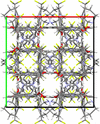
The compound [(R,S)-2,8-bis(trifluoromethyl)quinolin-4-yl](piperidin-2-yl)methanol methanol monosolvate crystallizes in the I41/acd space group. The X-ray crystal structure determination revealed that O—H⋯O, N—H⋯O and O—H⋯N hydrogen bonds are involved in the intermolecular forces of attraction. This is supported by Hirshfeld surface analysis. The X-ray crystallographic data are supported by DFT calculations.
CCDC reference: 2473105
Download citation
Download citation
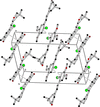
The crystal packing of the title compound, C18H21BrO3, is consolidated by C—H⋯O hydrogen bonds, which form inversion dimers with R22(24) graph-set motifs.
CCDC reference: 2473698
Download citation
Download citation
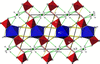
The (NH4)M(HSO4)(SO4)(H2O)2 (M = Fe, Co, Ni) compounds are isotypic and exhibit a phase transition from an ordered crystal structure at T = 100 K to a disordered crystal structure at T = 296 K.
Download citation
Download citation
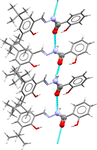
The structure of the title compound, 4C22H28N2O3·C2H6O, exhibits a one-dimensional pore structure composed of channels formed by molecules having an acylhydrazone segment connecting a 3,5-di-tert-butylphenol unit and a 2-hydroxyphenol unit. The channels contain disordered ethanol molecules.
CCDC reference: 2474602
Download citation
Download citation
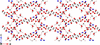
The crystal structures of a flexible metal–organic framework based on CuII and 2,3-dhtp in different states of solvation are reported.
Download citation
Download citation
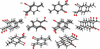
The molecule of the title halogenated benzaldehyde derivative contains an aldehyde moiety, ortho bromine, and para methyl group. Packing via van der Waals forces, the molecules are arranged with both offset face-to-face and an edge-to-face π-stacking interaction revealed by Hirshfeld surface characterization.
CCDC reference: 2471403
Download citation
Download citation
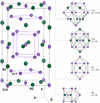
The structural parameters of pentachromium triboride, Cr5B3, with Shastry–Sutherland lattices were refined based on single-crystal X-ray diffraction data. Cr5B3 crystallizes in the space group I4/mcm (No. 140). The present study succeeded in refining the positional and anisotropic atomic displacement parameters of the Cr and B atoms.
CCDC reference: 2473809
Download citation
Download citation
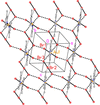
Molecular structures and packing diagrams of four systems involving 3,5-lutidine and gold(III) centres are analysed in terms of hydrogen bonds, halogen bonds, coinage bonds and stacking interactions.
Download citation
Download citation
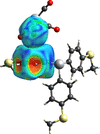
The title compound comprises a triangle of Os atoms, two of which are bonded to four carbonyl ligands. The third Os atom is bound to three carbonyl ligands, and the arsine ligand [As(C6H4SCH3)3] occupies the equatorial position. In the crystal, the molecules are linked by C—H⋯O hydrogen bonds.
CCDC reference: 2474325
Download citation
Download citation
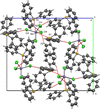
The crystal structures of three salts of the triphenylsulfonium cation, C18H15S+, namely bis(triphenylsulfonium) tetrachloridomanganate(II), triphenylsulfonium tetrachloridoferrate(III) and bis(triphenylsulfonium) tetrachloridocobaltate(II) are reported.
Download citation
Download citation
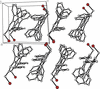
The crystal structures of 3,4,5-triphenyltoluene and 3,4,5-triphenylbenzyl bromide are described, the former of which crystallizes in two polymorphic forms.
addenda and errata
Download citation
Download citation