journal menu


issue contents
September 2025 issue
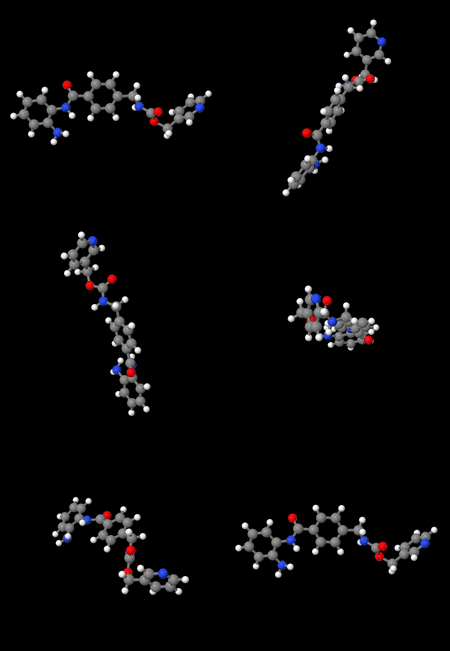
Cover illustration: Using X-ray powder diffraction, the crystal structure of the B-form of entinostat, an antitumor drug currently in clinical trials, was determined. The authors describe in detail the combination of Monte Carlo simulated annealing techniques, Rietveld refinement and density functional techniques used. See: Kaduk & Rai [Acta Cryst. (2025). E81, 865–869].
research communications


Download citation


Download citation
The structure and analysis of the 1:1 cocrystal formed between 1-bromo-3,5-dinitrobenzene and N,N-dimethylpyridin-4-amine is reported. Hirshfeld surface analysis and intermolecular interaction energies within the cocrystal structure are reported.
CCDC reference: 2476608
Download citation
Download citation
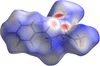
In the crystal, molecules are interconnected by intermolecular N—H⋯O, C—H⋯O, and C—H⋯Cl interactions establishing a three-dimensional network. Furthermore, the molecules form layers parallel to the (002) plane via C—H⋯π interactions.
CCDC reference: 2476058
Download citation
Download citation
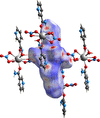
The title complex features an eight-coordinate Ca2+ center with a distorted trigonal–dodecahedral geometry.
CCDC reference: 2476945
Download citation
Download citation
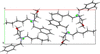
An investigation is reported of the synthesis and crystal structure of 4-benzyl-4-pentylmorpholin-4-ium chloride
CCDC reference: 2477070
Download citation
Download citation
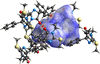
The molecular and crystal structures of 3-ethyl-2-(methylsulfanyl)-5,5-diphenyl-3H-imidazol-4(5H)-one were determined and compared with the structures of similar molecules obtained from the CSD. Intermolecular interactions were further examined through a Hirshfeld surface analysis.
CCDC reference: 2478215
Download citation
Download citation
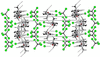
In the title compound, bromide ions link 4-formyl-N,N-dimethylbenzenaminium molecules through intermolecular C—H⋯Br and N—H⋯Br hydrogen bonds, while intermolecular C—H⋯O hydrogen bonds link the cations, enclosing R22(18) ring motifs, into a di-periodic network structure. The tetrabromomethane molecules fill the spaces between the layers.
CCDC reference: 2477918
Download citation
Download citation
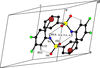
N-(2-Iodophenyl)benzenesulfonamide, C12H10INO2, and N-(4,5-difluoro-2-iodophenyl)benzenesulfonamide, C12H8F2INO2S differ only in the replacement of two H atoms by F atoms, which changes the symmetry from P21/c to P1 and is accompanied by different molecular conformations and packing features.
Download citation
Download citation
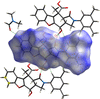
The molecular conformation of the title compound, C24H23NO5·C3H7NO, is consolidated by intramolecular C—H⋯O O—H⋯O hydrogen bonds, forming an S(6) ring motif. In the crystal, the molecules are connected by C—H⋯O hydrogen bonds, forming layers parallel to the (101) plane. Additionally, C—H⋯π interactions lead to the formation of layers parallel to the (102) plane.
CCDC reference: 2477243
Download citation
Download citation
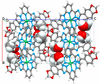
The neutral title compound bis{3-(benzo[d][1,3]dioxol-5-yl)-5-[6-(1H-pyrazol-1-yl)pyridin-2-yl]-4H-1,2,4-triazol-4-ido}nickel(II) methanol disolvate has a distorted pseudooctahedral coordination environment of the metal ion. As a result of their conical shape and polar nature, the molecules stack in one-dimensional columns that are bound by weak hydrogen bonds into layers, which are arranged in three dimensions without interlayer interactions below van der Waals radii.
CCDC reference: 2477384
Download citation
Download citation
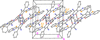
The central pyridinic rings are approximately coplanar to the benzothiazole moieties in both the neutral molecule and the anion. Bond lengths and angles indicate considerable delocalization of the multiple bonding. The neutral molecule is E-configured about the central C=C bond, but the anion is Z. Classical and ‘weak' hydrogen bonds lead to a broad ribbon of residues.
CCDC reference: 2478343
Download citation
Download citation
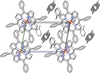
The title complex, [Fe(C4H6N2)2(C44H28N4)]·3C7H8, possesses inversion symmetry with the iron(II) atom located on a center of symmetry. The metal atom is coordinated in a symmetric octahedral geometry by four pyrrole N atoms of the porphyrin ligand in the equatorial plane and two N atoms of 1-methylimidazole ligands in the axial sites; the complex crystallizes with three toluene solvent molecules.
CCDC reference: 2478878
Download citation
Download citation

The title was synthesized by an acid–phenol coupling reaction. In the crystal, intermolecular C—H⋯O hydrogen bonding links the molecules into cyclic hydrogen-bonded inversion dimers with R22(10) motifs. The packing is further consolidated by C—H⋯π and C—Cl⋯π interactions.
CCDC reference: 2478544
Download citation
Download citation
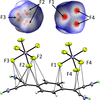
Tetracyanoquinodimethane (TCNQ - C12H4N4) can be doubly protonated by the superacid HF/AsF5 to give crystals of [C12H6N4]2+[AsF6]−2.
CCDC reference: 2478779
Download citation
Download citation
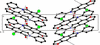
The title molecule is essentially planar [r.m.s. deviation = 0.004 Å]. In the crystal, C—H⋯O and C—H⋯Br hydrogen bonds link the molecules, forming ribbons along the b-axis direction. π–π interactions are also observed.
CCDC reference: 2479912
Download citation
Download citation
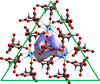
The title salt features BO4 tetrahedra at the centre of [B(C3H2O4)2]− anions.
CCDC reference: 2455003
Download citation
Download citation
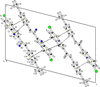
The structure of the title compound was determined at 100 K. In the crystal, the molecules are connected through C—H⋯N and C—H⋯Cl intermolecular hydrogen bonds generating a network that extend along the [010] direction. I
CCDC reference: 2480418
Download citation
Download citation
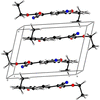
The asymmetric unit of the title compound contains isoxazol and phenyl rings. The 2-cyanoacrylate moiety is in an E- configuration. In crystal, there are there are no intermolecular hydrogen-bonding or C—H⋯π(ring) interactions, only a π–π interaction between the parallel isoxazol rings with centroid-to-centroid distance of 3.4932 (9) Å.
CCDC reference: 2477570
Download citation
Download citation
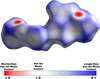
5-(3-Nitro-1H-pyrazol-4-yl)tetrazole crystallizes with two molecules of nearly identical conformation in the asymmetric unit.
CCDC reference: 2480396
Download citation
Download citation
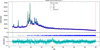
The crystal structure of entinostat Form B has been solved and refined using laboratory X-ray powder diffraction data, and optimized using density functional techniques.
Download citation
Download citation
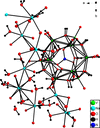
The crystal structure of a nitrate anion caged in spherical vanadium and oxygen structure surrounded by sodium hydroxy and water solvent molecules is reported.
CCDC reference: 2364387
Download citation
Download citation
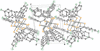
The title compound crystallizes as closely associated pairs across an inversion center, with near approach enabled by Ni⋯S intermolecular contacts of 3.396 (2) Å and bending of the dithiolene ligands away from one another.
CCDC reference: 2480642