issue contents

Journal logoCRYSTALLOGRAPHIC
COMMUNICATIONS
ISSN: 2056-9890

October 2025 issue

Highlighted illustration

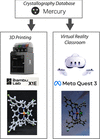
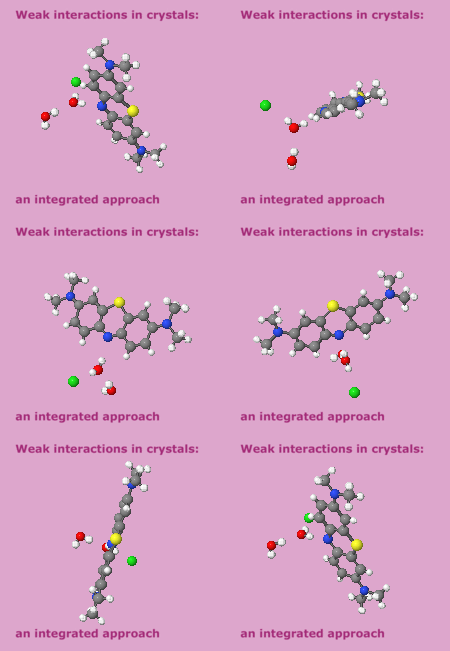
Cover illustration: Crystallographers are well known for always being willing to help novice and experienced researchers deal with problems encountered in the analysis of diffraction data of compounds of the most varied nature. Many courses on basic, intermediate and advanced crystallography take place every year all over the world, taught by experienced and enthusiastic crystallographers always ready to share experiences, tips and tricks, and advice. In addition, many science outreach efforts include crystal growth experiments of compounds of everyday use, to encourage children and youths to pursue studies in chemistry, biology, physics, materials science, and other disciplines that commonly use information obtained from crystallographic studies. This issue of Acta Crystallographica Section E contains the first contributions to the new permanent ‘Education and Outreach’ section. The articles in this issue highlight precisely some of the things that crystallographers are known to enjoy. S. Parkin illustrates with an example how to achieve good values of the parameters in the SHELXL weighting scheme when data reduction or refinement problems give values outside the expected range. Dogutan, Sullivan & Wolfskill present an approach to teaching structural science using 3D printing of .cif files obtained from databases. This experience demonstrates the use of new tools to improve teaching of structural concepts to students of all academic levels. R. J. Staples shares his experiences and advice on obtaining crystals of quality appropriate for single crystal data collection. We look forward to your contributions to this new section of the journal. See: Zheng & Parkin [(2025). Acta Cryst. E81, 879–881].

education and outreach


link to html
The Acta Crystallographica Section E announces a call for papers for its new Education and outreach section, dedicated to showcasing innovative practices, resources, and insights in crystallography and structural chemistry education and public engagement.

link to html
A remedy for unusual weighting schemes sometimes encountered in structure refinements with SHELXL is presented, along with a worked example.

link to html
A pedagogical approach to teaching structural chemistry is introduced. This new methodology involves obtaining crystal structures from crystal structure databases, 3D printing models of molecules, and visualizing the molecules in a virtual classroom in a 360° view.

link to html
Review of crystal growth properties and techniques for generating a crystal for single crystal X-ray structure analysis.

research communications

link to html
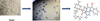
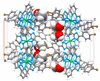
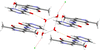
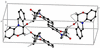
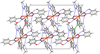
The title compound, a neutral bis­{3-(4-bromo­phen­yl)-5-[6-(1H-pyrazol-1-yl)pyridin-2-yl]-4H-1,2,4-triazol-4-ido}nickel(II) methanol disolvate, exhibits a distorted pseudo­octa­hedral coordination environment around the metal ion. Due to the conical geometry and polar characteristics the mol­ecules stack in one-dimensional columns that are connected by weak hydrogen bonds to form layers. These layers are arranged in a three-dimensional lattice without inter­layer inter­actions closer than van der Waals distances.

link to html
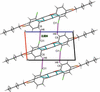
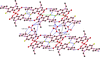
In the title compound, the aromatic rings are oriented at a dihedral angle of 83.30 (2)°. An intra­molecular C—H⋯O contact generates a five-membered S(5) ring motif. In the crystal, C—H⋯O hydrogen bonds link the mol­ecules through R12(6), R22(10), R22(14) hydrogen-bond motifs.

link to html
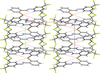
The synthesis and crystal structure of (E)-N-[(2-bromo­phen­yl)methyl­idene]-3,5-bis­(tri­fluoro­meth­yl)aniline are reported.

link to html
The title mol­ecule contains a non-planar oxazine and two benzene rings, with the oxazine ring in a twisted-boat conformation.

link to html
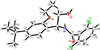
The title hydrazone derivative crystallizes with one mol­ecule of water. Inter­molecular N—H⋯O, O—H⋯O and C—H⋯O hydrogen bonds are responsible for the consolidation of the crystal packing.

link to html
ZnBr2(2,3-di­methyl­pyrazine) is reported as isotypic to its zinc chloride counterpart. In the crystal, the Zn cations are connected by the 2,3-di­methyl­pyrazine ligands into corrugated chains.

link to html
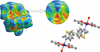
The title compound features a three-dimensional supra­molecular architecture, which is sustained by a set of weak hydrogen bonding and stacking inter­actions. Hirshfeld surface and inter­action energy analyses confirm dispersion-driven inter­actions as the dominant contributors to the packing.

link to html
The closely related title compounds show quite different hydrogen-bonding motifs from the same donor atoms in the cations.

link to html
The title complex adopts a square-planar geometry, involving the bidentate chelation of two norfloxacin mol­ecules with copper, while nitrate ions acts as counter-ions.

link to html
The crystal structure of the cobalt complex [Co(C5H7O2)2(C7H6N2S)(H2O)] was determined in the triclinic space group Pī. The unit cell consists of two independent complex mol­ecules linked by N—H⋯O and O—H⋯O hydrogen bonds along the [011] direction. Hirshfeld surface analysis revealed that the largest contributions to the crystal packing originate from H⋯H, H⋯C/C⋯H, O⋯H/H⋯O, and H⋯S/S⋯H contacts.

link to html
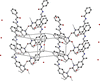
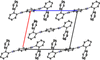
This research highlights the synthesis, characterization and single-crystal XRD structure of a conjugated 1,4-phenyl­enedi­imine encumbered with biphenyl units. The biphenyl units and the central phenyl ring are connected through the imine bonds, creating three aromatic planes that are almost perpendicular to each other. The overall structure of the mol­ecule was found to be controlled by substituent's steric bulk and the weak inter­actions assisted by the nitro­gen of the imine group.

link to html
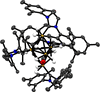
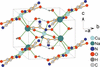
The single-crystal X-ray structure analysis of a penta­nuclear iridium hydride cluster containing four N-heterocyclic carbenes and a CO ligand was supported by DFT-calculations. The penta­nuclear iridium core exhibits a trigonal–bipyramidal structure and the 15 hydride sites show terminal, μ2- and μ3-bridging coordination modes.

link to html
The crystal structure and Hirshfeld surface analysis of N-[1-(4-tert-butyl-2-eth­oxy­phen­yl)-2-hy­droxy­eth­yl]-2,6-di­fluoro­benzamide, C21H25F2NO3, a metabolite of the insecticide/acaricide etoxazole designated R4, is presented.

link to html
In the title compound, the CuII cation lies on an inversion center and exhibits a distorted octa­hedral coordination geometry, formed by two 2-amino-1-methyl­benzimidazole ligands coordinating via their ring nitro­gen atom and two bidentate salicylate anions binding through the carboxyl­ate oxygen atoms.

link to html
The synthesis and mol­ecular crystal structure of an anionic copper(II) complex with 2-cyano-2-(hy­droxy­imino)­propionic acid are reported. The complex exhibits distorted octahedral coordination geometry around the copper(II) center, featuring two bidentate dianionic ligands arranged in a trans-configuration. Coordination occurs via the nitro­gen atom of the oxime group and the oxygen atom of the carboxyl­ate group, with the latter binding in a monodentate manner.

link to html
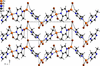
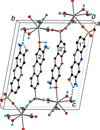
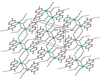
The title compound, [Ni(N3)2(C12H12N2)]n, was synthesized solvothermally and characterized crystallographically. In the crystal, adjacent polymer chains are linked into sheets by means of a single C—H⋯N hydrogen bond.

link to html
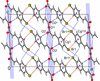
An aqueous reaction of barium hydroxide and 3-amino-4-hy­droxy­benzene­sulfonic acid yielded a very small amount of an unexpected product, bis­(2-amino-3-oxo-3H-phenoxazine-8-sulfonato)­tetra­aqua­barium. The extended structure has columns of nearly parallel anions that are bridged by the hydrated barium cations so that the overall motif consists of alternating layers of inorganic cations and organic anions.

link to html
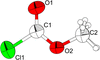
In the crystal structure of methyl chloro­formate, the staggered ClC(O)OCH3 mol­ecule adopts CS symmetry. A phase transition is not observed between 200 and 100 K.

Research communications
Research communications are designed to help authors bring out the science behind their structure determinations. Authors are encouraged to report more than one structure in the same communication and also to include the results of investigations with other techniques. The Research communications format makes Acta E the natural home for structure determinations with interesting science to report.
Emerging Sources Citation Index

Acta E is included in the Emerging Sources Citation Index.

ESCI

Follow Acta Cryst. E
Sign up for e-alerts
Follow Acta Cryst. on Twitter
Follow us on facebook
Sign up for RSS feeds