issue contents

Journal logoCRYSTALLOGRAPHIC
COMMUNICATIONS
ISSN: 2056-9890

July 2026 issue

Early view articles

Journal cover

early career research


link to html
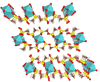
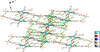
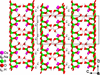
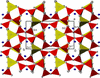
An aluminium hydroxide methane­sulfonate salt, Al(OH)(CH3SO3)2, crystallizes with one-dimensional chains of AlO6 connected via hydrogen bonding.

research communications

link to html
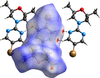
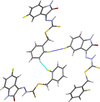
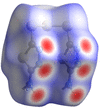
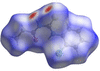
The crystal structure of the title solvate features homohalogen (F⋯F) Type I inter­molecular inter­actions, non classical Car—H⋯F and Car—H⋯S hydrogen bonds, as well as S⋯O chalcogen bonds.

link to html
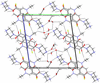
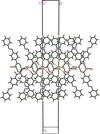
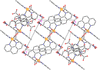
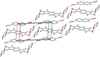
The components of the title mol­ecular salt are linked by numerous N—H⋯O and O—H⋯O hydrogen bonds and aromatic π–π stacking inter­actions.

link to html
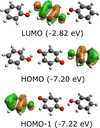
The solvent-free synthesis of X-ray quality crystals of pheno­quinone (1:2 p-benzo­phenone:phenol cocrystal) is reported, along with its crystal structure re-determined at low temperature. A detailed time-dependent density functional examination of the charge-transfer excitation of pheno­quinone accounting for its color is also provided.

link to html
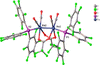
The title heterometallic single cubane cluster [(Tp*)MoFe3S33-Cl)(PMe3)3](BPh4) [Tp* = tris­(3,5-di­methyl­pyrazol-1-yl)hydro­borate(1–)] features distinct coordination geometries for the Mo and Fe sites and serves as a typical example in the Mo–Fe–S cluster family with potential applications for the construction of high-nuclearity clusters and synthesis of FeMo-co mimics.

link to html
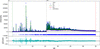
Synthetic SrZnSi3O8 belongs to the feldspar group with 1/4 of the cationic sites of the tetra­hedral framework fully occupied by Zn2+ and 3/4 fully occupied by Si4+.

link to html
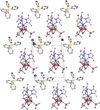
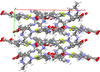
A novel tetra­nuclear Cu2+ complex was solvothermally constructed from a salicyl­aldehyde-based Schiff base ligand, which possesses a centrosymmetric framework with two dinuclear Cu2+ units; all Cu2+ centers adopt a distorted trigonal–bipyramidal coordination geometry. C—H⋯O hydrogen bonds and C—H⋯π inter­actions further consolidate the packing.

link to html
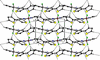
The title compound contains two 1,3,4-thia­diazol-2-amine moieties bridged by a tris­ulfanediyl group. In the crystal, N—H⋯N hydrogen bonds generate infinite [010] chains.

link to html
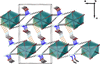
In the title compound, the Zn2+ ions are coordinated by one water mol­ecule and four oxygen atoms from four different pba ligands to form a [ZnO5] trigonal bipyramid. The trigonal bipyramids are bridged by the pba ligands, extending the structure into chains. The chains are connected through hydrogen-bonding inter­actions.

link to html
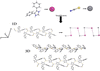
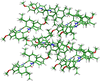
In the crystal structure of the sparfloxacinium 4-amino­salicylate salt, two sparfloxacin and two 4-amino­salicylic acid mol­ecules inter­act with each other through N—H⋯O hydrogen bonds, forming an R44(12) ring motif.

link to html
In the title salt, the components are linked by N—H⋯N, C—H⋯S, C—H⋯π and C—S⋯π inter­actions.

Research communications
Research communications are designed to help authors bring out the science behind their structure determinations. Authors are encouraged to report more than one structure in the same communication and also to include the results of investigations with other techniques. The Research communications format makes Acta E the natural home for structure determinations with interesting science to report.
Emerging Sources Citation Index

Acta E is included in the Emerging Sources Citation Index.

ESCI

Follow Acta Cryst. E
Sign up for e-alerts
Follow Acta Cryst. on Twitter
Follow us on facebook
Sign up for RSS feeds