

 journal menu


issue contents
February 2026 issue
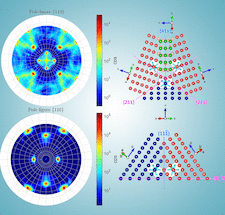
Cover illustration: Cejpek et al. [J. Appl. Cryst. (2026), 59, 190–205] illustrate the possibility of controlling the crystallographic orientation of thin metallic films via heteroepitaxy to a single-crystalline substrate using the example of molybdenum films deposited on MgO substrates. The relaxation mechanisms of the lattice strain induced by the lattice misfit between the film and the substrate were identified via X-ray and electron diffraction and transmission electron microscopy.
research papers



We describe the Wombat neutron diffraction instrument, which has been operational for the past 17 years at the Australian Centre for Neutron Scattering.
Open  access
access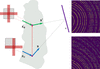
We introduce the moving-beam diffraction geometry as implemented at the Dual Imaging and Diffraction beamline at Diamond Light Source, and provide a quantitative assessment of the precision offered by this geometry and the nearest-neighbor calibration method.
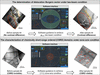
A crystallographic approach is elaborated to guide sample alignments for imaging desired microstructural features in transmission electron microscopy (TEM) characterization. This approach eliminates time-consuming trial-and-error processes, making TEM operations user friendly, especially for non-experts. A dedicated software module has been developed and integrated into the ATEX software to streamline the experimental workflow.

Open access
access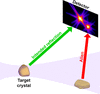
We present an adaptively coupled phase retrieval algorithm for multi-peak Bragg coherent diffraction imaging. The technique uses the redundant information contained in separate Bragg peaks to detect and remove spurious signal.
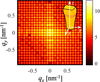
Fast calculation method for small-angle X-ray scattering spectra of high-aspect-ratio nanostructures
This work presents a semi-analytical method based on Green's theorem for accurate and efficient scattering field simulation of high-aspect-ratio nanostructures in X-ray critical dimension metrology. By significantly reducing sampling requirements, the proposed approach achieves a baseline speedup of one to three orders of magnitude over conventional methods while maintaining high accuracy. Further acceleration and optimization strategies are also discussed.
Open access
access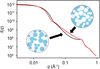
Small-angle scattering form factors of composite particles built from either embedded spheres or randomly distributed voids within a sphere are obtained by Monte Carlo simulations, and analytical expressions that reproduce the simulations are derived.
Open access
access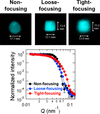
While maintaining or even improving Q resolution, a long array of short-focal-length magnetic lenses, with zero transmission loss and no diffuse scattering, successfully polarized and enhanced the intensity of neutron beams for small-angle neutron scattering at momentum transfer Q > 0.1 nm−1.
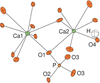
The scattering factors of atoms in hydroxyapatite are derived from the electron density distribution optimized using density functional theory. The accuracy of powder X-ray diffraction crystal structure refinement with optimized scattering factors is shown to be comparable to that of single-crystal neutron diffraction data.
Open access
access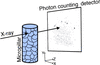
A rapid scanning X-ray nanodiffraction method is demonstrated to efficiently assess local microstructural changes in polycrystalline micropillars during deformation, enabling real-time insights.

Open access
access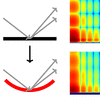
The paper formally addresses the influence of the substrate curvature and size on the grazing-incidence small-angle X-ray scattering (GISAXS) signal. Using the established theory, GISAXS can be combined with substrate-curvature-based stress measurements, which is demonstrated on the example of Ag thin-film growth.
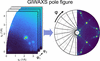
Grazing-incidence wide-angle X-ray scattering is presented as a novel approach to measure X-ray diffraction pole figures, enhancing sensitivity to nanoparticle and thin-film texture when compared with conventional Schulz geometry. Tuning of the grazing-incidence angle is utilized to obtain texture information at different depths in thin films.
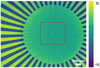
A total-reflection Kirkpatrick–Baez nanofocusing mirror system at the Shanghai Synchrotron Radiation Facility achieves a two-dimensional spot of about 50 nm, with preliminary imaging and ptychography experiments demonstrating sub-50 nm resolution. This advancement enhances high-resolution experimental applications in materials science and nanotechnology.
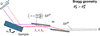
The effect of chromatic dispersion due to the difference between Si(111) double-crystal monochromator and sample Bragg angles in rocking curve imaging at a synchrotron has been evaluated. This previously unaccounted for mismatch leads to a change in the image size parallel to the scattering plane which must be considered for accurate determination of diffraction profiles, image resolution and lattice plane curvatures.

Download citation


Download citation
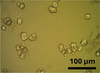
A new carrier matrix for the high-viscosity injection of protein microcrystals during serial crystallography experiments is presented and characterized. Its suitability is validated by crystallographic data collection at the SACLA XFEL and further characterization at the ESRF synchrotron.
PDB reference: 9qtl, HEWL micro-crystals embedded in G-hydrogel

A reverse Monte Carlo/pair distribution function method was used to reconstruct the disordered 3D atomic structure of simulated AuPd nanoparticles at various stages of diffusional mixing.
Open access
access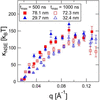
We present results and practical considerations for the analysis of neutron spin echo data from vesicles with undulating membranes using a framework that was recently published [Granek et al. (2024). Eur. Phys. J. E 47, 12]. We show the importance of vesicle diffusion, size, lamellarity and osmotic pressure as well as the effects of membrane viscosity on the quantitative value for the bending rigidity.
Open access
access
The present study investigates the deformation behavior of high-strength steels and the associated evolution of material anisotropy. Particular focus is placed on the impact of crystallographic texture and intergranular strains on how residual stresses can be evaluated using X-ray diffraction and the associated assessment of weld seams in the automotive industry.
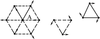
On the basis of phenomenological theory, taking into account the crystal-chemical properties of the compounds, the factors determining the formation of rotationally ordered phases in a large group of rare earth perovskites have been identified. The tendency of the linear configuration of the cation–anion bonds to bend generates two types of rotational ordering, the interaction of which determines the structure and arrangement of the ordered phases.
Open access
access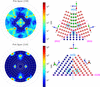
The possibility of controlling the crystallographic orientation of thin metallic films via heteroepitaxy to a single-crystalline substrate is illustrated on the example of molybdenum films deposited on MgO substrates having the orientations (001) and (011). The relaxation mechanisms of the lattice strain induced by the lattice misfit between the film and the substrate were identified via X-ray and electron diffraction and electron microscopy.
Open access
access
This study introduces the novel Auto Diffraction Pipeline to generate large-scale synthetic 2D X-ray diffraction datasets from crystallographic information files. By training convolutional neural networks on these diverse datasets, the authors achieve rapid and automated classification across all seven crystal systems and 230 space groups.
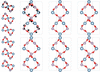
First-principles calculations on SiO2 and AlPO4 show that phase transitions reversing space-group chirality do not change the sign of optical rotation, clarifying the microscopic origin of this phenomenon.
teaching and education
Free
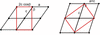
This study establishes a mathematical framework connecting symmetry operations with metrical restrictions through systematic analysis of symmetry operation representation matrices.
Open access
access
Six recurrent misconceptions in crystallography, some involving mineral and crystal optics, are analyzed and discussed. The explanation of these and similar misconceptions could serve as educational resources for teachers.
computer programs
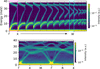
The pathSQE software automates the processing and analysis of single-crystal inelastic neutron scattering datasets collected with time-of-flight instruments. It enables systematic slicing, symmetrization and visualization of data in reciprocal space, facilitating the exploration of large wavevector–energy volumes and comparisons with theoretical predictions.
Open access
access
A new Python package, pygid, enables fast batch processing of X-ray scattering data, with a particular focus on grazing-incidence geometries.
addenda and errata
Open access
access
The funding information for the article by Arakawa et al. [J. Appl. Cryst. (2025), 58, 886–896] is corrected.