

 journal menu


issue contents
April 2026 issue
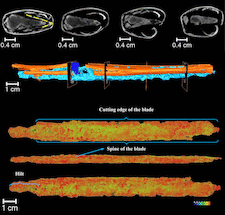
Cover illustration: Wang et al. [J. Appl. Cryst. (2026), 59, 477–482] use neutron tomography to conduct non-destructive characterization of a corroded Western Han dynasty writing knife.
research papers


Open  access
access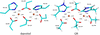
For the first time quantum refinement has been performed with X-ray free-electron laser and microcrystal electron diffraction data for the dinuclear iron site in the R2a protein of ribonucleotide reductase. The method is shown to work well and can be used to determine the protonation state of the bridging solvent molecule and deduce photoreduction in two of the structures.

Download citation


Download citation
Open access
access
Open access
access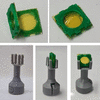
A user-friendly fixed-target platform for serial synchrotron crystallography is described, which allows low-background X-ray diffraction data collection, in situ crystallization and transportation of protein microcrystals at room temperature.
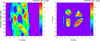
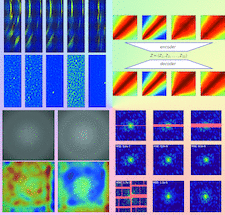
The combination of grazing-incidence wide-angle X-ray scattering (GIWAXS) tomography and pole figure measurements enables advanced analysis of transition metal dichalcogenide (TMD) thin films even under standard laboratory conditions. This approach could contribute to accelerating the development of TMD film manufacturing techniques in research laboratories.
Open access
access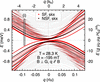
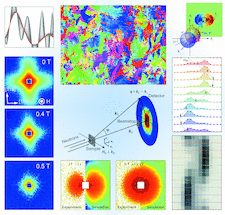
Inelastic neutron scattering shows that the non-reciprocal nature of the magnons in the skyrmion phase of MnSi is maintained for high temperatures well beyond the skyrmion–paramagnetic phase transition.
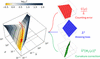
Binning in small-angle neutron scattering is conventionally performed using empirical parameters, often leading to inconsistent precision and resolution. This work introduces a correlation-aware framework that determines the optimal bin width from first principles by extending the Freedman–Diaconis rule through Gaussian-process inference. Experimental validation confirms that correlation-aware inference systematically improves precision and establishes a general foundation for statistically optimized data reduction.
Open access
access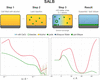
Neutron reflectometry is used to compare supported lipid bilayers formed by vesicle fusion and solvent-assisted lipid bilayer (SALB) methods, revealing structurally comparable architectures with minor differences in acyl chain thickness and low residual solvent incorporation. The study establishes the structural validity and limitations of the SALB approach, emphasizing the need for case-specific validation in membrane interaction studies.
Open access
access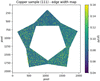
Additive manufacturing represents a highly promising technique across various research and development sectors. In this work, Bragg edge neutron imaging is employed to characterize the crystallographic structure of additively manufactured metal samples, aiming to validate and optimize the production process.
Open access
access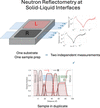
We introduce a twin-compartment solid–liquid cell for neutron reflectometry that divides a single substrate into two independent measurement areas, doubling sample capacity and enabling direct side-by-side comparisons. This sample environment also reduces alignment and sample preparation time and has been successfully tested on both vertical and horizontal reflectometers at ISIS and Institut Laue–Langevin.
Open access
access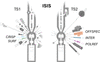
This article presents the current capabilities of the four time-of-flight neutron reflectometers at the ISIS Neutron and Muon Source, highlighting recent advances in instrumentation, automation and data analysis that enable high-precision studies of interfacial structures across diverse scientific fields.
Open access
access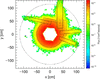
This paper explores the options for upgrading the cold neutron source at the Budapest Research Reactor.
Open access
access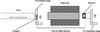
McStas simulations of a recent time-of-flight characterization of the PF1B instrument at the Institut Laue–Langevin show good agreement with the current beamline model, while also highlighting opportunities to refine some parameters of the simulation using the collected time-of-flight data as a benchmark.
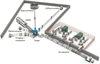
ARGITU is a proposal for a local neutron source aiming to serve the European and Spanish community. A neutron instrument suite formed by five scientific instruments is hereby proposed to develop its science program: a thermal powder diffractometer, a horizontal reflectometer, a small-angle scattering instrument, an imaging instrument and a backscattering spectrometer.

One-dimensional Trench-MWPC detector for the D20 powder diffractometer at the Institut Laue–Langevin
The first one-dimensional implementation of the Trench-MWPC technology has been carried out in a large (1.5 m radius and 160° angular coverage) curved 3He-based detector for the D20 high-resolution high-intensity neutron diffractometer at the Institut Laue–Langevin.
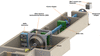
A new wide-aperture multi-element scintillation detector was commissioned at the high-resolution neutron Fourier diffractometer operating at the IBR-2 pulsed reactor. The performance of the diffractometer has improved significantly, and new experimental opportunities have emerged.
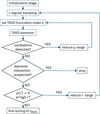
The direct transform of a small-angle X-ray scattering curve using truncated singular value decomposition yields the pair distance distribution function, a key step for data validation, especially in the context of biological structural modelling.
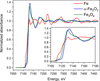
A method for high-quality X-ray absorption spectroscopy in transmission mode is proposed, which can be easily applied on a laboratory X-ray powder diffractometer. Such application may contribute to the wider use of this powerful technique in materials research laboratories.
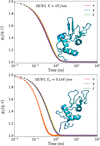
This work uses molecular dynamics simulations to model ultrafast X-ray studies of proteins under static electric fields. This approach successfully captures various protein dynamics in response to external stimuli, demonstrating the feasibility of using ultrafast X-ray photon correlation spectroscopy to study protein dynamics.
Open access
access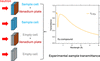
An experimental method for absorption correction of powder samples containing highly neutron absorbing elements is reported.
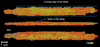
This study used neutron tomography to conduct non-destructive characterization of a corroded Western Han dynasty writing knife. By exploiting the advantages of neutrons, this work addresses the shortcomings of traditional non-destructive imaging techniques (e.g. X-rays) in analysing composite structures of ancient iron-based cultural relics, providing a reliable non-destructive method for their structural characterization and conservation research.
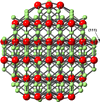
This paper reports the structure of the ultrawide-bandgap semiconductor β-Ga2O3:Fe subjected to B+ implantation. Advanced methodological issues in the use of complementary high-resolution X-ray diffraction, X-ray reflectometry and high-resolution transmission electron microscopy in the analysis of the β→γ phase transformation in an irradiated monocrystal of β-Ga2O3 are considered.
Open access
access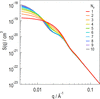
We have elucidated the polymer adsorption layer structure in filler–rubber systems by conducting spin-contrast-variation small-angle neutron scattering on partially and fully swollen filler–rubber samples with and without a silane coupling agent.
Open access
access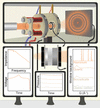
A versatile sample environment enabling operando studies of solid-state batteries with temperature control and pressure monitoring is described.
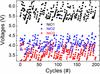
The resistive switching characteristics of NiO-based RRAM capacitors were enhanced by introducing oxygen-deficient NiO0.95 layers at both electrode interfaces. Increasing the thickness of the NiO0.95 layer effectively reduced the Schottky barrier height, thereby lowering the forming, SET and RESET voltages and improving overall device performance.
Open access
access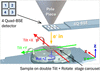
We explore and address many of the major challenges associated with using electron channeling contrast imaging in a scanning electron microscope, with the goal of more easily revealing and characterizing crystalline defects such as dislocations.
Open access
access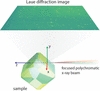
This paper introduces LaueMatching, a rapid and robust algorithm for indexing Laue diffraction patterns using a pre-computed simulation library. It employs pattern-correlation matching, overcoming challenges like weak signals, missing peaks and highly distorted peaks from complex microstructures which are often faced by traditional peak-finding methods.
Open access
access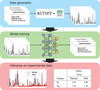
A machine-learning-driven methodology is introduced to automatically refine crystal structures using powder X-ray diffraction data.
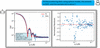
Powered by large language models, SasAgent allows users to perform small-angle scattering data analysis through natural language communication, paving the way for artificial-intelligence-agent-assisted scientific research.
Open access
access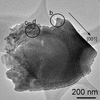
A transmission electron microscopy study of cryogenic calcite samples reveals the homo-epitaxial intergrowths of {1120}//{1120}rotated, {0001}//{1100} and {1102}//{1108} interfaces, all being energetically favorable, along with their cooperation with {1014} twinning.
Open access
access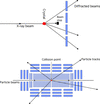
A computational method for refinement of multi-panel detector geometry has been adapted from high-energy physics to serial crystallography. The method is many times faster and much more accurate than previous approaches.
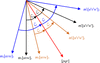
A computation algorithm for plesiotwinning analysis is presented, based on the derivation of coincidence-site lattices.
computer programs
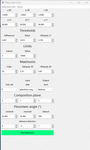
Computation software for plesiotwinning analysis is presented, implementing the algorithm introduced in the companion article [Nespolo (2026). J. Appl. Cryst. 59, https://doi.org/10.1107/S1600576726001135].
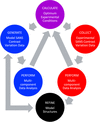
Software for small-angle neutron scattering contrast variation experiment planning and data analysis
The development of a new contrast software suite for small-angle neutron scattering (SANS) contrast variation (CV) experiments is reported. This new platform, integrated into the SASSIE-web framework, streamlines experiment planning, simulation and data analysis to improve the accessibility and efficiency of SANS CV studies for multi-component biological complexes.
Open access
access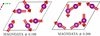
STENSOR automatically computes symmetry-adapted tensors under spin and magnetic point groups. It generates tensors for both spin and magnetic point groups from structural data files or spin-group generators. The comparison permits separation of the effects due to spin–orbit coupling from non-relativistic contributions, as illustrated by examples.
Open access
access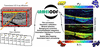
LamelODF is a MATLAB-based toolbox aimed at simplifying the automated extraction of orientation distribution functions from 2D X-ray diffraction data of lamellar minerals in transmission mode. It accommodates both laboratory and synchrotron data formats, providing an integrated pipeline from raw data to spatially resolved textural maps, enabling robust quantification of orientation parameters and mineral phase discrimination.
Open access
access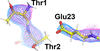
pyDiSCaMB provides an interface between cctbx and DiSCaMB. The former drives Phenix and the latter provides multipolar parameterization of scattering, thus enabling multipolar modelling in Phenix.
Open access
access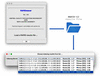
RAPIDviewer has been developed as an ImageJ macro that visualizes the indexing results of zone-axis-aligned electron diffraction patterns of cubic materials obtained with the program RAPID. The software facilitates the integration of crystallographic analysis within the ImageJ platform, offering a range of functionalities including configurable spot pattern overlays, Kikuchi line plotting, orientation plots and VESTA export.
Open access
access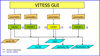
VITESS 3.8 introduces modernized neutron-source modeling with new artificial-intelligence-based and KDSource modules, plus expanded component support including a prism module and NCrystal-integrated sample module. It also delivers major upgrades to existing modules and multiple new features, advancing the simulation framework.
Open access
access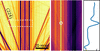
We introduce a Python package with parallel computing capabilities designed for the refinement of convergent-beam electron diffraction (CBED) or large-angle CBED patterns.
laboratory notes
Open access
access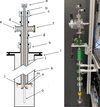
We describe an optimized gas-delivery stick for use with top-loading cryostats for neutron scattering measurements.
addenda and errata
Open access
access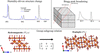
An error in the article by Sednev-Lugovets et al. [J. Appl. Cryst. (2025), 58, 1908–1919] is corrected.
Free

The name of one of the authors of the article by Zhang et al. [J. Appl. Cryst. (2025), 58, 746–758] is corrected.