

 journal menu


issue contents
August 2026 issue
Early view articles

research papers


Open  access
access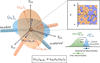
This work demonstrates that diffraction-based residual strain calculations and uncertainty estimates depend on how grain populations are sub-sampled, with important implications for interpreting residual stresses in heterogeneous materials with fine-scale microstructure and strain gradients.
Open access
access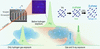
Powder diffraction is used to reveal X-ray-induced hydride formation in palladium nanowires in a gaseous hydrogen environment.
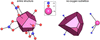
This work provides a unified crystallographic description of a series of rare-earth nitrate hydrates, [RE(NO3)3(H2O)n]·xH2O (RE = La–Lu, Y), and their aqueous solutions. The findings integrate X-ray diffraction, EXAFS, topological descriptors and computational modelling to offer transferable methodologies for interpreting structural anomalies in coordination compounds and precursors for functional materials.
Open access
access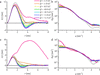
Pair distance distribution functions of interacting ellipsoidal particles can be hard to interpret. This difficulty can be circumvented partially by the generalized indirect Fourier transformation.
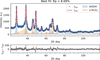
A full-profile quantitative X-ray phase analysis method is developed for mixtures of low-temperature aluminium oxides and pseudoboehmite, combining experimental and calculated (via the Debye scattering equation) reference profiles. The approach provides high accuracy for model γ-Al2O3/χ-Al2O3 and γ-Al2O3/AlOOH mixtures and is applicable to complex nanocrystalline oxide and catalyst systems with poorly described diffraction patterns.
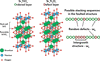
This study investigates the impact of correlated Ruddlesden–Popper faults on the diffraction patterns of tetragonal A2BO4-type structures, using Sr2TiO4 as a representative example. Simulations demonstrate that these correlations give rise to distinctive diffraction features – including intensity redistribution, anisotropic peak broadening and diffuse scattering – that distinguish coherent intergrowths of Sr2TiO4 and Sr3Ti2O7 from conventional two-phase systems.