


 journal menu


issue contents
 access
September 2025 issue
scientific commentaries


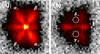
Quasicrystals are long-range-ordered materials with rotational symmetry incompatible with periodicity. Takakura et al. [(2025). IUCrJ 12, 435–443] present a study of a single grain of icosahedrite, the first natural icosahedral quasicrystal, which was found in a meteorite in 2009. Through detailed analysis of the diffraction peaks, they conclude that natural AlCuFe is an icosahedral quasicrystal superimposed by a phasonic modulation along the fivefold directions, which is similar to that observed in the synthetic quasicrystal. Based on knowledge of the synthesis and phase stability of icosahedral AlCuFe, they discuss the formation of icosahedrite in the meteorite.
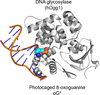
Structural analysis of the co-crystal between human DNA glycosylase hOGG1 and a light-sensitive substrate analog highlights its utility as a platform for real-time observation of catalytic dynamics.
research letters
BIOLOGY | MEDICINE


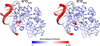
Engineered in crystallo photosensitivity in a DNA-repair enzyme is carefully assessed for its suitability as a target for time-resolved crystallographic studies.
MATERIALS | COMPUTATION
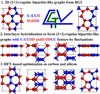
This study identifies carbon crystal structures as 4-degree quotient graphs and proposes a novel approach for generating 3D 4-coordinate networks using 2D (2+1)-regular bipartite-like graphs. Through a random group and graph theory (RG2) method, we discover 509 new structures, including two low-energy phases (Pbam48 and Pbam40) that exhibit exceptional stability and potential applications as superhard carbon and quasi-direct band gap silicon materials in mechanical processing and solar photovoltaic technologies.
research papers
PHYSICS | FELS
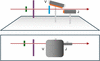
This work demonstrates that high-quality ultra-fast total scattering data and pair distribution function data can be obtained from a single ∼30 fs pulse at the European XFEL, achieving a record Q range of up to 16.6 Å−1. These results establish XFELs as powerful tools for probing atomic scale structures on ultra-fast timescales, opening new opportunities for studying dynamic processes in disordered and complex materials.
NEUTRON | SYNCHROTRON
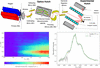
A new satellite is discovered in the manganese Kβ spectrum using extended-range high-energy-resolution fluorescence detection. Advanced insights on its structure and evolution are extracted with principal component analysis.
CRYO | EM
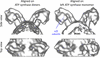
Electron cryo-tomography of ATP synthase dimers in plant mitochondria indicates a wide dimer angle and a plant-specific subunit in the peripheral stalk.
NEUTRON | SYNCHROTRON
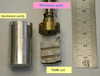
Highlighting radical sites through polarized neutron scattering from AFP-modulated polarized protons
Selective nuclear spin reversal by the method of adiabatic fast passage is a way to order a system of dynamically polarized nuclei. Using polarized neutron scattering, it increases the visibility of sources and sinks of proton polarization in radical proteins. Notably, Tyr369 has been confirmed as a potential radical site in bovine liver catalase.
BIOLOGY | MEDICINE

We demonstrate the application of a nitric oxide releasing photocage system for time-resolved serial crystallography studies of two heme containing proteins using a fixed target sample delivery system. Optimal parameters for successful photocage activation and nitric oxide release are explored.
PDB references: DtpB SSX resting state, 9i4q; DtpB SSX photocaged NO 0.8µJ, 9iaa; DtpB SSX photocaged NO 8µJ, 9ia9; DtpB SSX photocaged NO 16µJ, 9i6g; DtpB SSX photocaged NO 32µJ, 9i4u; DtpB SSX photocaged NO 64µJ, 9i4s; DtpB SFX photocaged NO 10µJ 10ms, 9hl1; DtpB SFX photocaged NO 30µJ 100µs, 9hxx; DtpB SFX photocaged NO 30µJ 10ms, 9ho7; DtpB SFX photocaged NO 100µJ 100µs, 9hyv; McCP resting SFX, 9hqt; McCP resting SSX, 9hu1; McCP dark control, 9hyz; McCP ProliNO, 9hs8; McCP photocaged NO 0.19µJ, 9htt; McCP photocaged NO 0.95µJ, 9htv; McCP photocaged NO 9.6µJ, 9q86; McCP photocaged NO 12.9µJ, 9qme; McCP photocaged NO 1600µJ, 9htc
CHEMISTRY | CRYSTENG
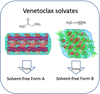
Seven venetoclax solvates were structurally characterized and studied for their desolvation behaviour, leading to the identification of two solvent-free polymorphs. Advanced crystallographic and computational analyses, including Solvate Analyser, CSD-Particle, FTIR and solid-state NMR, revealed key factors governing solvate stability and transformation. Notably, the acetone solvate exhibited exceptional stability and the desolvated forms retained the molecular arrangement of their parent solvates.


