


 journal menu


issue contents
 access
May 2026 issue

editorial



Sustaining public investment in neutron and photon science facilities demands breakthrough results comparable to a Higgs moment. Harnessing AI across their accumulated experimental data and collaborative programmes is what makes that possible.
scientific commentaries

The systematic comparison of 3D-ED methods in terms of data quality presented by Schmitt et al. [IUCrJ (2026), 13, 291–303] is discussed.
scientific comment
BIOLOGY | MEDICINE
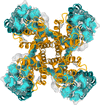
Protein dynamics are often manifested as disappearing densities in cryo-EM structures. Making sense of such disappearing densities in order to understand their biological implications requires approaches beyond high-resolution structures.
topical reviews
CRYO | EM


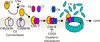
Advances in cryo-electron microscopy have enabled molecular insights into the assembly and regulation of the complement membrane attack complex.
research letters
BIOLOGY | MEDICINE

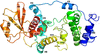
We characterized MltB from the human pathogen Acinetobacter baumannii and unveiled its high-resolution crystal structure, revealing that abMltB features three domains forming a tunnel-like catalytic cavity. Structural comparison with related enzymes reveals conserved catalytic residues and a unique C-terminal domain orientation. Based on the current structural and biochemical studies, we modeled the working mechanism of abMltB.
research papers
BIOLOGY | MEDICINE
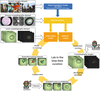
AXIS: a Lab-in-the-Loop machine learning approach for automated detection of macromolecular crystals
AXIS (AI-based Crystal Identification System) combines artificial intelligence with an iterative Lab-in-the-Loop approach for automated crystal detection. AXIS ensures high performance in crystal detection, requires small training datasets and facilitates rapid adaptation to local and changing conditions at any given facility.
PHYSICS | FELS
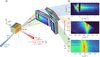
We demonstrate a grazing-incidence XFEL platform that simultaneously records time-resolved GISAXS and GID, enabling depth-selective probing of ultrafast surface and subsurface dynamics in a laser-irradiated gold film. The approach correlates nanoscale morphology evolution with lattice compression, melting and recrystallization, providing benchmarks for ultrafast laser–matter interaction models.
CRYO | EM
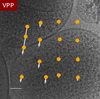
We use sub-2 Å single-particle analysis and analytical contrast transfer function modeling to show that the Volta phase plate (VPP) boosts low-frequency signal relevant for cryo-electron tomography (cryo-ET) tilt-series alignment, improving contrast and alignment robustness in thick, crowded samples. Despite reduced subtomogram averaging resolution, these results establish the VPP's value for cryo-ET in thick, dense specimens, where tilt-series alignment is challenging and moderate-resolution information can still provide valuable biological insights.
EMDB references: PP7 virus-like-particle without VPP (full dataset), EMD-75881; PP7 virus-like-particle with VPP (full dataset), EMD-75882; PP7 virus-like-particle with VPP (partial dataset), EMD-75890; 80S ribosome without VPP (full dataset), EMD-75895; 80S ribosome without VPP (partial dataset), EMD-75896; 80S ribosome with VPP (full dataset), EMD-75897; 70S ribosome without VPP (full dataset), EMD-75898; 70S ribosome without VPP (partial dataset), EMD-75899; 70S ribosome with VPP (full dataset), EMD-75900; apoferritin without VPP, EMD-75265; apoferritin with VPP, EMD-75263
ELECTRON CRYSTALLOGRAPHY

Download citation


Download citation
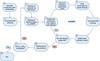
A new algorithm based on molecular replacement has been developed for structure determination of small molecules from MicroED data with resolutions from 0.85 to 2.0 Å.
CCDC reference: 2543412
ELECTRON CRYSTALLOGRAPHY
Download citation
Download citation

Using ultrashort-pulse MeV electron diffraction at the REGAE accelerator with increased penetration depth of the electrons significantly expands the applicable thickness range of samples, overcoming restrictions associated with traditional electron diffraction. We report the successful implementation of MeV electron diffraction for ab initio 3D structure determination of the quasi-2D material muscovite and the quantum material 1T-TaS2 at atomic resolution and open up new opportunities for in situ and time-resolved experiments.
B-IncStrDB reference: IAyACLYazaI
ELECTRON CRYSTALLOGRAPHY
Download citation
Download citation
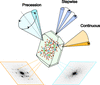
Three ceramic samples were analysed using three-dimensional electron diffraction and a comparison of the different data collection strategies revealed that coherent inelastic scattering effects hamper the interpretation of difference electrostatic potential maps and can have a significant impact on the refinement statistics.


